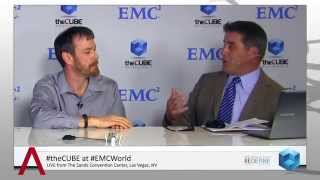
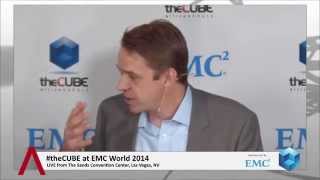
Yuri Rabover, VMTurbo, with John Furrier and Dave Vellante at EMC World 2014
@thecube
#emcworld
This week’s EMC World 2014 Event, held at The Sands Convention Center in Las Vegas, is theCUBE’s fifth year in attendance and also one of the two live broadcasts brought to you by SiliconANGLE. In this interview, Yuri Rabover, Founder of VMTurbo, joins John Furrier and Dave Vellante to discuss how his company works to change IT’s “break and fix” mentality.
Furrier started off the interview by asking Rabover what he thinks of this year’s EMC World. He replied that he was impressed with the event and seemed pleased about the recognition of virtualization software definition. Rabover said that he believes that “the world is driving in the right direction.”
VMTurbo
The topic of conversation then steered towards VMTurbo. Furrier asked Rabover to give an update on the company. He described that it started five years ago and that they received their first round of venture funding in December 2008, during the global financial crisis. Rabover shared that it was both “impressive and challenging” to get their first funding at a time when a bank a week went down. He also mentioned that VMTurbo started selling their first solution in Q1 of 2010 and has grown 320 percent since that time – a 100 percent growth rate year after year. The company currently has about 600 paying customers and over 10,000 free users.
The Virtualization Landscape
.
Furrier then talked about virtualization being a big part of the trend and Flash changing the game from a persistent storage standpoint. He asked Rabover what the DSSD acquisition now means to the EMC ecosystem. However, Rabover wasn’t able to offer a response as he had just gotten word of the news a few hours before the interview.
Moving on, Furrier started discussing stable infrastructure on the Flash array and how virtualized stuff is currently hot. Rabover agreed and also added that this, combined with other trends, creates an interesting environment. He considers Virtual Xen and SDN to be two key pieces of technology that are heavily important in the market. “They actually drastically changed the way the industry is going to work because, if V Xen catches up, it may have an impact on a parent company like EMC because of storage communitization.”
Vellante then entered the discussion talking about the return of server SAN and asked Rabover if he thinks it’s going to take off. Rabover responded that it will take off and also believes it’s natural that this is happening now. He added that it’s a tough time for hardware vendors and that “they need to react.”
Shifting IT’s “Break and Fix” Mentality
.
Circling the conversation back to VMTurbo, Vellante asked Rabover to talk about what problem the company is solving. He described that the company is trying to guarantee workload service levels, while, at the same time, increasing and maximizing infrastructure utilization efficiency. Rabover mentioned that this a really important problem that, though recognized, is not solved. He went to describe that IT is the only industry today that has a “break and fix” mentality, meaning it relies on human labor to fix problems as there’s an expectation for things to be broken.
Rabover brought up nuclear plants and airlines as examples of industries that have systems in place to prevent problems, rather than waiting for problems to happen. “No other mission critical industry in the world works like that,” said Rabover. This is the problem that VMTurbo is trying to solve.
Vellante then asked how VMTurbo solves this. Rabover responded saying, “Our solution, using the common data model, attaches all the layers of the IT stack – represent them as a single common data model and allows to, basically, bring the workload demand with the equilibrium of the infrastructure supply. If we accomplish this equilibrium using our economics scheduling engine, the workload will definitely receive the resources it needs. It means the service levels will be intact. But, because it’s an equilibrium, the infrastructure utilization will be as high as possible and safe for the workload levels.”
Forgot Password
Almost there!
We just sent you a verification email. Please verify your account to gain access to
EMC World 2014 | Las Vegas. If you don’t think you received an email check your
spam folder.
In order to sign in, enter the email address you used to registered for the event. Once completed, you will receive an email with a verification link. Open this link to automatically sign into the site.
Register For EMC World 2014 | Las Vegas
Please fill out the information below. You will recieve an email with a verification link confirming your registration. Click the link to automatically sign into the site.
You’re almost there!
We just sent you a verification email. Please click the verification button in the email. Once your email address is verified, you will have full access to all event content for EMC World 2014 | Las Vegas.
I want my badge and interests to be visible to all attendees.
Checking this box will display your presense on the attendees list, view your profile and allow other attendees to contact you via 1-1 chat. Read the Privacy Policy. At any time, you can choose to disable this preference.
Select your Interests!
add
Upload your photo
Uploading..
OR
Connect via Twitter
Connect via Linkedin
EDIT PASSWORD
Share
Forgot Password
Almost there!
We just sent you a verification email. Please verify your account to gain access to
EMC World 2014 | Las Vegas. If you don’t think you received an email check your
spam folder.
In order to sign in, enter the email address you used to registered for the event. Once completed, you will receive an email with a verification link. Open this link to automatically sign into the site.
Sign in to gain access to EMC World 2014 | Las Vegas
Please sign in with LinkedIn to continue to EMC World 2014 | Las Vegas. Signing in with LinkedIn ensures a professional environment.
Are you sure you want to remove access rights for this user?
Details
Manage Access
email address
Community Invitation
Yuri Rabover | EMC World 2014
Yuri Rabover, VMTurbo, with John Furrier and Dave Vellante at EMC World 2014
@thecube
#emcworld
This week’s EMC World 2014 Event, held at The Sands Convention Center in Las Vegas, is theCUBE’s fifth year in attendance and also one of the two live broadcasts brought to you by SiliconANGLE. In this interview, Yuri Rabover, Founder of VMTurbo, joins John Furrier and Dave Vellante to discuss how his company works to change IT’s “break and fix” mentality.
Furrier started off the interview by asking Rabover what he thinks of this year’s EMC World. He replied that he was impressed with the event and seemed pleased about the recognition of virtualization software definition. Rabover said that he believes that “the world is driving in the right direction.”
VMTurbo
The topic of conversation then steered towards VMTurbo. Furrier asked Rabover to give an update on the company. He described that it started five years ago and that they received their first round of venture funding in December 2008, during the global financial crisis. Rabover shared that it was both “impressive and challenging” to get their first funding at a time when a bank a week went down. He also mentioned that VMTurbo started selling their first solution in Q1 of 2010 and has grown 320 percent since that time – a 100 percent growth rate year after year. The company currently has about 600 paying customers and over 10,000 free users.
The Virtualization Landscape
.
Furrier then talked about virtualization being a big part of the trend and Flash changing the game from a persistent storage standpoint. He asked Rabover what the DSSD acquisition now means to the EMC ecosystem. However, Rabover wasn’t able to offer a response as he had just gotten word of the news a few hours before the interview.
Moving on, Furrier started discussing stable infrastructure on the Flash array and how virtualized stuff is currently hot. Rabover agreed and also added that this, combined with other trends, creates an interesting environment. He considers Virtual Xen and SDN to be two key pieces of technology that are heavily important in the market. “They actually drastically changed the way the industry is going to work because, if V Xen catches up, it may have an impact on a parent company like EMC because of storage communitization.”
Vellante then entered the discussion talking about the return of server SAN and asked Rabover if he thinks it’s going to take off. Rabover responded that it will take off and also believes it’s natural that this is happening now. He added that it’s a tough time for hardware vendors and that “they need to react.”
Shifting IT’s “Break and Fix” Mentality
.
Circling the conversation back to VMTurbo, Vellante asked Rabover to talk about what problem the company is solving. He described that the company is trying to guarantee workload service levels, while, at the same time, increasing and maximizing infrastructure utilization efficiency. Rabover mentioned that this a really important problem that, though recognized, is not solved. He went to describe that IT is the only industry today that has a “break and fix” mentality, meaning it relies on human labor to fix problems as there’s an expectation for things to be broken.
Rabover brought up nuclear plants and airlines as examples of industries that have systems in place to prevent problems, rather than waiting for problems to happen. “No other mission critical industry in the world works like that,” said Rabover. This is the problem that VMTurbo is trying to solve.
Vellante then asked how VMTurbo solves this. Rabover responded saying, “Our solution, using the common data model, attaches all the layers of the IT stack – represent them as a single common data model and allows to, basically, bring the workload demand with the equilibrium of the infrastructure supply. If we accomplish this equilibrium using our economics scheduling engine, the workload will definitely receive the resources it needs. It means the service levels will be intact. But, because it’s an equilibrium, the infrastructure utilization will be as high as possible and safe for the workload levels.”