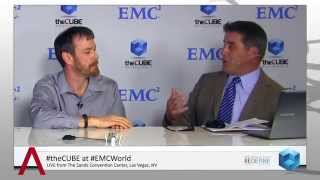
Luciano Ammenti, Biblioteca Apostolica, Vaticana, (The Vatican Library) with John Furrier and Dave Vellante at EMC World 2014
@thecube
#emcworld
In its 500-year history, Biblioteca Apostolica Vaticana (the Vatican Library) has only allowed 20 percent of its 80,000 plus manuscript collection to be studied. On top of that, it’s extremely difficult to get access to the library. Now, the Vatican is working to digitize its collection so everyone can have open access to this historic archive.
At EMC World 2014 earlier this month, Luciano Ammenti, CIO of the Vatican Library, sat down with Jim Furrier and Dave Vellante to talk about the project. Ammenti said the Vatican decided on doing this project four years ago, and the library is just one part of the initiative. Based on current resources, he estimates it will take about 10 years to complete, with a work flow producing 1,000 – 2,000 manuscripts a month.
Format, Storage and Security
.
The Vatican Library is using a Flexible Image Transport System (FITS) format to digitalize manuscripts. A project by NASA, FITS was created to capture astronomic images. This is the first time it’s being used for manuscripts. Regarding storage, the Vatican Library stores everything on disk using EMC Isilon architecture.
In terms of security, Ammenti explained the Vatican Library has different levels of firewall for security management of the data. Ammenti added that he prefers to be high up enough on security so that no one can try to get into their system.
Workflow
Ammenti stated human resource is the principle part of the Vatican Library’s work flow. For example, the restoration office determines which manuscripts are able to go through digitalization. After the manuscripts are digitalized, two levels of tutors perform quality checks before they go into storage. The Vatican Library uses SRM for monitoring details on the storage, VNIX and Atmos. Ammenti hopes the next Viper is going to be a big help for them on this front.
The ViPR Revolution
.
Furrier then questioned Ammenti on future plans and asked why ViPR fits into them. Ammenti considers it a total innovation because it’s an open source. It gives users the chance to perform top level management. ViPR is also very user friendly because it allows the efficient movement of file systems from one to another. This makes things easy for those working in data centers.
Ammenti also believes that using applications with ViPR is a revolution because it’s a complete resource for all that you have down. It offers another point of view from a very high level.
For Humanity
.
The interview ended with Ammenti explaining that this project to digitize the Vatican Library’s collection is not for the Vatican itself, but rather for the future of humanity. Some examples given by Ammenti include the copy of the New Testament, the original the Vangelo from Luca and the original La Divina Commedia by Dante Alighieri. Remarkable works like these would not have been accessible to the public otherwise. Preserving the Vatican Library’s historic collection in a digital format for all to read is truly an amazing thing.
Forgot Password
Almost there!
We just sent you a verification email. Please verify your account to gain access to
EMC World 2014 | Las Vegas. If you don’t think you received an email check your
spam folder.
In order to sign in, enter the email address you used to registered for the event. Once completed, you will receive an email with a verification link. Open this link to automatically sign into the site.
Register For EMC World 2014 | Las Vegas
Please fill out the information below. You will recieve an email with a verification link confirming your registration. Click the link to automatically sign into the site.
You’re almost there!
We just sent you a verification email. Please click the verification button in the email. Once your email address is verified, you will have full access to all event content for EMC World 2014 | Las Vegas.
I want my badge and interests to be visible to all attendees.
Checking this box will display your presense on the attendees list, view your profile and allow other attendees to contact you via 1-1 chat. Read the Privacy Policy. At any time, you can choose to disable this preference.
Select your Interests!
add
Upload your photo
Uploading..
OR
Connect via Twitter
Connect via Linkedin
EDIT PASSWORD
Share
Forgot Password
Almost there!
We just sent you a verification email. Please verify your account to gain access to
EMC World 2014 | Las Vegas. If you don’t think you received an email check your
spam folder.
In order to sign in, enter the email address you used to registered for the event. Once completed, you will receive an email with a verification link. Open this link to automatically sign into the site.
Sign in to gain access to EMC World 2014 | Las Vegas
Please sign in with LinkedIn to continue to EMC World 2014 | Las Vegas. Signing in with LinkedIn ensures a professional environment.
Are you sure you want to remove access rights for this user?
Details
Manage Access
email address
Community Invitation
Luciano Ammenti | EMC World 2014
Luciano Ammenti, Biblioteca Apostolica, Vaticana, (The Vatican Library) with John Furrier and Dave Vellante at EMC World 2014
@thecube
#emcworld
In its 500-year history, Biblioteca Apostolica Vaticana (the Vatican Library) has only allowed 20 percent of its 80,000 plus manuscript collection to be studied. On top of that, it’s extremely difficult to get access to the library. Now, the Vatican is working to digitize its collection so everyone can have open access to this historic archive.
At EMC World 2014 earlier this month, Luciano Ammenti, CIO of the Vatican Library, sat down with Jim Furrier and Dave Vellante to talk about the project. Ammenti said the Vatican decided on doing this project four years ago, and the library is just one part of the initiative. Based on current resources, he estimates it will take about 10 years to complete, with a work flow producing 1,000 – 2,000 manuscripts a month.
Format, Storage and Security
.
The Vatican Library is using a Flexible Image Transport System (FITS) format to digitalize manuscripts. A project by NASA, FITS was created to capture astronomic images. This is the first time it’s being used for manuscripts. Regarding storage, the Vatican Library stores everything on disk using EMC Isilon architecture.
In terms of security, Ammenti explained the Vatican Library has different levels of firewall for security management of the data. Ammenti added that he prefers to be high up enough on security so that no one can try to get into their system.
Workflow
Ammenti stated human resource is the principle part of the Vatican Library’s work flow. For example, the restoration office determines which manuscripts are able to go through digitalization. After the manuscripts are digitalized, two levels of tutors perform quality checks before they go into storage. The Vatican Library uses SRM for monitoring details on the storage, VNIX and Atmos. Ammenti hopes the next Viper is going to be a big help for them on this front.
The ViPR Revolution
.
Furrier then questioned Ammenti on future plans and asked why ViPR fits into them. Ammenti considers it a total innovation because it’s an open source. It gives users the chance to perform top level management. ViPR is also very user friendly because it allows the efficient movement of file systems from one to another. This makes things easy for those working in data centers.
Ammenti also believes that using applications with ViPR is a revolution because it’s a complete resource for all that you have down. It offers another point of view from a very high level.
For Humanity
.
The interview ended with Ammenti explaining that this project to digitize the Vatican Library’s collection is not for the Vatican itself, but rather for the future of humanity. Some examples given by Ammenti include the copy of the New Testament, the original the Vangelo from Luca and the original La Divina Commedia by Dante Alighieri. Remarkable works like these would not have been accessible to the public otherwise. Preserving the Vatican Library’s historic collection in a digital format for all to read is truly an amazing thing.