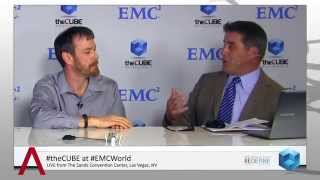
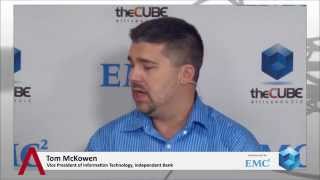
Jason Buffington, a senior analyst with ESG, discussed current trends around data protection and security challenges with theCUBE co-hosts Steve Kennistonn and Dave Vellante, in a live interview at the EMC World 2014 conference.
Commenting on whether data protection was the number one challenge for organizations, Buffington said that "data protection is always in the top three in IT spending."
In his experience, data protection is also the number one planned spend for mid-sized organizations year-over-year. Just when backup is figured out, Buffington explained, "workloads keep evolving, and that's why we have to reinvent backup. As the workloads evolve, we have to rediscover or reinvent how to back them up."
Buffington said data protection should be looked as having all the colors of the rainbow, not just part of them. Data protection is often confused with backup. "Backup is a one color of the data protection spectrum" he explained, which includes replication, disaster recovery, business continuity, etc.
"Your spectrum really ought to have all those rainbow colors in it," said Buffington. "Start first with what the business goals are on what you need to be able to recover."
How backup should work in the cloud
.
Speaking on moving data protection closer to the workload, Buffington said "it's not just about how you can get recovery. Whatever you do to be more intimate," the better your data protection is. "We want to make sure to talk about recovery goals and strategy that does not necessarily relate to a lot of different solutions," Buffington added.
Asked if backup is broken, Espsinosa said "it's not that backup is broken, just stop trying to use a hammer as a screw driver. If your workloads have evolved, and you haven't evolved your protection at the rate you've evolved your production, then backup is broken," going on to explain that with a highly virtualized environment, companies need to look at snapshots and rollback.
"When you find a workload that is so different, you truly just cannot use what you have used before," Buffington explained. When you are 20 percent virtualized, "you can use whichever mediocre solution you want." When you are 40-60 percent virtualized, you can no longer afford it.
"You should start every planning process thinking you're going to be hybrid," Buffington recommended, combining tape, disc, and flash.
"People are realizing that you have to back up the cloud," according to Buffington's observations. Backup as a service is becoming interesting for endpoint backup, he said. When it comes to the backup of something that's in the cloud, it has to be done with something that's in the cloud, there is no reason to first pull it back from the cloud.
One of the challenges whenever a new platform takes off, Buffington explained, is that the idea of plumbing for backup is not in the initial versions. There are "very few innovators who will say the problem needs a solution. You always have these few folks trying to solve it first, and then the rest of the industry tries to catch up."
Asked what developments Buffington expects in the next 12 to 24 months, he said companies "need to grow past just backup." There will be "fewer silos, better management, better economics."
Forgot Password
Almost there!
We just sent you a verification email. Please verify your account to gain access to
EMC World 2014 | Las Vegas. If you don’t think you received an email check your
spam folder.
In order to sign in, enter the email address you used to registered for the event. Once completed, you will receive an email with a verification link. Open this link to automatically sign into the site.
Register For EMC World 2014 | Las Vegas
Please fill out the information below. You will recieve an email with a verification link confirming your registration. Click the link to automatically sign into the site.
You’re almost there!
We just sent you a verification email. Please click the verification button in the email. Once your email address is verified, you will have full access to all event content for EMC World 2014 | Las Vegas.
I want my badge and interests to be visible to all attendees.
Checking this box will display your presense on the attendees list, view your profile and allow other attendees to contact you via 1-1 chat. Read the Privacy Policy. At any time, you can choose to disable this preference.
Select your Interests!
add
Upload your photo
Uploading..
OR
Connect via Twitter
Connect via Linkedin
EDIT PASSWORD
Share
Forgot Password
Almost there!
We just sent you a verification email. Please verify your account to gain access to
EMC World 2014 | Las Vegas. If you don’t think you received an email check your
spam folder.
In order to sign in, enter the email address you used to registered for the event. Once completed, you will receive an email with a verification link. Open this link to automatically sign into the site.
Sign in to gain access to EMC World 2014 | Las Vegas
Please sign in with LinkedIn to continue to EMC World 2014 | Las Vegas. Signing in with LinkedIn ensures a professional environment.
Are you sure you want to remove access rights for this user?
Details
Manage Access
email address
Community Invitation
Jason Buffington | EMC World 2014
Jason Buffington, a senior analyst with ESG, discussed current trends around data protection and security challenges with theCUBE co-hosts Steve Kennistonn and Dave Vellante, in a live interview at the EMC World 2014 conference.
Commenting on whether data protection was the number one challenge for organizations, Buffington said that "data protection is always in the top three in IT spending."
In his experience, data protection is also the number one planned spend for mid-sized organizations year-over-year. Just when backup is figured out, Buffington explained, "workloads keep evolving, and that's why we have to reinvent backup. As the workloads evolve, we have to rediscover or reinvent how to back them up."
Buffington said data protection should be looked as having all the colors of the rainbow, not just part of them. Data protection is often confused with backup. "Backup is a one color of the data protection spectrum" he explained, which includes replication, disaster recovery, business continuity, etc.
"Your spectrum really ought to have all those rainbow colors in it," said Buffington. "Start first with what the business goals are on what you need to be able to recover."
How backup should work in the cloud
.
Speaking on moving data protection closer to the workload, Buffington said "it's not just about how you can get recovery. Whatever you do to be more intimate," the better your data protection is. "We want to make sure to talk about recovery goals and strategy that does not necessarily relate to a lot of different solutions," Buffington added.
Asked if backup is broken, Espsinosa said "it's not that backup is broken, just stop trying to use a hammer as a screw driver. If your workloads have evolved, and you haven't evolved your protection at the rate you've evolved your production, then backup is broken," going on to explain that with a highly virtualized environment, companies need to look at snapshots and rollback.
"When you find a workload that is so different, you truly just cannot use what you have used before," Buffington explained. When you are 20 percent virtualized, "you can use whichever mediocre solution you want." When you are 40-60 percent virtualized, you can no longer afford it.
"You should start every planning process thinking you're going to be hybrid," Buffington recommended, combining tape, disc, and flash.
"People are realizing that you have to back up the cloud," according to Buffington's observations. Backup as a service is becoming interesting for endpoint backup, he said. When it comes to the backup of something that's in the cloud, it has to be done with something that's in the cloud, there is no reason to first pull it back from the cloud.
One of the challenges whenever a new platform takes off, Buffington explained, is that the idea of plumbing for backup is not in the initial versions. There are "very few innovators who will say the problem needs a solution. You always have these few folks trying to solve it first, and then the rest of the industry tries to catch up."
Asked what developments Buffington expects in the next 12 to 24 months, he said companies "need to grow past just backup." There will be "fewer silos, better management, better economics."