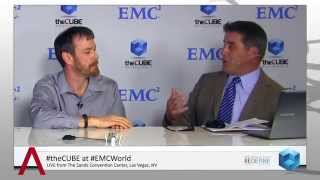
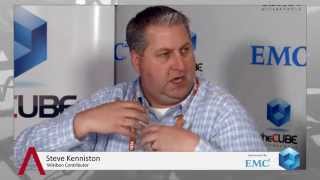
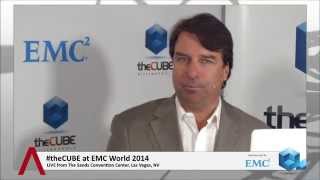
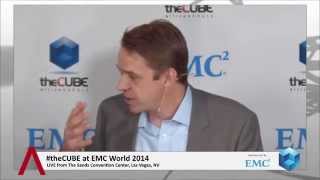
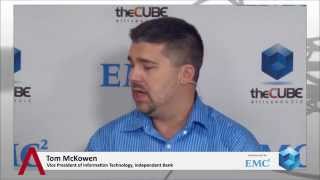
This week's EMC World 2014 Event, held at The Sands Convention Center in Las Vegas, is actually the site of where theCUBE broadcast its first event five years ago, and also the site of two live broadcasts brought to you by SiliconANGLE. Joining co-hosts Jeff Frick and Steve Kenniston was Bart Sjerps, Principal Engineer for EMC out of EMEA.
Dirty Cache
To start off the interview, Kenniston asked Sjerps about his blog Dirty Cache. He explained that the inspiration behind his blog's name came from a 90s song with the same title, and also because he likes to help his customers save money. You can read more on that story here, and even find a video link to the referenced song.
Insights on Oracle
.
As Sjerps is an Oracle specialist, Kenniston went on to ask about his perspective.
"What I see now in my customer base is that customers are actually virtualizing their databases," Sjerps responded. "They are conservative, and I don't blame them. So, what they do is start with test and development, and they slowly move a virtual platform."
"Some of our customers are putting mission critical production database on VMweb, and they solve all the issues around support and certification, and what they have to do if Oracle finds an issue."
Kenniston then went on to ask Sjerps what best practices he has learned along the way, or some of the right first steps as one is thinking of putting your Oracle database into the cloud.
"The first thing you have to do is start conservative," said Sjerps. "Be very slow moving. Just test it out. Make sure the tools are in place. If you would go and migrate the whole thing at once, then you'll probably hit some issues down the road."
The next thing that Sjerps goes into is licensing, emphasizing its importance.
"Oracle is very keen on licensing. They have audits, policies and stuff like that," he warned. "Make sure that your licenses are in place, that you're compliant with your Oracle policy and all that. That's critical. If you're not in compliance, then you might have some severe issues later."
Hybrid and Public Clouds
.
Frick went on to ask Sjerps about what he's seeing with hybrid clouds and public clouds.
"Customers are very conservative," Sjerps answered. "So, they will probably deploy on a private cloud -- maybe hybrid if the hybrid partner is an outsourcer that they trust."
Frick then brought the conversation back to licensing and asked if customers are finding it to be a relatively neutral transition cost-wise when they move from the regular licenses to the virtualized.
"Many databases that are physically deployed have a very low CPU utilization," said Sjerps. "Now, Oracle, I would say 90 percent of the cases are licensed by CPU core and it's pretty expensive. Probably, as you know, 70 -- 80 percent of a database tech -- the cost of it -- is made by licensing and support of those licenses. So, if my database tech is expensive and 80 percent of that cost is in Oracle licensing and that 80 percent is only utilized for 20 percent, you see how many dollars I am basically wasting."
Sjerps then explained that customers have to do this because they have to size for big loads or for future growth. Oversizing one's server means average utilization is low.
"One of the things you can do with virtualization is basically glue all those CPU resources together and now you have kind of like a cloud, if you will," Sjerps explained. "That cloud allows you to move workloads and set CPU shares and all of that stuff so now every database can use all of the CPUs in the farm. And, by doing that, and using some specific workload management techniques, you can drive utilization."
After discussing Sjerps' history with the EMC conference and finding out what he hopes to learn at the event this year, the interview concluded with him going into further detail about Dirty Cache. The number one topic that his customers ask for is performance on databases. Sjerps also uses real-world examples in his blog posts and does tests to show what's going on. See the blog here for more details.
Forgot Password
Almost there!
We just sent you a verification email. Please verify your account to gain access to
EMC World 2014 | Las Vegas. If you don’t think you received an email check your
spam folder.
In order to sign in, enter the email address you used to registered for the event. Once completed, you will receive an email with a verification link. Open this link to automatically sign into the site.
Register For EMC World 2014 | Las Vegas
Please fill out the information below. You will recieve an email with a verification link confirming your registration. Click the link to automatically sign into the site.
You’re almost there!
We just sent you a verification email. Please click the verification button in the email. Once your email address is verified, you will have full access to all event content for EMC World 2014 | Las Vegas.
I want my badge and interests to be visible to all attendees.
Checking this box will display your presense on the attendees list, view your profile and allow other attendees to contact you via 1-1 chat. Read the Privacy Policy. At any time, you can choose to disable this preference.
Select your Interests!
add
Upload your photo
Uploading..
OR
Connect via Twitter
Connect via Linkedin
EDIT PASSWORD
Share
Forgot Password
Almost there!
We just sent you a verification email. Please verify your account to gain access to
EMC World 2014 | Las Vegas. If you don’t think you received an email check your
spam folder.
In order to sign in, enter the email address you used to registered for the event. Once completed, you will receive an email with a verification link. Open this link to automatically sign into the site.
Sign in to gain access to EMC World 2014 | Las Vegas
Please sign in with LinkedIn to continue to EMC World 2014 | Las Vegas. Signing in with LinkedIn ensures a professional environment.
Are you sure you want to remove access rights for this user?
Details
Manage Access
email address
Community Invitation
Bart Sjerps, EMC | EMC World 2014
This week's EMC World 2014 Event, held at The Sands Convention Center in Las Vegas, is actually the site of where theCUBE broadcast its first event five years ago, and also the site of two live broadcasts brought to you by SiliconANGLE. Joining co-hosts Jeff Frick and Steve Kenniston was Bart Sjerps, Principal Engineer for EMC out of EMEA.
Dirty Cache
To start off the interview, Kenniston asked Sjerps about his blog Dirty Cache. He explained that the inspiration behind his blog's name came from a 90s song with the same title, and also because he likes to help his customers save money. You can read more on that story here, and even find a video link to the referenced song.
Insights on Oracle
.
As Sjerps is an Oracle specialist, Kenniston went on to ask about his perspective.
"What I see now in my customer base is that customers are actually virtualizing their databases," Sjerps responded. "They are conservative, and I don't blame them. So, what they do is start with test and development, and they slowly move a virtual platform."
"Some of our customers are putting mission critical production database on VMweb, and they solve all the issues around support and certification, and what they have to do if Oracle finds an issue."
Kenniston then went on to ask Sjerps what best practices he has learned along the way, or some of the right first steps as one is thinking of putting your Oracle database into the cloud.
"The first thing you have to do is start conservative," said Sjerps. "Be very slow moving. Just test it out. Make sure the tools are in place. If you would go and migrate the whole thing at once, then you'll probably hit some issues down the road."
The next thing that Sjerps goes into is licensing, emphasizing its importance.
"Oracle is very keen on licensing. They have audits, policies and stuff like that," he warned. "Make sure that your licenses are in place, that you're compliant with your Oracle policy and all that. That's critical. If you're not in compliance, then you might have some severe issues later."
Hybrid and Public Clouds
.
Frick went on to ask Sjerps about what he's seeing with hybrid clouds and public clouds.
"Customers are very conservative," Sjerps answered. "So, they will probably deploy on a private cloud -- maybe hybrid if the hybrid partner is an outsourcer that they trust."
Frick then brought the conversation back to licensing and asked if customers are finding it to be a relatively neutral transition cost-wise when they move from the regular licenses to the virtualized.
"Many databases that are physically deployed have a very low CPU utilization," said Sjerps. "Now, Oracle, I would say 90 percent of the cases are licensed by CPU core and it's pretty expensive. Probably, as you know, 70 -- 80 percent of a database tech -- the cost of it -- is made by licensing and support of those licenses. So, if my database tech is expensive and 80 percent of that cost is in Oracle licensing and that 80 percent is only utilized for 20 percent, you see how many dollars I am basically wasting."
Sjerps then explained that customers have to do this because they have to size for big loads or for future growth. Oversizing one's server means average utilization is low.
"One of the things you can do with virtualization is basically glue all those CPU resources together and now you have kind of like a cloud, if you will," Sjerps explained. "That cloud allows you to move workloads and set CPU shares and all of that stuff so now every database can use all of the CPUs in the farm. And, by doing that, and using some specific workload management techniques, you can drive utilization."
After discussing Sjerps' history with the EMC conference and finding out what he hopes to learn at the event this year, the interview concluded with him going into further detail about Dirty Cache. The number one topic that his customers ask for is performance on databases. Sjerps also uses real-world examples in his blog posts and does tests to show what's going on. See the blog here for more details.