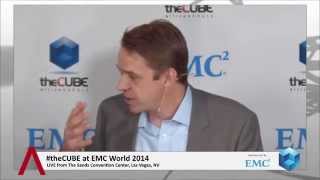
Phil O'Reilly, Brocade, with John Furrier and Dave Vellante at EMC World 2014
@thecube
#emcworld
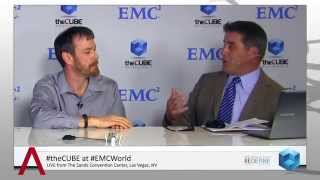
Last week’s EMC World 2014 Event, held at The Sands Convention Center in Las Vegas, is theCUBE’s fifth year in attendance and also one of the two live broadcasts brought to you by SiliconANGLE. In this interview, Phil O’Reilly, Brocade’s VP of Worldwide Sales, Ethernet Fabrics, joined John Furrier and Dave Vellante to discuss how software is changing the data center world.
After briefly adding in the fact that Brocade was holding a Tequila party that evening, Furrier asked O’Reilly about what Brocade was doing at EMC World this year, and also how Brocade and EMC fit into the massively disruptive third platform equation, as it seems to be a hot topic at the event.
O’Reilly responded saying that, in addition to having a long-term relationship with EMC, Brocade is at the event because things don’t stop at data anymore. The data center has evolved and is no longer composed of just applications, data and network.
“It’s one thing converged into a single solution to meet the end-user expectation,” said O’Reilly, adding that he was at EMC World this year to talk about the evolution of the virtualized data center on the data side, but also how the network plays in that story.
A Software World
.
Referencing a previous interview with VMTurbo’s Yuri Rabover, Furrier brought up how the old way of managing things is over when you have a software world that’s really connecting new elements together. He asked O’Reilly how this changes the data center equation from a customer standpoint, and the pain points it creates.
O’Reilly said the underlying structure should be looked at first, then determine what it is capable of being automated, virtualized and scaled.
“So, what we’re proposing is that, to get the real advantage of the software defined networking (SDN), you need to begin by thinking about the underlying network and converting it into a platform: a platform that will activate your virtualization both for applications and also for data, but a platform on which you can begin to virtualize services as well, and that’s really the ultimate goal,” explained O’Reilly. He advised to virtualize services in the data center, then control it with a software defined environment that drives a set of business rules and not IT limitations.
Vellante then asked O’Reilly what would happen to the box in this world, and how it would change. He replied saying that there won’t be a need for the purpose-built operating system (OS) anymore, as the processor capability in servers gets more pronounced. There will be the ability to deploy services in this compute infrastructure, shared with applications. However, performance still matters with these services.
O’Reilly also described that the infrastructure itself is controlled by a programmable software layer. “Not only do you get the capability that you have, you can evolve that capability as new opportunities present themselves,” he added.
Vellante questioned what this means for the economics of the hardware business. O’Reilly responded, “I think eventually the hardware companies will be more software-like. I think that’s inevitable, but I think what you’re going to see is the relevance of partnerships, so you get these converged solutions.”
O’Reilly gave an example of what Brocade is currently doing with EMC in terms of building converged solutions that don’t isolate the data environment. They integrate it with the network layer and, from the top down, integrate the network layer with the application layer.
The evolution of partnerships and software functionality are key differentiations for the future.
Brocade Fabrics : Defining differentiation?
.
Furrier then steered the conversation towards Brocade, asking O’Reilly of the products available on the fabric side, and what progress has been made. O’Reilly explained that Brocade has been building SAN fabrics for two decades and now have IP fabrics. The market has exploded for them, and their customer base is expanding because the use cases for the fabric has dramatically grown.
Searching for more clarity, Furrier asked of fabric’s differentiation points in a copycat market. O’Reilly noted that customers are looking for three things: incredible flexibility, real automation in the design itself and economics with regards to scalability that are unavailable in their current network.
“Those are the characteristics that we build into the Ethernet fabric and the marketplace is responding aggressively,” O’Reilly added.
Forgot Password
Almost there!
We just sent you a verification email. Please verify your account to gain access to
EMC World 2014 | Las Vegas. If you don’t think you received an email check your
spam folder.
In order to sign in, enter the email address you used to registered for the event. Once completed, you will receive an email with a verification link. Open this link to automatically sign into the site.
Register For EMC World 2014 | Las Vegas
Please fill out the information below. You will recieve an email with a verification link confirming your registration. Click the link to automatically sign into the site.
You’re almost there!
We just sent you a verification email. Please click the verification button in the email. Once your email address is verified, you will have full access to all event content for EMC World 2014 | Las Vegas.
I want my badge and interests to be visible to all attendees.
Checking this box will display your presense on the attendees list, view your profile and allow other attendees to contact you via 1-1 chat. Read the Privacy Policy. At any time, you can choose to disable this preference.
Select your Interests!
add
Upload your photo
Uploading..
OR
Connect via Twitter
Connect via Linkedin
EDIT PASSWORD
Share
Forgot Password
Almost there!
We just sent you a verification email. Please verify your account to gain access to
EMC World 2014 | Las Vegas. If you don’t think you received an email check your
spam folder.
In order to sign in, enter the email address you used to registered for the event. Once completed, you will receive an email with a verification link. Open this link to automatically sign into the site.
Sign in to gain access to EMC World 2014 | Las Vegas
Please sign in with LinkedIn to continue to EMC World 2014 | Las Vegas. Signing in with LinkedIn ensures a professional environment.
Are you sure you want to remove access rights for this user?
Details
Manage Access
email address
Community Invitation
Phil O'Reilly | EMC World 2014
Phil O'Reilly, Brocade, with John Furrier and Dave Vellante at EMC World 2014
@thecube
#emcworld
Last week’s EMC World 2014 Event, held at The Sands Convention Center in Las Vegas, is theCUBE’s fifth year in attendance and also one of the two live broadcasts brought to you by SiliconANGLE. In this interview, Phil O’Reilly, Brocade’s VP of Worldwide Sales, Ethernet Fabrics, joined John Furrier and Dave Vellante to discuss how software is changing the data center world.
After briefly adding in the fact that Brocade was holding a Tequila party that evening, Furrier asked O’Reilly about what Brocade was doing at EMC World this year, and also how Brocade and EMC fit into the massively disruptive third platform equation, as it seems to be a hot topic at the event.
O’Reilly responded saying that, in addition to having a long-term relationship with EMC, Brocade is at the event because things don’t stop at data anymore. The data center has evolved and is no longer composed of just applications, data and network.
“It’s one thing converged into a single solution to meet the end-user expectation,” said O’Reilly, adding that he was at EMC World this year to talk about the evolution of the virtualized data center on the data side, but also how the network plays in that story.
A Software World
.
Referencing a previous interview with VMTurbo’s Yuri Rabover, Furrier brought up how the old way of managing things is over when you have a software world that’s really connecting new elements together. He asked O’Reilly how this changes the data center equation from a customer standpoint, and the pain points it creates.
O’Reilly said the underlying structure should be looked at first, then determine what it is capable of being automated, virtualized and scaled.
“So, what we’re proposing is that, to get the real advantage of the software defined networking (SDN), you need to begin by thinking about the underlying network and converting it into a platform: a platform that will activate your virtualization both for applications and also for data, but a platform on which you can begin to virtualize services as well, and that’s really the ultimate goal,” explained O’Reilly. He advised to virtualize services in the data center, then control it with a software defined environment that drives a set of business rules and not IT limitations.
Vellante then asked O’Reilly what would happen to the box in this world, and how it would change. He replied saying that there won’t be a need for the purpose-built operating system (OS) anymore, as the processor capability in servers gets more pronounced. There will be the ability to deploy services in this compute infrastructure, shared with applications. However, performance still matters with these services.
O’Reilly also described that the infrastructure itself is controlled by a programmable software layer. “Not only do you get the capability that you have, you can evolve that capability as new opportunities present themselves,” he added.
Vellante questioned what this means for the economics of the hardware business. O’Reilly responded, “I think eventually the hardware companies will be more software-like. I think that’s inevitable, but I think what you’re going to see is the relevance of partnerships, so you get these converged solutions.”
O’Reilly gave an example of what Brocade is currently doing with EMC in terms of building converged solutions that don’t isolate the data environment. They integrate it with the network layer and, from the top down, integrate the network layer with the application layer.
The evolution of partnerships and software functionality are key differentiations for the future.
Brocade Fabrics : Defining differentiation?
.
Furrier then steered the conversation towards Brocade, asking O’Reilly of the products available on the fabric side, and what progress has been made. O’Reilly explained that Brocade has been building SAN fabrics for two decades and now have IP fabrics. The market has exploded for them, and their customer base is expanding because the use cases for the fabric has dramatically grown.
Searching for more clarity, Furrier asked of fabric’s differentiation points in a copycat market. O’Reilly noted that customers are looking for three things: incredible flexibility, real automation in the design itself and economics with regards to scalability that are unavailable in their current network.
“Those are the characteristics that we build into the Ethernet fabric and the marketplace is responding aggressively,” O’Reilly added.