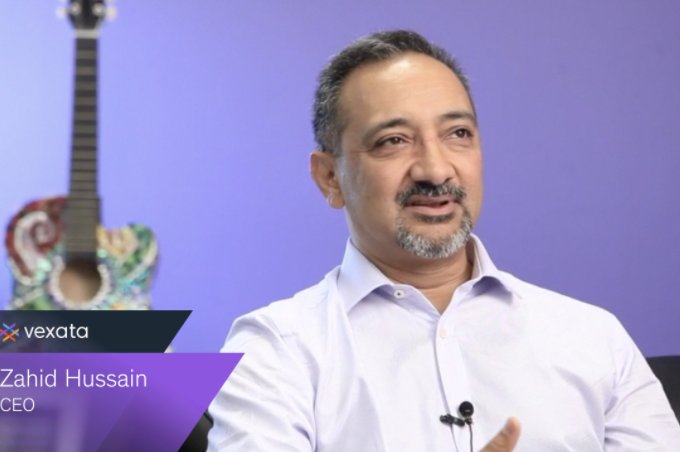
Zahid Hussain, EMC, at EMC World 2013 with John Furrier and Dave Vellante.
Zahid Hussain, EMC Senior VP/GM, Flash Products Division, discussed EMC's flash products and strategy with theCube co-hosts Dave Vellante and John Furrier, live at the 2013 edition of EMC World.
"We feel great about the portfolio we're bringing to the market," Hussain said, mentioning a great transformation to flash-based architecture that the storage industry is currently undergoing. Discussing mindset shifts, he stated that the performance one's getting out of flash is not just about "a faster version of your storage," it will change everything one expects, how data is analyzed or visualized, applications starting to expect something different from the infrastructure, etc. As the infrastructure changes, applications also change and then further accelerate changes at the infrastructure level.
Hussain also said deployments of flash at different levels of the stack will exponentially increase in the near future. EMC is currently focusing on driving latency to its lowest possible levels. "We should expect that a large class of workloads will fit comfortably in flash environments," he said, while a lot of enterprise customers will get terabytes of flash storage.
Flash isn't just faster
Flash is not just faster, he stressed, what one gets from flash is also a reduction of power which translates into lower total cost of ownership. Flash-based environments help reduce operational expenses, the TCO of such an environment will thus become compelling. "We will start to see that the cost effectiveness of putting your hot data on flash will become more and more compelling", despite the fact that it's not likely for companies to store all their data on flash.
Talking about EMC's strategy, Zahid Hussain said that "we're under pressure to innovate. [...] We are under pressure to do the right thing for our customers," not cannibalizing other products is not a concern. There is overlap between some of EMC's products, he agreed, but it's better to overlap than to have gaps into what the company is offering its customers.
Speaking of future trends, Zahid Hussain pointed out a new class of applicationss, a new generation, that increasingly operates off a memory tier, driven mainly by open source environments and slowly moving into the enterprise. A lot of the value will be in constructing the software layers to allow users to scale this new app class and connect to the capacity. He also mentioned that currently the industry has to deal with very large scale infrastructures, while answering key questions such as how to resource manage across them and how to provide all the software tears for them. "That is where we want to innovate," he added.
What else can software do in the datacenter?
Asked what should be done in software, beyond software-led infrastructure, Zahid Hussain said getting to a model where you can continue to drive lowest latency in a scale environment will become very important. How do you manage this at scale, how do you manage the liability — these will be the key questions. The innovations in software will revolve around scalability and getting to a resource manage abstract model.
Talking about EMC's position in the software-led storage space, Hussain said software defined storage often means grasping what is happening in a truly software provisioned model. EMC see intersections between software-defined storage and flash-based environments.
Talking about the stack and EMC's storage management and data management directions, Hussain said they were working on making it much more of a self-service model. Stressing future development trends, he mentioned that "we're making it possible to migrate data across different array types," as well offering automation in how data is provisioned on flash-based storage.
Forgot Password
Almost there!
We just sent you a verification email. Please verify your account to gain access to
EMC World 2013 | Las Vegas. If you don’t think you received an email check your
spam folder.
In order to sign in, enter the email address you used to registered for the event. Once completed, you will receive an email with a verification link. Open this link to automatically sign into the site.
Register For EMC World 2013 | Las Vegas
Please fill out the information below. You will recieve an email with a verification link confirming your registration. Click the link to automatically sign into the site.
You’re almost there!
We just sent you a verification email. Please click the verification button in the email. Once your email address is verified, you will have full access to all event content for EMC World 2013 | Las Vegas.
I want my badge and interests to be visible to all attendees.
Checking this box will display your presense on the attendees list, view your profile and allow other attendees to contact you via 1-1 chat. Read the Privacy Policy. At any time, you can choose to disable this preference.
Select your Interests!
add
Upload your photo
Uploading..
OR
Connect via Twitter
Connect via Linkedin
EDIT PASSWORD
Share
Forgot Password
Almost there!
We just sent you a verification email. Please verify your account to gain access to
EMC World 2013 | Las Vegas. If you don’t think you received an email check your
spam folder.
In order to sign in, enter the email address you used to registered for the event. Once completed, you will receive an email with a verification link. Open this link to automatically sign into the site.
Sign in to gain access to EMC World 2013 | Las Vegas
Please sign in with LinkedIn to continue to EMC World 2013 | Las Vegas. Signing in with LinkedIn ensures a professional environment.
Are you sure you want to remove access rights for this user?
Details
Manage Access
email address
Community Invitation
Zahid Hussain | EMC World 2013
Zahid Hussain, EMC, at EMC World 2013 with John Furrier and Dave Vellante.
Zahid Hussain, EMC Senior VP/GM, Flash Products Division, discussed EMC's flash products and strategy with theCube co-hosts Dave Vellante and John Furrier, live at the 2013 edition of EMC World.
"We feel great about the portfolio we're bringing to the market," Hussain said, mentioning a great transformation to flash-based architecture that the storage industry is currently undergoing. Discussing mindset shifts, he stated that the performance one's getting out of flash is not just about "a faster version of your storage," it will change everything one expects, how data is analyzed or visualized, applications starting to expect something different from the infrastructure, etc. As the infrastructure changes, applications also change and then further accelerate changes at the infrastructure level.
Hussain also said deployments of flash at different levels of the stack will exponentially increase in the near future. EMC is currently focusing on driving latency to its lowest possible levels. "We should expect that a large class of workloads will fit comfortably in flash environments," he said, while a lot of enterprise customers will get terabytes of flash storage.
Flash isn't just faster
Flash is not just faster, he stressed, what one gets from flash is also a reduction of power which translates into lower total cost of ownership. Flash-based environments help reduce operational expenses, the TCO of such an environment will thus become compelling. "We will start to see that the cost effectiveness of putting your hot data on flash will become more and more compelling", despite the fact that it's not likely for companies to store all their data on flash.
Talking about EMC's strategy, Zahid Hussain said that "we're under pressure to innovate. [...] We are under pressure to do the right thing for our customers," not cannibalizing other products is not a concern. There is overlap between some of EMC's products, he agreed, but it's better to overlap than to have gaps into what the company is offering its customers.
Speaking of future trends, Zahid Hussain pointed out a new class of applicationss, a new generation, that increasingly operates off a memory tier, driven mainly by open source environments and slowly moving into the enterprise. A lot of the value will be in constructing the software layers to allow users to scale this new app class and connect to the capacity. He also mentioned that currently the industry has to deal with very large scale infrastructures, while answering key questions such as how to resource manage across them and how to provide all the software tears for them. "That is where we want to innovate," he added.
What else can software do in the datacenter?
Asked what should be done in software, beyond software-led infrastructure, Zahid Hussain said getting to a model where you can continue to drive lowest latency in a scale environment will become very important. How do you manage this at scale, how do you manage the liability — these will be the key questions. The innovations in software will revolve around scalability and getting to a resource manage abstract model.
Talking about EMC's position in the software-led storage space, Hussain said software defined storage often means grasping what is happening in a truly software provisioned model. EMC see intersections between software-defined storage and flash-based environments.
Talking about the stack and EMC's storage management and data management directions, Hussain said they were working on making it much more of a self-service model. Stressing future development trends, he mentioned that "we're making it possible to migrate data across different array types," as well offering automation in how data is provisioned on flash-based storage.