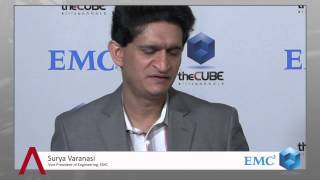
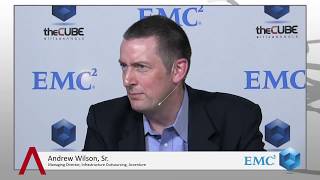
Amitabh Srivastava, President ASD at EMC - "Race to Zero" with John Furrier and Dave Vellante at EMC World 2013 - theCUBE
After a whole day of unveiling EMC's latest initiative ViPR, the reaction of customers was extremely positive. theCUBE hosts John Furrier and Dave Vellante sat down with Amitabh Srivastava, EMC Advanced Storage Division President, during EMC World this week to discuss ViPR's monetization strategy.
EMC had an early adopters program, focused on enterprise and service providers. While there's a lot of overlap between the two, their needs are somewhat distinct. Amitabh goes on to explain how the vision of ViPR and software-defined storage meet these distinct needs.
How ViPR works
ViPR decouples the control plane form the data plane. That part is common for both the enterprise and the service providers. But data services can be added on top, and by doing so, enterprises and service providers can use it in different ways. Service providers can offer distinctive services, which can be different than what the public cloud offers, in the way that they address handling of Objects. Enterprises can use the same facility to build cloud services and use them as a path to move to the cloud.
In a way, it is a monetization strategy for the cloud services providers, and a migration strategy for the enterprise.
The forecast that the cloud will be offered only by a handful of companies has some really tangible support. Public clouding is a very costly business, data centers need to be built, and there's only a couple of companies with the financial power to do that. But then there's a massive numbers of service providers. They will offer a different set of possibilities, they all have scale, they certainly have muscle, but it remains to be seen if they can keep up with the technology or if they get left behind. Amitabh agrees that the main thing that they miss is the technology itself. They may have scale, but they lack IP, and here's where EMC can help them.
There are 3 places where value can be added to ViPR:
1. The number of arrays that it supports. API will be open, so anyone will be able to add to that, just in the same manner they plug in a device driver.
2. The interface for Viper into different management stacks
3. The data services that can be written on top of Viper.
The end objective here for EMC is to increase the market that it can serve. "ViPR is open, but it's not open source", clarifies Amitabh Srivastava. There are three vectors: performance, availability and function, and that will determine the price.
Forgot Password
Almost there!
We just sent you a verification email. Please verify your account to gain access to
EMC World 2013 | Las Vegas. If you don’t think you received an email check your
spam folder.
In order to sign in, enter the email address you used to registered for the event. Once completed, you will receive an email with a verification link. Open this link to automatically sign into the site.
Register For EMC World 2013 | Las Vegas
Please fill out the information below. You will recieve an email with a verification link confirming your registration. Click the link to automatically sign into the site.
You’re almost there!
We just sent you a verification email. Please click the verification button in the email. Once your email address is verified, you will have full access to all event content for EMC World 2013 | Las Vegas.
I want my badge and interests to be visible to all attendees.
Checking this box will display your presense on the attendees list, view your profile and allow other attendees to contact you via 1-1 chat. Read the Privacy Policy. At any time, you can choose to disable this preference.
Select your Interests!
add
Upload your photo
Uploading..
OR
Connect via Twitter
Connect via Linkedin
EDIT PASSWORD
Share
Forgot Password
Almost there!
We just sent you a verification email. Please verify your account to gain access to
EMC World 2013 | Las Vegas. If you don’t think you received an email check your
spam folder.
In order to sign in, enter the email address you used to registered for the event. Once completed, you will receive an email with a verification link. Open this link to automatically sign into the site.
Sign in to gain access to EMC World 2013 | Las Vegas
Please sign in with LinkedIn to continue to EMC World 2013 | Las Vegas. Signing in with LinkedIn ensures a professional environment.
Are you sure you want to remove access rights for this user?
Details
Manage Access
email address
Community Invitation
Amitabh Srivastava | EMC World 2013
Amitabh Srivastava, President ASD at EMC - "Race to Zero" with John Furrier and Dave Vellante at EMC World 2013 - theCUBE
After a whole day of unveiling EMC's latest initiative ViPR, the reaction of customers was extremely positive. theCUBE hosts John Furrier and Dave Vellante sat down with Amitabh Srivastava, EMC Advanced Storage Division President, during EMC World this week to discuss ViPR's monetization strategy.
EMC had an early adopters program, focused on enterprise and service providers. While there's a lot of overlap between the two, their needs are somewhat distinct. Amitabh goes on to explain how the vision of ViPR and software-defined storage meet these distinct needs.
How ViPR works
ViPR decouples the control plane form the data plane. That part is common for both the enterprise and the service providers. But data services can be added on top, and by doing so, enterprises and service providers can use it in different ways. Service providers can offer distinctive services, which can be different than what the public cloud offers, in the way that they address handling of Objects. Enterprises can use the same facility to build cloud services and use them as a path to move to the cloud.
In a way, it is a monetization strategy for the cloud services providers, and a migration strategy for the enterprise.
The forecast that the cloud will be offered only by a handful of companies has some really tangible support. Public clouding is a very costly business, data centers need to be built, and there's only a couple of companies with the financial power to do that. But then there's a massive numbers of service providers. They will offer a different set of possibilities, they all have scale, they certainly have muscle, but it remains to be seen if they can keep up with the technology or if they get left behind. Amitabh agrees that the main thing that they miss is the technology itself. They may have scale, but they lack IP, and here's where EMC can help them.
There are 3 places where value can be added to ViPR:
1. The number of arrays that it supports. API will be open, so anyone will be able to add to that, just in the same manner they plug in a device driver.
2. The interface for Viper into different management stacks
3. The data services that can be written on top of Viper.
The end objective here for EMC is to increase the market that it can serve. "ViPR is open, but it's not open source", clarifies Amitabh Srivastava. There are three vectors: performance, availability and function, and that will determine the price.