The Cube - EMCworld 2012 - Peter Chang, Oxygen Cloud, with John Furrier and Dave Vellante
EMC has always been about storage and, as a result, how storage effects the use of data in computing architectures. Products such as Oxygen Cloud seeks to be part of this decoupling of data from computation, enabling data to float free from applications and allow it to be available anywhere.
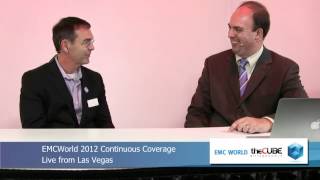
Peter Chang, CEO of Oxygen Cloud, met with John Furrier and Dave Vellante in the Cube at EMC World 2012 to speak about how his company is looking into the market to furrow out their niche. He expects that people can move their processing into the cloud, but you still have to move that data—and currently processing is virtualized, but it’s also important to virtualize data so that it follows behind computing.
“The infrastructure makes things possible,” Chang says, “so Big Data architecture might make it possible for you to store and crunch a lot of data; but what you do with it, that’s what’s next, that’s where the value actually comes from. How can you build on this infrastructure to create things that change people’s lives?”
When asked about use cases and the best traction, Chang explains that he sees people seeing access to enterprise content in the cloud. Employees want access to data via iPad and Android and mobile devices with security and control—such as enterprises really need. At NodeSummit he spoke about a similar expectation from the market, especially with the bring-your-own-device trend creeping into enterprise.
Oxygen Cloud, Furrier believes, is navigating some very choppy and dark waters and the company is just a start up between huge groups such as EMC, VMware, IBM, and HP. Chang sees it as a challenge, but that the market has a need but the big companies don’t have the technology or mobility to deliver what the market needs at the level that smaller startups can nimbly approach. So Chang says that he hopes to provide technology—such as anywhere access to EMC storage, Isilon, etc.—through partnerships with EMC.
Chang sees the end-user as the important linchpin for much storage delivery. While the big companies move and make huge waves through the cloud environment, the enterprise venue involves taking data out of the vast expanse of the cloud and bringing it down to the service level. Such as IT departments look to provide data and storage to end users.
“We’re going to be eventually managing storage as a service, I think that’s a forgone conclusion,” Chang says. “The question is what are the qualities of that service, where does that data live, and how do we drive lower costs?”
His vision is to build out a complete platform that not only provides access to all content across the enterprise—but also take advantage of that data set and provide value added services on top of that. Oxygen Cloud doesn’t provide just cloud storage, Chang explains, as in they’re not just there to provide access to files.
“We don’t think of ourselves as an application,” he says, “we think of ourselves as part of the infrastructure.”
We’re looking at an interesting niche with Oxygen Cloud, especially in comparison to traditional cloud-services such as Amazon Web Services. SiliconANGLE’s Alex Williams recently made a comparison between AWS and Oxygen Cloud looking at just these expectations.
The middle-man making the cloud-storage better. With Oxygen Cloud, certainly there is cloud-storage entailed; but to distribute data means to build out a platform, APIs for accessing that platform, and delivering all the necessary elements that make a solution for a storage-as-a-service. As a result, Chang sees that Oxygen Cloud will be able to compete by providing a superior service for cloud-storage providers to connect with IT departments and the enterprise sector.
Forgot Password
Almost there!
We just sent you a verification email. Please verify your account to gain access to
EMC World 2012 | Las Vegas. If you don’t think you received an email check your
spam folder.
In order to sign in, enter the email address you used to registered for the event. Once completed, you will receive an email with a verification link. Open this link to automatically sign into the site.
Register For EMC World 2012 | Las Vegas
Please fill out the information below. You will recieve an email with a verification link confirming your registration. Click the link to automatically sign into the site.
You’re almost there!
We just sent you a verification email. Please click the verification button in the email. Once your email address is verified, you will have full access to all event content for EMC World 2012 | Las Vegas.
I want my badge and interests to be visible to all attendees.
Checking this box will display your presense on the attendees list, view your profile and allow other attendees to contact you via 1-1 chat. Read the Privacy Policy. At any time, you can choose to disable this preference.
Select your Interests!
add
Upload your photo
Uploading..
OR
Connect via Twitter
Connect via Linkedin
EDIT PASSWORD
Share
Forgot Password
Almost there!
We just sent you a verification email. Please verify your account to gain access to
EMC World 2012 | Las Vegas. If you don’t think you received an email check your
spam folder.
In order to sign in, enter the email address you used to registered for the event. Once completed, you will receive an email with a verification link. Open this link to automatically sign into the site.
Sign in to gain access to EMC World 2012 | Las Vegas
Please sign in with LinkedIn to continue to EMC World 2012 | Las Vegas. Signing in with LinkedIn ensures a professional environment.
Are you sure you want to remove access rights for this user?
Details
Manage Access
email address
Community Invitation
Peter Chang - EMC World 2012 - theCUBE - #EMCWorld
The Cube - EMCworld 2012 - Peter Chang, Oxygen Cloud, with John Furrier and Dave Vellante
EMC has always been about storage and, as a result, how storage effects the use of data in computing architectures. Products such as Oxygen Cloud seeks to be part of this decoupling of data from computation, enabling data to float free from applications and allow it to be available anywhere.
Peter Chang, CEO of Oxygen Cloud, met with John Furrier and Dave Vellante in the Cube at EMC World 2012 to speak about how his company is looking into the market to furrow out their niche. He expects that people can move their processing into the cloud, but you still have to move that data—and currently processing is virtualized, but it’s also important to virtualize data so that it follows behind computing.
“The infrastructure makes things possible,” Chang says, “so Big Data architecture might make it possible for you to store and crunch a lot of data; but what you do with it, that’s what’s next, that’s where the value actually comes from. How can you build on this infrastructure to create things that change people’s lives?”
When asked about use cases and the best traction, Chang explains that he sees people seeing access to enterprise content in the cloud. Employees want access to data via iPad and Android and mobile devices with security and control—such as enterprises really need. At NodeSummit he spoke about a similar expectation from the market, especially with the bring-your-own-device trend creeping into enterprise.
Oxygen Cloud, Furrier believes, is navigating some very choppy and dark waters and the company is just a start up between huge groups such as EMC, VMware, IBM, and HP. Chang sees it as a challenge, but that the market has a need but the big companies don’t have the technology or mobility to deliver what the market needs at the level that smaller startups can nimbly approach. So Chang says that he hopes to provide technology—such as anywhere access to EMC storage, Isilon, etc.—through partnerships with EMC.
Chang sees the end-user as the important linchpin for much storage delivery. While the big companies move and make huge waves through the cloud environment, the enterprise venue involves taking data out of the vast expanse of the cloud and bringing it down to the service level. Such as IT departments look to provide data and storage to end users.
“We’re going to be eventually managing storage as a service, I think that’s a forgone conclusion,” Chang says. “The question is what are the qualities of that service, where does that data live, and how do we drive lower costs?”
His vision is to build out a complete platform that not only provides access to all content across the enterprise—but also take advantage of that data set and provide value added services on top of that. Oxygen Cloud doesn’t provide just cloud storage, Chang explains, as in they’re not just there to provide access to files.
“We don’t think of ourselves as an application,” he says, “we think of ourselves as part of the infrastructure.”
We’re looking at an interesting niche with Oxygen Cloud, especially in comparison to traditional cloud-services such as Amazon Web Services. SiliconANGLE’s Alex Williams recently made a comparison between AWS and Oxygen Cloud looking at just these expectations.
The middle-man making the cloud-storage better. With Oxygen Cloud, certainly there is cloud-storage entailed; but to distribute data means to build out a platform, APIs for accessing that platform, and delivering all the necessary elements that make a solution for a storage-as-a-service. As a result, Chang sees that Oxygen Cloud will be able to compete by providing a superior service for cloud-storage providers to connect with IT departments and the enterprise sector.