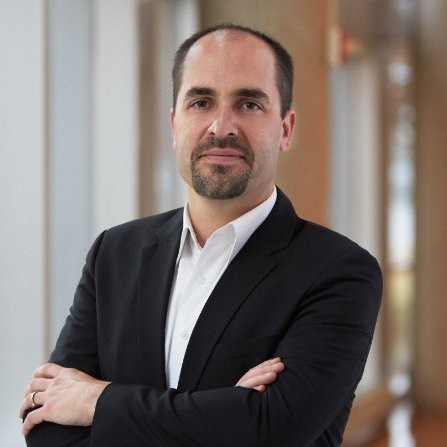
Nick Curcuru, VP, Data Analytics and Cyber Security Strategist, Mastercard & Thierry Pellegrino, VP, High Performance Computing, Dell EMC | @th_pellegrino sit with Lisa Martin & Stu Miniman for Dell Technologies World 2019 in Las Vegas, NV.
#DellTechWorld #theCUBE
https://siliconangle.com/2019/05/01/data-privacy-security-data-driven-world-will-hpc-answer-delltechworld/
Q&A: Data privacy and security in a data-driven world: Will HPC be the answer?
Data security and data privacy are the ever-looming concerns when it comes to analytics, artificial intelligence and machine learning. So how does this all come together in the context of large enterprises and technological innovation?
The key is in high-performance computing when generating high amounts of data, according to Thierry Pellegrino (pictured, right), vice president of business strategy and HPC solutions server and infrastructure systems at Dell EMC, and Nick Curcuru (pictured, left), vice president of global big data consulting at MasterCard International Inc.
Pellegrino and Curcuru spoke with Lisa Martin (@LisaMartinTV) and Stu Miniman (@stu), co-hosts of theCUBE, SiliconANGLE Media’s mobile livestreaming studio, during the Dell Tech World event in Las Vegas. They discussed data security in an AI world (see the full interview with transcript here). (* Disclosure below.)
[Editor’s note: The following has been condensed for clarity.]
Martin: We talk a lot about [HPC], AI, and machine learning, but let’s look at it in the context of all this data. How are you guys working together — Dell Technologies and MasterCard — to ensure that this data is protected?
Pellegrino: We work together to really, well, worry about the data being secure, but also privacy being a key item that we worry about. Every day, you get a lot of data coming through, and if we let customer information or any kind of information out there, it can be really detrimental. So we’ve really spent a lot of time not only helping manage and work through the data through the infrastructure and the solutions that we’ve put together.
Martin: How do you do that when there are devices that are listening constantly? How do you draw the line?
Curcuru: At a certain point, when it comes to privacy, you’ve got to have a little bit of parenting. Just because you have that information doesn’t mean you need to use that information. So that’s where we as humans have to come into play and start thinking about, ‘What is the data that we’re collecting, and how should we use that information?’ You have to make that decision again. It’s about being a parent at this point. That’s the ethical part of data.
Miniman: Talk to us some about the underlying architecture that’s going to drive all of this.
Pellegrino: First, the underlying infrastructure. We have our set of products that have security intrinsic in the way they’re designed. We really worry about key management for software. We have Silicon-based root-of-trust throughout a lot of our portfolio. We also think about secure supply chain, even thinking through secure erase — if you lose your hard drive, we can go and make sure that the data is not removed. So that’s on the security front.
We want to really make sure that innovation is not stifled, and the way we get there is to make sure that the data sets are as broad as possible. And today it’s very difficult to share data sets. There are parts of the industry that are so worried about data that they will not even get it anywhere else than their own data center and locked behind closed doors. But if you think about all the data scientists, they’re craving more data. The way we can get there … is making sure that the data that is collected is free of personal information and can still be qualified for some analysis and letting all the data scientists out there to get a lot of value out of it.
Martin: So HPC can help make the data scientist job simpler or simplify evaluating this innumerable amount of data.
Pellegrino: When you start thinking about finding a black hole in the galaxy, you can’t do that on tablet. So you’re going to have to use several computers in a cluster with the right storage or the right interconnect. And that’s why HPC comes in place.
...
Watch the complete video interview below, and be sure to check out more of SiliconANGLE’s and theCUBE’s coverage of the Dell Tech World 2019 event. (* Disclosure: Dell Technologies Inc. sponsored this segment of theCUBE. Neither Dell nor other sponsors have editorial control over content on theCUBE or SiliconANGLE.)
Forgot Password
Almost there!
We just sent you a verification email. Please verify your account to gain access to
Dell Technologies World 2019 | Las Vegas. If you don’t think you received an email check your
spam folder.
Sign in to Dell Technologies World 2019 | Las Vegas.
In order to sign in, enter the email address you used to registered for the event. Once completed, you will receive an email with a verification link. Open this link to automatically sign into the site.
Register For Dell Technologies World 2019 | Las Vegas
Please fill out the information below. You will recieve an email with a verification link confirming your registration. Click the link to automatically sign into the site.
You’re almost there!
We just sent you a verification email. Please click the verification button in the email. Once your email address is verified, you will have full access to all event content for Dell Technologies World 2019 | Las Vegas.
I want my badge and interests to be visible to all attendees.
Checking this box will display your presense on the attendees list, view your profile and allow other attendees to contact you via 1-1 chat. Read the Privacy Policy. At any time, you can choose to disable this preference.
Select your Interests!
add
Upload your photo
Uploading..
OR
Connect via Twitter
Connect via Linkedin
EDIT PASSWORD
Share
Forgot Password
Almost there!
We just sent you a verification email. Please verify your account to gain access to
Dell Technologies World 2019 | Las Vegas. If you don’t think you received an email check your
spam folder.
Sign in to Dell Technologies World 2019 | Las Vegas.
In order to sign in, enter the email address you used to registered for the event. Once completed, you will receive an email with a verification link. Open this link to automatically sign into the site.
Sign in to gain access to Dell Technologies World 2019 | Las Vegas
Please sign in with LinkedIn to continue to Dell Technologies World 2019 | Las Vegas. Signing in with LinkedIn ensures a professional environment.
Are you sure you want to remove access rights for this user?
Details
Manage Access
email address
Community Invitation
Nick Curcuru, Mastercard, & Thierry Pellegrino, Dell EMC | Dell Technologies World 2019
Nick Curcuru, VP, Data Analytics and Cyber Security Strategist, Mastercard & Thierry Pellegrino, VP, High Performance Computing, Dell EMC | @th_pellegrino sit with Lisa Martin & Stu Miniman for Dell Technologies World 2019 in Las Vegas, NV.
#DellTechWorld #theCUBE
https://siliconangle.com/2019/05/01/data-privacy-security-data-driven-world-will-hpc-answer-delltechworld/
Q&A: Data privacy and security in a data-driven world: Will HPC be the answer?
Data security and data privacy are the ever-looming concerns when it comes to analytics, artificial intelligence and machine learning. So how does this all come together in the context of large enterprises and technological innovation?
The key is in high-performance computing when generating high amounts of data, according to Thierry Pellegrino (pictured, right), vice president of business strategy and HPC solutions server and infrastructure systems at Dell EMC, and Nick Curcuru (pictured, left), vice president of global big data consulting at MasterCard International Inc.
Pellegrino and Curcuru spoke with Lisa Martin (@LisaMartinTV) and Stu Miniman (@stu), co-hosts of theCUBE, SiliconANGLE Media’s mobile livestreaming studio, during the Dell Tech World event in Las Vegas. They discussed data security in an AI world (see the full interview with transcript here). (* Disclosure below.)
[Editor’s note: The following has been condensed for clarity.]
Martin: We talk a lot about [HPC], AI, and machine learning, but let’s look at it in the context of all this data. How are you guys working together — Dell Technologies and MasterCard — to ensure that this data is protected?
Pellegrino: We work together to really, well, worry about the data being secure, but also privacy being a key item that we worry about. Every day, you get a lot of data coming through, and if we let customer information or any kind of information out there, it can be really detrimental. So we’ve really spent a lot of time not only helping manage and work through the data through the infrastructure and the solutions that we’ve put together.
Martin: How do you do that when there are devices that are listening constantly? How do you draw the line?
Curcuru: At a certain point, when it comes to privacy, you’ve got to have a little bit of parenting. Just because you have that information doesn’t mean you need to use that information. So that’s where we as humans have to come into play and start thinking about, ‘What is the data that we’re collecting, and how should we use that information?’ You have to make that decision again. It’s about being a parent at this point. That’s the ethical part of data.
Miniman: Talk to us some about the underlying architecture that’s going to drive all of this.
Pellegrino: First, the underlying infrastructure. We have our set of products that have security intrinsic in the way they’re designed. We really worry about key management for software. We have Silicon-based root-of-trust throughout a lot of our portfolio. We also think about secure supply chain, even thinking through secure erase — if you lose your hard drive, we can go and make sure that the data is not removed. So that’s on the security front.
We want to really make sure that innovation is not stifled, and the way we get there is to make sure that the data sets are as broad as possible. And today it’s very difficult to share data sets. There are parts of the industry that are so worried about data that they will not even get it anywhere else than their own data center and locked behind closed doors. But if you think about all the data scientists, they’re craving more data. The way we can get there … is making sure that the data that is collected is free of personal information and can still be qualified for some analysis and letting all the data scientists out there to get a lot of value out of it.
Martin: So HPC can help make the data scientist job simpler or simplify evaluating this innumerable amount of data.
Pellegrino: When you start thinking about finding a black hole in the galaxy, you can’t do that on tablet. So you’re going to have to use several computers in a cluster with the right storage or the right interconnect. And that’s why HPC comes in place.
...
Watch the complete video interview below, and be sure to check out more of SiliconANGLE’s and theCUBE’s coverage of the Dell Tech World 2019 event. (* Disclosure: Dell Technologies Inc. sponsored this segment of theCUBE. Neither Dell nor other sponsors have editorial control over content on theCUBE or SiliconANGLE.)