Open source: Docker’s secret sauce | #DockerCon
by Elizabeth Kays | Jun 24, 2015
https://siliconangle.com/2015/06/24/open-source-dockers-secret-sauce-dockercon/
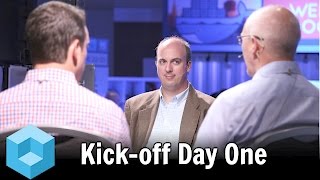
As the CEO of Docker, Ben Golub is at the forefront of the container revolution. In only two years, Docker has grown into a huge ecosystem that is starting to see widespread adoption across the enterprise market. The company has nearly quadrupled in size, and the statistics for applications are even more impressive.
“There were like 15,000 of them last DockerCon; now it’s 150,000,” Golub told theCUE during DockerCon 2015. “If you look at how often those were downloaded, they’d been downloaded 3 million times at the last DockerCon in June. In January, that was 100 million. Now, it’s 500 million. So to a large extent, what life at Docker has been is just trying to keep up with this amazing ecosystem and all the activity. And it’s not just web companies using Docker now, but we’re seeing it being used by some of the most serious enterprises on the planet.”
The pros and cons of open source
Golub credits much of this growth to the company’s open-source model, despite the potential drawbacks. “Certainly, there are some tough things about open source,” he pointed out. “And you sort of have to accept the fact that you’re not in control.”
Golub likens it to being a parent, understanding that development may happen in unexpected ways — and that makes it wonderful. “Docker couldn’t exist a as a proprietary company,” he said, both because they have access to a wider pool of programmers in the open-source ecosystem and because the open-source label allows for wider and deeper adoption.
“Every major operating system, every major Cloud provider, every major DevOps tool, every major ops platform latching on to Docker — that only happens if you’re open source. And now that we’re moving into commercial, you know, there’s no way that we could play golf with the CIOs of every Fortune 500.”
But because of the wide reach of the ecosystem, he said, “We know that every one of those companies has a Docker project going on. That was one of the stats we showed …. Something like 10% of all Fortune 500 CIOs say that they’ve got Docker in pilot or in production, and another 30% plan to do it by the end of the year. So that only happens if you’re open.”
The tipping point
That openness is part of what sets Docker apart from earlier container services, Golub said. Before Docker, containers “weren’t designed for developers. They were just an infrastructure tool. So I think Solomon’s insight was let’s try and make this the standard, let’s make it as open as possible so that anybody can design it, and let’s get it in the hands of developers first,” he said. “And once developers started using it, things starts taking off.”
That was the tipping point. “Suddenly, it made sense for Red Hat, and Microsoft, and IBM, and Intel and all of these guys to embrace Docker,” Golub said
Watch the full interview below, and be sure to check out more of SiliconANGLE and theCUBE’s coverage of DockerCon.
@theCUBE @Docker #Docker #DockerCon @SiliconANGLE theCUBE #theCUBE @theCUBE #Containers
Forgot Password
Almost there!
We just sent you a verification email. Please verify your account to gain access to
DockerCon 2015 | San Francisco. If you don’t think you received an email check your
spam folder.
In order to sign in, enter the email address you used to registered for the event. Once completed, you will receive an email with a verification link. Open this link to automatically sign into the site.
Register For DockerCon 2015 | San Francisco
Please fill out the information below. You will recieve an email with a verification link confirming your registration. Click the link to automatically sign into the site.
You’re almost there!
We just sent you a verification email. Please click the verification button in the email. Once your email address is verified, you will have full access to all event content for DockerCon 2015 | San Francisco.
I want my badge and interests to be visible to all attendees.
Checking this box will display your presense on the attendees list, view your profile and allow other attendees to contact you via 1-1 chat. Read the Privacy Policy. At any time, you can choose to disable this preference.
Select your Interests!
add
Upload your photo
Uploading..
OR
Connect via Twitter
Connect via Linkedin
EDIT PASSWORD
Share
Forgot Password
Almost there!
We just sent you a verification email. Please verify your account to gain access to
DockerCon 2015 | San Francisco. If you don’t think you received an email check your
spam folder.
In order to sign in, enter the email address you used to registered for the event. Once completed, you will receive an email with a verification link. Open this link to automatically sign into the site.
Sign in to gain access to DockerCon 2015 | San Francisco
Please sign in with LinkedIn to continue to DockerCon 2015 | San Francisco. Signing in with LinkedIn ensures a professional environment.
Are you sure you want to remove access rights for this user?
Details
Manage Access
email address
Community Invitation
Ben Golub, Docker | DockerCon 2015
Open source: Docker’s secret sauce | #DockerCon
by Elizabeth Kays | Jun 24, 2015
https://siliconangle.com/2015/06/24/open-source-dockers-secret-sauce-dockercon/
As the CEO of Docker, Ben Golub is at the forefront of the container revolution. In only two years, Docker has grown into a huge ecosystem that is starting to see widespread adoption across the enterprise market. The company has nearly quadrupled in size, and the statistics for applications are even more impressive.
“There were like 15,000 of them last DockerCon; now it’s 150,000,” Golub told theCUE during DockerCon 2015. “If you look at how often those were downloaded, they’d been downloaded 3 million times at the last DockerCon in June. In January, that was 100 million. Now, it’s 500 million. So to a large extent, what life at Docker has been is just trying to keep up with this amazing ecosystem and all the activity. And it’s not just web companies using Docker now, but we’re seeing it being used by some of the most serious enterprises on the planet.”
The pros and cons of open source
Golub credits much of this growth to the company’s open-source model, despite the potential drawbacks. “Certainly, there are some tough things about open source,” he pointed out. “And you sort of have to accept the fact that you’re not in control.”
Golub likens it to being a parent, understanding that development may happen in unexpected ways — and that makes it wonderful. “Docker couldn’t exist a as a proprietary company,” he said, both because they have access to a wider pool of programmers in the open-source ecosystem and because the open-source label allows for wider and deeper adoption.
“Every major operating system, every major Cloud provider, every major DevOps tool, every major ops platform latching on to Docker — that only happens if you’re open source. And now that we’re moving into commercial, you know, there’s no way that we could play golf with the CIOs of every Fortune 500.”
But because of the wide reach of the ecosystem, he said, “We know that every one of those companies has a Docker project going on. That was one of the stats we showed …. Something like 10% of all Fortune 500 CIOs say that they’ve got Docker in pilot or in production, and another 30% plan to do it by the end of the year. So that only happens if you’re open.”
The tipping point
That openness is part of what sets Docker apart from earlier container services, Golub said. Before Docker, containers “weren’t designed for developers. They were just an infrastructure tool. So I think Solomon’s insight was let’s try and make this the standard, let’s make it as open as possible so that anybody can design it, and let’s get it in the hands of developers first,” he said. “And once developers started using it, things starts taking off.”
That was the tipping point. “Suddenly, it made sense for Red Hat, and Microsoft, and IBM, and Intel and all of these guys to embrace Docker,” Golub said
Watch the full interview below, and be sure to check out more of SiliconANGLE and theCUBE’s coverage of DockerCon.
@theCUBE @Docker #Docker #DockerCon @SiliconANGLE theCUBE #theCUBE @theCUBE #Containers