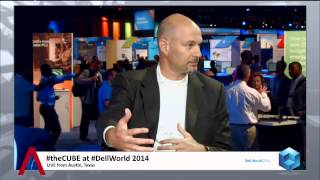
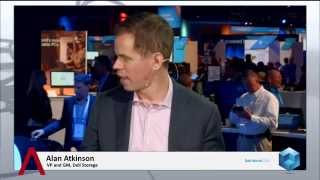
Dell Inc. has been a work in progress for the better part of the last decade as Michael Dell worked to make the personal computer maker he established in his dorm room in the 1980s a bigger part of the enterprise market. Wikibon chief analyst Dave Vellante and principal research contributor Stu Miniman traveled to the hardware powerhouse’s annual customer conference in Austin last week to check how the founder’s plans have progressed since he took his namesake company private last October.
Although Dell no longer divulges financial performance, there’s plenty of evidence to suggest that the vendor’s shift away from Wall Street’s constant gaze – and subsequent lifting of the pressure to meet quarterly forecasts – has had a positive impact on Michael Dell’s enterprise crusade. “The message coming from Dell is now that they don’t have answer to the 90-day shock clock, they can move much faster, listen to customers and act fast rather than taking a year to get back to them,” Miniman told Vellante in their opening session on the first day of Dell World.
Major changes to Dell’s portfolio
That change of pace is best felt in the company’s portfolio, which has been expanded aggressively over the last few quarters to encompass the full breadth of the data center infrastructure landscape along with numerous other strategic areas higher up the stack. Dell is also shifting gears on the business side, following rivals such as Hewlett-Packard Co. and IBM Corp. beyond its traditional comfort zone within the supply chain into uncharted territory.
“Dell has been reaching out to the channel for the last couple of years and about 40 percent of its revenue now comes through the channel,” Vellante highlighted. “Dell is changing the way in which they’re operating from a sales and distribution standpoint.” But the reforms started since the company’s privatization have not stopped there.
.
It’s all about choice
As Miniman noted in a follow-up discussion at the end of the first day of the conference, Dell has also has carried out selective cuts to its workforce under a “voluntary separation program” meant to remove change inhibitors within the company. But at the same time, the vendor is also actively hiring more workers in key growth areas as part of efforts to establish a bigger presence across the various battle fields in which it competes.
“For me, the real striking thing is they talk a lot about choice: there’s so many different markets out there, all of these little sub-climates inside IT and Dell is playing a lot of bets,” Miniman remarked. It’s no easy to task to juggle so many priorities at the same time, but the effort is more than paying of for the vendor, which Vellante pointed out has found itself commanding a truly unique position in the marketplace.
Last one standing
Now that IBM has sold its commodity server business to Lenovo Group Ltd. and HP is splitting into two companies, Dell stands out as the last remaining hardware supplier to boast a truly end-to-end spanning from x86 data center machines to office workstations, he explained. And that’s a very big deal. “What is the value of end-to-end to the customer? One, supply chain, which gives Dell buying power – Dell now got one of the biggest supply chain in the industry,” Vellante detailed. “And you can buy virtually anything from the company.”
That not only includes various hardware products but also professional services, which he highlighted accounted for about $10 billion in revenue the last time Dell released financial results, as well as cloud solutions. Another major priority for the company is converged infrastructure, a space where it maintains its own homegrown solutions but relies in large part on an alliance with Nutanix Inc. to compete, a strategy Miniman believes could prove risky on the long-run.
“Dell does not have any stake in Nutanix, so if Nutanix keeps growing at the current pace, if there becomes tension between the in-house solutions that Dell has and Nutanix – they’re not married, they’re just closely partnered,” he explained. But like Vellante, Miniman is nonetheless confident in where the company is headed. “Since they’re private, Dell has been writing their own narrative,” he concluded.“But Dell is placing a lot of bets, and it’s not easy being great at a dozen things.
Forgot Password
Almost there!
We just sent you a verification email. Please verify your account to gain access to
Dell World 2014 | Austin. If you don’t think you received an email check your
spam folder.
In order to sign in, enter the email address you used to registered for the event. Once completed, you will receive an email with a verification link. Open this link to automatically sign into the site.
Register For Dell World 2014 | Austin
Please fill out the information below. You will recieve an email with a verification link confirming your registration. Click the link to automatically sign into the site.
You’re almost there!
We just sent you a verification email. Please click the verification button in the email. Once your email address is verified, you will have full access to all event content for Dell World 2014 | Austin.
I want my badge and interests to be visible to all attendees.
Checking this box will display your presense on the attendees list, view your profile and allow other attendees to contact you via 1-1 chat. Read the Privacy Policy. At any time, you can choose to disable this preference.
Select your Interests!
add
Upload your photo
Uploading..
OR
Connect via Twitter
Connect via Linkedin
EDIT PASSWORD
Share
Forgot Password
Almost there!
We just sent you a verification email. Please verify your account to gain access to
Dell World 2014 | Austin. If you don’t think you received an email check your
spam folder.
In order to sign in, enter the email address you used to registered for the event. Once completed, you will receive an email with a verification link. Open this link to automatically sign into the site.
Sign in to gain access to Dell World 2014 | Austin
Please sign in with LinkedIn to continue to Dell World 2014 | Austin. Signing in with LinkedIn ensures a professional environment.
Are you sure you want to remove access rights for this user?
Details
Manage Access
email address
Community Invitation
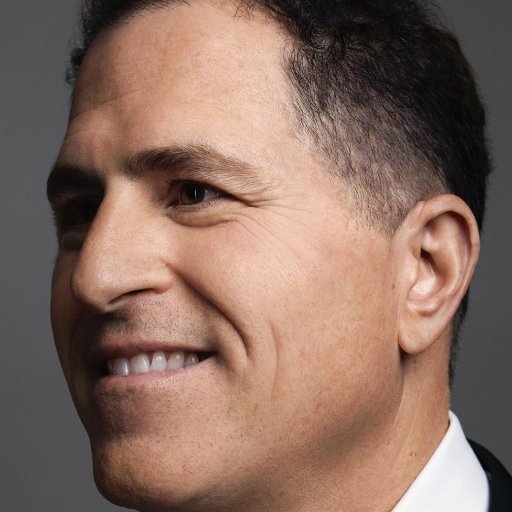
Michael Dell, Dell | Dell World 2014
Dell Inc. has been a work in progress for the better part of the last decade as Michael Dell worked to make the personal computer maker he established in his dorm room in the 1980s a bigger part of the enterprise market. Wikibon chief analyst Dave Vellante and principal research contributor Stu Miniman traveled to the hardware powerhouse’s annual customer conference in Austin last week to check how the founder’s plans have progressed since he took his namesake company private last October.
Although Dell no longer divulges financial performance, there’s plenty of evidence to suggest that the vendor’s shift away from Wall Street’s constant gaze – and subsequent lifting of the pressure to meet quarterly forecasts – has had a positive impact on Michael Dell’s enterprise crusade. “The message coming from Dell is now that they don’t have answer to the 90-day shock clock, they can move much faster, listen to customers and act fast rather than taking a year to get back to them,” Miniman told Vellante in their opening session on the first day of Dell World.
Major changes to Dell’s portfolio
That change of pace is best felt in the company’s portfolio, which has been expanded aggressively over the last few quarters to encompass the full breadth of the data center infrastructure landscape along with numerous other strategic areas higher up the stack. Dell is also shifting gears on the business side, following rivals such as Hewlett-Packard Co. and IBM Corp. beyond its traditional comfort zone within the supply chain into uncharted territory.
“Dell has been reaching out to the channel for the last couple of years and about 40 percent of its revenue now comes through the channel,” Vellante highlighted. “Dell is changing the way in which they’re operating from a sales and distribution standpoint.” But the reforms started since the company’s privatization have not stopped there.
.
It’s all about choice
As Miniman noted in a follow-up discussion at the end of the first day of the conference, Dell has also has carried out selective cuts to its workforce under a “voluntary separation program” meant to remove change inhibitors within the company. But at the same time, the vendor is also actively hiring more workers in key growth areas as part of efforts to establish a bigger presence across the various battle fields in which it competes.
“For me, the real striking thing is they talk a lot about choice: there’s so many different markets out there, all of these little sub-climates inside IT and Dell is playing a lot of bets,” Miniman remarked. It’s no easy to task to juggle so many priorities at the same time, but the effort is more than paying of for the vendor, which Vellante pointed out has found itself commanding a truly unique position in the marketplace.
Last one standing
Now that IBM has sold its commodity server business to Lenovo Group Ltd. and HP is splitting into two companies, Dell stands out as the last remaining hardware supplier to boast a truly end-to-end spanning from x86 data center machines to office workstations, he explained. And that’s a very big deal. “What is the value of end-to-end to the customer? One, supply chain, which gives Dell buying power – Dell now got one of the biggest supply chain in the industry,” Vellante detailed. “And you can buy virtually anything from the company.”
That not only includes various hardware products but also professional services, which he highlighted accounted for about $10 billion in revenue the last time Dell released financial results, as well as cloud solutions. Another major priority for the company is converged infrastructure, a space where it maintains its own homegrown solutions but relies in large part on an alliance with Nutanix Inc. to compete, a strategy Miniman believes could prove risky on the long-run.
“Dell does not have any stake in Nutanix, so if Nutanix keeps growing at the current pace, if there becomes tension between the in-house solutions that Dell has and Nutanix – they’re not married, they’re just closely partnered,” he explained. But like Vellante, Miniman is nonetheless confident in where the company is headed. “Since they’re private, Dell has been writing their own narrative,” he concluded.“But Dell is placing a lot of bets, and it’s not easy being great at a dozen things.