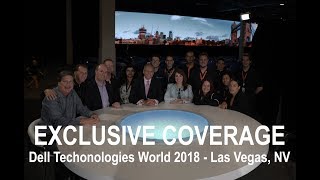
Ty Schmitt joins CUBE hosts, Lisa Martin @LuccaZara & Dave Vellante @dvellante, at Dell Technologies World 2018 in Las Vegas, NV.
#DellTechWorld #theCUBE
https://siliconangle.com/2018/05/08/reducing-wasteful-spending-with-edge-computing-delltechworld/
Reducing wasteful spending with edge computing
Go back 10 years or so to the wild west days of data centers, when businesses were busily focused on buying up single computing racks. As time went by, mega-giant retailers like eBay faced quite the conundrum with their online outlets — rapid growth led to countless servers, making it increasingly difficult to scale the management and optimization of data processing.
That’s where edge computing comes in — literally, it’s a business driver where data processing is fulfilled at the edge of the network, near the source of the data itself. A primary objective with edge computing is to address the scaling issue; as computing infrastructure services try to keep up with business needs, some customers end up with unwanted components, according to Ty Schmitt, vice president and fellow at Dell EMC.
“If I’m having to buy something that is for the general purpose or general masses, there may be things in there that I don’t value and therefore I pay too much for those — or Dell’s not going to make much money on those,” Schmitt said.
Schmitt spoke with Dave Vellante (@dvellante) and Lisa Martin (@LuccaZara), co-hosts of theCUBE, SiliconANGLE Media’s mobile livestreaming studio, at the Dell Technologies World event in Las Vegas. They discussed how edge computing is helping customers on their data storage needs. (* Disclosure below.)
The approach is to aggregate all information technology gear, reduce waste and optimize revenue-driving solutions through edge computing, Schmitt explained.
Hallmarks to product offerings
For Dell EMC, the company had to transform its offerings alongside its customers as the industry looks to effectively leverage cloud computing beyond traditional data centers, according to Schmitt. With major customers in computing, retail and the public sector, Dell recognizes the business demand for scaling new technologies while maintaining the underlying infrastructure.
Schmitt’s teams build models and analyze the physical infrastructure, security, density and power cooling. Customers often must balance cost, risk and time factors as they operationalize massive computing systems for discrete, edge-type computing.
With a myriad of variables involved in edge computing, operational models are different for customers buying 10 megawatts in one location compared to a customer that wants to spread the 10 megawatts across a 1,000 different locations — that requires a different operational model, a different approach, and a different architecture, Schmitt explained.
“At the end of the day, if your data center … is limiting your software, your application, your customer-focused transformation — if it’s a limiting factor to what you can do, that’s a problem,” Schmitt said. “Your IT solution should be driving your facility strategy, not the other way around.”
Watch the complete video interview below, and be sure to check out more of SiliconANGLE’s and theCUBE’s coverage of the Dell Technologies World 2018 event. (* Disclosure: Dell EMC sponsored this segment of theCUBE. Neither Dell EMC nor other sponsors have editorial control over content on theCUBE or SiliconANGLE.)
Forgot Password
Almost there!
We just sent you a verification email. Please verify your account to gain access to
Dell Technologies World 2018 | Las Vegas. If you don’t think you received an email check your
spam folder.
Sign in to Dell Technologies World 2018 | Las Vegas.
In order to sign in, enter the email address you used to registered for the event. Once completed, you will receive an email with a verification link. Open this link to automatically sign into the site.
Register For Dell Technologies World 2018 | Las Vegas
Please fill out the information below. You will recieve an email with a verification link confirming your registration. Click the link to automatically sign into the site.
You’re almost there!
We just sent you a verification email. Please click the verification button in the email. Once your email address is verified, you will have full access to all event content for Dell Technologies World 2018 | Las Vegas.
I want my badge and interests to be visible to all attendees.
Checking this box will display your presense on the attendees list, view your profile and allow other attendees to contact you via 1-1 chat. Read the Privacy Policy. At any time, you can choose to disable this preference.
Select your Interests!
add
Upload your photo
Uploading..
OR
Connect via Twitter
Connect via Linkedin
EDIT PASSWORD
Share
Forgot Password
Almost there!
We just sent you a verification email. Please verify your account to gain access to
Dell Technologies World 2018 | Las Vegas. If you don’t think you received an email check your
spam folder.
Sign in to Dell Technologies World 2018 | Las Vegas.
In order to sign in, enter the email address you used to registered for the event. Once completed, you will receive an email with a verification link. Open this link to automatically sign into the site.
Sign in to gain access to Dell Technologies World 2018 | Las Vegas
Please sign in with LinkedIn to continue to Dell Technologies World 2018 | Las Vegas. Signing in with LinkedIn ensures a professional environment.
Are you sure you want to remove access rights for this user?
Details
Manage Access
email address
Community Invitation
Ty Schmitt, Dell EMC | Dell Technologies World 2018
Ty Schmitt joins CUBE hosts, Lisa Martin @LuccaZara & Dave Vellante @dvellante, at Dell Technologies World 2018 in Las Vegas, NV.
#DellTechWorld #theCUBE
https://siliconangle.com/2018/05/08/reducing-wasteful-spending-with-edge-computing-delltechworld/
Reducing wasteful spending with edge computing
Go back 10 years or so to the wild west days of data centers, when businesses were busily focused on buying up single computing racks. As time went by, mega-giant retailers like eBay faced quite the conundrum with their online outlets — rapid growth led to countless servers, making it increasingly difficult to scale the management and optimization of data processing.
That’s where edge computing comes in — literally, it’s a business driver where data processing is fulfilled at the edge of the network, near the source of the data itself. A primary objective with edge computing is to address the scaling issue; as computing infrastructure services try to keep up with business needs, some customers end up with unwanted components, according to Ty Schmitt, vice president and fellow at Dell EMC.
“If I’m having to buy something that is for the general purpose or general masses, there may be things in there that I don’t value and therefore I pay too much for those — or Dell’s not going to make much money on those,” Schmitt said.
Schmitt spoke with Dave Vellante (@dvellante) and Lisa Martin (@LuccaZara), co-hosts of theCUBE, SiliconANGLE Media’s mobile livestreaming studio, at the Dell Technologies World event in Las Vegas. They discussed how edge computing is helping customers on their data storage needs. (* Disclosure below.)
The approach is to aggregate all information technology gear, reduce waste and optimize revenue-driving solutions through edge computing, Schmitt explained.
Hallmarks to product offerings
For Dell EMC, the company had to transform its offerings alongside its customers as the industry looks to effectively leverage cloud computing beyond traditional data centers, according to Schmitt. With major customers in computing, retail and the public sector, Dell recognizes the business demand for scaling new technologies while maintaining the underlying infrastructure.
Schmitt’s teams build models and analyze the physical infrastructure, security, density and power cooling. Customers often must balance cost, risk and time factors as they operationalize massive computing systems for discrete, edge-type computing.
With a myriad of variables involved in edge computing, operational models are different for customers buying 10 megawatts in one location compared to a customer that wants to spread the 10 megawatts across a 1,000 different locations — that requires a different operational model, a different approach, and a different architecture, Schmitt explained.
“At the end of the day, if your data center … is limiting your software, your application, your customer-focused transformation — if it’s a limiting factor to what you can do, that’s a problem,” Schmitt said. “Your IT solution should be driving your facility strategy, not the other way around.”
Watch the complete video interview below, and be sure to check out more of SiliconANGLE’s and theCUBE’s coverage of the Dell Technologies World 2018 event. (* Disclosure: Dell EMC sponsored this segment of theCUBE. Neither Dell EMC nor other sponsors have editorial control over content on theCUBE or SiliconANGLE.)