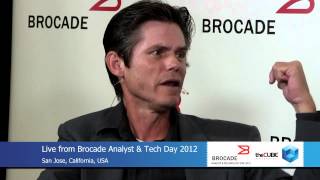
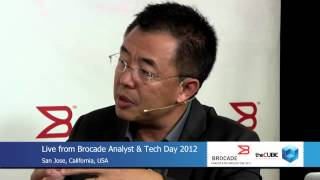
Continuing SiliconANGLE's coverage of Brocade Analyst and Tech Day 2012, Stu Miniman of Wikibon.org spoke with Luke Norris, CEO and Founder of Peak Colo. Miniman and Norris discuss new occurrences in the service provider space and transformations in IT.
Norris' experience working with Sun Guard Availability Services was helpful in founding Peak Colo, a service provider to service providers. The company builds baseline infrastructure services, allowing SAS and PAS providers to build products on top of Peak Colo. Norris adds the company is also, "leading the transformation of our community to sell cloud-based services."
Peak Colo has been around for six years and is currently developing its 6th iteration on the cloud. Norris says this process, "makes service providers so much more adaptable to it. Our procurement cycles are really driven by business demand instead of by 3 year or 5 year acquisition cycles."
Miniman notes that while many companies are growing, Brocade has experienced hyper-growth. Norris says, "In the course of a year, I think we've grown over 3 petabytes just within one data center," and Peak Colo has also grown across multiple data centers. One facility has reached 15,000 VMs, with each VM averaging 32 to 64 gigabytes of memory.
Miniman refers to Brocade's announcement of giant scalable fabric environments that can go up to 300,000 VMs, and asks, as service providers, "Do you need that?". Norris, explains that Peak Colo has a methodology called failure zones, which the company keeps very small. "It's kinda going back to Brocade's old methodology. They themselves built small pods when it came to the SAN based architecture...We're building 15 to 20 60-port VDX switches. It's more so an isolation level for how many physical ports we can connect to it. We're not worried about over-running the ARP address translation maximization...So, you can see 5,000 to 10,000 VMs in these ARP address pods."
Given that there are some applications customers keep in house and other applications for which clients seek out "as a service" solutions. In light of these trends, Miniman asks, "Are you seeing cloud-bursting becoming a reality?" Norris responds, "What we find is the main limitation is on this is just how fast you can move one packet from one location to another...A lot of our growth strategy is putting these micro-clouds in all the major cities because we find out that many of these enterprises are on 3 to 5 year adoption cycles, but their applications and their customer demands aren't following those cycles. If we can actually give them an agile infrastructure to do cloud-bursting, they'll do it if that latency and their core applications will respond out of house as they were in house."
Miniman also asks about the profile and process of companies that are adopting the service providers that Peak Colo works with. For example, does the CEO have to be on-board and how big of a leap is it to adopt. According to Norris, "End-user adoption seems to be coming from the C-levels. It's the CTO or CIO understanding the transformation that's happening and then, after that, it's the CFO that's understanding the transformation that's happening at his level. He can move those acquisition cycles, the operational cycles into that monolithic three or five year block and now he can actually start as a CFO, work with a CIO and derive value from an enterprise saying this application is going to go through 6-month iteration cycles, so why doesn't our infrastructure and why doesn't our IT have that same level of agility. If that decision is made at that level, it's a rapid move to us." He notes that from an IT level, however, the adoption is more like a toe-dip. He quips, "Our favorite line is, 'Your development is going to run better than your production in-house.'"
Norris concludes with some of the most exciting these he has seen in the technology space. He's particularly impressed with the startups that are able to go to market faster because of cloud. With technology that allows developers to write code faster, he's also excited about the increased pace of innovation all the way through the stack.
Forgot Password
Almost there!
We just sent you a verification email. Please verify your account to gain access to
Brocade Tech Day 2012 | San Jose. If you don’t think you received an email check your
spam folder.
In order to sign in, enter the email address you used to registered for the event. Once completed, you will receive an email with a verification link. Open this link to automatically sign into the site.
Register For Brocade Tech Day 2012 | San Jose
Please fill out the information below. You will recieve an email with a verification link confirming your registration. Click the link to automatically sign into the site.
You’re almost there!
We just sent you a verification email. Please click the verification button in the email. Once your email address is verified, you will have full access to all event content for Brocade Tech Day 2012 | San Jose.
I want my badge and interests to be visible to all attendees.
Checking this box will display your presense on the attendees list, view your profile and allow other attendees to contact you via 1-1 chat. Read the Privacy Policy. At any time, you can choose to disable this preference.
Select your Interests!
add
Upload your photo
Uploading..
OR
Connect via Twitter
Connect via Linkedin
EDIT PASSWORD
Share
Forgot Password
Almost there!
We just sent you a verification email. Please verify your account to gain access to
Brocade Tech Day 2012 | San Jose. If you don’t think you received an email check your
spam folder.
In order to sign in, enter the email address you used to registered for the event. Once completed, you will receive an email with a verification link. Open this link to automatically sign into the site.
Sign in to gain access to Brocade Tech Day 2012 | San Jose
Please sign in with LinkedIn to continue to Brocade Tech Day 2012 | San Jose. Signing in with LinkedIn ensures a professional environment.
Are you sure you want to remove access rights for this user?
Details
Manage Access
email address
Community Invitation
Luke Norris, Peak Colo - Brocade Tech Day - theCUBE
Continuing SiliconANGLE's coverage of Brocade Analyst and Tech Day 2012, Stu Miniman of Wikibon.org spoke with Luke Norris, CEO and Founder of Peak Colo. Miniman and Norris discuss new occurrences in the service provider space and transformations in IT.
Norris' experience working with Sun Guard Availability Services was helpful in founding Peak Colo, a service provider to service providers. The company builds baseline infrastructure services, allowing SAS and PAS providers to build products on top of Peak Colo. Norris adds the company is also, "leading the transformation of our community to sell cloud-based services."
Peak Colo has been around for six years and is currently developing its 6th iteration on the cloud. Norris says this process, "makes service providers so much more adaptable to it. Our procurement cycles are really driven by business demand instead of by 3 year or 5 year acquisition cycles."
Miniman notes that while many companies are growing, Brocade has experienced hyper-growth. Norris says, "In the course of a year, I think we've grown over 3 petabytes just within one data center," and Peak Colo has also grown across multiple data centers. One facility has reached 15,000 VMs, with each VM averaging 32 to 64 gigabytes of memory.
Miniman refers to Brocade's announcement of giant scalable fabric environments that can go up to 300,000 VMs, and asks, as service providers, "Do you need that?". Norris, explains that Peak Colo has a methodology called failure zones, which the company keeps very small. "It's kinda going back to Brocade's old methodology. They themselves built small pods when it came to the SAN based architecture...We're building 15 to 20 60-port VDX switches. It's more so an isolation level for how many physical ports we can connect to it. We're not worried about over-running the ARP address translation maximization...So, you can see 5,000 to 10,000 VMs in these ARP address pods."
Given that there are some applications customers keep in house and other applications for which clients seek out "as a service" solutions. In light of these trends, Miniman asks, "Are you seeing cloud-bursting becoming a reality?" Norris responds, "What we find is the main limitation is on this is just how fast you can move one packet from one location to another...A lot of our growth strategy is putting these micro-clouds in all the major cities because we find out that many of these enterprises are on 3 to 5 year adoption cycles, but their applications and their customer demands aren't following those cycles. If we can actually give them an agile infrastructure to do cloud-bursting, they'll do it if that latency and their core applications will respond out of house as they were in house."
Miniman also asks about the profile and process of companies that are adopting the service providers that Peak Colo works with. For example, does the CEO have to be on-board and how big of a leap is it to adopt. According to Norris, "End-user adoption seems to be coming from the C-levels. It's the CTO or CIO understanding the transformation that's happening and then, after that, it's the CFO that's understanding the transformation that's happening at his level. He can move those acquisition cycles, the operational cycles into that monolithic three or five year block and now he can actually start as a CFO, work with a CIO and derive value from an enterprise saying this application is going to go through 6-month iteration cycles, so why doesn't our infrastructure and why doesn't our IT have that same level of agility. If that decision is made at that level, it's a rapid move to us." He notes that from an IT level, however, the adoption is more like a toe-dip. He quips, "Our favorite line is, 'Your development is going to run better than your production in-house.'"
Norris concludes with some of the most exciting these he has seen in the technology space. He's particularly impressed with the startups that are able to go to market faster because of cloud. With technology that allows developers to write code faster, he's also excited about the increased pace of innovation all the way through the stack.