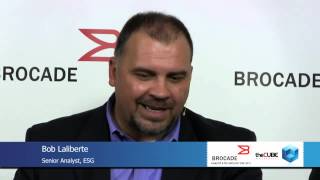
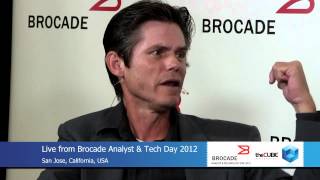
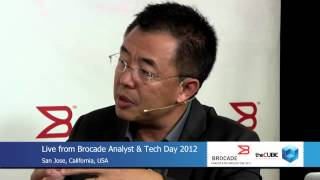
John Furrier and Stu Miniman spoke with IBM Fellow, Nagui Halim, as part of SiliconANGLE’s ongoing coverage of Brocade Analyst and Tech Day 2012. The panelists discuss big data, IBM’s approach to AI and machine learning, the advantages of Brocade partnership and acquisitions.
Speaking of how his experience with IBM has impacted his perspective on big data strategy, Halim shares, “I like to think about big data not from the data perspective, but rather from the perspective of what it is people are creating. Some people are [creating] immensely complicated Telco networks [and] transportation networks…When those systems operate, what’s really happening is that they throw off a lot of data and that data can now be used to understand what the system is doing.”
Furrier says the advent of NoSQL databases and virtualization “provides a new paradigm for developers,” as well as the growth of Solid State which offers unlimited memory. Halim shares his take on what Furrier calls, “new transformation to the modern era,” in which programmability, addressability and database technology, for example, are all changing. Halim says, “If it’s dissemination of information to individuals to personal devices, or if it’s in a hospital devices where you’re monitoring patients…these are systems that provide some kind [of] benefit for individuals. And, now those systems are being built out of all these new technologies. You build them out of solid state instead of disk, you build them out of high-speed networks instead of old networks [to, for example] provide better healthcare.” For Halim, the advantage of big data is answering questions faster, more accurately, and recognizing questions you may not have considered before.
Every industry can’t project one syntax into another, which requires agility and adaptability around systems. Halim says, what’s really needed is to have specialists in given industries that may not be able to understand analytics (and the data that is thrown off by analytic systems), but specialists. Since IBM, “can’t have expertise in every single domain, we need to partner with experts.”
Furrier also gets Halim’s IBM take on the increasingly popular topics of AI, machine learning and meta-reasoning. Halim suggests, what’s important in these scenarios is “not just the analytic kernels, it may also be the combination of those kernels for end-to-end applications that are very smart flexible and adaptable. And, some of this requires that’s actually quite advanced [like] planning technology that can understand a little about the problem your solving and essentially reconfigure the application.”
In terms of the progression of such advanced technologies, Halim suggests our reach exceeds our grasp. “We’re pretty good at solving the problems that people want to take on now, [but] there are problems way beyond the ambition of people that we can’t yet solve.” Halim explains, for example, transaction fraud technology is typically simple to implement, while airport face recognition technology or real-time speech analysis may be beyond IBM’s present capabilities.
Miniman inquires about IBM’s Brocade partnership. Halim explains that “We partnered with Brocade because it has the very well known MLIC device that sits on a telecommunication network and provides some first level handling of the data. So, think of it as creating a sensor that sits on a network that allows streams behind that device to process the data for higher-level analytics. Furthermore, we can actually diagnose situations and streams with very elaborate applications and analytics and give feedback to the device so the MLIC can actually look at different parts of the network depending on what we’re seeing.”
Lastly, Miniman asks about IBM research and acquisition strategies. “Typically when we do an acquisition, we earmark some funds for them to work with research. The research division then has a shot at partnering with that new acquisition to enhance or elaborate their technology, broaden it out and pull it into other activities.” Halim concludes saying that it’s a very interesting time for IBM in terms of acquisitions.
Forgot Password
Almost there!
We just sent you a verification email. Please verify your account to gain access to
Brocade Tech Day 2012 | San Jose. If you don’t think you received an email check your
spam folder.
In order to sign in, enter the email address you used to registered for the event. Once completed, you will receive an email with a verification link. Open this link to automatically sign into the site.
Register For Brocade Tech Day 2012 | San Jose
Please fill out the information below. You will recieve an email with a verification link confirming your registration. Click the link to automatically sign into the site.
You’re almost there!
We just sent you a verification email. Please click the verification button in the email. Once your email address is verified, you will have full access to all event content for Brocade Tech Day 2012 | San Jose.
I want my badge and interests to be visible to all attendees.
Checking this box will display your presense on the attendees list, view your profile and allow other attendees to contact you via 1-1 chat. Read the Privacy Policy. At any time, you can choose to disable this preference.
Select your Interests!
add
Upload your photo
Uploading..
OR
Connect via Twitter
Connect via Linkedin
EDIT PASSWORD
Share
Forgot Password
Almost there!
We just sent you a verification email. Please verify your account to gain access to
Brocade Tech Day 2012 | San Jose. If you don’t think you received an email check your
spam folder.
In order to sign in, enter the email address you used to registered for the event. Once completed, you will receive an email with a verification link. Open this link to automatically sign into the site.
Sign in to gain access to Brocade Tech Day 2012 | San Jose
Please sign in with LinkedIn to continue to Brocade Tech Day 2012 | San Jose. Signing in with LinkedIn ensures a professional environment.
Are you sure you want to remove access rights for this user?
Details
Manage Access
email address
Community Invitation
Nagui Halim, IBM - Brocade Tech Day - theCUBE
John Furrier and Stu Miniman spoke with IBM Fellow, Nagui Halim, as part of SiliconANGLE’s ongoing coverage of Brocade Analyst and Tech Day 2012. The panelists discuss big data, IBM’s approach to AI and machine learning, the advantages of Brocade partnership and acquisitions.
Speaking of how his experience with IBM has impacted his perspective on big data strategy, Halim shares, “I like to think about big data not from the data perspective, but rather from the perspective of what it is people are creating. Some people are [creating] immensely complicated Telco networks [and] transportation networks…When those systems operate, what’s really happening is that they throw off a lot of data and that data can now be used to understand what the system is doing.”
Furrier says the advent of NoSQL databases and virtualization “provides a new paradigm for developers,” as well as the growth of Solid State which offers unlimited memory. Halim shares his take on what Furrier calls, “new transformation to the modern era,” in which programmability, addressability and database technology, for example, are all changing. Halim says, “If it’s dissemination of information to individuals to personal devices, or if it’s in a hospital devices where you’re monitoring patients…these are systems that provide some kind [of] benefit for individuals. And, now those systems are being built out of all these new technologies. You build them out of solid state instead of disk, you build them out of high-speed networks instead of old networks [to, for example] provide better healthcare.” For Halim, the advantage of big data is answering questions faster, more accurately, and recognizing questions you may not have considered before.
Every industry can’t project one syntax into another, which requires agility and adaptability around systems. Halim says, what’s really needed is to have specialists in given industries that may not be able to understand analytics (and the data that is thrown off by analytic systems), but specialists. Since IBM, “can’t have expertise in every single domain, we need to partner with experts.”
Furrier also gets Halim’s IBM take on the increasingly popular topics of AI, machine learning and meta-reasoning. Halim suggests, what’s important in these scenarios is “not just the analytic kernels, it may also be the combination of those kernels for end-to-end applications that are very smart flexible and adaptable. And, some of this requires that’s actually quite advanced [like] planning technology that can understand a little about the problem your solving and essentially reconfigure the application.”
In terms of the progression of such advanced technologies, Halim suggests our reach exceeds our grasp. “We’re pretty good at solving the problems that people want to take on now, [but] there are problems way beyond the ambition of people that we can’t yet solve.” Halim explains, for example, transaction fraud technology is typically simple to implement, while airport face recognition technology or real-time speech analysis may be beyond IBM’s present capabilities.
Miniman inquires about IBM’s Brocade partnership. Halim explains that “We partnered with Brocade because it has the very well known MLIC device that sits on a telecommunication network and provides some first level handling of the data. So, think of it as creating a sensor that sits on a network that allows streams behind that device to process the data for higher-level analytics. Furthermore, we can actually diagnose situations and streams with very elaborate applications and analytics and give feedback to the device so the MLIC can actually look at different parts of the network depending on what we’re seeing.”
Lastly, Miniman asks about IBM research and acquisition strategies. “Typically when we do an acquisition, we earmark some funds for them to work with research. The research division then has a shot at partnering with that new acquisition to enhance or elaborate their technology, broaden it out and pull it into other activities.” Halim concludes saying that it’s a very interesting time for IBM in terms of acquisitions.