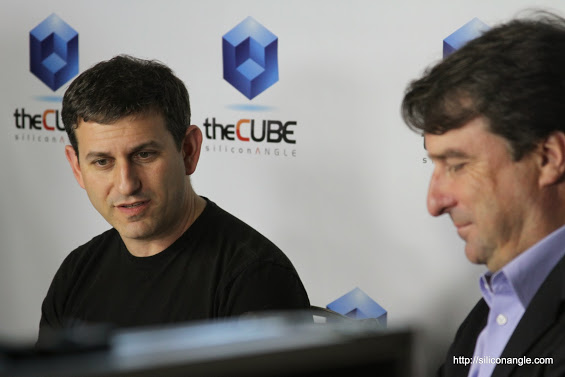
Joe Hellerstein, Trifacta, at BigDataSV 2014 with John Furrier and Jeff Kelly
@thecube
#BigDataSV
In their ongoing coverage of the 2014 Strata Conference in Santa Clara, California, John Furrier and Jeff Kelly speak with Joe Hellerstein, Founder and CEO of Trifacta. The three discuss future trends in data science, what computer science students are eager to learn and new business models for open source.
The most significant change Hellerstein has observed in the field concerns open source. He explains, “the big change we’ve seen is re-tooling of the whole stack when open source became viable.” And, given Moore’s law, he suggests its only logical that data analysis will become more efficient over time.
Hellerstein suggests that customer’s experiences with hardware and everyday platforms influences their expectations for software. “People use Google everyday and they expect software to be as good as their iPhone and as smart as Google to predict what they
want and figure out how they want to interact.” Over time the data technology may exceed these expectations.
As Hellerstein is also a computer science professor at University of California, Berkeley, Furrier asks what young computer science students are passionate about and hungry to learn. Previously, data discussions bored Hellerstein’s students. He shows that this attitude has changed, explaining: “They’re like, we get it. data is at the center of most technology and that’s what we want.” Furrier adds that it is now officially sexy to be a data scientist.
The data science discipline is still difficult and complex. Furrier asks Hellerstein how he might see the field “get easier” in the future. Simply put, when it comes to data Hellerstein says, “if you can’t do statistics, business and code, you can’t do it.” Data science is still largely about cleaning data, but could be much more “intelligently tooled” according to Hellerstein. More specifically, the people who care about data analysis, shouldn’t have to wait for an IT expert to help them understand what the numbers say, but work with it themselves.
A major strength for Trifacta is its visual environment. The company’s aim was not so much to create a ground-breaking technology as it was making people more productive. In doing so, the company has changed the existing model. Hellerstein explains, “Traditionally an analyst would go in and write some code to analyze their data. We start the user with a visual representation of the data first; [it's] very much a visual environment.”
Furrier asks Hellerstein what he looks forward to in the open source world of code. He shares, “My head is spinning on this whole open source model. I’ve been excited to watch folks who have built out Spark. Spark [is a] completely different model, there are others that I think are going to come forward. I think there will be experimentation that will be part of the open source movement, which I think is fun.”
Forgot Password
Almost there!
We just sent you a verification email. Please verify your account to gain access to
BigData SV 2014 | Santa Clara. If you don’t think you received an email check your
spam folder.
In order to sign in, enter the email address you used to registered for the event. Once completed, you will receive an email with a verification link. Open this link to automatically sign into the site.
Register For BigData SV 2014 | Santa Clara
Please fill out the information below. You will recieve an email with a verification link confirming your registration. Click the link to automatically sign into the site.
You’re almost there!
We just sent you a verification email. Please click the verification button in the email. Once your email address is verified, you will have full access to all event content for BigData SV 2014 | Santa Clara.
I want my badge and interests to be visible to all attendees.
Checking this box will display your presense on the attendees list, view your profile and allow other attendees to contact you via 1-1 chat. Read the Privacy Policy. At any time, you can choose to disable this preference.
Select your Interests!
add
Upload your photo
Uploading..
OR
Connect via Twitter
Connect via Linkedin
EDIT PASSWORD
Share
Forgot Password
Almost there!
We just sent you a verification email. Please verify your account to gain access to
BigData SV 2014 | Santa Clara. If you don’t think you received an email check your
spam folder.
In order to sign in, enter the email address you used to registered for the event. Once completed, you will receive an email with a verification link. Open this link to automatically sign into the site.
Sign in to gain access to BigData SV 2014 | Santa Clara
Please sign in with LinkedIn to continue to BigData SV 2014 | Santa Clara. Signing in with LinkedIn ensures a professional environment.
Are you sure you want to remove access rights for this user?
Details
Manage Access
email address
Community Invitation
Joe Hellerstein - BigDataSV 2014 - theCUBE
Joe Hellerstein, Trifacta, at BigDataSV 2014 with John Furrier and Jeff Kelly
@thecube
#BigDataSV
In their ongoing coverage of the 2014 Strata Conference in Santa Clara, California, John Furrier and Jeff Kelly speak with Joe Hellerstein, Founder and CEO of Trifacta. The three discuss future trends in data science, what computer science students are eager to learn and new business models for open source.
The most significant change Hellerstein has observed in the field concerns open source. He explains, “the big change we’ve seen is re-tooling of the whole stack when open source became viable.” And, given Moore’s law, he suggests its only logical that data analysis will become more efficient over time.
Hellerstein suggests that customer’s experiences with hardware and everyday platforms influences their expectations for software. “People use Google everyday and they expect software to be as good as their iPhone and as smart as Google to predict what they
want and figure out how they want to interact.” Over time the data technology may exceed these expectations.
As Hellerstein is also a computer science professor at University of California, Berkeley, Furrier asks what young computer science students are passionate about and hungry to learn. Previously, data discussions bored Hellerstein’s students. He shows that this attitude has changed, explaining: “They’re like, we get it. data is at the center of most technology and that’s what we want.” Furrier adds that it is now officially sexy to be a data scientist.
The data science discipline is still difficult and complex. Furrier asks Hellerstein how he might see the field “get easier” in the future. Simply put, when it comes to data Hellerstein says, “if you can’t do statistics, business and code, you can’t do it.” Data science is still largely about cleaning data, but could be much more “intelligently tooled” according to Hellerstein. More specifically, the people who care about data analysis, shouldn’t have to wait for an IT expert to help them understand what the numbers say, but work with it themselves.
A major strength for Trifacta is its visual environment. The company’s aim was not so much to create a ground-breaking technology as it was making people more productive. In doing so, the company has changed the existing model. Hellerstein explains, “Traditionally an analyst would go in and write some code to analyze their data. We start the user with a visual representation of the data first; [it's] very much a visual environment.”
Furrier asks Hellerstein what he looks forward to in the open source world of code. He shares, “My head is spinning on this whole open source model. I’ve been excited to watch folks who have built out Spark. Spark [is a] completely different model, there are others that I think are going to come forward. I think there will be experimentation that will be part of the open source movement, which I think is fun.”