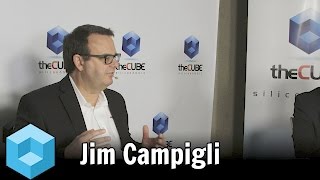
Konstantin Boudnik, WANdisco, at BigDataSV 2014 with John Furrier and Dave Vellante
@thecube
#BigDataSV
Webcasting from #BigDataSV in Santa Clara, California, theCUBE veterans John Furrier and Dave Vellante welcomed Konstantin Boudnik for a quick interview regarding the big data trends and the involvement of big companies in the open source process.
The former Yahoo and Cloudera architect and current Director of Advanced Technologies at WANdisco was asked for his view on Silicon Valley, Big Data and Strata.
“I think Big Data is being caught on more big enterprises’ radars. As always when it comes to new technologies, there’s a lot of noise, but also a lot of real deal. Some of the real-deal companies are the ones standing behind the open source movement, essentially the Hadoop and HBase technologies, as well as the real-time processes such as Spark and Shark,” said Boudnik. “We see huge momentum gain in these companies. I believe this segment of the market will grow up and keep growing.”
In Boudnik’s opinion, NonStop HBase is growing at a fast pace and all the analytical tool-sets are still struggling to reach HBase’s level of responsibility.
“In terms of interest from the companies, we see that the WAN edition is significantly higher in demand. People need to have a way to solve the disaster and recovery problem between the data centers, considering that the traditional solutions are very costly and have limited capabilities,” explained Boudnik. “NonStop WAN is being received very well.”
Addressing issues with emerging standards in Hadoop
.
“HBase is pretty good,” agreed Vellante, “it is catching a lot of momentum in the marketplace and it is the de-facto standard in Hadoop, but there are also a lot of complaints about it. There’s a lot of heavy-lifting involved, it’s actually not Non-Stop, do you think those complaints are valid?” asked Vellante.
Boudnik replied: “HBase has redundant fail-over capabilities built in. The administrative component manages the regional servers that track the data placements. There is a way to fail-over regional server if the ActiVision server failed, but the problem in distributive systems is the speed. If you are lucky, fail-over could happen very quickly. If you are not so lucky it could take a few hours. That essentially means server interruptions.
“Another problem is that the HBase client is not HA capable; the HDFS clients can fail-over quickly because the proxy-providers help them bounce to a standby node. But HBase doesn’t have such capabilities,”Boudnik goes on. “You have a bunch of clients writing the data at high speed into the regions servers. If the region server goes down, the fail-over capability that HBase has right now can help you to re-register the region server on a different host, but client won’t fail over.”
In the offering that was announced yesterday, WANdisco tried to address this issue, making multiple region servers available.
“You are saying that the problem is the fact that recovery is very variable,” summarized Vellante.
“We are now offering the clients the possibility to run multiple region servers,” said Boudnik.
“What kind of apps, use-cases you see your solution to be utilized in?” asked Vellante.
“Most of the real-time applications will benefit from it, because even at 10-20 seconds of downtime it might mean huge loss of data, as well as anybody using HBase in production, search, e-commerce, ad serving and fraud detection,” Boudnik answered.
And every new day there’s a new technology coming out. “I see the community being focused on bringing the stable API, complete version of HBase into the game,” declared Boudnik.
Contributing to a revolution
.
About the big companies who have recently embraced open source, Vellante asked: “You have been in the technical circle of Hadoop since the beginning, what’s the contribution to the core of the technical community? Are there companies that are stepping up and bringing their capabilities to open source, or is it pure marketing?”
“The open source development is similar to the evolutionary process,” said Boudnik. “We try to approach thousands of different ways and see what works best. The community is thrilled by the arrivals of big names because the more people will contribute to the product, the better the product will be.”
Some companies are riding this wave for marketing reasons though, admits Konstantin Boudnik. In terms of contributions the regional core teams that focused on Hadoop and HBase are still around. “You have to innovate and collaborate, bouncing ideas very quickly.”
Asked by Furrier on the revelations of the current show from his standpoint, Boudnik declared: “I am thrilled to see a lot of big companies getting on the bandwagon. I like the momentum and the speed. We will gain from all that high speed craze,” concluded Boudnik.
Forgot Password
Almost there!
We just sent you a verification email. Please verify your account to gain access to
BigData SV 2014 | Santa Clara. If you don’t think you received an email check your
spam folder.
In order to sign in, enter the email address you used to registered for the event. Once completed, you will receive an email with a verification link. Open this link to automatically sign into the site.
Register For BigData SV 2014 | Santa Clara
Please fill out the information below. You will recieve an email with a verification link confirming your registration. Click the link to automatically sign into the site.
You’re almost there!
We just sent you a verification email. Please click the verification button in the email. Once your email address is verified, you will have full access to all event content for BigData SV 2014 | Santa Clara.
I want my badge and interests to be visible to all attendees.
Checking this box will display your presense on the attendees list, view your profile and allow other attendees to contact you via 1-1 chat. Read the Privacy Policy. At any time, you can choose to disable this preference.
Select your Interests!
add
Upload your photo
Uploading..
OR
Connect via Twitter
Connect via Linkedin
EDIT PASSWORD
Share
Forgot Password
Almost there!
We just sent you a verification email. Please verify your account to gain access to
BigData SV 2014 | Santa Clara. If you don’t think you received an email check your
spam folder.
In order to sign in, enter the email address you used to registered for the event. Once completed, you will receive an email with a verification link. Open this link to automatically sign into the site.
Sign in to gain access to BigData SV 2014 | Santa Clara
Please sign in with LinkedIn to continue to BigData SV 2014 | Santa Clara. Signing in with LinkedIn ensures a professional environment.
Are you sure you want to remove access rights for this user?
Details
Manage Access
email address
Community Invitation
Konstantin Boudnik - BigDataSV 2014 - theCUBE
Konstantin Boudnik, WANdisco, at BigDataSV 2014 with John Furrier and Dave Vellante
@thecube
#BigDataSV
Webcasting from #BigDataSV in Santa Clara, California, theCUBE veterans John Furrier and Dave Vellante welcomed Konstantin Boudnik for a quick interview regarding the big data trends and the involvement of big companies in the open source process.
The former Yahoo and Cloudera architect and current Director of Advanced Technologies at WANdisco was asked for his view on Silicon Valley, Big Data and Strata.
“I think Big Data is being caught on more big enterprises’ radars. As always when it comes to new technologies, there’s a lot of noise, but also a lot of real deal. Some of the real-deal companies are the ones standing behind the open source movement, essentially the Hadoop and HBase technologies, as well as the real-time processes such as Spark and Shark,” said Boudnik. “We see huge momentum gain in these companies. I believe this segment of the market will grow up and keep growing.”
In Boudnik’s opinion, NonStop HBase is growing at a fast pace and all the analytical tool-sets are still struggling to reach HBase’s level of responsibility.
“In terms of interest from the companies, we see that the WAN edition is significantly higher in demand. People need to have a way to solve the disaster and recovery problem between the data centers, considering that the traditional solutions are very costly and have limited capabilities,” explained Boudnik. “NonStop WAN is being received very well.”
Addressing issues with emerging standards in Hadoop
.
“HBase is pretty good,” agreed Vellante, “it is catching a lot of momentum in the marketplace and it is the de-facto standard in Hadoop, but there are also a lot of complaints about it. There’s a lot of heavy-lifting involved, it’s actually not Non-Stop, do you think those complaints are valid?” asked Vellante.
Boudnik replied: “HBase has redundant fail-over capabilities built in. The administrative component manages the regional servers that track the data placements. There is a way to fail-over regional server if the ActiVision server failed, but the problem in distributive systems is the speed. If you are lucky, fail-over could happen very quickly. If you are not so lucky it could take a few hours. That essentially means server interruptions.
“Another problem is that the HBase client is not HA capable; the HDFS clients can fail-over quickly because the proxy-providers help them bounce to a standby node. But HBase doesn’t have such capabilities,”Boudnik goes on. “You have a bunch of clients writing the data at high speed into the regions servers. If the region server goes down, the fail-over capability that HBase has right now can help you to re-register the region server on a different host, but client won’t fail over.”
In the offering that was announced yesterday, WANdisco tried to address this issue, making multiple region servers available.
“You are saying that the problem is the fact that recovery is very variable,” summarized Vellante.
“We are now offering the clients the possibility to run multiple region servers,” said Boudnik.
“What kind of apps, use-cases you see your solution to be utilized in?” asked Vellante.
“Most of the real-time applications will benefit from it, because even at 10-20 seconds of downtime it might mean huge loss of data, as well as anybody using HBase in production, search, e-commerce, ad serving and fraud detection,” Boudnik answered.
And every new day there’s a new technology coming out. “I see the community being focused on bringing the stable API, complete version of HBase into the game,” declared Boudnik.
Contributing to a revolution
.
About the big companies who have recently embraced open source, Vellante asked: “You have been in the technical circle of Hadoop since the beginning, what’s the contribution to the core of the technical community? Are there companies that are stepping up and bringing their capabilities to open source, or is it pure marketing?”
“The open source development is similar to the evolutionary process,” said Boudnik. “We try to approach thousands of different ways and see what works best. The community is thrilled by the arrivals of big names because the more people will contribute to the product, the better the product will be.”
Some companies are riding this wave for marketing reasons though, admits Konstantin Boudnik. In terms of contributions the regional core teams that focused on Hadoop and HBase are still around. “You have to innovate and collaborate, bouncing ideas very quickly.”
Asked by Furrier on the revelations of the current show from his standpoint, Boudnik declared: “I am thrilled to see a lot of big companies getting on the bandwagon. I like the momentum and the speed. We will gain from all that high speed craze,” concluded Boudnik.