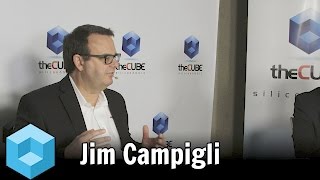
George Mathew, alteryx, at BigDataSV 2014 with John Furrier and Jeff Kelly
@thecube
#BigDataSV
ver the past three years, Big Data has evolved from hype to reality in the enterprise, presenting a new paradigm for decision-making with the potential to drive competitive advantage as well as operational efficiencies. Alteryx COO George Mathew believes that the next phase of the analytics journey is putting the power in the hands of end-users, which means moving up the stack.
Appearing on theCUBE during SiliconANGLE’s #BigDataSV 2014 event in Santa Clara, the executive highlights that Hadoop is quickly outgrowing the science experiment stage as more and more organizations roll out clusters into production and vendors adjust their product strategies accordingly. The major distributors, namely Cloudera, MapR and Hortonworks, are rethinking data management at scale, while firms such as Alteryx and Tableau provide higher level functionality like data blending and visualization to accelerate time to insight.
Operationalizing analytics
.
The industry-wide effort to operationalize analytics is helping to address the lack of productization in the open source ecosystem, Mathew says, and driving the emergence of a “new stack” that he describes as tightly integrated, horizontally scalable and extensible. Implementing this concept is much easier said than done in large organizations with existing IT Investments to sustain, he admits, but the transition is inevitable.
“When you look at the capabilities of the last, as we describe it, stack, we almost think of it as vertical hardware and software that’s fatly built up. But right now for anyone building [at] scale in this world, it’s all about scale-out and really being able to build that stack on a horizontal basis,” Mathew tells theCUBE hosts John Furrier and Dave Vellante.
”If you look at servers today, any layer of that stack is really about horizontal scale-out, less so about throwing more high-end infrastructure at it but more about how commodity hardware can be used up and down that stack very easily,” he adds. This capability holds the promise of enabling a fundamental shift in how information is processed and consumed.
Historically, business analysts had to make do with Excel or manually develop, deploy and scale algorithms for more advanced functionality. According to Mathew, Alteryx is working to achieve a middle ground “where someone can do effective scale-out and have repeatability and ease of use in what’s being done” without having to master a programming language, familiarize themselves with database software or get bogged down by legacy constraints.
Realizing the vision
.
Partnerships are central to the company’s vision to democratize analytics. Mathew names Tableau as his firm’s “strongest and most strategic partner today,” detailing that the pair collaborate in many different areas as part of an effort to deliver an “integrated experience” through their complementary products. Cloud computing is another top priority for Alteryx, and a critical component to the adoption of Big Data.
Mathew explains that access to infrastructure resources on a pay-as-you-go basis enables organizations to crunch large volumes of information without making a heavy upfront capital investment in infrastructure. This elasticity makes it possible for users to efficiently execute scale-out workloads that could not be as easily accommodated by an on-premise deployment.
“One of the real proponents of the cloud is now the fact there’s now an ability for business analysts, business users and the business line to make [an] impact on how decisions are done faster without the infrastructure underpinnings that were needed inside the four walls of the organization,” he elaborates. “So the decision makers and the buyers are becoming the chief analytics officer, the chief marketing officer, less so the chief information officer.”
The push to reduce operational dependence on the IT organization is driven in large part by the growing need for self-service analytics among employees struggling to keep up with changing business requirements. Data is a strategic asset that must be treated as such, Mathew summarizes.
Forgot Password
Almost there!
We just sent you a verification email. Please verify your account to gain access to
BigData SV 2014 | Santa Clara. If you don’t think you received an email check your
spam folder.
In order to sign in, enter the email address you used to registered for the event. Once completed, you will receive an email with a verification link. Open this link to automatically sign into the site.
Register For BigData SV 2014 | Santa Clara
Please fill out the information below. You will recieve an email with a verification link confirming your registration. Click the link to automatically sign into the site.
You’re almost there!
We just sent you a verification email. Please click the verification button in the email. Once your email address is verified, you will have full access to all event content for BigData SV 2014 | Santa Clara.
I want my badge and interests to be visible to all attendees.
Checking this box will display your presense on the attendees list, view your profile and allow other attendees to contact you via 1-1 chat. Read the Privacy Policy. At any time, you can choose to disable this preference.
Select your Interests!
add
Upload your photo
Uploading..
OR
Connect via Twitter
Connect via Linkedin
EDIT PASSWORD
Share
Forgot Password
Almost there!
We just sent you a verification email. Please verify your account to gain access to
BigData SV 2014 | Santa Clara. If you don’t think you received an email check your
spam folder.
In order to sign in, enter the email address you used to registered for the event. Once completed, you will receive an email with a verification link. Open this link to automatically sign into the site.
Sign in to gain access to BigData SV 2014 | Santa Clara
Please sign in with LinkedIn to continue to BigData SV 2014 | Santa Clara. Signing in with LinkedIn ensures a professional environment.
Are you sure you want to remove access rights for this user?
Details
Manage Access
email address
Community Invitation
George Mathew, Alteryx - BigDataSV 2014 - #BigDataSV #theCUBE
George Mathew, alteryx, at BigDataSV 2014 with John Furrier and Jeff Kelly
@thecube
#BigDataSV
ver the past three years, Big Data has evolved from hype to reality in the enterprise, presenting a new paradigm for decision-making with the potential to drive competitive advantage as well as operational efficiencies. Alteryx COO George Mathew believes that the next phase of the analytics journey is putting the power in the hands of end-users, which means moving up the stack.
Appearing on theCUBE during SiliconANGLE’s #BigDataSV 2014 event in Santa Clara, the executive highlights that Hadoop is quickly outgrowing the science experiment stage as more and more organizations roll out clusters into production and vendors adjust their product strategies accordingly. The major distributors, namely Cloudera, MapR and Hortonworks, are rethinking data management at scale, while firms such as Alteryx and Tableau provide higher level functionality like data blending and visualization to accelerate time to insight.
Operationalizing analytics
.
The industry-wide effort to operationalize analytics is helping to address the lack of productization in the open source ecosystem, Mathew says, and driving the emergence of a “new stack” that he describes as tightly integrated, horizontally scalable and extensible. Implementing this concept is much easier said than done in large organizations with existing IT Investments to sustain, he admits, but the transition is inevitable.
“When you look at the capabilities of the last, as we describe it, stack, we almost think of it as vertical hardware and software that’s fatly built up. But right now for anyone building [at] scale in this world, it’s all about scale-out and really being able to build that stack on a horizontal basis,” Mathew tells theCUBE hosts John Furrier and Dave Vellante.
”If you look at servers today, any layer of that stack is really about horizontal scale-out, less so about throwing more high-end infrastructure at it but more about how commodity hardware can be used up and down that stack very easily,” he adds. This capability holds the promise of enabling a fundamental shift in how information is processed and consumed.
Historically, business analysts had to make do with Excel or manually develop, deploy and scale algorithms for more advanced functionality. According to Mathew, Alteryx is working to achieve a middle ground “where someone can do effective scale-out and have repeatability and ease of use in what’s being done” without having to master a programming language, familiarize themselves with database software or get bogged down by legacy constraints.
Realizing the vision
.
Partnerships are central to the company’s vision to democratize analytics. Mathew names Tableau as his firm’s “strongest and most strategic partner today,” detailing that the pair collaborate in many different areas as part of an effort to deliver an “integrated experience” through their complementary products. Cloud computing is another top priority for Alteryx, and a critical component to the adoption of Big Data.
Mathew explains that access to infrastructure resources on a pay-as-you-go basis enables organizations to crunch large volumes of information without making a heavy upfront capital investment in infrastructure. This elasticity makes it possible for users to efficiently execute scale-out workloads that could not be as easily accommodated by an on-premise deployment.
“One of the real proponents of the cloud is now the fact there’s now an ability for business analysts, business users and the business line to make [an] impact on how decisions are done faster without the infrastructure underpinnings that were needed inside the four walls of the organization,” he elaborates. “So the decision makers and the buyers are becoming the chief analytics officer, the chief marketing officer, less so the chief information officer.”
The push to reduce operational dependence on the IT organization is driven in large part by the growing need for self-service analytics among employees struggling to keep up with changing business requirements. Data is a strategic asset that must be treated as such, Mathew summarizes.