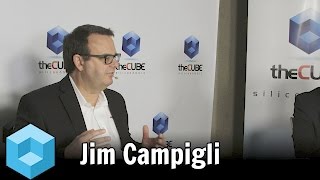
Bruno Aziza, Alpine Data Labs, (Day 3) at BigDataSV 2014 with John Furrier and Jeff Kelly
@thecube
#BigDataSV
The analytics vendor landscape can be roughly divided into two camps. There are those championing the traditional open-source approach to Big Data, like Hortonworks, and then there are the firms that are diverging from the beaten path and differentiating with proprietary technology. Opponents of the latter model argue that a single company cannot possibly sustain a lead over an entire community of contributors, but Bruno Aziza of Alpine Data Labs begs to differ.
In a live debate with InfoObjects CEO Rishi Yadev during SiliconANGLE’s BigDataSV meeting, the executive asserted that commercial software will continue to play a defining role in the Big Data industry. Yadev on the other hand believes that the open source ecosystem is simply moving too fast for proprietary vendors to keep up and remain relevant in the long haul, momentum that Aziza sees as an opportunity rather than a challenge. Alpine Data Labs is combining the best of two worlds, he explained, tapping into the power of the community in order to push ahead of the curve.
The startup offers a free tool called Chorus that borrows from social networks to increase the productivity of data scientists and IT professionals. According to Aziza, “we’ve taken the code into Alpine’s commercial software that adds advanced analytics and collaboration to it,” providing extra value for customers with requirements more specific than a group of commiters would take the trouble to address.
The newest version of Chorus, which was launched at the O’Reilly Strata Conference earlier this month, introduces an application layer that makes it possible for analysts to run custom algorithms against HDFS without having to move any data around. In a subsequent interview on the third day of BigDataSV, Aziza described the solution as “SharePoint for data science,” highlighting that it is gaining significant steam in the healthcare and financial services industries.
The offering underpins Alpine’s vision for the “predictive enterprise,” taking analytics beyond dashboards with capabilities for proactively identifying new revenue streams and cost cutting opportunities. The benefits to organizations are many, Aziza tells hosts John Furrier and Jeff Kelly.
“One reason might be ‘well, I just simply want to extend the power of my data scientist,’ but the other one is also a policy problem, because we’ve had this proliferation of BI tools and proliferation of data platforms [and] now we’re starting to be the “Wild Wild West” a little bit,” he details. “So now executives want to rally everybody around the same platform so they can repeat their successes, and we find that our product is giving them what they want.”
Alpine is taking a bottom-up approach to helping enterprises effectively leverage analytics at the organizational level, starting by allowing data scientists to work more efficiently. Chorus also bridges the language divide between the geeks and the business analysts, who can in turn utilize the platform to communicate insights to decision makers. The technology kills two birds with one stone, Azzia notes, accelerating time to insight while enabling clients to foster the kind of data-driven culture needed to truly take advantage of analytics.
“I do hear a lot about data democratization, and the data-driven organization, and after people say that they think about more reports, better looking dashboards. That’s necessary, but the companies we’re working with are interesting in playing where the game is going to be at, mastermind the future and that’s where predictive analytics and the stuff that we work on come into play,” he remarks. Hadoop is another important piece of the Big Data puzzle, he adds, especially as more and more organizations adopt the platform.
Some CIOs are “betting the farm” on the batch processing platform while others simply choose to ignore it, Aziza notes, but the overwhelming majority are somewhere in between. He believes that the biggest challenge facing IT leaders is achieving expected returns on their clusters while sustaining existing data warehouse investments, a complicated task that is made even more difficult in regulated industries such as healthcare. For this reason, Alpine partners aggressively to meet as broad a range of customer needs as possible, providing integration with widely used solutions such as Tableau.
Wrapping up the interview, Azzia designates 2014 as the “year of productivity.” Now that the market has shifted its focus from the underlying technologies that enable Big Data to meeting business objectives using analytics, the battle is moving up the stack.
Forgot Password
Almost there!
We just sent you a verification email. Please verify your account to gain access to
BigData SV 2014 | Santa Clara. If you don’t think you received an email check your
spam folder.
In order to sign in, enter the email address you used to registered for the event. Once completed, you will receive an email with a verification link. Open this link to automatically sign into the site.
Register For BigData SV 2014 | Santa Clara
Please fill out the information below. You will recieve an email with a verification link confirming your registration. Click the link to automatically sign into the site.
You’re almost there!
We just sent you a verification email. Please click the verification button in the email. Once your email address is verified, you will have full access to all event content for BigData SV 2014 | Santa Clara.
I want my badge and interests to be visible to all attendees.
Checking this box will display your presense on the attendees list, view your profile and allow other attendees to contact you via 1-1 chat. Read the Privacy Policy. At any time, you can choose to disable this preference.
Select your Interests!
add
Upload your photo
Uploading..
OR
Connect via Twitter
Connect via Linkedin
EDIT PASSWORD
Share
Forgot Password
Almost there!
We just sent you a verification email. Please verify your account to gain access to
BigData SV 2014 | Santa Clara. If you don’t think you received an email check your
spam folder.
In order to sign in, enter the email address you used to registered for the event. Once completed, you will receive an email with a verification link. Open this link to automatically sign into the site.
Sign in to gain access to BigData SV 2014 | Santa Clara
Please sign in with LinkedIn to continue to BigData SV 2014 | Santa Clara. Signing in with LinkedIn ensures a professional environment.
Are you sure you want to remove access rights for this user?
Details
Manage Access
email address
Community Invitation
Bruno Aziza (Day 3) - BigDataSV 2014 - theCUBE
Bruno Aziza, Alpine Data Labs, (Day 3) at BigDataSV 2014 with John Furrier and Jeff Kelly
@thecube
#BigDataSV
The analytics vendor landscape can be roughly divided into two camps. There are those championing the traditional open-source approach to Big Data, like Hortonworks, and then there are the firms that are diverging from the beaten path and differentiating with proprietary technology. Opponents of the latter model argue that a single company cannot possibly sustain a lead over an entire community of contributors, but Bruno Aziza of Alpine Data Labs begs to differ.
In a live debate with InfoObjects CEO Rishi Yadev during SiliconANGLE’s BigDataSV meeting, the executive asserted that commercial software will continue to play a defining role in the Big Data industry. Yadev on the other hand believes that the open source ecosystem is simply moving too fast for proprietary vendors to keep up and remain relevant in the long haul, momentum that Aziza sees as an opportunity rather than a challenge. Alpine Data Labs is combining the best of two worlds, he explained, tapping into the power of the community in order to push ahead of the curve.
The startup offers a free tool called Chorus that borrows from social networks to increase the productivity of data scientists and IT professionals. According to Aziza, “we’ve taken the code into Alpine’s commercial software that adds advanced analytics and collaboration to it,” providing extra value for customers with requirements more specific than a group of commiters would take the trouble to address.
The newest version of Chorus, which was launched at the O’Reilly Strata Conference earlier this month, introduces an application layer that makes it possible for analysts to run custom algorithms against HDFS without having to move any data around. In a subsequent interview on the third day of BigDataSV, Aziza described the solution as “SharePoint for data science,” highlighting that it is gaining significant steam in the healthcare and financial services industries.
The offering underpins Alpine’s vision for the “predictive enterprise,” taking analytics beyond dashboards with capabilities for proactively identifying new revenue streams and cost cutting opportunities. The benefits to organizations are many, Aziza tells hosts John Furrier and Jeff Kelly.
“One reason might be ‘well, I just simply want to extend the power of my data scientist,’ but the other one is also a policy problem, because we’ve had this proliferation of BI tools and proliferation of data platforms [and] now we’re starting to be the “Wild Wild West” a little bit,” he details. “So now executives want to rally everybody around the same platform so they can repeat their successes, and we find that our product is giving them what they want.”
Alpine is taking a bottom-up approach to helping enterprises effectively leverage analytics at the organizational level, starting by allowing data scientists to work more efficiently. Chorus also bridges the language divide between the geeks and the business analysts, who can in turn utilize the platform to communicate insights to decision makers. The technology kills two birds with one stone, Azzia notes, accelerating time to insight while enabling clients to foster the kind of data-driven culture needed to truly take advantage of analytics.
“I do hear a lot about data democratization, and the data-driven organization, and after people say that they think about more reports, better looking dashboards. That’s necessary, but the companies we’re working with are interesting in playing where the game is going to be at, mastermind the future and that’s where predictive analytics and the stuff that we work on come into play,” he remarks. Hadoop is another important piece of the Big Data puzzle, he adds, especially as more and more organizations adopt the platform.
Some CIOs are “betting the farm” on the batch processing platform while others simply choose to ignore it, Aziza notes, but the overwhelming majority are somewhere in between. He believes that the biggest challenge facing IT leaders is achieving expected returns on their clusters while sustaining existing data warehouse investments, a complicated task that is made even more difficult in regulated industries such as healthcare. For this reason, Alpine partners aggressively to meet as broad a range of customer needs as possible, providing integration with widely used solutions such as Tableau.
Wrapping up the interview, Azzia designates 2014 as the “year of productivity.” Now that the market has shifted its focus from the underlying technologies that enable Big Data to meeting business objectives using analytics, the battle is moving up the stack.