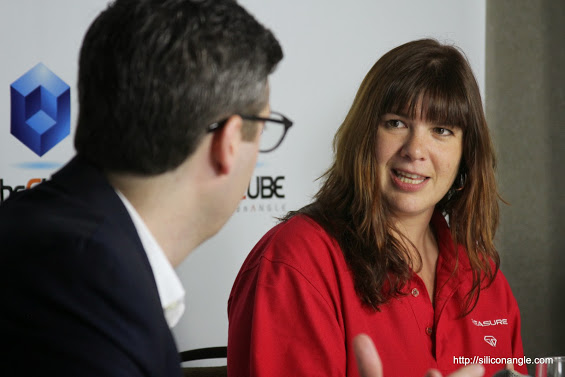
Hannah Smalltree, Treasure Data, at BigDataSV 2014 with John Furrier and Jeff Frick
@thecube
#BigDataSV
Hannah Smalltree, Director of Treasure Data, joined John Furrier and Jeff Kelly in theCUBE at BigDataSV 2014 to discuss the tremendous growth of Treasure Data and the current trends in the industry.
Furrier noted the tremendous traction that Treasure Data enjoyed and wanted Smalltree to elaborate on that, explaining where it originated from.
“TreasureData has a really unique solution in this market: we offer SaaS for Big Data. We have a technology that helps people acquire, store and analyze data. A lot of our ‘secret sauce’ is in our acquisition technology; we focus on data that’s created very rapidly, and we get it into our cloud environment.”
“There was a lot of demand about that,” confessed Smalltree. “It’s about streaming data into an environment and making it quickly available for analysis.”
“The big bet was on the ingestion side,” hinted Furrier. Smalltree agreed: “The ingestion side and the storage side. We are really good at data management at huge, huge scales, and then rapidly making that data available for analysis,” she boasted. “Instead of people worrying about building, maintaining and monitoring their infrastructure, they can focus on the fun part, of doing the analytics at the other end, where you get value from the data.”
“We keep speculating on the time when cloud and data are actually going to merge,” said Kelly. “Describe the ways that Treasure Data is delivering the service.”
“We do have one primary service, but people use it in different ways,” stated Smalltree, who then proceeded to explain: “We tend to talk about it in three phases: data acquisition, data storage and data analysis. Some people are using that all in line: they are streaming their data into our cloud environment, doing their analysis in the cloud; other people are putting us as part of a larger data ecosystem, using us to ingest all that data coming in very rapidly, to store it at scale (sometimes 10 billions of rows a day), then maybe doing some aggregation to bring down the size of the data and export the results to another system internally – where they might combine it with other data or bring it into another analytics environment or using an on-premise analytics tool.”
A treasured business model
.
Treasure Data can be used in a variety of ways. Some businesses use Treasure Data as their core analytics technology, while others use it to solve a specific business problem.
Therefore Treasure Data has different business models: either it can fit in larger data ecosystems, or it can provide the entire end-to-end solution used in place.
“We really try to make it open for use into existing ecosystems and we are committed to data portability. We are not trying to lock you in or make it difficult for you to take your data back,” clarified Smalltree. “People will do that on a small scale when they are doing queries and pushing the results out,” she added.
The issue of acquisition and ingestion is another differentiator, in Smalltree’s opinion: “There are a lot of cloud storage platforms where, in order to get your data in, you have to use FTP and bulk imports; our data streaming technology addresses a very big pain: you don’t need to stage it, land it and figure out how to get it into the cloud. As that data is being created, our treasure agent technology sits right on the servers and streams that data into our environment.”
“We provide reliability, compression, filtering, transformation of that end-node, so when the data gets to the cloud, it’s available for analysis within a few minutes of being created,” specified Smalltree. “Also, you are not trying to push a huge bulk of data up a small pipe; you are bringing small bits of data on a more rapid basis.”
Use-cases
Treasure Data provides cost-effective packaged solutions for specific use cases that include data collection, dashboards for standard KPIs and setup – making deployment and adoption faster and easier.
“It’s augmenting your data warehouses with Big Data capabilities,” said Smalltree. She relayed the case of a large retailer who recently announced their mobile application. Naturally, they wanted to understand how their mobile users were engaging with their product and compare what people did online with what people did in the stores. Being able to get this 360 degree of the customer and understand where the differences in interactions are in the mobile vs web vs retail environment meant leveraging that information to make more money for their business.
Forgot Password
Almost there!
We just sent you a verification email. Please verify your account to gain access to
BigData SV 2014 | Santa Clara. If you don’t think you received an email check your
spam folder.
In order to sign in, enter the email address you used to registered for the event. Once completed, you will receive an email with a verification link. Open this link to automatically sign into the site.
Register For BigData SV 2014 | Santa Clara
Please fill out the information below. You will recieve an email with a verification link confirming your registration. Click the link to automatically sign into the site.
You’re almost there!
We just sent you a verification email. Please click the verification button in the email. Once your email address is verified, you will have full access to all event content for BigData SV 2014 | Santa Clara.
I want my badge and interests to be visible to all attendees.
Checking this box will display your presense on the attendees list, view your profile and allow other attendees to contact you via 1-1 chat. Read the Privacy Policy. At any time, you can choose to disable this preference.
Select your Interests!
add
Upload your photo
Uploading..
OR
Connect via Twitter
Connect via Linkedin
EDIT PASSWORD
Share
Forgot Password
Almost there!
We just sent you a verification email. Please verify your account to gain access to
BigData SV 2014 | Santa Clara. If you don’t think you received an email check your
spam folder.
In order to sign in, enter the email address you used to registered for the event. Once completed, you will receive an email with a verification link. Open this link to automatically sign into the site.
Sign in to gain access to BigData SV 2014 | Santa Clara
Please sign in with LinkedIn to continue to BigData SV 2014 | Santa Clara. Signing in with LinkedIn ensures a professional environment.
Are you sure you want to remove access rights for this user?
Details
Manage Access
email address
Community Invitation
Hannah Smalltree - BigDataSV 2014 - theCUBE
Hannah Smalltree, Treasure Data, at BigDataSV 2014 with John Furrier and Jeff Frick
@thecube
#BigDataSV
Hannah Smalltree, Director of Treasure Data, joined John Furrier and Jeff Kelly in theCUBE at BigDataSV 2014 to discuss the tremendous growth of Treasure Data and the current trends in the industry.
Furrier noted the tremendous traction that Treasure Data enjoyed and wanted Smalltree to elaborate on that, explaining where it originated from.
“TreasureData has a really unique solution in this market: we offer SaaS for Big Data. We have a technology that helps people acquire, store and analyze data. A lot of our ‘secret sauce’ is in our acquisition technology; we focus on data that’s created very rapidly, and we get it into our cloud environment.”
“There was a lot of demand about that,” confessed Smalltree. “It’s about streaming data into an environment and making it quickly available for analysis.”
“The big bet was on the ingestion side,” hinted Furrier. Smalltree agreed: “The ingestion side and the storage side. We are really good at data management at huge, huge scales, and then rapidly making that data available for analysis,” she boasted. “Instead of people worrying about building, maintaining and monitoring their infrastructure, they can focus on the fun part, of doing the analytics at the other end, where you get value from the data.”
“We keep speculating on the time when cloud and data are actually going to merge,” said Kelly. “Describe the ways that Treasure Data is delivering the service.”
“We do have one primary service, but people use it in different ways,” stated Smalltree, who then proceeded to explain: “We tend to talk about it in three phases: data acquisition, data storage and data analysis. Some people are using that all in line: they are streaming their data into our cloud environment, doing their analysis in the cloud; other people are putting us as part of a larger data ecosystem, using us to ingest all that data coming in very rapidly, to store it at scale (sometimes 10 billions of rows a day), then maybe doing some aggregation to bring down the size of the data and export the results to another system internally – where they might combine it with other data or bring it into another analytics environment or using an on-premise analytics tool.”
A treasured business model
.
Treasure Data can be used in a variety of ways. Some businesses use Treasure Data as their core analytics technology, while others use it to solve a specific business problem.
Therefore Treasure Data has different business models: either it can fit in larger data ecosystems, or it can provide the entire end-to-end solution used in place.
“We really try to make it open for use into existing ecosystems and we are committed to data portability. We are not trying to lock you in or make it difficult for you to take your data back,” clarified Smalltree. “People will do that on a small scale when they are doing queries and pushing the results out,” she added.
The issue of acquisition and ingestion is another differentiator, in Smalltree’s opinion: “There are a lot of cloud storage platforms where, in order to get your data in, you have to use FTP and bulk imports; our data streaming technology addresses a very big pain: you don’t need to stage it, land it and figure out how to get it into the cloud. As that data is being created, our treasure agent technology sits right on the servers and streams that data into our environment.”
“We provide reliability, compression, filtering, transformation of that end-node, so when the data gets to the cloud, it’s available for analysis within a few minutes of being created,” specified Smalltree. “Also, you are not trying to push a huge bulk of data up a small pipe; you are bringing small bits of data on a more rapid basis.”
Use-cases
Treasure Data provides cost-effective packaged solutions for specific use cases that include data collection, dashboards for standard KPIs and setup – making deployment and adoption faster and easier.
“It’s augmenting your data warehouses with Big Data capabilities,” said Smalltree. She relayed the case of a large retailer who recently announced their mobile application. Naturally, they wanted to understand how their mobile users were engaging with their product and compare what people did online with what people did in the stores. Being able to get this 360 degree of the customer and understand where the differences in interactions are in the mobile vs web vs retail environment meant leveraging that information to make more money for their business.