Could the GPU be the sleeper hit of the new cognitive computing world? | #BigDataNYC
by R. Danes | Sep 26, 2016
It’s no secret that Big Data is putting heavy strain on traditional infrastructure and processing systems. And symbiotic technologies, like cognitive computing, machine learning and artificial intelligence, that an SVP at IBM recently called “Big Data on steroids,” won’t be lightening the load. Some IT professionals say these technologies will require major infrastructural changes down to the level of the central processing unit. So are they designing a new, super-speed CPU? Nope, they’re all abuzz about GPUs — graphic processing units. Aren’t those for video games or something?
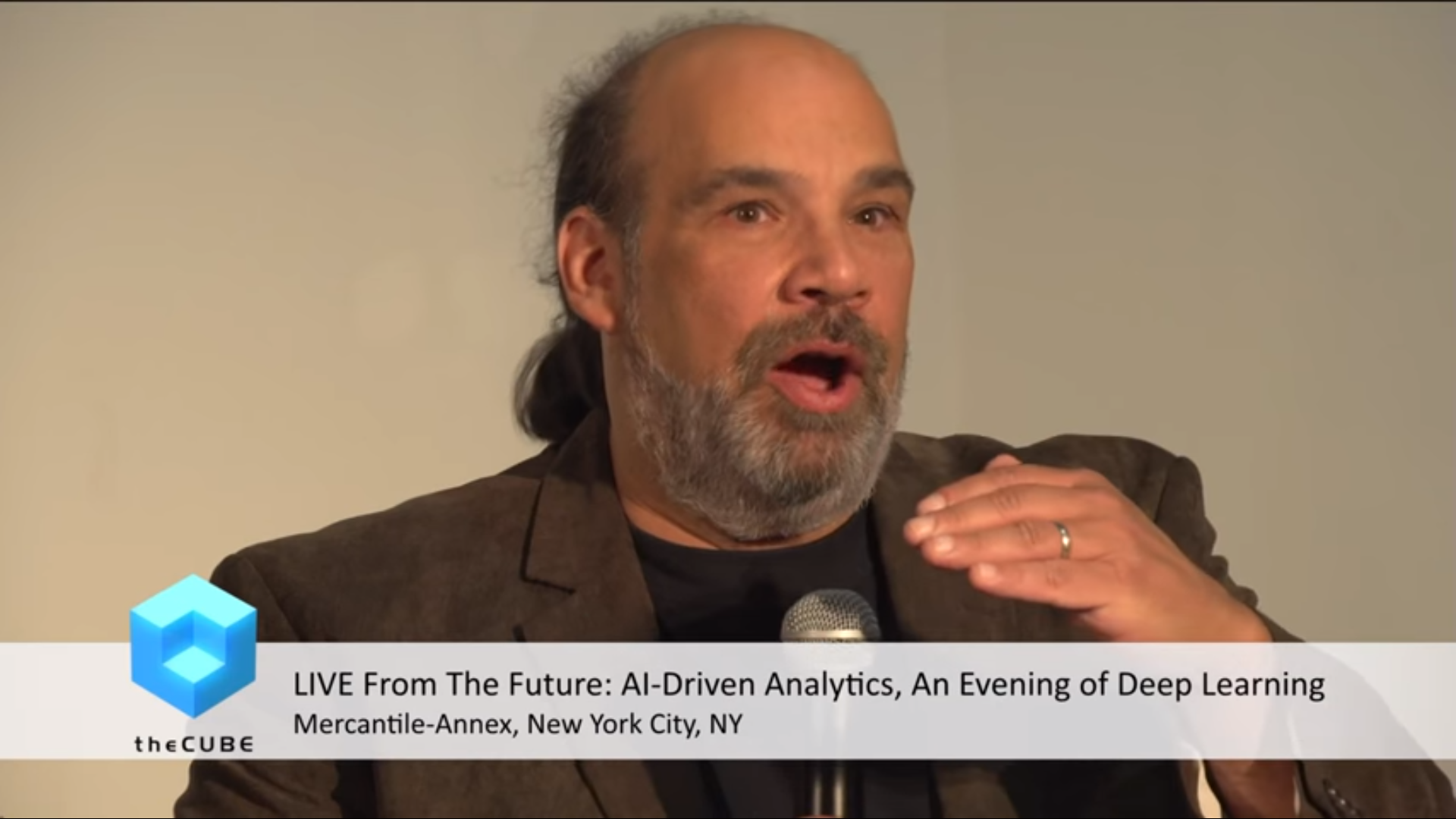
To address these issues, and more, SiliconANGLE Media and NVIDIA Corp. held a special event, called The Future: AI-Driven Analytics, An Evening of Deep Learning (in conjunction with the BigDataNYC 2016 event), that included keynotes and panel sessions.
Scott Wiener, Board of Advisors at SQream Technologies, said that the synergistic boost that GPUs can give to CPUs has been known to technologists for years now. However, he lamented that they’re potential is not better known outside geek circles.
“I don’t think we have done a good job of communicating to the market just how capable these systems are right now,” he told Peter Burris (@plburris) of theCUBE, from the SiliconANGLE Media team, and moderator of tonight’s panel on GPU accelerated databases, analytics and visualization, AI, ML, Spark, and Next-Gen apps.
“We think GPUs should be everywhere,” Wiener said, going on to explain how GPU computing is going to change the game. “You get a certain number of a transistors on a chip, and we used to be able to just make them go faster — just crank a knob, and they would get faster; every time you’d buy a new computer, it would be twice as fast. And that hasn’t happened in quite a while,” Wiener said.
In a parallel processing universe
The imperative now is to find new ways to solve problems of processing speed without having to build CPUs to totally impractical new standards. Wiener said, “We need ways to solve problems in new ways, in parallel rather that sequentially.”
Moderated by Peter Burris, Chief Research Officer, SiliconANGLE Media Inc.
Mark Brooks, Systems Engineer, Kinetica
Bill Maimone, VP Engineering, MapD
Scott Wiener, Board of Advisors, Sqream Tech
Mark Hammond, CEO & Founder, Bonsai
Claudio Silva, Professor, Computer Science & Engineering & Data Science, New York University
on the #theCUBE at #BigDataNYC 2016 New York, New York
Forgot Password
Almost there!
We just sent you a verification email. Please verify your account to gain access to
BigData NYC 2016 | New York. If you don’t think you received an email check your
spam folder.
In order to sign in, enter the email address you used to registered for the event. Once completed, you will receive an email with a verification link. Open this link to automatically sign into the site.
Register For BigData NYC 2016 | New York
Please fill out the information below. You will recieve an email with a verification link confirming your registration. Click the link to automatically sign into the site.
You’re almost there!
We just sent you a verification email. Please click the verification button in the email. Once your email address is verified, you will have full access to all event content for BigData NYC 2016 | New York.
I want my badge and interests to be visible to all attendees.
Checking this box will display your presense on the attendees list, view your profile and allow other attendees to contact you via 1-1 chat. Read the Privacy Policy. At any time, you can choose to disable this preference.
Select your Interests!
add
Upload your photo
Uploading..
OR
Connect via Twitter
Connect via Linkedin
EDIT PASSWORD
Share
Forgot Password
Almost there!
We just sent you a verification email. Please verify your account to gain access to
BigData NYC 2016 | New York. If you don’t think you received an email check your
spam folder.
In order to sign in, enter the email address you used to registered for the event. Once completed, you will receive an email with a verification link. Open this link to automatically sign into the site.
Sign in to gain access to BigData NYC 2016 | New York
Please sign in with LinkedIn to continue to BigData NYC 2016 | New York. Signing in with LinkedIn ensures a professional environment.
Could the GPU be the sleeper hit of the new cognitive computing world? | #BigDataNYC
by R. Danes | Sep 26, 2016
It’s no secret that Big Data is putting heavy strain on traditional infrastructure and processing systems. And symbiotic technologies, like cognitive computing, machine learning and artificial intelligence, that an SVP at IBM recently called “Big Data on steroids,” won’t be lightening the load. Some IT professionals say these technologies will require major infrastructural changes down to the level of the central processing unit. So are they designing a new, super-speed CPU? Nope, they’re all abuzz about GPUs — graphic processing units. Aren’t those for video games or something?
To address these issues, and more, SiliconANGLE Media and NVIDIA Corp. held a special event, called The Future: AI-Driven Analytics, An Evening of Deep Learning (in conjunction with the BigDataNYC 2016 event), that included keynotes and panel sessions.
Scott Wiener, Board of Advisors at SQream Technologies, said that the synergistic boost that GPUs can give to CPUs has been known to technologists for years now. However, he lamented that they’re potential is not better known outside geek circles.
“I don’t think we have done a good job of communicating to the market just how capable these systems are right now,” he told Peter Burris (@plburris) of theCUBE, from the SiliconANGLE Media team, and moderator of tonight’s panel on GPU accelerated databases, analytics and visualization, AI, ML, Spark, and Next-Gen apps.
“We think GPUs should be everywhere,” Wiener said, going on to explain how GPU computing is going to change the game. “You get a certain number of a transistors on a chip, and we used to be able to just make them go faster — just crank a knob, and they would get faster; every time you’d buy a new computer, it would be twice as fast. And that hasn’t happened in quite a while,” Wiener said.
In a parallel processing universe
The imperative now is to find new ways to solve problems of processing speed without having to build CPUs to totally impractical new standards. Wiener said, “We need ways to solve problems in new ways, in parallel rather that sequentially.”
Moderated by Peter Burris, Chief Research Officer, SiliconANGLE Media Inc.
Mark Brooks, Systems Engineer, Kinetica
Bill Maimone, VP Engineering, MapD
Scott Wiener, Board of Advisors, Sqream Tech
Mark Hammond, CEO & Founder, Bonsai
Claudio Silva, Professor, Computer Science & Engineering & Data Science, New York University
on the #theCUBE at #BigDataNYC 2016 New York, New York