The future of AI-driven analytics: Expert panel | #BigDataNYC
by Bev Terrell | Sep 26, 2016
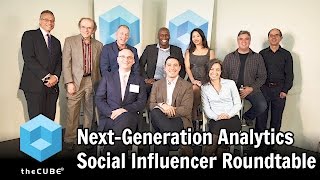
“The Future: AI-Driven Analytics, An Evening of Deep Learning,” a special evening of panel segments, kicked off the BigDataNYC 2016 event today. To start, Peter Burris (@plburris), chief research officer at Wikibon and cohost of theCUBE, from the SiliconANGLE Media team, introduced the first keynote speaker.
Claudio Silva, professor of computer science, engineering and data science at New York University, spoke about about his research regarding the intersection of visualization and geometric computing, and Ash Damle, founder and CEO of Lumiata, Inc., discussed his company’s focus on leveraging medical Artificial Intelligence (AI) to make health human.
Data: It’s a problem of scale
Burris pointed out that one of the greatest challenges today is how to use software, data, deep learning and business together, in new and exciting ways.
“What we think the core is data … data is a crucial differentiating asset in business,” said Burris. While we have a great many ways of capturing data, “A crucial challenge of taking data from large numbers of input and how the emerging role of data [can] create new models [of] superior business,” Burris explained.
Evaluating taxi rides and major league baseball players
Silva’s recent research is around the analysis of urban data and major league baseball. He has also developed widely used visualization and analysis tools. He started out by talking about the challenges in gathering data for transportation in big cities.
“Urban data analysis … [it’s in] cities are where things are happening. Fifty percent of our population lives in cities today; [that number is predicted to be] 70 percent by 2050. So we need someone to make cities more efficient and sustainable … computing is an aspect that can help this,” said Silva.
He used the example of something very familiar to urban dwellers: New York City taxis. These taxis take approximately 200 million trips a year, and that information (in raw data) is tracked on GitHub. If you look at this information, and begin to analyze it, he explained, you can immediately begin to see trends in ridership based on things such as weather, beginning of school, holidays, etc. And then the issue becomes, “Time and space components; how do you find anything on so much data? A typical data set could have a billion data points … [so] what we really need … is sub-second responses. What we find, time and again … that you get so much faster when you think through the problems in GPUs,” continued Silva. Of course, being able to process that data faster means you can access and analyze that much faster as well.
Silva has also been working on capturing data point on players in major league baseball. “You see the virtual players … in an augmented reality application … [there’s] all kinds of processing we have to do; calibrating cameras, tracking players … we’re showing you raw data, in real time,” he said. Despite the huge amount of data involved, no processing takes longer than 11 seconds. In analyzing this data, he explained. “One of things we’re trying to do [is] use deep neural networks to analyze player behaviors.” he added.
This information provides a very valuable tool for player evaluation in major league baseball, and major league hockey is also interested in tracking their players’ data points, as well Silva said.
AI: Our best tool for predictive patient analysis
Damle started out by asking, “How do we unpack AI for healthcare?” There’s a sense of lack of predictability in healthcare, leading to higher and higher costs, across the board, which impacts us all consumers, he explained. However, “Through AI and deep learning, we can surmount these challenges and make a difference,” Damle added.
He continued to point out, “Healthcare data is perhaps one of the most complicated data sets out there … it’s very wide and very deep. For an individual, you can have thousands upon thousands data points.” His company, Lumiata, is “… bringing clarity, management and control [to healthcare]; we are building medical AI to manage an individual’s risk, and to enable the automation we’re looking for,” said Damle.
The raw data from a patient is converted into a structured, standardized form by Lumiata, and then it can ideally go on to predict the future health of the patient, as well as suggestions for their future care.
“Through AI, can we make health human again? Can we give people the control to manage their health? How [is] an individual’s health is today, and how it is evolving?” asked Damle. “These are the questions that we’re hoping to answer, through the AI.”
Forgot Password
Almost there!
We just sent you a verification email. Please verify your account to gain access to
BigData NYC 2016 | New York. If you don’t think you received an email check your
spam folder.
In order to sign in, enter the email address you used to registered for the event. Once completed, you will receive an email with a verification link. Open this link to automatically sign into the site.
Register For BigData NYC 2016 | New York
Please fill out the information below. You will recieve an email with a verification link confirming your registration. Click the link to automatically sign into the site.
You’re almost there!
We just sent you a verification email. Please click the verification button in the email. Once your email address is verified, you will have full access to all event content for BigData NYC 2016 | New York.
I want my badge and interests to be visible to all attendees.
Checking this box will display your presense on the attendees list, view your profile and allow other attendees to contact you via 1-1 chat. Read the Privacy Policy. At any time, you can choose to disable this preference.
Select your Interests!
add
Upload your photo
Uploading..
OR
Connect via Twitter
Connect via Linkedin
EDIT PASSWORD
Share
Forgot Password
Almost there!
We just sent you a verification email. Please verify your account to gain access to
BigData NYC 2016 | New York. If you don’t think you received an email check your
spam folder.
In order to sign in, enter the email address you used to registered for the event. Once completed, you will receive an email with a verification link. Open this link to automatically sign into the site.
Sign in to gain access to BigData NYC 2016 | New York
Please sign in with LinkedIn to continue to BigData NYC 2016 | New York. Signing in with LinkedIn ensures a professional environment.
The future of AI-driven analytics: Expert panel | #BigDataNYC
by Bev Terrell | Sep 26, 2016
“The Future: AI-Driven Analytics, An Evening of Deep Learning,” a special evening of panel segments, kicked off the BigDataNYC 2016 event today. To start, Peter Burris (@plburris), chief research officer at Wikibon and cohost of theCUBE, from the SiliconANGLE Media team, introduced the first keynote speaker.
Claudio Silva, professor of computer science, engineering and data science at New York University, spoke about about his research regarding the intersection of visualization and geometric computing, and Ash Damle, founder and CEO of Lumiata, Inc., discussed his company’s focus on leveraging medical Artificial Intelligence (AI) to make health human.
Data: It’s a problem of scale
Burris pointed out that one of the greatest challenges today is how to use software, data, deep learning and business together, in new and exciting ways.
“What we think the core is data … data is a crucial differentiating asset in business,” said Burris. While we have a great many ways of capturing data, “A crucial challenge of taking data from large numbers of input and how the emerging role of data [can] create new models [of] superior business,” Burris explained.
Evaluating taxi rides and major league baseball players
Silva’s recent research is around the analysis of urban data and major league baseball. He has also developed widely used visualization and analysis tools. He started out by talking about the challenges in gathering data for transportation in big cities.
“Urban data analysis … [it’s in] cities are where things are happening. Fifty percent of our population lives in cities today; [that number is predicted to be] 70 percent by 2050. So we need someone to make cities more efficient and sustainable … computing is an aspect that can help this,” said Silva.
He used the example of something very familiar to urban dwellers: New York City taxis. These taxis take approximately 200 million trips a year, and that information (in raw data) is tracked on GitHub. If you look at this information, and begin to analyze it, he explained, you can immediately begin to see trends in ridership based on things such as weather, beginning of school, holidays, etc. And then the issue becomes, “Time and space components; how do you find anything on so much data? A typical data set could have a billion data points … [so] what we really need … is sub-second responses. What we find, time and again … that you get so much faster when you think through the problems in GPUs,” continued Silva. Of course, being able to process that data faster means you can access and analyze that much faster as well.
Silva has also been working on capturing data point on players in major league baseball. “You see the virtual players … in an augmented reality application … [there’s] all kinds of processing we have to do; calibrating cameras, tracking players … we’re showing you raw data, in real time,” he said. Despite the huge amount of data involved, no processing takes longer than 11 seconds. In analyzing this data, he explained. “One of things we’re trying to do [is] use deep neural networks to analyze player behaviors.” he added.
This information provides a very valuable tool for player evaluation in major league baseball, and major league hockey is also interested in tracking their players’ data points, as well Silva said.
AI: Our best tool for predictive patient analysis
Damle started out by asking, “How do we unpack AI for healthcare?” There’s a sense of lack of predictability in healthcare, leading to higher and higher costs, across the board, which impacts us all consumers, he explained. However, “Through AI and deep learning, we can surmount these challenges and make a difference,” Damle added.
He continued to point out, “Healthcare data is perhaps one of the most complicated data sets out there … it’s very wide and very deep. For an individual, you can have thousands upon thousands data points.” His company, Lumiata, is “… bringing clarity, management and control [to healthcare]; we are building medical AI to manage an individual’s risk, and to enable the automation we’re looking for,” said Damle.
The raw data from a patient is converted into a structured, standardized form by Lumiata, and then it can ideally go on to predict the future health of the patient, as well as suggestions for their future care.
“Through AI, can we make health human again? Can we give people the control to manage their health? How [is] an individual’s health is today, and how it is evolving?” asked Damle. “These are the questions that we’re hoping to answer, through the AI.”