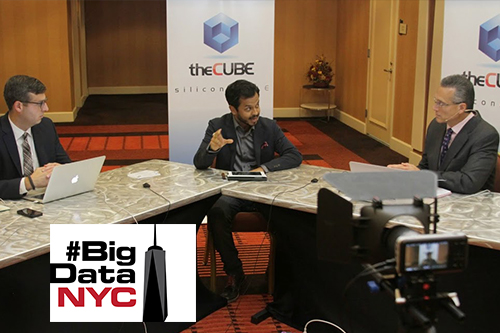
Gustavo De Leon, Cognizant, at BigDataNYC 2014 with Dave Vellante and Jeff Kelly
@theCUBE
#BigDataNYC
Gustavo DeLeon, CognizantThe enterprise has passed the “science experiment” phase in its journey to adopt Hadoop, and it’s now entering a time when the real value of unstructured data can start coming to bear, according to Gustavo De Leon of Cognizant Technology Solutions Corp. The executive dropped by theCUBE at SiliconANGLE’s recent BigDataNYC meet-up to share his observations with hosts Dave Vellante and Jeff Kelly.
As the senior director of the consultancy powerhouse’s enterprise information management group, De Leon has seen the evolution of the analytics movement unfold firsthand. “In 2013 there were a lot of science experiments going on…now we’re seeing the enterprise is much more ready to accept Big Data,” he told Vellante and Kelly.
Adoption typically proceeds in two stages, he continued. The first is implementing Hadoop to consolidate existing infrastructure and cut costs. The batch processing framework makes it possible to distribute large amounts of data across commodity hardware while providing a high degree of accessibility, which De Leon explained makes it ideal for archiving. The cost-effectiveness of the platform is also useful for offloading certain workloads from enterprise data warehouses, which are notoriously expensive to run and maintain in addition to having a difficult time accommodating some of the newer types of information pouring into the corporate network.
The experience and general know-how organizations can gain over the course of such projects often provides a valuable on-ramp to the second path, which De Leon said involves transitioning from saving money with Hadoop to making money. And that’s where the platform truly shines. It provides a means of scanning more information than ever possible before for insights into operations and customers.
“They see that there is a business case, there is a use case, there’s something that they need to drive out to have a competitive advantage,” De Leon noted. “And it’s either because they’re forward-looking in that way, or because they’re now reacting to their industry or to other vertical industries.”
Having a coherent business justification necessary to realize a return on any Hadoop investment, according to De Leon, a challenge that Wikibon has said the majority of organizations still struggle with today. The IT department should also have a voice in the process, he added, but it mustn’t be dictating the priorities. Instead technology leaders should collaborate with their counterparts on the business side. “In the groups that are leading this, the industry leaders across different verticals, IT and business are coming together,” he said.
Forgot Password
Almost there!
We just sent you a verification email. Please verify your account to gain access to
BigData NYC 2014 | New York. If you don’t think you received an email check your
spam folder.
In order to sign in, enter the email address you used to registered for the event. Once completed, you will receive an email with a verification link. Open this link to automatically sign into the site.
Register For BigData NYC 2014 | New York
Please fill out the information below. You will recieve an email with a verification link confirming your registration. Click the link to automatically sign into the site.
You’re almost there!
We just sent you a verification email. Please click the verification button in the email. Once your email address is verified, you will have full access to all event content for BigData NYC 2014 | New York.
I want my badge and interests to be visible to all attendees.
Checking this box will display your presense on the attendees list, view your profile and allow other attendees to contact you via 1-1 chat. Read the Privacy Policy. At any time, you can choose to disable this preference.
Select your Interests!
add
Upload your photo
Uploading..
OR
Connect via Twitter
Connect via Linkedin
EDIT PASSWORD
Share
Forgot Password
Almost there!
We just sent you a verification email. Please verify your account to gain access to
BigData NYC 2014 | New York. If you don’t think you received an email check your
spam folder.
In order to sign in, enter the email address you used to registered for the event. Once completed, you will receive an email with a verification link. Open this link to automatically sign into the site.
Sign in to gain access to BigData NYC 2014 | New York
Please sign in with LinkedIn to continue to BigData NYC 2014 | New York. Signing in with LinkedIn ensures a professional environment.
Are you sure you want to remove access rights for this user?
Details
Manage Access
email address
Community Invitation
Gustavo De Leon - BigDataNYC 2014 - theCUBE - #BigDataNYC
Gustavo De Leon, Cognizant, at BigDataNYC 2014 with Dave Vellante and Jeff Kelly
@theCUBE
#BigDataNYC
Gustavo DeLeon, CognizantThe enterprise has passed the “science experiment” phase in its journey to adopt Hadoop, and it’s now entering a time when the real value of unstructured data can start coming to bear, according to Gustavo De Leon of Cognizant Technology Solutions Corp. The executive dropped by theCUBE at SiliconANGLE’s recent BigDataNYC meet-up to share his observations with hosts Dave Vellante and Jeff Kelly.
As the senior director of the consultancy powerhouse’s enterprise information management group, De Leon has seen the evolution of the analytics movement unfold firsthand. “In 2013 there were a lot of science experiments going on…now we’re seeing the enterprise is much more ready to accept Big Data,” he told Vellante and Kelly.
Adoption typically proceeds in two stages, he continued. The first is implementing Hadoop to consolidate existing infrastructure and cut costs. The batch processing framework makes it possible to distribute large amounts of data across commodity hardware while providing a high degree of accessibility, which De Leon explained makes it ideal for archiving. The cost-effectiveness of the platform is also useful for offloading certain workloads from enterprise data warehouses, which are notoriously expensive to run and maintain in addition to having a difficult time accommodating some of the newer types of information pouring into the corporate network.
The experience and general know-how organizations can gain over the course of such projects often provides a valuable on-ramp to the second path, which De Leon said involves transitioning from saving money with Hadoop to making money. And that’s where the platform truly shines. It provides a means of scanning more information than ever possible before for insights into operations and customers.
“They see that there is a business case, there is a use case, there’s something that they need to drive out to have a competitive advantage,” De Leon noted. “And it’s either because they’re forward-looking in that way, or because they’re now reacting to their industry or to other vertical industries.”
Having a coherent business justification necessary to realize a return on any Hadoop investment, according to De Leon, a challenge that Wikibon has said the majority of organizations still struggle with today. The IT department should also have a voice in the process, he added, but it mustn’t be dictating the priorities. Instead technology leaders should collaborate with their counterparts on the business side. “In the groups that are leading this, the industry leaders across different verticals, IT and business are coming together,” he said.