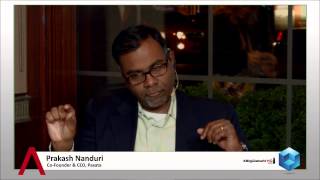
George Mathew, Alteryx, at Big Data NYC 2013 with John Furrier and Dave Vellante
Mathew's first observation is that the whole analytics trend has come a very long way since his last appearance on theCube during SAP's SAPphire 2010. Back then, he says, the community focused on fleshing out the infrastructure around Hadoop. The ecosystem managed to solve a lot of the key challenges in the span of two years, and now the emphasis is shifting towards extracting business value out of the technology. The term big data is used a lot more often, for one.
Mathew sees his company playing a central role in this transition. He described Alteryx's offering as a fast, cost-efficient means of consumerizing analytics within the enterprise and make the data much more accessible to workers.
The executive also makes a point out of distinguishing between business intelligence and big data. BI, in his book, is data warehousing technology with ETL and dashboards that sit on top and convey information to the user -- usually an analyst with a say on big business decisions. Big data, on the other hand, is the process of taking data from both sides of the firewall and packaging them for tens of thousands of workers. This data is real-time and predictive rather than historical, and one data analyst should be able to handle the entire task. More complexity is translated into slower response times, according to Mathew.
The executive expands on the technological angle. He says that big data is not a substitute for BI, but rather a very viable supplement. A big part of it is that CIOs don't have to worry so much about the price tag -- testing Hadoop and NoSQL internally requires very little resources in comparison to an enterprise's existing infrastructure investments.
@thecube
#BigDataNYC
Forgot Password
Almost there!
We just sent you a verification email. Please verify your account to gain access to
BigData NYC 2013 | New York. If you don’t think you received an email check your
spam folder.
In order to sign in, enter the email address you used to registered for the event. Once completed, you will receive an email with a verification link. Open this link to automatically sign into the site.
Register For BigData NYC 2013 | New York
Please fill out the information below. You will recieve an email with a verification link confirming your registration. Click the link to automatically sign into the site.
You’re almost there!
We just sent you a verification email. Please click the verification button in the email. Once your email address is verified, you will have full access to all event content for BigData NYC 2013 | New York.
I want my badge and interests to be visible to all attendees.
Checking this box will display your presense on the attendees list, view your profile and allow other attendees to contact you via 1-1 chat. Read the Privacy Policy. At any time, you can choose to disable this preference.
Select your Interests!
add
Upload your photo
Uploading..
OR
Connect via Twitter
Connect via Linkedin
EDIT PASSWORD
Share
Forgot Password
Almost there!
We just sent you a verification email. Please verify your account to gain access to
BigData NYC 2013 | New York. If you don’t think you received an email check your
spam folder.
In order to sign in, enter the email address you used to registered for the event. Once completed, you will receive an email with a verification link. Open this link to automatically sign into the site.
Sign in to gain access to BigData NYC 2013 | New York
Please sign in with LinkedIn to continue to BigData NYC 2013 | New York. Signing in with LinkedIn ensures a professional environment.
Are you sure you want to remove access rights for this user?
Details
Manage Access
email address
Community Invitation
George Mathew - BigDataNYC 2013 - theCUBE - #BigDataNYC
George Mathew, Alteryx, at Big Data NYC 2013 with John Furrier and Dave Vellante
Mathew's first observation is that the whole analytics trend has come a very long way since his last appearance on theCube during SAP's SAPphire 2010. Back then, he says, the community focused on fleshing out the infrastructure around Hadoop. The ecosystem managed to solve a lot of the key challenges in the span of two years, and now the emphasis is shifting towards extracting business value out of the technology. The term big data is used a lot more often, for one.
Mathew sees his company playing a central role in this transition. He described Alteryx's offering as a fast, cost-efficient means of consumerizing analytics within the enterprise and make the data much more accessible to workers.
The executive also makes a point out of distinguishing between business intelligence and big data. BI, in his book, is data warehousing technology with ETL and dashboards that sit on top and convey information to the user -- usually an analyst with a say on big business decisions. Big data, on the other hand, is the process of taking data from both sides of the firewall and packaging them for tens of thousands of workers. This data is real-time and predictive rather than historical, and one data analyst should be able to handle the entire task. More complexity is translated into slower response times, according to Mathew.
The executive expands on the technological angle. He says that big data is not a substitute for BI, but rather a very viable supplement. A big part of it is that CIOs don't have to worry so much about the price tag -- testing Hadoop and NoSQL internally requires very little resources in comparison to an enterprise's existing infrastructure investments.
@thecube
#BigDataNYC