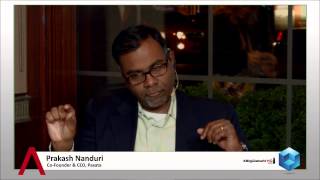
Bill Schmarzo, the CTO, EIM Service Line for EMC, discussed the release of his book, Big Data -- Understanding How Data Powers Big Business with theCUBE co-hosts Dave Vellante and John Furrier, live at #BigDataNYC 2013 in New York.
"The inspiration for the book really started three years ago," Schmarzo said, with a conference session on Big Data focusing on helping technology people understand how the business should think about employing data. The Dean of Big Data said he "had a framework in mind about what I wanted to tell people. It all kind of came together." The book features numerous case studies of how different companies are using or could be using Big Data technology. "I also talk about it as a business function" from the sales and marketing perspective.
Big Data tech is still 'morphing'
"To me what's interesting is that the technology sands underneath the Big Data discussion are still morphing. There's all kinds of new products coming out. The business side is starting to realize there's real value in the data," Schmarzo said.
If you understand what an organization is trying to achieve, if you think about it from a business perspective, it puts a framework on data processes you need to improve, he explained. "It takes this mind-numbing technology and simplifies it," he continued.
Vellante said that the promise of Business Intelligence of using Big Data to have non-analytical business users tap into analytic tools has never happened. Schmarzo stated that "if we create all these great analytics but don't present them in a way that's actionable to end users, why bother?" How companies surface IT applications to users is paramount. "The average user is not an analyst. They want to know what's working and what's not working," instead of dealing with BI tools, charts, etc. "They want to have the tech mine this data, tell them what's going on," and give them insight that's actionable, Schmarzo explained.
Commenting on use cases for Big Data, Schmarzo said,"I think what we're seeing is that the organizations are seeing the use case, but they want to know what it means to them. How do I make it relevant to my organization." A concept he explored in his book, the 4 Ms of Big Data -- "make me more money," comes into play, "that's what they want to know."
New data-powered roles in the organization
Discussing the new roles emerging in the organizations, Schmarzo said that the Chief Data Officers needs to be separate from IT. "My recommendation is an Economics major. He can look at it from a risk and compliance perspective," not just a monetary one. Organizations will also have a Chief Analytics Officer, as well as a User Experience Officer, which will become a key role for most organizations.
"You're going to have all these new roles. I'm not sure where they go and we'll learn as we go, but those roles are critical." They will help determine how to get more data, how to protect it, to get more from it.
Asked about his take on the art of data, Schmarzo said "the data artist concept is a pretty good idea. I'm not sure if it's a role, or more of a characteristic, someone who is trying to carve out an experience that is very rewarding, interesting, natural, and actionable."
@thecube
#BigDataNYC
Forgot Password
Almost there!
We just sent you a verification email. Please verify your account to gain access to
BigData NYC 2013 | New York. If you don’t think you received an email check your
spam folder.
In order to sign in, enter the email address you used to registered for the event. Once completed, you will receive an email with a verification link. Open this link to automatically sign into the site.
Register For BigData NYC 2013 | New York
Please fill out the information below. You will recieve an email with a verification link confirming your registration. Click the link to automatically sign into the site.
You’re almost there!
We just sent you a verification email. Please click the verification button in the email. Once your email address is verified, you will have full access to all event content for BigData NYC 2013 | New York.
I want my badge and interests to be visible to all attendees.
Checking this box will display your presense on the attendees list, view your profile and allow other attendees to contact you via 1-1 chat. Read the Privacy Policy. At any time, you can choose to disable this preference.
Select your Interests!
add
Upload your photo
Uploading..
OR
Connect via Twitter
Connect via Linkedin
EDIT PASSWORD
Share
Forgot Password
Almost there!
We just sent you a verification email. Please verify your account to gain access to
BigData NYC 2013 | New York. If you don’t think you received an email check your
spam folder.
In order to sign in, enter the email address you used to registered for the event. Once completed, you will receive an email with a verification link. Open this link to automatically sign into the site.
Sign in to gain access to BigData NYC 2013 | New York
Please sign in with LinkedIn to continue to BigData NYC 2013 | New York. Signing in with LinkedIn ensures a professional environment.
Are you sure you want to remove access rights for this user?
Details
Manage Access
email address
Community Invitation
Bill Schmarzo - BigDataNYC 2013 - theCUBE - #BigDataNYC
Bill Schmarzo, the CTO, EIM Service Line for EMC, discussed the release of his book, Big Data -- Understanding How Data Powers Big Business with theCUBE co-hosts Dave Vellante and John Furrier, live at #BigDataNYC 2013 in New York.
"The inspiration for the book really started three years ago," Schmarzo said, with a conference session on Big Data focusing on helping technology people understand how the business should think about employing data. The Dean of Big Data said he "had a framework in mind about what I wanted to tell people. It all kind of came together." The book features numerous case studies of how different companies are using or could be using Big Data technology. "I also talk about it as a business function" from the sales and marketing perspective.
Big Data tech is still 'morphing'
"To me what's interesting is that the technology sands underneath the Big Data discussion are still morphing. There's all kinds of new products coming out. The business side is starting to realize there's real value in the data," Schmarzo said.
If you understand what an organization is trying to achieve, if you think about it from a business perspective, it puts a framework on data processes you need to improve, he explained. "It takes this mind-numbing technology and simplifies it," he continued.
Vellante said that the promise of Business Intelligence of using Big Data to have non-analytical business users tap into analytic tools has never happened. Schmarzo stated that "if we create all these great analytics but don't present them in a way that's actionable to end users, why bother?" How companies surface IT applications to users is paramount. "The average user is not an analyst. They want to know what's working and what's not working," instead of dealing with BI tools, charts, etc. "They want to have the tech mine this data, tell them what's going on," and give them insight that's actionable, Schmarzo explained.
Commenting on use cases for Big Data, Schmarzo said,"I think what we're seeing is that the organizations are seeing the use case, but they want to know what it means to them. How do I make it relevant to my organization." A concept he explored in his book, the 4 Ms of Big Data -- "make me more money," comes into play, "that's what they want to know."
New data-powered roles in the organization
Discussing the new roles emerging in the organizations, Schmarzo said that the Chief Data Officers needs to be separate from IT. "My recommendation is an Economics major. He can look at it from a risk and compliance perspective," not just a monetary one. Organizations will also have a Chief Analytics Officer, as well as a User Experience Officer, which will become a key role for most organizations.
"You're going to have all these new roles. I'm not sure where they go and we'll learn as we go, but those roles are critical." They will help determine how to get more data, how to protect it, to get more from it.
Asked about his take on the art of data, Schmarzo said "the data artist concept is a pretty good idea. I'm not sure if it's a role, or more of a characteristic, someone who is trying to carve out an experience that is very rewarding, interesting, natural, and actionable."
@thecube
#BigDataNYC