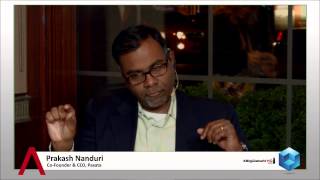
David Parker, SAP at Big Data NYC 2013 with John Furrier and Dave Vellante
"First and foremost, we're an application company," Parker stated. SAP's Big Data approach was powered by its customers who need solutions for their challenge of storing vast, large quantities of data, "which naturally gravitates towards a Hadoop cluster."
SAP HANA is the flagship product the company uses to drive application development. "The Big Data world is somehow owned by Hadoop," Parker said. Unstructured data needs to be collected and merged with enterprise data -- CRM, books and records.
Building for customers
"How we go to market is all around customer choice" and focusing on use cases that make a difference. "We are database and data source agnostic," Parker said. SAP currently focused on 25 different industries.
"We had to build Big Data specific applications," Parker stated. The company today launched four new Big Data applications focusing on fraud management and customer experience intelligence, the later focusing on buying profiles of customers based on how they interact via social media. By allowing customers to store this type of data and merge it with customer data from leads to better insights into customer behavior analysis.
HANA powers "the concept of smart data access -- data federation, data query. A query can go directly into HANA," Parker explained, which sees where the data is stored, runs a query directly into Hadoop when needed and run MapReduce tasks on it. The users get the answer, without knowing where the data is coming from.
The company also focuses on the new SAP Lumira, a self-service analytical tools that empowers users to use granular data, which can be both historical and transactional data.
The Big Data perception
Asked how customers perceived Big Data, Parker said "they are not aware that Big Data exists. All they know is that they have a data challenge." The problem can be the variety or velocity of the data. "They don't actually understand the concepts behind 'what do I need to build a Big Data platform,'" and educating them in terms of what the market is doing and what the company in their industry are doing is very important.
Once they understand the use cases, they think about the technology they need. "Once they understand what value they derive from the data, we turn that into information for them, and they turn it into knowledge." The process focuses on how to understand your data, understand what you can do with it, then become empowered on what you can do for your business.
SAP's big data evolution
Commenting on how SAP evolved to a point where HANA became central to its strategy, coming from the ERP world and transitioning into analytics and BI, Parker said "it's been an exciting change for us, a refreshing change. We looked at what the customers asked us for, and kept an eye on the vision of the company."
A major trend was the move from on-premise to cloud based solutions. "We now have a HANA enterprise cloud environment. We use HANA to drive our own systems internally in the cloud." Another major point of focus was the mobility aspect and how it relates to data. It is key to derive consistent analytics from applications and make it available on demand in the cloud.
@thecube
#BigDataNYC
Forgot Password
Almost there!
We just sent you a verification email. Please verify your account to gain access to
BigData NYC 2013 | New York. If you don’t think you received an email check your
spam folder.
In order to sign in, enter the email address you used to registered for the event. Once completed, you will receive an email with a verification link. Open this link to automatically sign into the site.
Register For BigData NYC 2013 | New York
Please fill out the information below. You will recieve an email with a verification link confirming your registration. Click the link to automatically sign into the site.
You’re almost there!
We just sent you a verification email. Please click the verification button in the email. Once your email address is verified, you will have full access to all event content for BigData NYC 2013 | New York.
I want my badge and interests to be visible to all attendees.
Checking this box will display your presense on the attendees list, view your profile and allow other attendees to contact you via 1-1 chat. Read the Privacy Policy. At any time, you can choose to disable this preference.
Select your Interests!
add
Upload your photo
Uploading..
OR
Connect via Twitter
Connect via Linkedin
EDIT PASSWORD
Share
Forgot Password
Almost there!
We just sent you a verification email. Please verify your account to gain access to
BigData NYC 2013 | New York. If you don’t think you received an email check your
spam folder.
In order to sign in, enter the email address you used to registered for the event. Once completed, you will receive an email with a verification link. Open this link to automatically sign into the site.
Sign in to gain access to BigData NYC 2013 | New York
Please sign in with LinkedIn to continue to BigData NYC 2013 | New York. Signing in with LinkedIn ensures a professional environment.
Are you sure you want to remove access rights for this user?
Details
Manage Access
email address
Community Invitation
David Parker - BigDataNYC 2013 - theCUBE - #BigDataNYC
David Parker, SAP at Big Data NYC 2013 with John Furrier and Dave Vellante
"First and foremost, we're an application company," Parker stated. SAP's Big Data approach was powered by its customers who need solutions for their challenge of storing vast, large quantities of data, "which naturally gravitates towards a Hadoop cluster."
SAP HANA is the flagship product the company uses to drive application development. "The Big Data world is somehow owned by Hadoop," Parker said. Unstructured data needs to be collected and merged with enterprise data -- CRM, books and records.
Building for customers
"How we go to market is all around customer choice" and focusing on use cases that make a difference. "We are database and data source agnostic," Parker said. SAP currently focused on 25 different industries.
"We had to build Big Data specific applications," Parker stated. The company today launched four new Big Data applications focusing on fraud management and customer experience intelligence, the later focusing on buying profiles of customers based on how they interact via social media. By allowing customers to store this type of data and merge it with customer data from leads to better insights into customer behavior analysis.
HANA powers "the concept of smart data access -- data federation, data query. A query can go directly into HANA," Parker explained, which sees where the data is stored, runs a query directly into Hadoop when needed and run MapReduce tasks on it. The users get the answer, without knowing where the data is coming from.
The company also focuses on the new SAP Lumira, a self-service analytical tools that empowers users to use granular data, which can be both historical and transactional data.
The Big Data perception
Asked how customers perceived Big Data, Parker said "they are not aware that Big Data exists. All they know is that they have a data challenge." The problem can be the variety or velocity of the data. "They don't actually understand the concepts behind 'what do I need to build a Big Data platform,'" and educating them in terms of what the market is doing and what the company in their industry are doing is very important.
Once they understand the use cases, they think about the technology they need. "Once they understand what value they derive from the data, we turn that into information for them, and they turn it into knowledge." The process focuses on how to understand your data, understand what you can do with it, then become empowered on what you can do for your business.
SAP's big data evolution
Commenting on how SAP evolved to a point where HANA became central to its strategy, coming from the ERP world and transitioning into analytics and BI, Parker said "it's been an exciting change for us, a refreshing change. We looked at what the customers asked us for, and kept an eye on the vision of the company."
A major trend was the move from on-premise to cloud based solutions. "We now have a HANA enterprise cloud environment. We use HANA to drive our own systems internally in the cloud." Another major point of focus was the mobility aspect and how it relates to data. It is key to derive consistent analytics from applications and make it available on demand in the cloud.
@thecube
#BigDataNYC