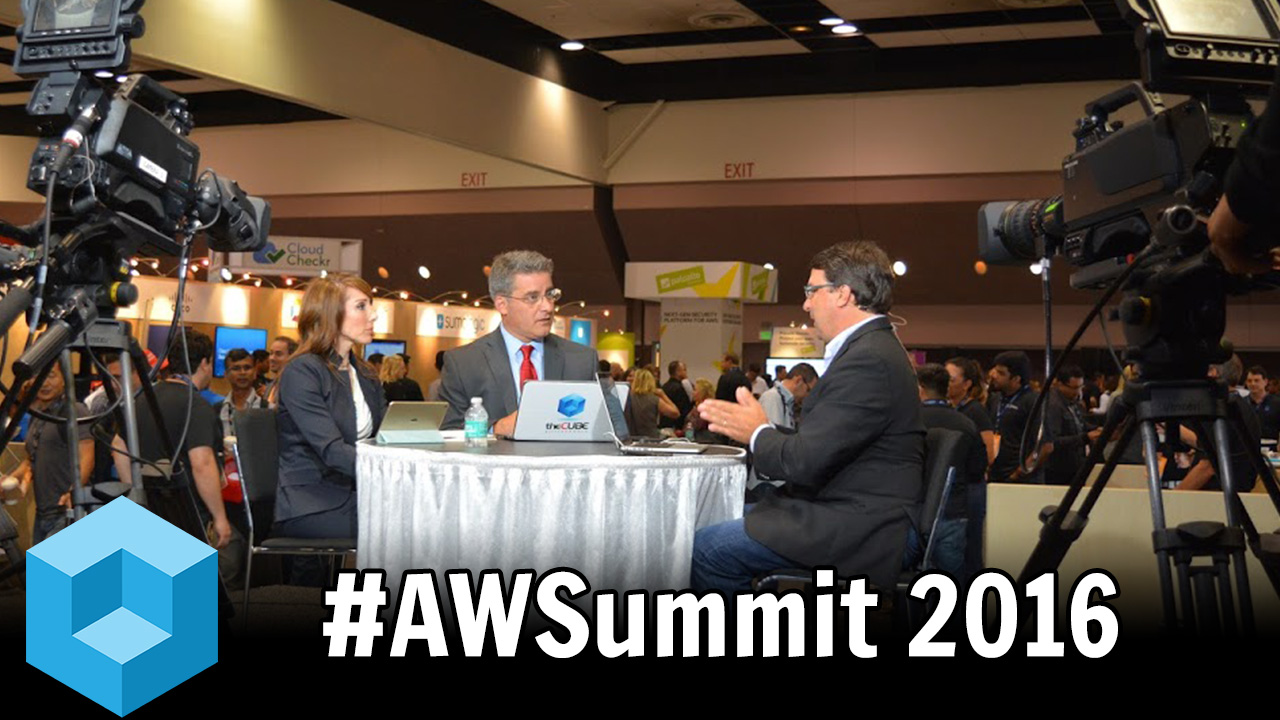
Ashwin Viswanath, Director of Product Marketing, Talend, joined Jeff Frick and Lisa Martin at AWS Summit 2016
#theCUBE #Talend #AWS #AWSSummit #SiliconANGLE
01. Ashwin Viswanath, Talend, visits #theCUBE!. (00:16)
02. The Background of Talend. (01:01)
03. The Impact of Cloud on Big Data. (01:45)
04. Cloud Data Warehousing. (03:31)
05. Urging Customers to be Data Driven. (06:28)
06. Helping Customers Overcome Legacy Warehouses. (08:29)
07. The Buzz at AWS Summit 2016 and ReInvent. (09:47)
--- ---
The challenge of moving historical data to the cloud | #AWSSummit
by Amber Johnson | Jul 13, 2016
Talend, Inc. has been named as an Advanced Big Data Partner within AWS. It is an open-source Big Data integration company that has recently gotten into cloud integration. Ashwin Viswanath, director of Product Marketing at Talend, tied these two aspects together by looking at the impact cloud is having on Big Data. The company was founded in France in 2006. Presently, Talend has several R&D labs in Europe.
Viswanath spoke with Jeff Frick (@JeffFrick) and Lisa Martin (@Luccazara), cohosts of theCUBE, from the SiliconANGLE Media team, at AWS Summit 2016 in Santa Clara, CA. He remarked that cloud helps scale in a cost-effective way. Clouds can process and house data. With AWS, companies can do both for cheap, he said, and predicted that as more companies “see the power of cloud to scale up Big Data,” the industry will see more cloud converts.
Phasing out data warehouses
Data centers are becoming outdated due to start-up costs and the sheer amount of time spent building the stacks. During a keynote, one AWS Summit speaker said, “Friends don’t let friends build data centers.” Viswanath’s vision of the industry’s trajectory is in line with this quippy phrase. He sees customers coming out of legacy and into cloud, both in the near term and further out in the future.
These transitions are not without challenges, though. Historical data is one that has a particular set of teeth. Viswanath emphasized that these moves are not overnight. Rather, companies will be faced with legacy store procedure and outdated schemas. These will need to be confronted and converted to more modern and cloud compatible schemas. Getting that data ready to work within today’s parameters will be a process, but one well worth it, he added.
Forgot Password
Almost there!
We just sent you a verification email. Please verify your account to gain access to
AWS Summit 2016 | Santa Clara. If you don’t think you received an email check your
spam folder.
In order to sign in, enter the email address you used to registered for the event. Once completed, you will receive an email with a verification link. Open this link to automatically sign into the site.
Register For AWS Summit 2016 | Santa Clara
Please fill out the information below. You will recieve an email with a verification link confirming your registration. Click the link to automatically sign into the site.
You’re almost there!
We just sent you a verification email. Please click the verification button in the email. Once your email address is verified, you will have full access to all event content for AWS Summit 2016 | Santa Clara.
I want my badge and interests to be visible to all attendees.
Checking this box will display your presense on the attendees list, view your profile and allow other attendees to contact you via 1-1 chat. Read the Privacy Policy. At any time, you can choose to disable this preference.
Select your Interests!
add
Upload your photo
Uploading..
OR
Connect via Twitter
Connect via Linkedin
EDIT PASSWORD
Share
Forgot Password
Almost there!
We just sent you a verification email. Please verify your account to gain access to
AWS Summit 2016 | Santa Clara. If you don’t think you received an email check your
spam folder.
In order to sign in, enter the email address you used to registered for the event. Once completed, you will receive an email with a verification link. Open this link to automatically sign into the site.
Sign in to gain access to AWS Summit 2016 | Santa Clara
Please sign in with LinkedIn to continue to AWS Summit 2016 | Santa Clara. Signing in with LinkedIn ensures a professional environment.
Are you sure you want to remove access rights for this user?
Details
Manage Access
email address
Community Invitation
Ashwin Viswanath, Talend | AWS Summit Santa Clara 2016
Ashwin Viswanath, Director of Product Marketing, Talend, joined Jeff Frick and Lisa Martin at AWS Summit 2016
#theCUBE #Talend #AWS #AWSSummit #SiliconANGLE
01. Ashwin Viswanath, Talend, visits #theCUBE!. (00:16)
02. The Background of Talend. (01:01)
03. The Impact of Cloud on Big Data. (01:45)
04. Cloud Data Warehousing. (03:31)
05. Urging Customers to be Data Driven. (06:28)
06. Helping Customers Overcome Legacy Warehouses. (08:29)
07. The Buzz at AWS Summit 2016 and ReInvent. (09:47)
--- ---
The challenge of moving historical data to the cloud | #AWSSummit
by Amber Johnson | Jul 13, 2016
Talend, Inc. has been named as an Advanced Big Data Partner within AWS. It is an open-source Big Data integration company that has recently gotten into cloud integration. Ashwin Viswanath, director of Product Marketing at Talend, tied these two aspects together by looking at the impact cloud is having on Big Data. The company was founded in France in 2006. Presently, Talend has several R&D labs in Europe.
Viswanath spoke with Jeff Frick (@JeffFrick) and Lisa Martin (@Luccazara), cohosts of theCUBE, from the SiliconANGLE Media team, at AWS Summit 2016 in Santa Clara, CA. He remarked that cloud helps scale in a cost-effective way. Clouds can process and house data. With AWS, companies can do both for cheap, he said, and predicted that as more companies “see the power of cloud to scale up Big Data,” the industry will see more cloud converts.
Phasing out data warehouses
Data centers are becoming outdated due to start-up costs and the sheer amount of time spent building the stacks. During a keynote, one AWS Summit speaker said, “Friends don’t let friends build data centers.” Viswanath’s vision of the industry’s trajectory is in line with this quippy phrase. He sees customers coming out of legacy and into cloud, both in the near term and further out in the future.
These transitions are not without challenges, though. Historical data is one that has a particular set of teeth. Viswanath emphasized that these moves are not overnight. Rather, companies will be faced with legacy store procedure and outdated schemas. These will need to be confronted and converted to more modern and cloud compatible schemas. Getting that data ready to work within today’s parameters will be a process, but one well worth it, he added.