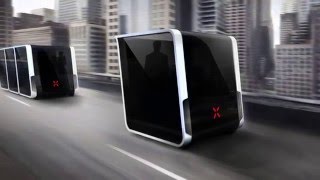
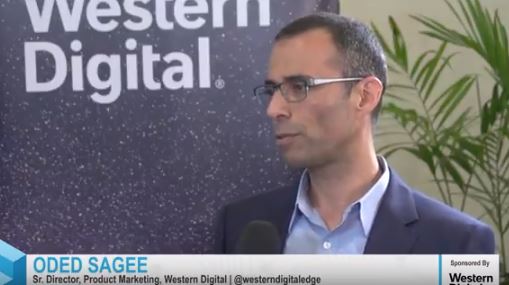
Oded Sagee, Sr. Director, Product Marketing at Western Digital, chats with Jeff Frick at Autotech Council's meet-up at Western Digital in Milpitas, California. Visit https://DataMakesPossible.com to learn more.
https://siliconangle.com/2018/04/20/driverless-vehicle-ecosystem-strives-overcome-storage-challenges-autotech/
Driverless vehicle ecosystem strives to overcome data storage challenges
Disruption in the automotive industry continues to move at a fast pace, driven by heavy investment in self-driving cars and high hopes. With global market revenue expected to exceed $125 billion by 2027, autonomous vehicles will need dedicated technology systems in the coming years. From wireless networking to artificial intelligence, the flocks of cars coming online comes with a myriad of technological obstacles.
“… There are so many new systems in the car now that generate data or consume data,” said Oded Sagee, senior director of product marketing at Western Digital Corp. His company is forging a path to the digital transformation by looking for the use case for contemporary car makers. “How is this going to look in the future? Who’s going to define it? Who’s going to buy it? Who’s going to pay for it? It has become more and more complex. Happily, storage is the center of all this.”
Sagee spoke with Jeff Frick (@JeffFrick), host of theCUBE, SiliconANGLE Media’s mobile livestreaming studio, at the Autotech Council Autonomous Vehicles event in Milpitas, California. They discussed data storage in the autonomous vehicle space. (* Disclosure below.)
Finding affordable solutions
Within the evolving autonomous vehicle ecosystem, companies are seeing a new level of investment, expense and data flow. From sensors to AI algorithms, car companies have a lot to juggle, according to Sagee.
“For them, storage is currently an afterthought,” he said of car makers. “They’re saying, ‘Once we meet mass production, we’ll just go and buy some storage and everything’s going to be fine.”
But storage requirements are very different in the autonomous car space. Driverless cars move through areas with no connectivity, temperature variation and low data latency, so storage is significantly impacted. Temperature is a key issue for self-driving vehicle data storage. Because vehicles move between hot and cold temperatures, the challenge is to keep data accurate and safe from corruption.
“For us to figure out … the temperature range that the car — through its lifetime — is going to go through, and make sure that we meet the use case, that’s a big one,” Sagee said.
Planning for the recording of data in all use cases is essential, as Sagee points out that these cars continuously record data. “How much do you need to record?” he asked.
Western Digital plans to continue educating the autonomous vehicle ecosystem about storage use cases. “If we don’t design the future storage solutions today … people are going to pay much more for storage just to make a basic use case work,” Sagee stated. If the storage issue is addressed now, however, an affordable solution is possible in five to seven years, he concluded.
(* Disclosure: TheCUBE is a paid media partner for the Autotech Council Autonomous Vehicles event. Neither Western Digital Corp., the event sponsor, nor other sponsors have editorial control over content on theCUBE or SiliconANGLE.)
@Western Digital Corporation @SiliconANGLE theCUBE #theCUBE @SiliconANGLE @AutotechCouncil #AutotechCouncil #WD
Forgot Password
Almost there!
We just sent you a verification email. Please verify your account to gain access to
Auto Tech Council 2018. If you don’t think you received an email check your
spam folder.
In order to sign in, enter the email address you used to registered for the event. Once completed, you will receive an email with a verification link. Open this link to automatically sign into the site.
Register For Auto Tech Council 2018
Please fill out the information below. You will recieve an email with a verification link confirming your registration. Click the link to automatically sign into the site.
You’re almost there!
We just sent you a verification email. Please click the verification button in the email. Once your email address is verified, you will have full access to all event content for Auto Tech Council 2018.
I want my badge and interests to be visible to all attendees.
Checking this box will display your presense on the attendees list, view your profile and allow other attendees to contact you via 1-1 chat. Read the Privacy Policy. At any time, you can choose to disable this preference.
Select your Interests!
add
Upload your photo
Uploading..
OR
Connect via Twitter
Connect via Linkedin
EDIT PASSWORD
Share
Forgot Password
Almost there!
We just sent you a verification email. Please verify your account to gain access to
Auto Tech Council 2018. If you don’t think you received an email check your
spam folder.
In order to sign in, enter the email address you used to registered for the event. Once completed, you will receive an email with a verification link. Open this link to automatically sign into the site.
Sign in to gain access to Auto Tech Council 2018
Please sign in with LinkedIn to continue to Auto Tech Council 2018. Signing in with LinkedIn ensures a professional environment.
Are you sure you want to remove access rights for this user?
Details
Manage Access
email address
Community Invitation
Oded Sagee, Western Digital | Autotech Council 2018
Oded Sagee, Sr. Director, Product Marketing at Western Digital, chats with Jeff Frick at Autotech Council's meet-up at Western Digital in Milpitas, California. Visit https://DataMakesPossible.com to learn more.
https://siliconangle.com/2018/04/20/driverless-vehicle-ecosystem-strives-overcome-storage-challenges-autotech/
Driverless vehicle ecosystem strives to overcome data storage challenges
Disruption in the automotive industry continues to move at a fast pace, driven by heavy investment in self-driving cars and high hopes. With global market revenue expected to exceed $125 billion by 2027, autonomous vehicles will need dedicated technology systems in the coming years. From wireless networking to artificial intelligence, the flocks of cars coming online comes with a myriad of technological obstacles.
“… There are so many new systems in the car now that generate data or consume data,” said Oded Sagee, senior director of product marketing at Western Digital Corp. His company is forging a path to the digital transformation by looking for the use case for contemporary car makers. “How is this going to look in the future? Who’s going to define it? Who’s going to buy it? Who’s going to pay for it? It has become more and more complex. Happily, storage is the center of all this.”
Sagee spoke with Jeff Frick (@JeffFrick), host of theCUBE, SiliconANGLE Media’s mobile livestreaming studio, at the Autotech Council Autonomous Vehicles event in Milpitas, California. They discussed data storage in the autonomous vehicle space. (* Disclosure below.)
Finding affordable solutions
Within the evolving autonomous vehicle ecosystem, companies are seeing a new level of investment, expense and data flow. From sensors to AI algorithms, car companies have a lot to juggle, according to Sagee.
“For them, storage is currently an afterthought,” he said of car makers. “They’re saying, ‘Once we meet mass production, we’ll just go and buy some storage and everything’s going to be fine.”
But storage requirements are very different in the autonomous car space. Driverless cars move through areas with no connectivity, temperature variation and low data latency, so storage is significantly impacted. Temperature is a key issue for self-driving vehicle data storage. Because vehicles move between hot and cold temperatures, the challenge is to keep data accurate and safe from corruption.
“For us to figure out … the temperature range that the car — through its lifetime — is going to go through, and make sure that we meet the use case, that’s a big one,” Sagee said.
Planning for the recording of data in all use cases is essential, as Sagee points out that these cars continuously record data. “How much do you need to record?” he asked.
Western Digital plans to continue educating the autonomous vehicle ecosystem about storage use cases. “If we don’t design the future storage solutions today … people are going to pay much more for storage just to make a basic use case work,” Sagee stated. If the storage issue is addressed now, however, an affordable solution is possible in five to seven years, he concluded.
(* Disclosure: TheCUBE is a paid media partner for the Autotech Council Autonomous Vehicles event. Neither Western Digital Corp., the event sponsor, nor other sponsors have editorial control over content on theCUBE or SiliconANGLE.)
@Western Digital Corporation @SiliconANGLE theCUBE #theCUBE @SiliconANGLE @AutotechCouncil #AutotechCouncil #WD