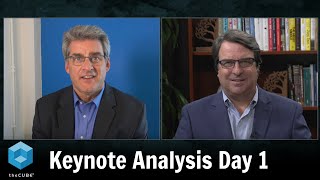
Ashesh Badani, Senior Vice President of Cloud Platforms, Red Hat | @asheshbadani, Stefanie Chiras, Vice President and General Manager, RHEL Business Unit, Red Hat | @stefaniechiras, & Joe Fitzgerald, Vice President and General Manager, Management Business Unit, Red Hat | @joeoncloud sit down with Dave Vellante at theCUBE Digital studios for AnsibleFest 2020.
#AnsibleFest2020 #theCUBE @SiliconANGLE theCUBE @Red Hat Videos
https://siliconangle.com/2020/10/13/distributed-systems-underscore-need-automation-mindset-ansiblefest/
Distributed IT systems underscore need for an automation mindset
VIDEO EXCLUSIVE BY SILVIA FREGONI
Businesses are building a massively distributed information technology system that comprises on-premises apps, public clouds and edge computing — and the challenge is to manage, secure and scale them up in a cost-effective way.
The key solution for dealing with this vast ecosystem efficiently is automation, according to Ashesh Badani (pictured, left), senior vice president of cloud platforms at Red Hat Inc. It is about adopting the automation mindset.
“There’s always this notion about developers, developers, developers, and that still holds true,” he said. “But, increasingly, as the scope and complexity of applications and services that are deployed in this heterogeneous environment increases, it’s more and more about automation, automation, automation.”
Badani, Joe Fitzgerald (right), vice president and general manager of management and automation at Red Hat, and Stefanie Chiras (center), senior vice president and general manager of the RHEL Business Unit at Red Hat, spoke with Dave Vellante, host of theCUBE, SiliconANGLE Media’s livestreaming studio, during AnsibleFest 2020. They discussed the importance of automation to scale in this ecosystem, what enterprises are demanding from their partners and how Red Hat’s Ansible is furthering its offerings to serve the enterprise. (* Disclosure below.)
Hybrid cloud expanded to include edge computing
In the past, the hybrid cloud was considered a combination of only on-premises and off-premises applications; today it’s perceived to be much broader. “Now hybrid translates to many layers in the stack. It can be VMs-hybrid with containers, it can be on-prem with off-prem, and clearly with edge involved as well,” Chiras said.
To bridge the gap between these different environments, Red Hat created OpenShift and RHEL, which allow organizations to use a single language to access all systems and deploy applications, and then automate everything.
“When I look at what customers require, it’s all about speed of building, deploying and running applications,” Chiras explained. “It’s [also] about stability… and, third, is all about scale. That’s where all of this automation comes in.”
But putting it all together does not come without difficulties. One is that edge computing has its “own island,” with different deployment models. And managing or automating something at the edge and with a very small footprint of some device across a constrained network is very different than managing things in a public cloud or in a data center, according to Fitzgerald.
“That’s where I think Red Hat is really focused, and that is our sweet spot — helping people manage those environments,” he said.
Red Hat begins to see edge deployments coming in. “We’re seeing big build-outs in the work we’re doing with telecom providers from a 5G perspective that’s helping drive that, [and] we’re seeing IoT-like opportunities with the automotive sector or some in the retail sector as well,” Badani said.
Automation reached OpenShift Kubernetes
The automation solution for these heterogenous environments also embraces containers and Kubernetes. Red Hat invested early in Kubernetes, through its OpenShift platform, to turn Kubernetes from a useful container tool into a foundational platform for hybrid cloud architectures.
“What we’re working on is to ensure that if you make a commitment to Kubernetes — and increasingly we see lots of customers around the world doing that — we ensure that we’re working closely, that our entire portfolio helps support that,” Badani said.
...
Here’s the complete video interview, part of SiliconANGLE’s and theCUBE’s coverage of AnsibleFest 2020. (* Disclosure: TheCUBE is a paid media partner for AnsibleFest 2020. Neither Red Hat, the sponsor for theCUBE’s event coverage, nor other sponsors have editorial control over content on theCUBE or SiliconANGLE.)
Forgot Password
Almost there!
We just sent you a verification email. Please verify your account to gain access to
AnsibleFest 2020 | Digital. If you don’t think you received an email check your
spam folder.
In order to sign in, enter the email address you used to registered for the event. Once completed, you will receive an email with a verification link. Open this link to automatically sign into the site.
Register For AnsibleFest 2020 | Digital
Please fill out the information below. You will recieve an email with a verification link confirming your registration. Click the link to automatically sign into the site.
You’re almost there!
We just sent you a verification email. Please click the verification button in the email. Once your email address is verified, you will have full access to all event content for AnsibleFest 2020 | Digital.
I want my badge and interests to be visible to all attendees.
Checking this box will display your presense on the attendees list, view your profile and allow other attendees to contact you via 1-1 chat. Read the Privacy Policy. At any time, you can choose to disable this preference.
Select your Interests!
add
Upload your photo
Uploading..
OR
Connect via Twitter
Connect via Linkedin
EDIT PASSWORD
Share
Forgot Password
Almost there!
We just sent you a verification email. Please verify your account to gain access to
AnsibleFest 2020 | Digital. If you don’t think you received an email check your
spam folder.
In order to sign in, enter the email address you used to registered for the event. Once completed, you will receive an email with a verification link. Open this link to automatically sign into the site.
Sign in to gain access to AnsibleFest 2020 | Digital
Please sign in with LinkedIn to continue to AnsibleFest 2020 | Digital. Signing in with LinkedIn ensures a professional environment.
Are you sure you want to remove access rights for this user?
Details
Manage Access
email address
Community Invitation
Ashesh Badani, Stefanie Chiras & Joe Fitzgerald, Red Hat | AnsibleFest 2020
Ashesh Badani, Senior Vice President of Cloud Platforms, Red Hat | @asheshbadani, Stefanie Chiras, Vice President and General Manager, RHEL Business Unit, Red Hat | @stefaniechiras, & Joe Fitzgerald, Vice President and General Manager, Management Business Unit, Red Hat | @joeoncloud sit down with Dave Vellante at theCUBE Digital studios for AnsibleFest 2020.
#AnsibleFest2020 #theCUBE @SiliconANGLE theCUBE @Red Hat Videos
https://siliconangle.com/2020/10/13/distributed-systems-underscore-need-automation-mindset-ansiblefest/
Distributed IT systems underscore need for an automation mindset
VIDEO EXCLUSIVE BY SILVIA FREGONI
Businesses are building a massively distributed information technology system that comprises on-premises apps, public clouds and edge computing — and the challenge is to manage, secure and scale them up in a cost-effective way.
The key solution for dealing with this vast ecosystem efficiently is automation, according to Ashesh Badani (pictured, left), senior vice president of cloud platforms at Red Hat Inc. It is about adopting the automation mindset.
“There’s always this notion about developers, developers, developers, and that still holds true,” he said. “But, increasingly, as the scope and complexity of applications and services that are deployed in this heterogeneous environment increases, it’s more and more about automation, automation, automation.”
Badani, Joe Fitzgerald (right), vice president and general manager of management and automation at Red Hat, and Stefanie Chiras (center), senior vice president and general manager of the RHEL Business Unit at Red Hat, spoke with Dave Vellante, host of theCUBE, SiliconANGLE Media’s livestreaming studio, during AnsibleFest 2020. They discussed the importance of automation to scale in this ecosystem, what enterprises are demanding from their partners and how Red Hat’s Ansible is furthering its offerings to serve the enterprise. (* Disclosure below.)
Hybrid cloud expanded to include edge computing
In the past, the hybrid cloud was considered a combination of only on-premises and off-premises applications; today it’s perceived to be much broader. “Now hybrid translates to many layers in the stack. It can be VMs-hybrid with containers, it can be on-prem with off-prem, and clearly with edge involved as well,” Chiras said.
To bridge the gap between these different environments, Red Hat created OpenShift and RHEL, which allow organizations to use a single language to access all systems and deploy applications, and then automate everything.
“When I look at what customers require, it’s all about speed of building, deploying and running applications,” Chiras explained. “It’s [also] about stability… and, third, is all about scale. That’s where all of this automation comes in.”
But putting it all together does not come without difficulties. One is that edge computing has its “own island,” with different deployment models. And managing or automating something at the edge and with a very small footprint of some device across a constrained network is very different than managing things in a public cloud or in a data center, according to Fitzgerald.
“That’s where I think Red Hat is really focused, and that is our sweet spot — helping people manage those environments,” he said.
Red Hat begins to see edge deployments coming in. “We’re seeing big build-outs in the work we’re doing with telecom providers from a 5G perspective that’s helping drive that, [and] we’re seeing IoT-like opportunities with the automotive sector or some in the retail sector as well,” Badani said.
Automation reached OpenShift Kubernetes
The automation solution for these heterogenous environments also embraces containers and Kubernetes. Red Hat invested early in Kubernetes, through its OpenShift platform, to turn Kubernetes from a useful container tool into a foundational platform for hybrid cloud architectures.
“What we’re working on is to ensure that if you make a commitment to Kubernetes — and increasingly we see lots of customers around the world doing that — we ensure that we’re working closely, that our entire portfolio helps support that,” Badani said.
...
Here’s the complete video interview, part of SiliconANGLE’s and theCUBE’s coverage of AnsibleFest 2020. (* Disclosure: TheCUBE is a paid media partner for AnsibleFest 2020. Neither Red Hat, the sponsor for theCUBE’s event coverage, nor other sponsors have editorial control over content on theCUBE or SiliconANGLE.)