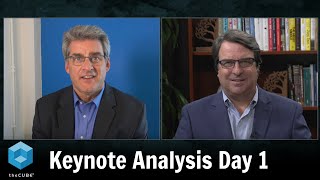
At theCUBE Digital studios, Jeff Frick and John Furrier analyze the Day 2 Keynotes for AnsibleFest 2020.
#AnsibleFest2020 #theCUBE @SiliconANGLE theCUBE
https://siliconangle.com/2020/10/14/automating-edge-highlighted-ansiblefest-day-2-keynote-ansiblefest/
Automating at the edge highlighted during AnsibleFest day 2 keynote
ANALYSIS BY BETSY AMY-VOGT
The future of enterprise computing dominated day two of this week’s AnsibleFest 2020 virtual event, and it was all about the edge.
“If you want to innovate, you must automate at the edge,” Chris Wright, chief technology officer of Red Hat Inc., said in his keynote speech. “5G is entering the market. And it’s an evolution that brings about fundamental change of how connections are made and what will be connected.”
The “internet of things” at the edge is going to be people, devices and everything, according to John Furrier, host of theCUBE, SiliconANGLE Media’s livestreaming studio. “This is a huge positioning shift in the marketplace as companies have to level up and figure out the edge,” Furrier said.
Furrier and co-host Jeff Frick sat down to discuss keynote speakers and announcements from day two of AnsibleFest 2020. (* Disclosure below.)
Automation is a journey, not a one-stop shop
What is edge computing? It’s moving compute to the location where the data is gathered, as well as where it is consumed. Taking a higher-level view of automation significantly helps streamline edge computing, as Wright pointed out in his keynote address.
Rather than being a “one-stop” implementation, “really think about automation in the context of a journey where you can input it in as many processes as you can,” Frick said. One solution addressing this need is the integration of Ansible automation with RedHat OpenShift, a hybrid-cloud enterprise Kubernetes application platform.
“It is a coming-home, if you will, for all the work from OpenStack to OpenShift, to public hybrid and now multicloud and with private cloud — aka the ‘telco cloud,’” Furrier said.
Slowing the journey toward a functional IoT edge with 5G isn’t only a question of “speeds and feeds” but trust, security and skills, according to Furrier. “Who’s going to build it? Who’s going to implement it? Who’s going to manage it?” he said. “This is all a whole new generation.”
Trust was another major theme in the Ansible Fest keynotes. But the trust isn’t only on the user side; trust within the open-source developer community is also essential. Ansible can be used to build that trust, according to keynote speaker Matthew Jones, architect of the Ansible Automation Platform.
“COVID has changed the dynamic of DevOps and the way DevOps teams work, and how they work, and what they measure and how they collaborate,” Frick said. “So if you don’t have trust, that puts you in a real bad spot.”
XaaS: Easy to say, hard to do
“Everything as a service,” known as XaaS, was another topic covered during day two of AnsibleFest. “The big megatrend on the business model side is everything as a service,” Furrier said.
The aim of making everything from disco balls to server space available on-demand is simplicity, but implementing it is complex.
The conversation will shift from “’automation, automation, automation’ to ‘services, services, services,'” Furrier predicted. “Because to get to anything as a service, you have got to have the underpinnings. You’ve got to have the data. You’ve got to have the automation. These are critical architectural, foundational things.”
Here’s the complete video analysis, part of SiliconANGLE’s and theCUBE’s coverage of AnsibleFest 2020. (* Disclosure: TheCUBE is a paid media partner for AnsibleFest 2020. Neither Red Hat, the sponsor for theCUBE’s event coverage, nor other sponsors have editorial control over content on theCUBE or SiliconANGLE.)
Forgot Password
Almost there!
We just sent you a verification email. Please verify your account to gain access to
AnsibleFest 2020 | Digital. If you don’t think you received an email check your
spam folder.
In order to sign in, enter the email address you used to registered for the event. Once completed, you will receive an email with a verification link. Open this link to automatically sign into the site.
Register For AnsibleFest 2020 | Digital
Please fill out the information below. You will recieve an email with a verification link confirming your registration. Click the link to automatically sign into the site.
You’re almost there!
We just sent you a verification email. Please click the verification button in the email. Once your email address is verified, you will have full access to all event content for AnsibleFest 2020 | Digital.
I want my badge and interests to be visible to all attendees.
Checking this box will display your presense on the attendees list, view your profile and allow other attendees to contact you via 1-1 chat. Read the Privacy Policy. At any time, you can choose to disable this preference.
Select your Interests!
add
Upload your photo
Uploading..
OR
Connect via Twitter
Connect via Linkedin
EDIT PASSWORD
Share
Forgot Password
Almost there!
We just sent you a verification email. Please verify your account to gain access to
AnsibleFest 2020 | Digital. If you don’t think you received an email check your
spam folder.
In order to sign in, enter the email address you used to registered for the event. Once completed, you will receive an email with a verification link. Open this link to automatically sign into the site.
Sign in to gain access to AnsibleFest 2020 | Digital
Please sign in with LinkedIn to continue to AnsibleFest 2020 | Digital. Signing in with LinkedIn ensures a professional environment.
Are you sure you want to remove access rights for this user?
Details
Manage Access
email address
Community Invitation
Keynote Analysis Day 2 | AnsibleFest 2020
At theCUBE Digital studios, Jeff Frick and John Furrier analyze the Day 2 Keynotes for AnsibleFest 2020.
#AnsibleFest2020 #theCUBE @SiliconANGLE theCUBE
https://siliconangle.com/2020/10/14/automating-edge-highlighted-ansiblefest-day-2-keynote-ansiblefest/
Automating at the edge highlighted during AnsibleFest day 2 keynote
ANALYSIS BY BETSY AMY-VOGT
The future of enterprise computing dominated day two of this week’s AnsibleFest 2020 virtual event, and it was all about the edge.
“If you want to innovate, you must automate at the edge,” Chris Wright, chief technology officer of Red Hat Inc., said in his keynote speech. “5G is entering the market. And it’s an evolution that brings about fundamental change of how connections are made and what will be connected.”
The “internet of things” at the edge is going to be people, devices and everything, according to John Furrier, host of theCUBE, SiliconANGLE Media’s livestreaming studio. “This is a huge positioning shift in the marketplace as companies have to level up and figure out the edge,” Furrier said.
Furrier and co-host Jeff Frick sat down to discuss keynote speakers and announcements from day two of AnsibleFest 2020. (* Disclosure below.)
Automation is a journey, not a one-stop shop
What is edge computing? It’s moving compute to the location where the data is gathered, as well as where it is consumed. Taking a higher-level view of automation significantly helps streamline edge computing, as Wright pointed out in his keynote address.
Rather than being a “one-stop” implementation, “really think about automation in the context of a journey where you can input it in as many processes as you can,” Frick said. One solution addressing this need is the integration of Ansible automation with RedHat OpenShift, a hybrid-cloud enterprise Kubernetes application platform.
“It is a coming-home, if you will, for all the work from OpenStack to OpenShift, to public hybrid and now multicloud and with private cloud — aka the ‘telco cloud,’” Furrier said.
Slowing the journey toward a functional IoT edge with 5G isn’t only a question of “speeds and feeds” but trust, security and skills, according to Furrier. “Who’s going to build it? Who’s going to implement it? Who’s going to manage it?” he said. “This is all a whole new generation.”
Trust was another major theme in the Ansible Fest keynotes. But the trust isn’t only on the user side; trust within the open-source developer community is also essential. Ansible can be used to build that trust, according to keynote speaker Matthew Jones, architect of the Ansible Automation Platform.
“COVID has changed the dynamic of DevOps and the way DevOps teams work, and how they work, and what they measure and how they collaborate,” Frick said. “So if you don’t have trust, that puts you in a real bad spot.”
XaaS: Easy to say, hard to do
“Everything as a service,” known as XaaS, was another topic covered during day two of AnsibleFest. “The big megatrend on the business model side is everything as a service,” Furrier said.
The aim of making everything from disco balls to server space available on-demand is simplicity, but implementing it is complex.
The conversation will shift from “’automation, automation, automation’ to ‘services, services, services,'” Furrier predicted. “Because to get to anything as a service, you have got to have the underpinnings. You’ve got to have the data. You’ve got to have the automation. These are critical architectural, foundational things.”
Here’s the complete video analysis, part of SiliconANGLE’s and theCUBE’s coverage of AnsibleFest 2020. (* Disclosure: TheCUBE is a paid media partner for AnsibleFest 2020. Neither Red Hat, the sponsor for theCUBE’s event coverage, nor other sponsors have editorial control over content on theCUBE or SiliconANGLE.)