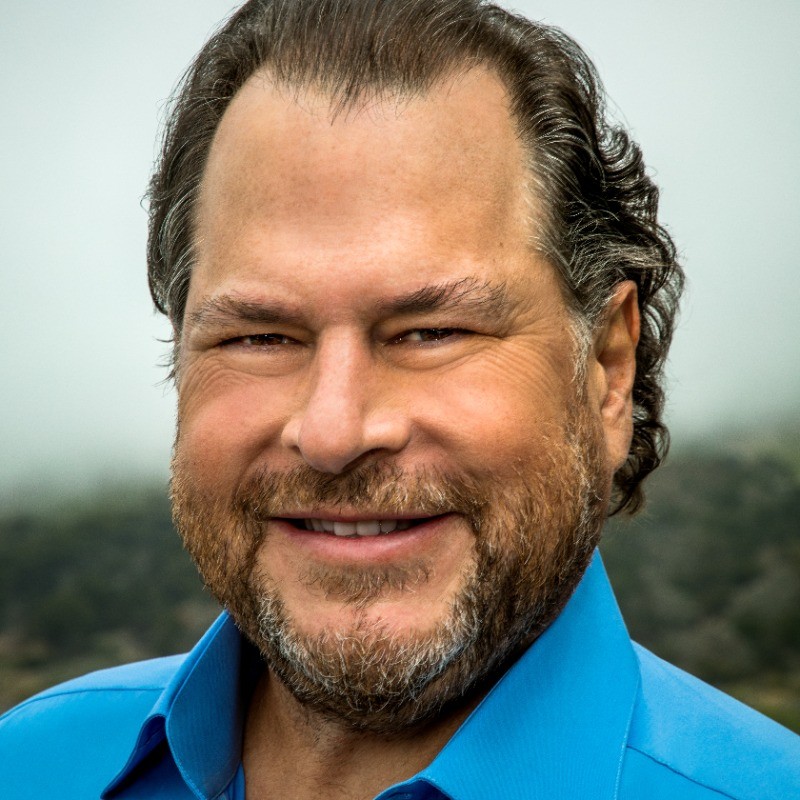
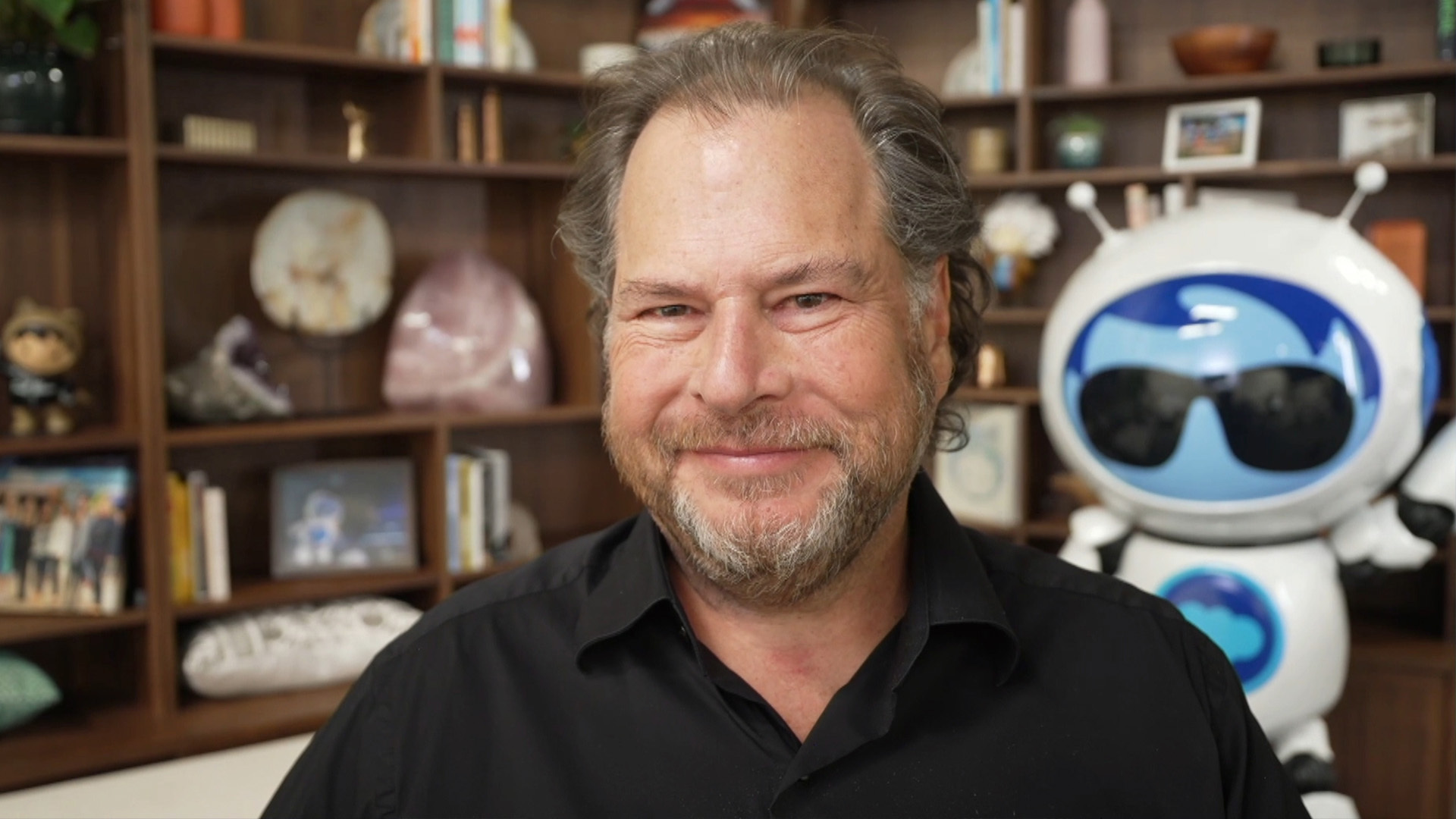
TheCUBE Research’s Dave Vellante and George Gilbert talk with Salesforce CEO Marc Benioff from theCUBE Studios in Palo Alto, CA and Boston, MA.
Summary Points
• Agents are driving a "digital labor revolution." Salesforce is targeting 50% productivity increases in its own engineering and services teams this year.
• Digital labor market will have a value of $3-12 trillion, far exceeding the current enterprise software market of ~$500 billion. That is the magnitude of the transition to Service as Software from the current Software as Service. We’ll access these services through an Agent Store.
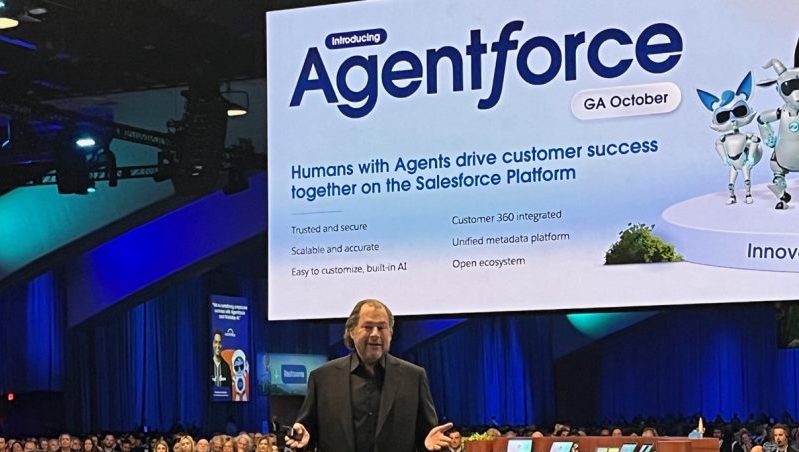
• Salesforce is building a tightly integrated three-layer architecture: applications (Sales/Service Cloud, Slack, etc.), unified data repository (Data Cloud) and an "agentic layer,” (Agentforce).
• Benioff embraced our idea of them as a "software hyperscaler." They federate bi-directionally with data platforms such as Databricks and Snowflake. But Data Cloud federation makes the data more valuable because it then enriches it into a 4D map of customer-related data for Tableau, the Customer 360 apps, agents, etc. That "data fluidity" enables agents to access information across previously siloed systems, including legacy applications.
• Benioff rejects Satya Nadella's assertion that SaaS will disappear and agents will talk directly to database schemas, arguing that proper governance, metadata and other deterministic mediation elements will remain essential. But we’re still waiting for Salesforce’s Klarna moment - a transformational customer showcase.
Agent productivity
Benioff compares today’s excitement to Salesforce’s early startup days. He says today’s CEOs represent “the last generation of executives leading exclusively human workforces.” He’s pushing this vision internally, aiming for 50% productivity gains in engineering, services and support via “agentic layers,” expecting annual compounding gains.
Digital labor
Salesforce’s expected $40.9B in annual SaaS revenue sits within a $500B enterprise software market — but the digital labor market could reach $3-12T. Agent-driven digital labor shifts SaaS to SaSo, a foundational transformation. Customer stories such as OpenTable’s show productivity jumps unimaginable just a year or two ago. Services will be shared through an Agent Store, akin to Apple’s App Store.
Salesforce integration vs DIY
Salesforce’s AI architecture includes three integrated layers. It’s doing the “heavy lifting” by rebuilding core apps in the Data Cloud, which merges internal and external data into a rich 4D business map. Tableau, rebuilt on this foundation, now operates fluidly across Sales Cloud, Service Cloud and Slack. Agentforce completes the stack. In contrast, DIY integration is viable only for the most advanced companies — and even then, struggles with reliability.
Becoming a software-only hyperscaler
Salesforce is evolving into a “software-only hyperscaler,” delivering cloud-scale apps and platforms without building data centers. Its Data Cloud federates with external data platforms and breaks silos, making data more useful. One example: Disney’s “agent fluidity,” where AI agents simultaneously access guest preferences, ride availability and other inputs to offer coordinated recommendations at scale — beyond what human staff could achieve alone.
Answering Nadella’s contention that SaaS goes away with agents
Microsoft CEO Satya Nadella claims SaaS will dissolve into the agent layer as agents tap database schemas directly — but Benioff dismisses this as trolling. Simply dumping data into a massive repo via a discovery API and letting employees loose is a governance nightmare. Metadata, controls and deterministic software layers remain essential, even with non-deterministic agents on top. We challenged Nadella’s jab about Microsoft 365 Copilot being like Clippy, but Benioff noted Salesforce could still federate its data into Data Cloud. On a Klarna-style AI moment, Benioff declined to give a timeline.
Forgot Password
Almost there!
We just sent you a verification email. Please verify your account to gain access to
AI Agent Builder Summit. If you don’t think you received an email check your
spam folder.
In order to sign in, enter the email address you used to registered for the event. Once completed, you will receive an email with a verification link. Open this link to automatically sign into the site.
Register For AI Agent Builder Summit
Please fill out the information below. You will recieve an email with a verification link confirming your registration. Click the link to automatically sign into the site.
You’re almost there!
We just sent you a verification email. Please click the verification button in the email. Once your email address is verified, you will have full access to all event content for AI Agent Builder Summit.
I want my badge and interests to be visible to all attendees.
Checking this box will display your presense on the attendees list, view your profile and allow other attendees to contact you via 1-1 chat. Read the Privacy Policy. At any time, you can choose to disable this preference.
Select your Interests!
add
Upload your photo
Uploading..
OR
Connect via Twitter
Connect via Linkedin
EDIT PASSWORD
Share
Forgot Password
Almost there!
We just sent you a verification email. Please verify your account to gain access to
AI Agent Builder Summit. If you don’t think you received an email check your
spam folder.
In order to sign in, enter the email address you used to registered for the event. Once completed, you will receive an email with a verification link. Open this link to automatically sign into the site.
Sign in to gain access to AI Agent Builder Summit
Please sign in with LinkedIn to continue to AI Agent Builder Summit. Signing in with LinkedIn ensures a professional environment.
Are you sure you want to remove access rights for this user?
Details
Manage Access
email address
Community Invitation
Marc Benioff, Salesforce | Road to Service-as-Software
Join Scott Hebner, principal analyst for artificial intelligence at SiliconANGLE Media and theCUBE Research, as they lead an engaging retrospective of the AI Agent Builder Summit. This first-of-its-kind event delves into the transformative potential of agentic AI, offering insights and best practices from industry pioneers. The summit features contributions from 20 thought leaders representing 12 diverse companies, including Semaphore.ai, Deloitte and IBM among others.
In this analysis session, Hebner is joined by Dave Vellante and John Furrier, co-founders and CEOs of SiliconANGLE Media and theCUBE. With hosts who have collectively interviewed over 10,000 leaders in enterprise high-tech, the discussion centers around the expertise shared at the summit. The panel explores the rapid advancement of AI infrastructure, the significance of the semantic layer and the fusion of platform engineering with AI agentic layers.
The session highlights several key takeaways from the summit. Notable insights include Vellante's observation of the data center's growth, signaling a shift towards AI dominance, and Furrier's emphasis on the evolving partnership between AI and human coworkers. The conversation also touches on the implications for both startups and large enterprises in the burgeoning AI landscape, as well as the role of culture in fostering innovation.
Marc Benioff, Salesforce | Road to Service-as-Software
Dave Vellante
Co-Founder & Co-CEOSiliconANGLE Media, Inc.
HOST
George Gilbert
Principal Analyst, Data & AISiliconANGLE & theCUBE
Marc Benioff
Chairman & CEOSalesforce
TheCUBE Research’s Dave Vellante and George Gilbert talk with Salesforce CEO Marc Benioff from theCUBE Studios in Palo Alto, CA and Boston, MA.
Summary Points • Agents are driving a "digital labor revolution." Salesforce is targeting 50% productivity increases in its own engineering and services teams this year. • Digital labor market will have a value of $3-12 trillion, far exceeding the current enterprise software market of ~$500 billion. That is the magnitude of the transition to Service as Software from the current Software as Service. We’ll...Read more
exploreKeep Exploring
What is the speaker moving into in terms of the workforce and how do they feel about it?add
What is the total size of the enterprise software industry and the estimated size of the digital labor market?add
What apps and platforms does the company currently offer and how are they working to integrate them into a central application layer?add
What is Salesforce's unique value proposition in relation to their Data Cloud vision and the integration of Tableau and Agentforce?add
What are the challenges faced by banks in terms of data management and regulatory compliance when implementing AI and analytics solutions?add
What is the significance of data governance in the era of transitioning to non-deterministic technology and the coexistence of deterministic software?add
What is the metaphor being used to explain the shifting value in enterprise software towards a 4D data platform?add
What are the benefits of data fluidity and the interoperation of AI agents in customer recommendations and experiences?add
What was the speaker's reaction after seeing a demo of Agentforce running for Disney?add
What are the benefits of using a platform to analyze data compared to doing it manually?add
What stage of revolution are we currently in regarding digital labor, the Data Cloud, and Agentforce?add
Marc Benioff, Salesforce | Road to Service-as-Software
search
Dave Vellante
>> Welcome to this episode of The Road to Service as Software. My name is Dave Vellante,
and George Gilbert and I are thrilled to welcome
Marc Benioff, co-founder, chairman, CEO,
extraordinary philanthropist and former assembly
language programmer, Marc. Good to see you. Welcome.
Thanks for coming on.
Marc Benioff
>> Great to be with you. Thank you so much.
Dave Vellante
>> You bet. I've heard you
refer to Larry Ellison at various points in time as your mentor. Now, you probably won't remember this, but this is not your
first time on theCUBE. Andrew, if you don't mind, 14 years ago. Okay? Remember this?
Marc Benioff
>> I thought you guys had forgotten.
Dave Vellante
>> No way. Larry threw you out. So this is notice that you and I haven't aged a bit in 14 years.
Marc Benioff
>> No, we haven't. That
longevity formula we have is really working.
Dave Vellante
>> I'm holding up that
flyer that you put out with your tweet about, "Hey, Larry kicked me off the keynote. I'm going to be over at the St. Regis. " And John Furrier, we were
very high-tech back then. He took his laptop, we were on Skype on wifi,
and he turned it around. You can see the excellent
production value. And you basically had
to move your keynote... Thank you, Andrew. To the
St. Regis, which was awesome. You were such a baller.
You just said, "No, I'm not doing it," on Thursday
morning after the big party. So that was great media.
Marc Benioff
>> Yeah, thank you.
- Yeah. And then, Andrew, if
you don't mind again, so we put out this piece, dug really... Andrew, if you bring that
up, we did this piece on Salesforce, dug deep into the architecture. You tweeted out-
Marc Benioff
>> I read that too. >> We were very pleased about that. And then I was like, "Oh crap. Did I just give Salesforce
a big wet kiss?"
Marc Benioff
>> I think so. >> But we really do believe
in what you guys are doing and it's super happy to have you on. And then we were reading this recent Wall Street Journal article... Thank you, Andrew. Where you said, "Today's CEOs are the final generation of executives leading
exclusively to human workforces. " You said, "Integrating AI
agents into daily operations is going to become a, leadership
skill, separates companies that thrive from those
that are left behind. " And so we wanted to ask you, you've been thinking
about this more than most, maybe except for Jensen. How have you honed your leadership skills to really prepare for this moment? How are you managing differently?
Marc Benioff
>> Well, we are moving into a new world. There's no doubt about it. We're in the digital labor revolution, just like I wrote about in
that Wall Street Journal op-ed or I've been doing on my Twitter feed, because I've gotten so excited. I don't think I've been more
excited in my job since I started Salesforce. It feels like a startup. It's hard, it's bigger, so
it's harder, but it's exciting. And there's so many customers doing so many exciting things
all over the world. It's hard to keep it all straight, and we're moving so many different things across the company. I can talk about that with
you as well, but you're right. I am the last generation of
CEOs who's only going to... Been the manager of humans. Everyone else is going
to be managing humans and agents working together. This is going to be a critical part of running a software company. I just met with our head of
engineering and services, and we look for productivity
increases this year, 50% in engineering, 50% in
services, 50% in support because we are really
aggressively using agentic layers across the company, and I'm advocating all of my
customers to consider this. Not all of them of course can
be ready to go right away, but over time, everybody's
going to have to get to this point to be competitive and to use technology
to its absolute maximum.
Dave Vellante
>> You were at, I think 30%
just a couple months ago, and so you're accelerating
that productivity hit. Yeah. Impress.
Marc Benioff
>> We are. We see some
amazing opportunities and I think that we're going
to see some great things. It's not going to stop. It's
not like this is the only year we're going to get 50%. I think it's going to just keep going. So we have to really be mindful
of what's happening with technology right now and where we're going to
go with our companies.
Dave Vellante
>> So we've been thinking deeply about this and want to get your
perspective on how customers and partners are going to
capture value from software. In the past enterprise software
was everybody looked at CFOs, "Ah, another CapEx," but we're envisioning this
human supervised agents working with intelligent platforms and you think about cloud
software, it was CRM and hr. What sort of services should
we envision that customers and partners are going
to be able to subscribe to going forward?
Marc Benioff
>> Well, you're right. When you look at the
enterprise software industry, well Salesforce this year
is going to do about 40. 9 billion in revenue, right? So how big is the total
enterprise software industry? I don't know. Is it 500 billion? I don't know the exact TAM numbers. All I can tell you is that the digital labor market is
probably going to be somewhere between three and 12 trillion. So we're not just making
enterprise software to help you create, read,
and update your data anymore. We're now providing digital labor. And this is already taking
place with our customers. I just took a look at what's
happening with OpenTables, our very first customer six
months ago with Agentforce, primarily using it in
an employee use case, and today they deployed it to consumers. And when you look at the
productivity increases that we're able to get for
an OpenTable, which is part of Booking incredible
CEO Glenn Fogel, you know what they're able to do
in the company is just not possible a year ago or two years ago. So he has to reconsider now what the productivity
implications are across the board, but that's true for all of our
companies and customers that and CEOs that we're dealing
with all over the world, and we're all trying to
get our head around exactly what is going on and where this is going, but it's a very exciting
and a thrilling moment.
Dave Vellante
>> George, you and I talk about
the app store all the time. We talked about it with Benoit. George, did you know that
Marc gifted appstore. com to Steve Jobs? Did you know that?
George Gilbert
>> I did not. Which is... It's kind of what goes
around comes around. Our question is now that you've wrapped or you're going to be
able to wrap the system of intelligence, system of
record, system of agency and system of engagement into
these services as software, are you going to set up
an app store that sort of brings together all the customers and partners who've built
these new types of services and will that be something
that Salesforce organizes in a central place like Apple's App Store, but instead of consumer apps, these are business services?
Marc Benioff
>> Well, you're right. We had
the first enterprise app store. It was called the Agent AppExchange. I'm kind of getting ahead of
myself. It was the AppExchange. We tested it originally with the name App store when
we first came up with it, and Steve Jobs had really motivated me to build an application economy. We had had a number of
conversations about it, so I built AppExchange,
then I tested App Store. It didn't work for us, but
I kept it in my pocket. I thought maybe I'd use
it at some later point. Then he had me come
down for a press event. He announced App Store at
the end that I walked out and I said, "Hey, I got
to gift for you appstore. com, the trademark app
store. I have it all for you. I've just given it to you no charge. " And he goes, "Oh, don't worry. This App Store thing is never going to be anything worthwhile. " He is a funny guy, I'll tell you that. And we miss him so much, by the way. And I'll tell you the other piece is that AppExchange has been
a huge success for us. It's a great place where
customers can find value. We've motivated and inspired so many other
app exchanges with all kinds of enterprise software companies, and now we're building our agent exchange. And that agent exchange is
really what you're talking about, this idea that we're going
to be able to find all kinds of new types of capabilities
that we're going to deploy through Agent four. So you're going to see
it in Slack as well. Slack has an incredible marketplace, but between the agent exchange or between the Slack
marketplace, you're going to have a whole different
kind of level of services and capabilities that before
was not really possible.
George Gilbert
>> So let's develop that a little more. I can see potentially we had
contact centers going out to the Philippines and India. They can now become sort of
human supervised services that are offered through
some centralized mechanism. But what other business
services might there be and what pricing models would
you see as part of that? And then Apple's sort of value capture from
that was enormous starting roughly 10 years ago. How might Salesforce participate in that?
Marc Benioff
>> Well, let's take it from
the very beginning, which is that there's three key
layers of Salesforce that we are unfolding. The first is our apps, our Sales Cloud and Service Cloud, marketing
cloud, Slack, Tableau, our core commerce platform, our core application development platform. These apps have really been
in some ways discreet in some areas they have been integrated, but we're really working to
integrate all of these apps as one central application layer. And then on that application
layer is our Data Cloud. And I know that you understand that that's that incredible repository
then of all of your data and metadata and it fully federates to everything else in your enterprise, including things like Snowflake
or Databricks or Big Query or S3 or whatever, wherever you're currently
storing your data so that you can have that very valuable data
infrastructure, unified, secured, shared with
the right sharing model. And then on top of that
is the agentic layer, and then that agentic
layer has that ability to create all kinds of services exactly as you are envisioning everything from what we're doing today on help. salesforce.com, which is
our customer service layer to a layer where you might be providing
a level of productivity. I just saw in this company Smartsheet, you probably know the
cloud spreadsheet company. Well, they've built Agentforce
now directly into the app itself. And because of that, you can
be in there, you could say, not only reset my password
or how do I use this feature, but even, "Hey, adjust my user account, make all of these changes. " So this idea that Agentforce
is getting unfolded, we're starting to see
exciting new use cases, lots of different kinds of customers and a lot of different kinds
of industries are using it. We have those stories. This
is unfolding very quickly. A year ago, Agentforce was just an idea. In October we released the code. Now we have dozens of stories. I could tell you I just got
back myself from a trip to Asia. I was with Singapore Airlines,
their CO, Goh, is amazing. He envisions this agentic layer
across the entire airline, been a customer for a long time. What are all the other kind of
services that we can for him? It's only, the imagination is your only constraint at this point,
Dave Vellante
>> But most customers aren't
going to be able to go from, or even technology companies go from idea to an agentic platform in a year. You have access to the
business logic, the metadata, the process logic. You did the hard work
to build the Data Cloud. So that just doesn't happen from idea to implementation in 12 months. And so, we feel like you
have an advantage there, but can you dig into that a little bit? When did you start this journey
and how much was foresight and how much was, well, it just sort of came together at the right time.
Marc Benioff
>> Well, better to be lucky than smart. I think in a lot of
cases, and in this case, and I was just talking with our head of products is a close friend of mine. And look, we've been on
this Data Cloud vision now for quite some time and there
are a lot of heavy lifting because we've rewritten
a lot of our core apps to be deeply embedded and
integrated in this Data Cloud. Let me give you an example.
You've heard of Tableau. It's one of the great apps
actually in our industry. We bought the company I think about six, seven, eight years ago. I don't know the exact time. And then we've been rebuilding
it doing different things. And then we had the idea, "Oh, we're going to rebuild it on the Data Cloud because they never really
had a strong data repository. " Then when we had that,
there was this fluidity between Sales Cloud and Service
Cloud and all of our apps and Tableau, which was awesome. And all of a sudden Tableau
could appear within our apps, even inside Slack itself,
you could have Tableau. But then this year we also
added Agentforce to it. And now you have Agentforce, Data Cloud, you have the new version
of Tableau, Tableau Next. And when we showed it to the
Data Fam, that's the name for the Tableau community,
they're like, "Whoa, this is not just making your graphic and analytics and business
intelligence anymore. We're running the whole company with this kind of visualization. We're like and side by
side with your agent. "
And it was kind of a show- stopping moment at the
conference in San Diego. And this is an example
of an entire platform that just got a huge reboot and it's like hitting that folks who just had a heart
attack with those paddles that Tableau just became something that you never saw was just
incredible and large customers, and there's so many huge
customers at Tableau said, "There's nothing like this
in the business intelligence analytics world because no one else has
done this heavy lifting. " And we're doing that same
formula on every single one of our apps. But it's not different
apps, it's all one platform. And that's our unique
value proposition right now for our large customers.
Dave Vellante
>> George, you remember last year?
George Gilbert
>> Yeah. - George, you remember
last year you said to, I wasn't at Dreamforce, you were. You said, "Dave, if you only
watch one talk, watch the head of Tableau," because
it kind of laid out what we've been talking
about with this future. But go ahead, George.
George Gilbert
>> Well, let me key in on something. Marc, you were saying about
Tableau first moving I think what was, its sort of standalone
app server now into Data Cloud, but soon the semantic
layer itself into Data Cloud. I want to tie in something that I don't know if I say he's
your nemesis, but Satya Nadella and you have this sort of
war of words going on back and forth, and there was when he appeared, as I'm sure you saw on the
Gurley-Gerstner podcast, Nadella went viral for
saying SaaS is going to move up into the agent layer and they're just going to talk directly to the database schema. Now the reason I want to tie that in is if you take... To use a real world example,
JP Morgan has attributes of customers spread out over
6,000 tables in god knows how many hundreds of applications. And if you try a
non-deterministic agent reading and writing to 6, 000 tables without some
deterministic layer in between, I'm like, even if you go
to talk to Silvio Savarese, your chief scientist, and say, "Will I be able to
do that sometime this decade? " I don't think the answer is yes. And the reason I bring this
up is even Power BI needs a semantic layer for read-only
access to a single DBMS. So let's answer this troll.
That's essentially what it was. Let's set the record straight. Why do agents need APIs,
preferably harmonized and or metadata, not raw DBMS schemas to be able to work with data and why will that be the
case for years to come?
Marc Benioff
>> Yeah. Well here, I'll give
you a couple of specific use cases, but number one is this idea that Tableau now has a semantic layer. Tableau now has a data layer. Tableau now has an action layer. Tableau now has a metadata layer and it is an embeddable application in our core apps in Slack. So that very much starts to set up the framework for the future. When you look at or talk
to a big bank, for example, about this conversation that we're having, let's say I was talking to a bank CO. Bank CO might say, "Oh, hey, I know how to make these agents happen. I'm going to just take all my data and I just put it into this model. And then out comes the
other side, all the agents. " And I had this very same conversation with my very good friend,
Dave McKay, who's the CE of Royal Bank Canada, RBC. And we've been having
it for a year or two, and he's got an incredible AI and analytics team out of
the University of Waterloo, and he's got an incredible
Salesforce implementation across this whole organization and his company. So there we are, we're
having the conversation and the conversation is
having over a period of time. And we start working with his
wealth management division, which is in the United States, and we get them live on Agentforce. And so I say, "Dave, now's the time to see the future of RBC. It's actually taking place
in wealth management. " And it was a moment for him because they hadn't seen
it yet at headquarters. So I had a motivating moment
where I said, you've got to bring these guys up
and really look at this. And then he could say, "Oh,
now I understand in banking, one banker can't see the other banker's accounts and balances. " The information is quite in
some ways siloed, governed. There's a whole process called KYC. There's a level of regulatory embrace with the banking system that
is not only in banking and because of that data has
to be managed a certain way that doesn't go away with
agents, it doesn't go away with AI agents. And this expression of
the agentic layer has to then come out of the
database in that same exact way. And I think that is very part and parcel of what we're talking about. Just dumping all your
data through some kind of maybe legal discovery API, into some big repository and then letting all your
employees jostle through that data, that is going to
get you into a lot of trouble. And what you need to
remain is with the level of data governance. And that is true if you're
using agents or apps or any kind of query tool. And that is true for most
companies, including my own.
George Gilbert
>> So what you're saying, just
to recap, is we're in an era where we're layering on a
non-deterministic technology, but as all transitions, you don't replace the old
at first you add to it, and that old layer is
deterministic software that mediates access and
in fact harmonizes access. If I am understanding what you're saying.
Marc Benioff
>> Well, I think that that's
going to be a critical part of how this technology is going to unfold. it's true in my own company today. That is our employees
who are using Agentforce and I have tens of
thousands of them right now, they don't have access to
data now that they didn't before this. The data is still governed
through the sharing model.
George Gilbert
>> Now we gave you a chance to sort of push back on Nadella. He was so clearly trolling you. Now I want to push back
on something you've said several times that Microsoft Copilot 365
is really Clippy rehashed, and Clippy wasn't their finest hour. For those who don't remember, but I just want to say that and acknowledge that all
the cool kids may use Slack, but there's also like a billion
people out there who's using Microsoft 365 or whatever the number is,
how many hundreds of millions and between 365 and Copilot and the Microsoft Graph,
there's productivity and collaboration context
that someday may be useful for your back end, for
your business processes that you may need to integrate with. So even if in its current
immature form you might characterize it as Clippy
someday, that is going to be a very robust collection of interactions that you're going to need. And I just want you to respond to that.
Marc Benioff
>> Well, let me directly address that because I think you're conflating a couple things incorrectly.
George Gilbert
>> Okay.
- So number one, look, when Microsoft repackaged
OpenAI's ChatGPT, which is what they did and
then called it Copilot, and then added it into 12 or 24 different instances
of different kinds of Copilots across their
company, I think they kind of did a disservice to what the potential of AI was in the enterprise. Now, one area where I think they did
get some productivity was with GitHub, you saw how
developers could start to use it and do some automated
coding and other things and get enhanced productivity, but they've kind of gotten,
I would say, zipped by cursor and by Windsurf and other technologies where were not able to take it forward fast enough
because it's not their model. It's not their code, and
it didn't really work well. And when they released it
in their office productivity suite, again, I don't think core customers got value. I've used the product and I don't understand the value of it just against using ChatGPT. So that's where I kind of said, "Oh, this feels more like Clippy 2. 0." Now, that second point
that Salesforce can easily with MuleSoft with a lot of our technology integrate interface with Microsoft's data
repositories and different graphs and bring that intelligence
into our Data Cloud, we already do that and
we'll continue to do that. We don't firewall ourselves
off and don't confuse marketing and our ability to differentiate
from our competitors with what reality is. Reality is that information
management is very complex, especially for these large customers and they all use many different products and there's an obligation on all of us to interoperate with all of them. But when we're launching or creating or trying to differentiate between the new and the old, it's important
for us to actually do that and to be able to make
aggressive statements. And I'm happy to take you aside and give you a class in
how I do marketing if that's interesting that you've
written a couple books on it, but I don't want you to conflate that with what technical reality is.
George Gilbert
>> All right, but I did hear-
- You're saying... Go ahead, George.
George Gilbert
>> There was a nugget in there
that was really interesting, which putting the pieces together, you can ingest Microsoft Office data with the emerging sort
of graph structuring of unstructured data that's
emerging in Data Cloud that's coming in Data Cloud. What I hear is you'll
build something similar to the Microsoft graph as a
way of organizing Microsoft and third-party productivity and collaboration data
essentially to create your own productivity and collaboration
context, if that's recapping,
Marc Benioff
>> I think a better way to say
it is, we're happy to federate to anybody who wants to basically do bi- directional federation with
us with our Data Cloud.
George Gilbert
>> Okay. - So you see that
already with Databricks, you see that with Snowflake, you see
that with Google, we see that with Amazon and we've also
talked to Microsoft about with Fabric doing this kind
of bi-directional federation. So anybody who wants to do
federation, we are going to bring that into our Data Cloud, because once it's in our Data Cloud, it is a supercharging moment
for all of our customers because then that data gets
unleashed into all of our apps. And because our architecture
is so unique in that way, I'm sure you'd agree that
no one else is building on a unified Data Cloud the way we are. And because of that, it means
that we're going to be able to deliver a huge amount
of value to the customers, not only in the Data Cloud, not only through the apps, but
through the agentic layer.
Dave Vellante
>> And we do see that. John Furrier was texting
me before we started here. He said, "Benioff's on Mad Money. " And I said, "What'd he say? " He said, "He gave me a
bunch of stats on cashflow. " And then he said,
"Salesforce is horizontal. " And I said, "He said that?" Now, of course George and I
were talking about it. He said, "Yeah, horizontal app." Okay. But the reason I bring that up is because you're saying you have access because you mentioned
Snowflake and Databricks and these data platforms, but so much of this data is
locked inside of applications. We've talked many times, George, you and I, about could
Salesforce be this software- only Hyperscaler having basically access to all this other data? But then I think about what SAP is doing, Celonis is suing SAP,
SAP is data portability. It's certainly what customers want. Can you imagine a day where
it actually is regulation that data portability is a right? And how do you
think about that and what does that
Marc Benioff
>> Do to you today? Okay, this is the words you're looking for. There's a lot of trap
value in these enterprises and this trap value is in these apps. It could be trapped value.
I'll just give you an example. We do a lot with Snowflake. We made 1. 6 billion on the IPO. We
helped get the company started. It's an incredible company,
it's an incredible platform. And we federated fully to our Data Cloud. In fact, they were the motivation for us building a Data
Cloud and federating, and it's amazing. I think there were 1.6
trillion records or something. I don't have the exact
number in front of me, but it was a huge number like that that federated in the last
week or month or something. So it's like an incredible
amount of data is going back and forth and the technical
architecture is incredible. But when I was with my employees
for our company kickoff and I had 10 or 15,000
or 20,000 in the room and 75,000 online, I said, "How many of you are Snowflake customers? Raise your hand. Users. Because
we have it in our company. "I've used it. It's great. Raise your hand if you use Snowflake. " And maybe two or three hands went up. And then I said, "How many
of you use just Tableau? " Everybody's hand go up.
"How many of you use Slack? " Everybody's hand go up. "How many of you use the Sales Cloud? " Everybody hands... And I'm
like, "Don't be trapped data. " And I think that that is one
of the things about companies that are building these Data Clouds and it could be Snowflake or Databricks, but then use our Data
Cloud to unleash the value to your customers because the apps that we have are incredible and we're able to really
give them an amazing, and this is not some future idea. This is right now. And that
is what I'm excited about. And Matt's excited about that
Tableau demo at the Keynote, which is the new Tableau
Next last week in San Diego because it's unleashing the value because Tableau is now on Data Cloud. Tableau is now on Snowflake,
it is on Databricks, it is on all of these things, and it means that you can
do more with your data.
Dave Vellante
>> So George, this brings us to how value is captured in the enterprise.
George Gilbert
>> Yeah. Marc, you teed it up for us just kind of perfectly. The conversation is all about Data Cloud and we've been struggling
for a metaphor to capture and express how value is
shifting in enterprise software. We talked in the beginning about agents and how customers will
get value from them, but now let's talk about where value is shifting for the vendors. And this metaphor is that we're transitioning from
applications based on symbolic code that tracked siloed, that siloed sort of historical 2D snapshots
of business entities, customers orders, things like that. That's the trap data
you were talking about. Now the idea is we want or agents need to be able
to see, analyze, decide, and act across these silos. So the metaphor we came up with... And just bear with me for a sec. We had self-driving cars 30 years ago, but in the desert by themselves, and we still haven't
gotten them to be pervasive with other self-driving
cars with other non- deterministic human drivers or non-deterministic pedestrians. And that perhaps could have happened so much quicker if we had a 4D digital map that they all shared that
captured people's history and trajectory. In other words, the
dynamics of the business and the equivalent in
enterprise software is a 4D data platform by 4D, not the
historical snapshots, but something that captures
the processes in your case, the customer engagement process. And with this 4D map, then you can have, not agents working in
isolation like in the desert, but you can have 50,000,
100,000, 200,000 agents that are cooperating with each other. And the reason I bring
this up is this is the seat of value you have, I think
the last we heard 300, 300 agent that are worth half a billion or more and there's like one
Data Cloud that has a 4D map of the enterprise, of the
customer, part of the enterprise. You do the math and figure
out who's more valuable.
Marc Benioff
>> Let me put it like this, which is that what you're talking about is what I would call agent fluidity. This idea that the agent can kind of, I'll give you a customer example. So we run Disney's customer touch points. And so this idea that we have the customer store know store. Disney.com, the salespeople
doing real estate, the cruise ship sales, even
the call center for Disney plus and the guides in the park, all the customer touch points
are essentially managed by Salesforce and the Disney
database is pretty awesome. What's in there and what's possible. The product line is incredibly complex. They've done a great job at Disney of building all these
products, it's truly amazing. So now you are in the park and you're walking across
the park having a nice day in physical world, and you're with a guide also in the physical world and you're like, "Hey, yeah,
let's go to Galaxy Edge and I'm going to go ride
the Millennium Falcon ride. " And you're on your
way and you're excited. And all of a sudden it says
on Slack, which he's using, "Oh no, it's broken, it's down. " And he's like, "Oh, what should I do? Should I take Marc over
here to Space Mountain? Should I take Marc over
here to this new ride? " And it says, "Oh no, do you
want to take him to Toontown. " Now, I've used this example before, but let me just kind of go to
one more level, which is that what it's doing is it's
able to look at all of that different data associated
with Marc Benioff that that guide has access to
and start to put it together and go, "Marc's looked at
already taken all these rides, has bought all of these products,
likes this kind of ride, has this kind of experience, and then is able to
come up with that idea. " The AI is able to look at all of the data simultaneously
across all the customer touch points and then make that
single recommendation that's the data fluidity
that Salesforce is offering because that idea that the Data Cloud has the
data, the agent that can see or the AI model can see across the data, and that becomes very exciting. And I think that is a
huge idea for the future and how these agents will interoperate. And then even when they're
talking to each other or interoperating with each
other, et cetera, you're going to need this data fluidity
to make all of this work.
Dave Vellante
>> And that's why I got
excited when you said horizontal. Go ahead, George. Sorry.
George Gilbert
>> I was just going to say,
I assume in this example, either now or in the future,
part of the fluidity is that before recommending to
you, let's say which backup ride, it'll know
who else is recommending what other agents are
recommending, what other rides and what the lines look like. That's the digital, the
map of all the other stuff.
Marc Benioff
>> It already looked at the lines.
George Gilbert
>> Okay, that's what standalone-
Marc Benioff
>> It already went to that
database, which is not a customer database and it is already federated and it already knows that this
is what the lines look like.
George Gilbert
>> Okay. That's the difference
between the standalone agent and the agent fluidity.
Marc Benioff
>> And I think these specific
examples are incredibly useful in kind of expressing
what's going on to everybody so they can kind of understand. Yeah, oh yeah, I've been
to Disneyland, I understand they have those monitors. You can see how long the rides are. All the rides lines are being
monitored by this database. That's not Salesforce, that's
not a customer touch point. We can interface with that very easily. And that's how we get to that point. And I just saw a demo of
Agentforce running for Disney and it was able to talk to the customers and it was doing things that I don't know how a human exactly could do because it's able to say,
"Oh yeah, you're coming to Disneyland, or in this
case it was Disney World. You want to go to this restaurant? Oh, I know that you have
a shellfish allergy. Oh, I understand that you
want to stay in this kind of luxury room. You're looking for this kind of package, this kind of promotion. You want to go to these five
rides are your priority. "I know that you've already
been on these five rides and that you also want to kind of connect to this new part of the park. " And it put it all
together and close the deal. And there was also a human
involved to assist the customer. That is very exciting. And that's where agents and
humans are working together. The agents have a level of fluidity. It's able to have this kind
of gravitas across the data. And it was working. It was
not fantasy land, sorry. And it was actually great and I had to send it
to my friends at Disney and go, "You kind of need to look at this because I think there's a case to be made that AI can increase your revenue because you guys have done an awesome job building all these products. But how can your employees,"
they call them cast members, "know how to put all this together? " There's no Superman at Disney. So they've got Agentforce, they can do it. And it was running and I'm
like, "We should deploy this. This is ready to roll.
This is incredible."
George Gilbert
>> Dave, you can go.
Dave Vellante
>> Yeah. There are people
that are going to still want to DIY, do it yourself. I want to understand the
trade-offs in terms of, you got got intelligent app providers like yourselves, you got other tools,
hyperscalers have their thing. You have vertical agents, data platforms. We've been talk about those.
How much easier is it going to be for a customer to tap into Salesforce
agents versus the hundreds of third party agents to, I think you used this acronym, site out. I first heard it, I thought
it was a disk drive interface. C, analyze the decide and act. How much easier is it going to be? Have you guys quantified that,
your sales team with their economic calculators, what's going to be the trade-off and the difference?
Marc Benioff
>> Listen, there's going to be
software developers who want to DIY it, that's do it yourself. And at Disney, they were doing that. They have a great technical
team by the way there, and they were doing that, but the accuracy that
they were getting is not what we ended up getting on accuracy. We started to get accuracy in
the 90 percents on the agents, and that's because we are able to take it across the Data Cloud. So yeah, you can try
to tie it all together, program it all together, hire
these engineers, do all this by the way, maintaining it. If you're not using a platform,
it's back to the old days of we're going to be able to
platform it for customers. We're going to make it so much
easier for them to make all of this work, but we're
going to deliver the level of accuracy that is much higher if they try to do it themselves. And the speed to value
is going to be much, much higher using our platform. It might not be right for
all customers, by the way. There may be customers who end up wanting to use another approach. Totally great, and we'll interface to that if they want us to. But I think for customers who are really already on
the Salesforce platform, want to look at that platform, understand the next
generation of our platform... I was just with a customer last week and they're a huge
customer on the platform, but there was another level
for them on Data Cloud and another level for them on Agentforce, and I kind of needed to lay
it out for the CEO exactly what was possible, because
his team was trying to DIY some separate solution in loyalty. And when I showed it to them, and I used the example of Marriott where we're actually deploying
this incredible new loyalty solution, it's like, "Oh,
I'm not going to only to save money in the development,
but in the maintenance and on the long-term value proposition and return of investment
on this project is going to be much better on
our platform approach. "
And this is what we believe so strongly. And for those large enterprises,
they may have a choice, but I'll tell you, on the small and medium enterprises that we also work with, they don't have a choice. So don't forget, there's
three types of categories of customers that we work with. Those with zero to 250 employees, they need a platform approach. 250 to 1,000 employees? Okay, some of them have technical teams, but a lot of them mostly
need a platform approach. A thousand above? And when you get into those companies who have then very large technical teams, that's where it can be... We could end up in a DIY versus
use the platform discussion and we want to have that discussion. We want to have a bake-off. We want to show them
what we showed at Disney that we're going to be
able to work together and we're going to have higher accuracy, and it's going to be amazing. But you're right, there's always going to be DIY. There always has been.
George Gilbert
>> But you are also... Dave,
let me just follow up on that.
Dave Vellante
>> Yeah.
- There's hundreds of agents' startups, just customer-facing alone, and there's only a few 4D maps so far of the enterprise. You dominate the customer-centric
entities and processes. There's Palantir, there's a company called
Blue Yonder building on relational AI. Everyone's sort of jockeying
for different parts of this map, but that seems to be the super high value
real estate in enterprise software where that's the linchpin from which
you integrate all the other pieces, it seems like.
Marc Benioff
>> I think that you left out a lot of companies I would've
added on that list. So I could give you two dozen companies and I think in every single
one, my message to them, some of them might think that I'm
their competitor or something, and I'm like, "No, no, no. " Let's just federate. Let's just connect. Let's federate, let the
customer decide how they want to operate and we'll federate
our data sources together. And that gives you access to
Salesforce data in a smart and intelligent way, in
a secure and shared way, and where our sharing model and security models are maintained.
George Gilbert
>> I think the distinction
I was making referred to whose maps have processes in addition to entities. We've tried-
Marc Benioff
>> I totally understand what you mean.
George Gilbert
>> Okay.
- I totally get it. I just think there is a big
universe of data that has to come together to achieve that. And when you talk about these
4D maps, I think there's a lot of ways that we could talk or debate about where the
4D maps really are today and what's happened because this idea of data management evolved from that master data management
idea maybe 20 years ago to where we are today, to these Data Clouds, it's changed a lot, and it's
going to change going forward. But this idea that we can federate and have this kind of
interoperability is proven by talk to our Data Cloud customers who are federating very
successfully with these large- scale databases.
Dave Vellante
>> And your quasi-competitors
are receptive to that? Is that a new sort of
attitude in this industry, a highly competitive industry? What's the reaction when you say-
Marc Benioff
>> Yeah, I'm surprised there
hasn't been more written and discussed about that
point that you just said, which is I think in the old
days it was all about like you just said, "Oh, well,
Celonis won't work with SAP and what's going to happen? " It's like the tariff situation
between the governments. But it's a new day when you talk to Snowflake or
Databricks or Amazon or Google or IBM or others. We're federating with
all these data sources and we're going to do some,
we have to do these things to get value to Agentforce in our apps, and it's in our interest and it's in our, it's in quasi- competitors if you'll talk about that. We'll call them partners' interest to have that kind of capability. And I'm talking to our own
employees more about that so they can understand the huge
value that we're providing. Let me give you an example. In Snowflake, like I mentioned, probably it's such a great
example, it's a great product, it's a great repository, a
lot of customers are using it and we federate with it, but because we federate with it, we offer that Snowflake community
a massive amount of value. We can bring them into all of our apps. We can build no-code applications on it. Slack can run on top of it,
Tableau can run on top of it, MuleSoft can run on top of it. We can integrate it with
all of these things. We can do all these things
that Snowflake cannot do. They're a great data repository, but they cannot do all these things. We're offering best of breed kind of capabilities across all
these application types and areas. So we should be working
even more closely with them. And that's where I
think we can offer value to their customers and they can offer value to our customers as well, just as they are.
Dave Vellante
>> Well at three to 12 trillion. It's not a zero-sum game, I guess. George, we got to go, but you want to give your last shot here?
Marc Benioff
>> I hope this was worthwhile
in what you guys wanted today.
Dave Vellante
>> Yeah. Well listen, we
can't thank you enough for spending all this time with us. Absolutely. We've been on this, I think we were early on
recognizing the hard work that you guys did, and it's
just great to be able to talk to one of the leading companies here and go deep with the CEO.
So thank you for that.
Marc Benioff
>> Well, your vision of the
fourth hyperscaler, that's empowering to me and inspiring, and I think that we have to
still flesh all exactly what that means out, because I think that we are a metadata across these, and because we work on multiple
substrates, whether it's Amazon, Google, Alibaba, our own, and others in the future,
we're open to having that kind of interoperability and provide
that kind of data fluidity and agent fluidity, and value fluidity for
all of our customers.
George Gilbert
>> So maybe one last question, Marc, and we'll close it out, which is, it's the crossing the chasm question. There was this Klarna moment a year ago, and it was a do it yourself
tech company essentially that projected they were saving 40
million a year replacing the work of or augmenting the work of 700 customer service
agents' Fintech in Europe. So you've got like, what is it, 150, 000 customers, something like that. It's sort of like the wildebeest crossings that you watch on YouTube.
Marc Benioff
>> Yeah. Do you know that that wasn't true and the CEO has still
since apologized for that?
George Gilbert
>> No, no, no, he says-
- Raised the situation. But it was a moment where everyone's like, "Wait, what's happening?"
George Gilbert
>> No, but he-
- Wasn't it like, "I don't know."
George Gilbert
>> He's clarified. He didn't rip out Salesforce. They harmonized some of the other apps.
Marc Benioff
>> Just that point.
- Yes.
Marc Benioff
>> Or Slack. And then he wrote
a huge blog about Slack on LinkedIn, on how he's used... It was very weird. I think they're promoting
their IPO, which is fine, and I think it's great, and they want to raise their visibility and position themself as a
thought leader and agents and technology and AI. It's all totally cool. But we are in a dynamic moment
right now in the industry for sure, so I don't think
that that is really a good example.
George Gilbert
>> No, no, I didn't mean it as a-
Marc Benioff
>> Oh, all right, go ahead. Sorry.
George Gilbert
>> What I meant was, that was
like a tech company doing it with a DIY, the DIY chops. But I'm saying now you've got
all the pieces to put together for 150,000 mainstream customers. And I'm thinking of, when is your Klarna moment going to cause
the 150,000 wildebeest to cross the river to start
stampeding after them?
Marc Benioff
>> Well, I think that
we are at the beginning of a digital labor revolution. We're at the beginning of
the Data Cloud revolution. We're at the beginning of
the Agentforce revolution. this is going to be... All of us are seeing the videos on Twitter and all these places of all
the robots walking around. I don't know if you've seen
that. And well, guess what? There's no robots walking around here. How about at your house, in your office? You got any robots walking around?
George Gilbert
>> No.
- Oh, okay. So we all know they're coming. We saw the movie Terminator. And they're coming, but
they're not here yet. Or the drones are flying around. Those are the scary videos
with the double propellers, and they look like these cylinders. I don't know. I don't
know if you read the book, Ghost Fleet, but if you haven't,
I'd highly recommend that. I think all of that is coming, but right now we're in
this reality, the blocking and tackling, the hard work
of enterprise software, of getting things running,
proving the value, delivering the ROI. This is where we are.
We're at the beginning so that we can say, "Hey, did
I tell you about Open Table that I tell you about Grupo Global? Did I tell you about Formula One? Or I just did a bunch of
new stories on Mad Money, " like you just said. And this is the exciting fun part where we're opening the
door for everyone else who will come, will eventually say, "Oh, we're better than them. We're this, we're that.
We're the new guys. " But we're delivering the infrastructure. And I want to get back to my point, you guys opened the door
on the fourth hyperscaler. That is a big idea. And
I would like to do that. A software hyperscaler. I don't want to build all
this CapEx, I don't want to build these data centers. I tried it for a while, it's no fun. Queuing all the hardware
up, it's like a nightmare. But we could be the software hyperscaler, there's no question.
George Gilbert
>> Okay. - Well, Marc, you
guys are doing some great work. Again, thanks so much for your time.
Marc Benioff
>> Thank you.
- Love to have you back and talk about many of the
other things you're doing
Marc Benioff
>> Anytime. Anytime.
Dave Vellante
>> Really appreciate it.
- I really appreciate all the great questions and everything you're doing. Thanks for all your support, and so many decades of
support of the industry and everything you've
done for everybody for so many years. We're so grateful to you.
Dave Vellante
>> Yeah, thank you.
- Thanks. >> And thank you, George, and thank you everybody for watching. This is Dave Vellante for George Gilbert, and we'll see you next time on theCUBE.