In this interview from Snowflake Summit 2026, Carl Perry, senior director of product management at Snowflake, joins Dave Mariani, co-founder and chief technology officer of AtScale, to talk with theCUBE's Rebecca Knight and Dave Vellante about why the semantic layer has become the essential governance foundation for enterprise agentic AI. Perry and Mariani jointly reveal Snowflake Semantic Views for XMLA Endpoints powered by AtScale — a native integration that enables Excel and Power BI users to query Snowflake data through a live connection with a single DDL statement. Mariani, who has spent 14 years building the universal semantic layer category, explains that headless AI agents running hundreds or thousands of queries cannot tolerate the data inconsistencies that humans once masked through process and judgment. Perry adds that semantic understanding must now live where the data resides, not above it in a BI tool, so that agents and analytics tools return identical, trusted answers.
The conversation also explores what this integration means for democratizing data access, with Mariani noting there are roughly one billion Excel users who could now run Snowflake queries without ever opening a dedicated BI tool. Perry and Mariani debate the future of dashboards, agreeing that static reports are giving way to agentic, natural language experiences — where LLMs generate visualizations on demand rather than requiring users to configure them. The discussion turns sharply toward governance, with both guests arguing that locking data down is the wrong enterprise default: open access backed by a governed semantic layer drives adoption, while excessive restriction produces shadow AI. From the shift in analytics from describing what happened to prescribing what to do next, to the emergence of personal agents spawning autonomous workflows, Perry and Mariani outline why a trusted semantic foundation is the prerequisite for every stage of the agentic enterprise.
Forgot Password
Almost there!
We just sent you a verification email. Please verify your account to gain access to
Snowflake Summit 2026. If you don’t think you received an email check your
spam folder.
In order to sign in, enter the email address you used to registered for the event. Once completed, you will receive an email with a verification link. Open the link to automatically sign into the site.
Register for Snowflake Summit 2026
Please fill out the information below. You will receive an email with a verification link confirming your registration. Click the link to automatically sign into the site.
You’re almost there!
We just sent you a verification email. Please click the verification button in the email. Once your email address is verified, you will have full access to all event content for Snowflake Summit 2026.
I want my badge and interests to be visible to all attendees.
Checking this box will display your presense on the attendees list, view your profile and allow other attendees to contact you via 1-1 chat. Read the Privacy Policy. At any time, you can choose to disable this preference.
Select your Interests!
add
Upload your photo
Uploading..
OR
Connect via Twitter
Connect via Linkedin
EDIT PASSWORD
Share
Forgot Password
Almost there!
We just sent you a verification email. Please verify your account to gain access to
Snowflake Summit 2026. If you don’t think you received an email check your
spam folder.
In order to sign in, enter the email address you used to registered for the event. Once completed, you will receive an email with a verification link. Open the link to automatically sign into the site.
Sign in to gain access to Snowflake Summit 2026
Please sign in with LinkedIn to continue to Snowflake Summit 2026. Signing in with LinkedIn ensures a professional environment.
Are you sure you want to remove access rights for this user?
Details
Manage Access
email address
Community Invitation
Carl Perry, Snowflake & Dave Mariani, AtScale
In this interview from Snowflake Summit 2026, Carl Perry, senior director of product management at Snowflake, joins Dave Mariani, co-founder and chief technology officer of AtScale, to talk with theCUBE's Rebecca Knight and Dave Vellante about why the semantic layer has become the essential governance foundation for enterprise agentic AI. Perry and Mariani jointly reveal Snowflake Semantic Views for XMLA Endpoints powered by AtScale — a native integration that enables Excel and Power BI users to query Snowflake data through a live connection with a single DDL statement. Mariani, who has spent 14 years building the universal semantic layer category, explains that headless AI agents running hundreds or thousands of queries cannot tolerate the data inconsistencies that humans once masked through process and judgment. Perry adds that semantic understanding must now live where the data resides, not above it in a BI tool, so that agents and analytics tools return identical, trusted answers.
The conversation also explores what this integration means for democratizing data access, with Mariani noting there are roughly one billion Excel users who could now run Snowflake queries without ever opening a dedicated BI tool. Perry and Mariani debate the future of dashboards, agreeing that static reports are giving way to agentic, natural language experiences — where LLMs generate visualizations on demand rather than requiring users to configure them. The discussion turns sharply toward governance, with both guests arguing that locking data down is the wrong enterprise default: open access backed by a governed semantic layer drives adoption, while excessive restriction produces shadow AI. From the shift in analytics from describing what happened to prescribing what to do next, to the emergence of personal agents spawning autonomous workflows, Perry and Mariani outline why a trusted semantic foundation is the prerequisite for every stage of the agentic enterprise.
In this interview from Snowflake Summit 2026, Carl Perry, senior director of product management at Snowflake, joins Dave Mariani, co-founder and chief technology officer of AtScale, to talk with theCUBE's Rebecca Knight and Dave Vellante about why the semantic layer has become the essential governance foundation for enterprise agentic AI. Perry and Mariani jointly reveal Snowflake Semantic Views for XMLA Endpoints powered by AtScale — a native integration that enables Excel and Power BI users to query Snowflake data through a live connection with a single DDL...Read more
exploreKeep Exploring
Why are enterprises revisiting the semantic layer, and how has generative AI changed that need?add
How can we combine the probabilistic creativity of LLMs with a deterministic semantic query engine to ensure consistent definitions (e.g., revenue, customer) when analyzing enterprise data?add
What did you announce regarding Snowflake Semantic Views for XMLA Endpoints powered by AtScale?add
>> Good afternoon everyone. We are in the home stretch of theCUBE's live coverage of the Snowflake Summit here at Moscone in San Francisco. I'm your host, Rebecca Knight alongside Dave Vellante, co-host and co-CEO, co-founder of theCUBE. You do it all.
Dave Vellante
>> There you go.
Rebecca Knight
>> I would like to welcome our last guests of the day. Dave Mariani, chief technology officer at AtScale. Welcome, Dave.
Dave Mariani
>> Thank you for having us.
Rebecca Knight
>> And Carl Perry, head of analytics at Snowflake. Welcome so much.
Carl Perry
>> Thank you so much. Great to be here.
Rebecca Knight
>> Dave, I'm going to start with you. I know you've got a little news to share, which we're going to hear more about, but for our viewers who are not as familiar with AtScale, tell a little bit about what you do.
Dave Mariani
>> AtScale is a universal semantic layer. We were the OG of a universal semantic layer. Been at this for almost 14 years now. We established that category and now everybody's talking about semantics now.
Rebecca Knight
>> Yeah. I mean, it's been talked about a lot, but this year feels different. Why are enterprises revisiting the semantic layer? What's going on?
Dave Mariani
>> You know I think that in the beginning, a single source of truth has always been something that companies strive for. But in BI, in business intelligence, you could sort of get by with humans and process and sort of mask over some of the warts of confusion and inconsistencies. When you put agents that are headless, they're asking hundreds or thousands of questions, you can't get away with that.
Rebecca Knight
>> And they're extremely literal.
Dave Mariani
>> You cannot get away with that anymore.
Rebecca Knight
>> Yeah.
Dave Mariani
>> And so I think now there's a realization that you have to have semantics if you want to power AI and have it be trustworthy and accurate.
Dave Vellante
>> Carl, from your perspective, and Dave, you and I have talked about this, but I want to ask Carl, why do you think it took so long for the industry to start talking about ... We've been talking about it for a while, but actually start getting serious about it and what has changed? How has AI, generative AI specifically, changed sort of that conversation?
Carl Perry
>> I mean, I think Dave said a couple of things that really resonated with me. When self-service BI came to fruition, the way that companies dealt with this is they would build a model above the data and they wouldn't worry about the fragmentation that was present. This is actually how you get in an organization a few number of enterprise data models. That's how they end up appearing to have kind of a cohesive, consistent semantic model. But the reality is the data underlying it doesn't have that cohesion, doesn't have that description. And so when you start using AI agents, which are not in BI tools and they intentionally are running autonomously and driving workflows, that model has to be where the agents are residing. And it's not in a BI tool that sits above the data, it's actually where the data resides. And so I think that's the big shift. We've all known for a really long time that semantic understanding is incredibly important and that's why you see it in every BI tool and that's why AtScale built the ... They were the OGs, the first solution around a universal semantic layer, but now people need it where their data resides so that the agents and the BI tools can get the same exact answers without diverging.
Dave Mariani
>> Yeah. That's absolutely right. The one thing that you look at is that without a semantic foundation ... you know LLMs, you want them to be creative. You want them to be creative because they're your research assistant, right? And so you want them to explore the data, but you don't want them to be creative about the definition of revenue or customer. You do not want them to be creative over your data. So there's a realization that you want to compare the probabilistic nature of an LLM so it can be creative with the deterministic nature of a semantic query engine. You put those two together and it's beautiful.
Carl Perry
>> Yes. Yes. I totally agree with you.
Dave Vellante
>> Carl, last year, I think it was, you guys really kind of acted on that notion that you want to bring the semantics closer to the data. You have hard news today. You guys both have hard news.
Carl Perry
>> Yep.
Dave Vellante
>> What's the news? Hang on. They're going to throw us out of here soon. We got to get to the news. So you're powering what?
Dave Mariani
>> So yeah, the news is we announced together, we have Snowflake Semantic Views for XMLA Endpoints powered by AtScale.
Dave Vellante
>> So Snowflake Semantic Views for XML Endpoints on Snowflake powered by AtScale?
Dave Mariani
>> Yes. Yes.
Dave Vellante
>> Okay. So you want to explain what that means?
Carl Perry
>> I'll try to explain it and then Dave can correct me where I get it wrong.
Dave Mariani
>> Okay. Let's go.
Carl Perry
>> There's a ton of data that is in systems like analysis services and Excel. Power BI also operates on this model and there's a ton of customers that are using these technologies to drive their business forward. What AtScale has built is an enterprise grade and ready engine, semantic engine that actually knows how to take queries or questions and convert them into what needs to be sent to those endpoints that speak XMLA. I mean, you guys have been doing this for years. And so the partnership made a ton of sense. AtScale has a solution that we can actually just integrate with and leverage to accelerate time to value for our customers while AtScale can actually help even more customers at the same time. And so it really opens up the aperture for defining semantics once, getting acceleration with things like BI reporting and leveraging it for other places like agents and Excel. So I think it's a really powerful partnership.
Dave Mariani
>> You just turn it on. It's embedded in Snowflake, which is so great. So you got one DDL statement to enable it and now your Snowflake semantic views get consumed by Excel and Power BI with a live connection. So all of those users out there, and there's a lot of them, especially with Excel. And you're going to be really surprised about that, Carl, as you see all your Excel usage all of a sudden, because they're left out of the equation right now because they can't really run Snowflake queries. Now, they'll be running a Snowflake query just by interacting with Excel.
Carl Perry
>> I mean, look, I totally agree with Dave. We have customers that are chomping in the bit to have an experience inside Snowflake that enables the rich capabilities that Semantic Views offer, but through Excel. We have a line of customers who are super excited about the integration.
Dave Vellante
>> So take that one step further, because I heard the word Excel today in the keynote and I heard a lot of clapping. I think this is an untapped opportunity. How do you think about that opportunity? How do you expect it to unfold? How large is it? I mean, it's every Excel user that's using Snowflake, right?
Dave Mariani
>> You know I think you always see there's a billion Excel users out there, right?
Carl Perry
>> Yes.
Dave Mariani
>> And so when we introduced Excel to AtScale and to our customers, all of a sudden we saw people doing analytics that never were doing analytics before. And we see consumption on the data platforms like Snowflake skyrocket because now you've opened Snowflake and that data to users who don't need to understand and be an expert in a BI tool like Tableau or even Power BI for that matter. It democratizes access to data. And so AI and now with AI and chatbots, that is like times 10, but just imagine all of a sudden you went beyond experts with Power BI and Tableau to anybody with Excel in their desktop. It's a level of democratization that we haven't really seen up until now.
Carl Perry
>> I agree. I agree.
Rebecca Knight
>> So is the era of the dashboard over? I mean, just in terms of what customers are asking for and the kinds of analysis they want to do.
Dave Mariani
>> I'll answer first and then I want hear more.
Dave Vellante
>> Interesting question.
Carl Perry
>> Maybe we'll disagree here.
Dave Mariani
>> I don't know. Let's see.
Carl Perry
>> Let's see.
Dave Mariani
>> So look, I don't think the era of dashboards is over because I think they have their place. Would you rather have somebody ask the same question 100 times, 100 people ask the same question 100 times, or is there a dashboard you could just go and get the answer and ask the question once? So there is a place for dashboards, but what I've seen myself when I pair a chatbot like Snowflake Intelligence or Snowflake CoWork and I pair it with a semantic layer, it's kind of crazy because the kinds of questions that basically LLM can ask is like, it can do it at much higher velocity. So you reach a new level of person who can just type or even speak a natural language question. So the democratization is what we saw with Excel, but like I said, times 10. It's crazy.
Dave Vellante
>> What do you think, Carl?
Carl Perry
>> Yeah. I mean, it's interesting. I think that most of the large players in the dashboarding space are coming from technology that's 10, 15, 20 years old in my mind. They start with reports that are curated and they share those. I think that you need to invert this situation. Of course, there's a need for curated insights. That's absolutely true. That's first defining the semantic layer and then it's exposed through reports that people build or dashboards. But that's not the thing that's actually going to change and empower businesses to truly make more value out of their data. It's starting with an agentic natural language experience on top of your data and that's what SnowWork does, number one. CoCo does that as well. And this is the key. You start from that point, you don't start from the curated insights. Those are needed, but that's not actually the revolution. The revolution is anybody in the enterprise can now go and ask questions and build things using these things and it never would have been possible before. So I think dashboards will have their place, but I think they're falling to the wayside as the thing that will truly revolutionize what happens.
Dave Vellante
>> I would say I think static dashboards.
Carl Perry
>> Yes. Yes. That's exactly right.
Rebecca Knight
>> Yes.
Dave Vellante
>> Because I think you're right, that curated dashboard, you don't want 100 people, 1,000 people asking the same question. I mean, because I go back to my same dashboard, but I want to know other things. I want to talk to it and make sure that the data that I'm getting is accurate.
Carl Perry
>> Well, that's exactly the thing. So usually people will build dashboards to share insights and of course that should happen still. What needs to happen is people need to be able to ask the questions with the curated insights, to be clear. So that's the way it starts instead of from the dashboard sharing and then trying to get answers from that.
Dave Mariani
>> Yeah. What I've seen, Carl, is that people who are using a chat interface, they'll do visualization, but the chatbot will do the visualization for them. So they're not like, "Okay, now build me a bar chart. Oh, now I want to turn it into a pie chart." No, it's doing it. The LLM is doing it for them.
Dave Vellante
>> My takeaway in the last couple of years at Snowflake Summit is you're moving from analytics that tell you what happened, maybe a little bit why it happened, but really deeply why it happened and what if I do this, what's going to happen and let's model out what my best action is. What should I do next? And how does that play out? And that's where we're headed.
Carl Perry
>> I absolutely agree. I mean, I think people want to know not what happened two weeks ago or yesterday. That's valuable. What they want to know is, how do I use my data in my business to be successful next week and next month and what do I need to do to help my customers then? I do honestly believe that AI enables us to ask these types of questions and get these, what should I be doing insights that's going to help my business drive forward? Again, I think it's revolutionizing how people think about insights and their data.
Dave Mariani
>> I want to ask Carl a question.
Rebecca Knight
>> Okay.
Dave Mariani
>> Because one of the things-
Dave Vellante
>> Give the mic to Dave Mariani.
Dave Mariani
>> One of the things we haven't seen yet is that we're still dealing with sort of the first wave of basically using AI to ask for the humans to ask questions. I'm more interested in like once you have headless agents to actually act on that data. So they're going to go ahead and they're going to ask the questions, but then they're going to take the answers and do something with it. Where do you see that going?
Carl Perry
>> I 100% agree. I think that people will have their own personal agents that they use for work and potentially personal life and they'll ask those agents to go do things for them. And those agents will spawn off workflows that other agents are driving. As we get more confidence in the data, and again, that's where our semantic model starts and gives us confidence these workflows will be driven by and completed by these agents autonomously. There's a lot of work left to get to that point, but that's absolutely where we're going, where my personal agent is helping me be 10 to 100 times more productive.
Dave Vellante
>> I just wrote about this. There's a similarity to the PC era, which was really driven by personal productivity. I mean, the difference was there was, from the CEO, "Thou shalt go AI native, make it happen." And now it's bubbling up on a personal productivity level and it's maybe a necessary step. I would predict we're going to have personal islands of intelligence and it's up to the chief AI officer or chief data officer, whomever, to make sure that there's a substrate of knowledge across the organization so that we bust those silos, which this industry has never really done a good job of.
Dave Mariani
>> But Dave, if there's not a governance layer, and that's really where the semantic layer comes in.
Dave Vellante
>> As should be.
Dave Mariani
>> Governance, it's off the rails and the enterprises won't let anybody do that, especially headless agents. So you can't skip that step. You can't skip the governance step. You got to have control plane.
Dave Vellante
>> But shadow AI will happen, but it's up to ... Like you're right, Dave, the governance has to be there, but somebody's got to make sure that the enterprise architecture is designed for a new organizational, new operating model, essentially.
Dave Mariani
>> Absolutely.
Dave Vellante
>> I mean, I think the hierarchical structure where we're organizing around departments and humans will dissolve, maybe not overnight, but I think eventually we'll be organizing around intelligence and that has to be governed intelligence.
Dave Mariani
>> I see some enterprises start with, let's lock everything down and then we'll just open up these doors for people to ask. I think that's the wrong model, right?
Carl Perry
>> Yeah. I agree.
Dave Mariani
>> You've got to say everything is open and we have to be confident that our governance infrastructure can make sure that the data doesn't get into the wrong hands.
Carl Perry
>> That's why shadow AI exists is because the enterprise doesn't give the-
Dave Mariani
>> Because they lock it down.
Carl Perry
>> ... people that need to do the things data.
Dave Vellante
>> And this is a flip on governance, right?
Carl Perry
>> Yes.
Dave Vellante
>> Governance used to be a blocker and now it's an accelerant.
Carl Perry
>> It absolutely is. It absolutely is.
Dave Mariani
>> It's got to do it with the semantic layer, baby.
Carl Perry
>> You do. You do. You do.
Rebecca Knight
>> Excellent. Well, this has been a fantastic conversation. Such a great way to end our first-
Dave Vellante
>> Great day one, Rebecca.
Rebecca Knight
>> ... day here at Snowflake. So thank you both so much for coming on the show. Really appreciate it.
Dave Mariani
>> Thanks for having us.
Rebecca Knight
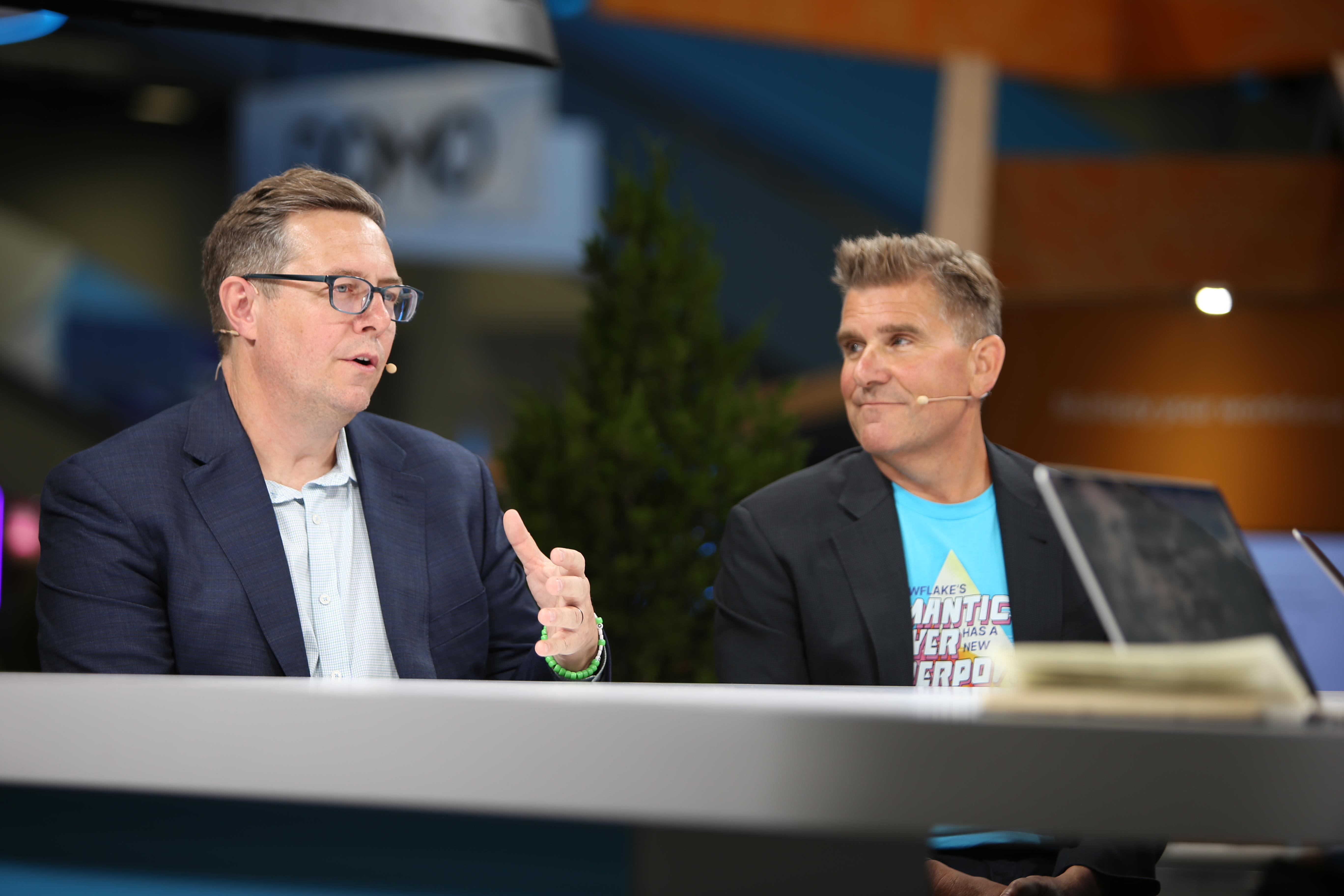
>> I should give a shout-out to your T-shirt because it's, "Snowflake semantic layer has a new super power."
Dave Vellante
>> I got to get a picture of this.
Rebecca Knight
>> It's pretty cool. It's pretty cool.
Carl Perry
>> Superpower.
Rebecca Knight
>> Yeah. I love it.
Carl Perry
>> Awesome.
Rebecca Knight
>> I love it. Thank you so much.
Carl Perry
>> Thank you guys.
Dave Mariani
>> Thank you .
Rebecca Knight
>> We'll be back tomorrow with more of theCUBE's live coverage of the Snowflake Summit. I'm Rebecca Knight with Dave Vellante. You've been watching theCUBE, the leader in enterprise tech news and analysis.











 Rebecca Knight
 Dave Vellante