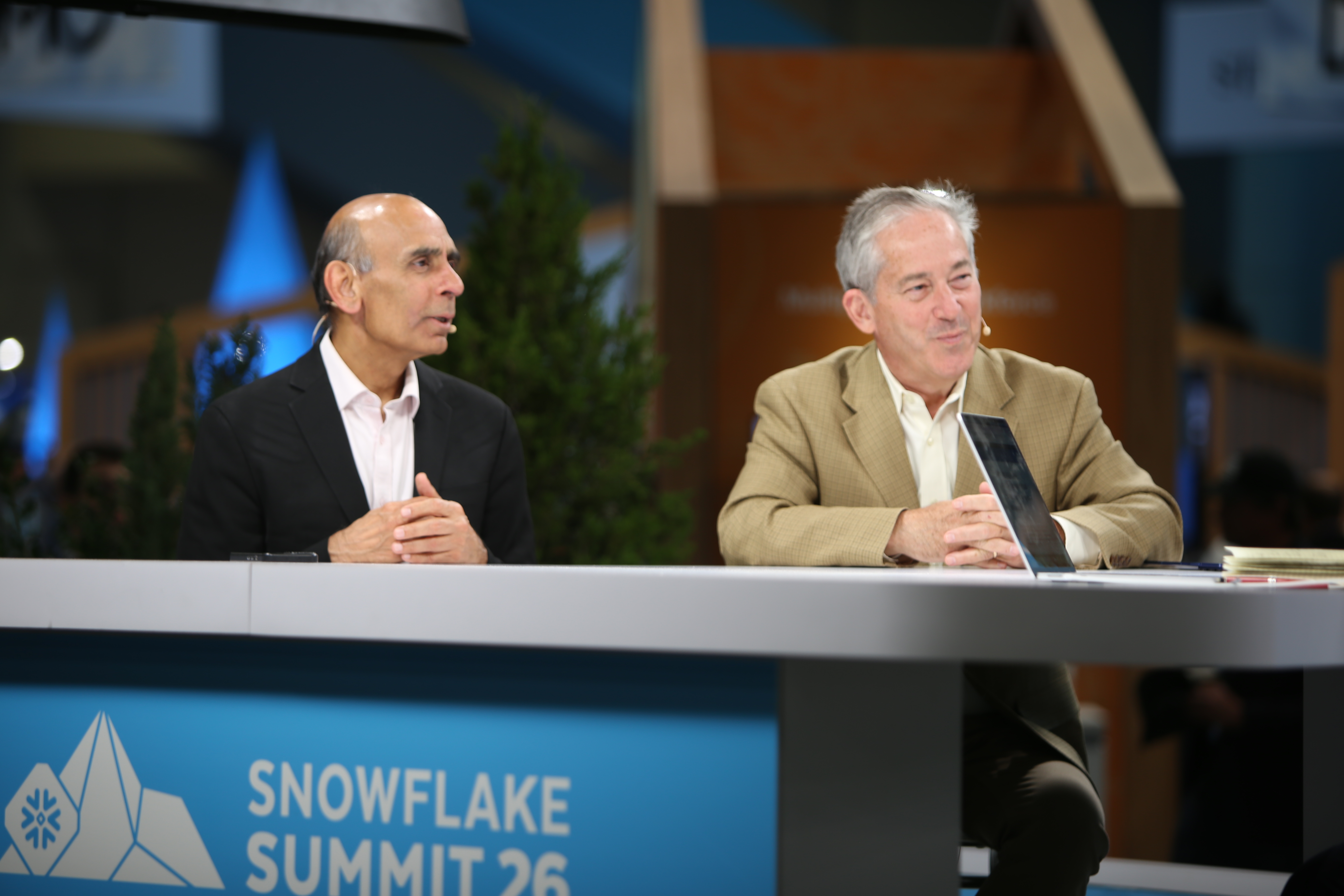
In this interview from Snowflake Summit 2026, Sanjeev Mohan, founder and owner of SanjMo, joins Bob O'Donnell, founder and chief analyst of TECHnalysis Research, to talk with theCUBE's Dave Vellante about the shift from data-centric experimentation to production-ready agentic AI. The analysts reflect on a notable theme reversal at this year's Summit: where Apache Iceberg and open table formats drove prior conversations, agentic AI is now the central story. O'Donnell highlights how GenAI has finally delivered on big data's long-deferred promise, enabling organizations to extract actionable intelligence from data that was previously impossible to query at scale. Mohan adds a structural counterpoint — arguing that as federation matures and egress costs disappear, the competitive moat has shifted from data storage to the metadata and context layer above it, where business semantics and governance are defined.
The conversation also explores what it takes to give agents the grounding they need to operate across fragmented, multi-format data environments. Mohan breaks down the difference between brute-force retrieval and genuine contextual understanding, explaining why semantics, taxonomy, ontology and knowledge graphs must be properly layered before agents can reliably handle complex business queries. Both analysts weigh in on the limits of AI judgment — debating whether true autonomous decision-making requires something close to enterprise AGI — while agreeing that platforms like Snowflake's CoWork, which learns from human reasoning traces over time, represent a practical path forward. O'Donnell brings cross-event perspective from Microsoft Build, noting parallel themes around developer tooling, specialized task-optimized models and the imperative to connect custom organizational data with frontier model capability. From Snowflake's deliberate pivot away from its own foundation models to the emergence of Natoma as an MCP-based tool for linking specialized models, the panel outlines a pragmatic, full-stack roadmap for turning fragmented AI initiatives into governed, scalable agentic systems.
Forgot Password
Almost there!
We just sent you a verification email. Please verify your account to gain access to
Snowflake Summit 2026. If you don’t think you received an email check your
spam folder.
In order to sign in, enter the email address you used to registered for the event. Once completed, you will receive an email with a verification link. Open the link to automatically sign into the site.
Register for Snowflake Summit 2026
Please fill out the information below. You will receive an email with a verification link confirming your registration. Click the link to automatically sign into the site.
You’re almost there!
We just sent you a verification email. Please click the verification button in the email. Once your email address is verified, you will have full access to all event content for Snowflake Summit 2026.
I want my badge and interests to be visible to all attendees.
Checking this box will display your presense on the attendees list, view your profile and allow other attendees to contact you via 1-1 chat. Read the Privacy Policy. At any time, you can choose to disable this preference.
Select your Interests!
add
Upload your photo
Uploading..
OR
Connect via Twitter
Connect via Linkedin
EDIT PASSWORD
Share
Forgot Password
Almost there!
We just sent you a verification email. Please verify your account to gain access to
Snowflake Summit 2026. If you don’t think you received an email check your
spam folder.
In order to sign in, enter the email address you used to registered for the event. Once completed, you will receive an email with a verification link. Open the link to automatically sign into the site.
Sign in to gain access to Snowflake Summit 2026
Please sign in with LinkedIn to continue to Snowflake Summit 2026. Signing in with LinkedIn ensures a professional environment.
Are you sure you want to remove access rights for this user?
Details
Manage Access
email address
Community Invitation
Sanjeev Mohan, SanjMo & Bob O'Donnell, TECHnalysis Research
In this interview from Snowflake Summit 2026, Sanjeev Mohan, founder and owner of SanjMo, joins Bob O'Donnell, founder and chief analyst of TECHnalysis Research, to talk with theCUBE's Dave Vellante about the shift from data-centric experimentation to production-ready agentic AI. The analysts reflect on a notable theme reversal at this year's Summit: where Apache Iceberg and open table formats drove prior conversations, agentic AI is now the central story. O'Donnell highlights how GenAI has finally delivered on big data's long-deferred promise, enabling organizations to extract actionable intelligence from data that was previously impossible to query at scale. Mohan adds a structural counterpoint — arguing that as federation matures and egress costs disappear, the competitive moat has shifted from data storage to the metadata and context layer above it, where business semantics and governance are defined.
The conversation also explores what it takes to give agents the grounding they need to operate across fragmented, multi-format data environments. Mohan breaks down the difference between brute-force retrieval and genuine contextual understanding, explaining why semantics, taxonomy, ontology and knowledge graphs must be properly layered before agents can reliably handle complex business queries. Both analysts weigh in on the limits of AI judgment — debating whether true autonomous decision-making requires something close to enterprise AGI — while agreeing that platforms like Snowflake's CoWork, which learns from human reasoning traces over time, represent a practical path forward. O'Donnell brings cross-event perspective from Microsoft Build, noting parallel themes around developer tooling, specialized task-optimized models and the imperative to connect custom organizational data with frontier model capability. From Snowflake's deliberate pivot away from its own foundation models to the emergence of Natoma as an MCP-based tool for linking specialized models, the panel outlines a pragmatic, full-stack roadmap for turning fragmented AI initiatives into governed, scalable agentic systems.
Sanjeev Mohan, SanjMo & Bob O'Donnell, TECHnalysis Research
Sanjeev Mohan
PrincipalSanjMo
Bob O'Donnell
Founder & Chief AnalystTECHnalysis Research
In this interview from Snowflake Summit 2026, Sanjeev Mohan, founder and owner of SanjMo, joins Bob O'Donnell, founder and chief analyst of TECHnalysis Research, to talk with theCUBE's Dave Vellante about the shift from data-centric experimentation to production-ready agentic AI. The analysts reflect on a notable theme reversal at this year's Summit: where Apache Iceberg and open table formats drove prior conversations, agentic AI is now the central story. O'Donnell highlights how GenAI has finally delivered on big data's long-deferred promise, enabling organ...Read more
exploreKeep Exploring
Has Unistore become Crunchy (i.e., has Unistore been replaced by or merged with Crunchy)?add
What were the initial impressions of the Snowflake Summit—particularly regarding the large audience, the shift from old “big data” approaches to AI/GenAI and agentic technologies, and how companies are trying to leverage and unite their data to make AI productive?add
Should organizations consolidate their data into platforms like Snowflake before investing in AI, or is a federated approach (with a metadata/context layer) preferable?add
How should organizations architect their data and metadata layers to support AI, and what roles will platforms like Snowflake, federation approaches (Apache Iceberg), and frontier models/SaaS vendors play in building the emerging "system of intelligence"?add
How can agents or LLMs determine the meaning of business terms (e.g., "quarter", "region", "salesperson") across multiple systems, and what infrastructure (semantic layer or context graph) is needed to connect definitions stored in structured, semi-structured, and unstructured sources?add
What are the main "picks-and-shovels" opportunities in the AI ecosystem beyond chips and infrastructure, and how could a company like Snowflake fit into that picture?add
Sanjeev Mohan, SanjMo & Bob O'Donnell, TECHnalysis Research
search
Dave Vellante
>> Hi everybody. Welcome back to Moscone South here in San Francisco. It's great to be in San Francisco. Snowflake brought this conference back, the Snowflake Summit, a couple years ago and theCUBE has been here now six or seven years in a row. Super excited. My name's Dave Vellante for Rebecca Knight, she's taking a quick break because we're going to go deep into the analyst session here. I'm super excited to have two good analyst business friends here. Bob O'Donnell is the principal and founder at TECHnalysis and Sanjeev Mohan is the principal and chief analyst at SanjMo, former Gartner analyst. Bob and I spent many years separately at IDC. Long time industry analyst friends, good to see you. Thanks for coming on.
Bob O'Donnell
>> Yeah, thanks for having us. Thank you.
Dave Vellante
>> So we got a lot to cover here. We've had CompuTech this week. You were just coming off of Microsoft Build. This is your first Snowflake Summit. But Sanjeev, I'm going to start with you. No big news this morning, no Tabular, not announcement, no database to front run Crunchy. Let's set it up for those who don't know what we're talking about. Every year Databricks comes in and tries to muck up like keynote.>> Yes. Correct.
Dave Vellante
>> Maybe the border war is over. I don't know.
Dave Vellante
>> So I was waiting. I was wondering if it's going to happen this year. In fact, the keynote was delayed by about 15 minutes or so. And I was wondering, is there something going on behind the scenes, but it went smoothly this year.
Dave Vellante
>> Yeah. No smoke coming out of the PR department.
Dave Vellante
>> Yeah, correct. I remember two years ago, you, George and I, we literally dashed to this location and we recorded a podcast because all of a sudden the world had changed. But the funny thing is what had happened that time, Iceberg.
Dave Vellante
>> Iceberg. Yeah.
Dave Vellante
>> Tabular.
Dave Vellante
>> Tabular.
Dave Vellante
>> This time data is not the key thing. It's all about agents.
Dave Vellante
>> Yeah, it's funny.>> It's a different conference.
Dave Vellante
>> So it must have been 2022. Benoit Dageville said, "Who here has heard of Iceberg?" I think three hands went up. And then Iceberg became the open table formats. And that changed the dynamic in the industry. Databricks narrative, particularly Ali Ghodsi, was very forceful around open, open table formats.>> Yeah, correct.
Dave Vellante
>> To Snowflake's credit, they responded very effectively, but Tabular or Databricks right before the keynote bought Tabular, the creator of Iceberg, Ryan Blue's company. And George and I had had Ryan Blue on the Breaking Analysis four months before asking him if Delta and Iceberg will ever come together and he was saying it'll never happen. So beautiful. And then last year it was the Crunchy announcement and sort of front run there.
Dave Vellante
>> Crunchy, Neon.
Dave Vellante
>> And we heard from Unistore today. Is that Crunchy? Has that come together? It's Crunchy, right?
Dave Vellante
>> No, no. Unistore happened before Crunchy.
Dave Vellante
>> Yeah, right.
Dave Vellante
>> Unistore was a first attempt by Snowflake to bring transactional-
Dave Vellante
>> But it never worked.
Dave Vellante
>> It didn't work at that time. So now they have two solutions. They have Snowflake, Postgres, and Unistore.
Dave Vellante
>> Ah, okay. So Unistore lives?
Dave Vellante
>> Yes. Correct.
Dave Vellante
>> Okay. A little bit of inside baseball.
Bob O'Donnell
>> All right, fair enough.
Dave Vellante
>> Bob, okay, let's up level it a little bit for our audience, Bob. Your first Snowflake Summit. You got to be impressed with the audience, 20,000 people here, probably double the size of Dell Tech World, which is now a $300 billion market cap company.
Bob O'Donnell
>> Yes, exactly.
Dave Vellante
>> And stock's rocking like crazy, but it's crowded here. It's like the old big data crowd has sort of morphed into this future and now you've got AI coming in, you got the ecosystem. What are your initial impressions?
Bob O'Donnell
>> Yeah. Well, I mean, it's funny you bring up the big data thing because in an interesting way, what we've seen happen over the last several years is everybody had given up big data for dead, maybe not Sanjeev, but most of the rest of the world had done that. But with AI... I'm just teasing. With GenAI and all these tools, all of a sudden the real promise of big data actually came to life because now you could actually do the kind of queries and get the kind of information that you actually wanted because in the past there was a big promise but you couldn't deliver. So what's interesting for me as somebody who used to watch that from far and to see what's happening now and to see all the buzz around AI and agentic and how all this is coming together, it's great. It makes so much sense because people have recognized to make AI productive and effective in their organization, they obviously have to tap into their own data. And that sounds great in theory, but it turns out the nuts and bolts of actually doing that are pretty darn hard. And so it's great for me to get a little bit more inside baseball on how some of this stuff is working and how companies are trying to figure out how indeed to leverage the various types of data they have and all the formats they have and all the locations they have it. And how to simplify the process of uniting those things and then in turn having agents, which as Sanjeev mentioned, is that's the news for this year from Snowflake. It's all the agentic stuff. How do those agents take advantage of all these combined data resources and turn it into something actually productive? And interestingly, I was at Microsoft Build this morning as well and there were similar themes, right? It was all about agentic stuff there as well. And so clearly the world is moving in that way.
Dave Vellante
>> Well, and so that's a great setup, Bob. Thank you for that. And so the market's confused right now. You see the SaaS apocalypse, you see all the SaaS companies, they sort of threw Snowflake into that bucket, but then Snowflake absolutely crushed its last quarter. I think people are starting to realize that companies like Snowflake, I would put Datadog in that category and there are others. They have a really important place now in the market. Now we just had Sanofi on, Emmanuel who was up on stage last night and he was basically saying, "First principles, get everything, we consolidated everything into Snowflake and that gave us a real leg up on when we started to initiate our modern AI initiatives."
And now they still, I'm sure, have shadow AI going on, but the premise is that if you have that clean consolidated data, you're going to be able to create that flywheel effect. And now I'll say this and I'd love your feedback on this. A lot of customers have said to me, "We got to get our data house in order before we start spending on AI." And as they go down that journey, they're like, "Wow, this is really hard." So it seems like having a Snowflake or some other sort of consolidated platform is going to give people a real leg up on their AI journey.
Dave Vellante
>> Sanofi is hugely successful. Obviously their strategy worked, but I would not recommend it for everybody. So you talk about big data. The problem with big data was that I took very clean operational data, which was very well modeled, relational data mostly, and I put it into files-
Dave Vellante
>> And messed it up....
Dave Vellante
>> messed it up. And then I created these very brittle pipelines to then recreate the relationships so I could run reports on it. Today what we are doing is actually opposite of that because the entire attempt to create a corporate data warehouse is fraught with problems. It's not for everybody. So the idea, what's successful today is that Federation has finally taken off. In fact, at Google Cloud Next, I was amazed to find out that there's no egress cost between the hyperscalers. So networks are fast, egress cost has gone away Apache Iceberg has become the common interoperable format. You can leave data where it is, you can connect in the ad run time, but now the moat has moved to a layer above it, which is the context layer or the metadata layer because you can apply security there, you can disambiguate what is the meaning of customer in SAP. So this whole SAP, Snowflake bidirectional metadata sync is a game changer in my opinion.
Dave Vellante
>> So it's interesting you say that. So I dropped a piece this morning called Snowflake moves up the AI stack, but the system of intelligence is what I call it, still being built. And then you wrote a piece, go to Sanjeev's LinkedIn, I teased it earlier, I think it's three back talking about one of the pet peeves you have about people. I had to write it down. You're talking about metadata, semantics, taxonomy, ontology, and knowledge graph and context, bottom to top of that stack. So I wanted to tap into that a little bit, but the relevance is Snowflake is essentially, my mind anyway, competing with the big frontier models, not competing, but eventually they're on a collision course. Frontier models, SaaS companies like Salesforce and ServiceNow that are all trying to build their own system of intelligence. Obviously Databricks is in there because that's going to be a very high value piece of real estate.>> Even OpenAI is getting into it .
Dave Vellante
>> Oh, there's no question. No, the frontier models, I would say have to get into it.
Dave Vellante
>> Yeah, correct.
Dave Vellante
>> They're not going to make money selling 20 bucks a month through consumers.
Bob O'Donnell
>> It's a lock-in. That is a lock-in.
Dave Vellante
>> And then 200 the suckers like me, but still, but that's not a business model, right? So that's kind of interesting, but we throw out all these terms. How do they stack on each other to get to where we really need to be?
Dave Vellante
>> So as long as you're working in one system, you can have a business glossary or a semantic layer. But the problem is that for humans, when we go to different systems, we can apply judgment, agents cannot. Even though we may say that the LLMs now are getting so smart, how would they know what is the meaning... If I want to say, show me all the top salespeople in a certain region for this quarter. What is a quarter? What is a region? What is a salesperson? Is it a full-time person? Is it commission? So there's a lot of business rules, a lot of definitions and they sit in different places. In fact, some of them they may sit even in email, some may sit in a PDF document. So in the past, semantic layer was almost always structured. Today we are dealing with structured, semi-structured, unstructured. So now we need to bubble up and we need to find this what some people call context graph or context layer. We need that graph of how related terminologies are connected to each other in different locations. Now you can put an agent on top and you can ask these kind of questions and the agent would know that I need to go to Slack for this information or I need to go to a Jira ticket.
Dave Vellante
>> So it knows where to get the data, but your premise is that it doesn't know how to do the judgment. I would agree today and I would also agree that, or I posit that AI in the near to midterm is going to deal with a lot of the coordination tasks that humans do. But ultimately, do you think AI has to get to that judgment layer, that tribal knowledge, that process knowledge to be able to make decisions independent, largely independent of the human?
Bob O'Donnell
>> Look, I think it's going to depend on the situation and we're seeing this already, right? We've got a human in the loop, a human on the loop. There's different ways to think about how these agents are driving actions. For certain tasks, the amount of judgment is probably not that much. There are certain things you just like, if this, then that, right? It's relatively straightforward. Flip the switch. Obviously, many other situations are not that clear. And so I think there's going to be multiple levels of that and some of the most advanced judgment things, that's where people obviously still have to be involved in making some of these decisions, being in the loop of what actions some of these agents take because they may misinterpret or they may not really have the semantic layer understanding that they need to fully interpret what you're doing. The thing is they are getting way, way better, right? I mean, every day these things are getting significantly better and so it makes it feel like they have some judgment type capabilities. Whether they really do is a long philosophical debate.
Dave Vellante
>> Sanjeev, I was just on with Blue Yonder. I want to set you up and what they were describing and what they're trying to do with supply chain, I felt like it would require a lot of judgment to really solve that problem. But go ahead. What were you thinking?
Dave Vellante
>> The question you asked, will we get to a time when the model foundation models frontier models can do judgment? It's the same question as AGI.
Dave Vellante
>> Right, exactly.
Dave Vellante
>> That is AGI. I don't think we'll get there and I don't think we should even aim.
Dave Vellante
>> Is it AGI?>> Yeah, I mean some degree. Yeah.
Dave Vellante
>> I guess so. I guess so.>> Yeah. And-
Dave Vellante
>> So I would argue, we kind of already had AGI. If we go back 10 years, it's like->> Yes, it is. Yeah.
Dave Vellante
>> This is amazing what we have now.>> But the frontier of AGI keeps getting pushed off.
Dave Vellante
>> Remove the goalpost.>> And I don't think we should even attempt it.
Dave Vellante
>> So I would call it enterprise AGI where you have that sort of corporate knowledge, but we're talking about essentially bringing the world of deterministic software and having probabilistic software on top or however you want to picture it. And then this layer of intelligence in between, which doesn't only come from the frontier models. It has to come from the organization itself. It has to come from the embedded knowledge.
Bob O'Donnell
>> At the end of the day, that's what this is really ultimately all about, right? It's about building systems that can leverage the general intelligence but then be injected with the local data and the local knowledge and what have you. And that's the magic here. One of the things I've been thinking about recently, everybody's been talking about the picks and shovels part of the AI business, which we know it's the chip guys, right? It's the GPUs, it's the networking stuff, it's the servers, it's the hyperscalers.
Dave Vellante
>> Energy.
Bob O'Donnell
>> It's the energy. But the next step in picks and shovels in my mind, obviously then there's the models, but then there's got to be the data connection to those models. If I am creating a layer of a set of tools, which is how I'm interpreting what a lot of Snowflake is doing that allow me to tap into all of my various data formats and files and locations and everything, but then combine it with the capabilities of these frontier models and then create actions that can run them. And then of course have to manage those and govern those and secure those, all that. But if I can start to be the connector piece to all of that data between that data and these frontier models, which again, as more of an outsider coming into this world, that's what it seems like a lot of what Snowflake is doing, that opens up a lot of interesting opportunities for the software part of the picks and shovels.
Dave Vellante
>> Well, we heard the word connector many, many times yesterday in the analyst session. So it starts with the connector, connecting into those operational systems. But then you've got to be able to harmonize not just the data, but also some people say the context, the business process logic, building ontologies, I think you had context as a layer on top of the ontologies, simplifying it, the tribal knowledge that lives within a corporation. I think both of you are saying we're either a ways away from actually having that capability or we may never get there.
Bob O'Donnell
>> Just to play devil's effort a little bit, I actually think we are moving in that direction.>> Yeah, we are.
Bob O'Donnell
>> I think there's a lot of developments that are pointing in that way. I mean, that's why these organizations are able to move past the POC into a real production environment of this stuff because they've now figured out how to integrate some of their own data and to make it generate useful things for their organization.
Dave Vellante
>> But not at that judgment layer. I'm trying to square the circle because I actually believe that over time, maybe it is AGI, but we have to get... I think it starts with coordination and then I think you have to get to that judgment level in order for AI to live up to its promises. You disagree.
Dave Vellante
>> So I actually agree with you. I think judgment is at a next level.
Dave Vellante
>> Yes.
Dave Vellante
>> What is happening with AI is that we are progressing by leaps and bounds. For example, I know you told me many years ago how you love reading S1 document.
Dave Vellante
>> Yeah. Not anymore.
Dave Vellante
>> Not anymore.
Dave Vellante
>> I just feed them into an LLM? And I ask it questions.
Dave Vellante
>> So I'm getting to that. So when GenAI first came out, the idea was that you have an S1, it's a PDF document, feed it to an LLM. LLM will go left to right and embedded trade vector embeddings and then you can ask your natural language questions on it. But that's a very, very poor man's way of doing it.
Dave Vellante
>> Brute force.
Dave Vellante
>> It's a brute force, because you may have some pages with two columns. So you can go left to right. You may have a table on page 2 that links to a table on page 10. So that kind of intelligence is now being built into AI so it can understand tables, relationships, and really be able to answer with high accuracy, but that's not same as judgment.
Dave Vellante
>> Right. I agree. It's not the same as judgment. However, when you get to that point and you have things like... I'm not supposed to call it Snowflake intelligence anymore, am I?
Dave Vellante
>> Yeah. CoWork.
Dave Vellante
>> CoWork.
Dave Vellante
>> CoWork.
Dave Vellante
>> When you have CoWork, which is essentially a new form of engagement-
Bob O'Donnell
>> Yes, correct.
Dave Vellante
>> Right?
Dave Vellante
>> Yeah.
Dave Vellante
>> So I'm going to engage with CoWork. I'm going to make exceptions. It's just the agent's not going to be able to handle it, so I'm going to have to bring a human into the loop. It's going to be exception, this is going to require adjudication. In theory, CoWork will learn from the reasoning traces of the humans and next time that occurs, it's going to resolve it without the human. Now, is that judgment? Maybe, maybe not, but that knowledge, if I can call it that, that intelligence is now in the system and it keeps getting smarter and smarter over time. That's how I see it. Is it all knowing? Is it AGI? Maybe not, but it will be able to do more, and more, and more.
Bob O'Donnell
>> It will learn. It's not unlike a child growing up. A parent tells it to do certain things, it learns, "Oh, I should do this. I shouldn't do that." And conceptually, it's somewhat similar.
Dave Vellante
>> When does it stop learning? We got the gray hair. We were talking at the bar last night. I was like, "Come on, we got to compete with these young guys. We got to keep learning."
Bob O'Donnell
>> Yeah, it's all good. No, it's true, but I mean, I don't know. I don't know when it stops. It's a good question.
Dave Vellante
>> When somebody first told me, "This AI is all bullshit, it hallucinates." My response was like, "Oh, you mean like humans?"
Bob O'Donnell
>> Yeah, exactly.
Dave Vellante
>> They must never go on social media.
Dave Vellante
>> Yeah, they're trying to mimic humans, right? So when was the last time humans were determined and strict and always right?
Dave Vellante
>> Yeah, never.
Bob O'Donnell
>> Never. Exactly.
Dave Vellante
>> So Bobby, what'd you learn at Build? What else can you tell us? What was the vibe like?
Bob O'Donnell
>> The vibe was intense. I mean, it was a much smaller show this year. They typically, I mean, they've done it here, they've done it in big places in the past. This year was limited to, it was only a couple of thousand people. There was a much smaller contingent of press and analysts than they typically have for these events and they initially positioned it to me as very developer focused and on a lot of tools. But at the end of the day, they actually announced a ton of stuff that I think was really cool. First, I got to get the hardware pieces of it out. They actually started with hardware. They reemphasized the new Surface-
Dave Vellante
>> Ultra. Yeah....
Bob O'Donnell
>> with N1X, which is the NVIDIA chip for a laptop.>> Phenomenal.
Bob O'Donnell
>> And now they have a dev box they call the Surface RTX Spark Dev Box. It's this super cool device. It's about the size of my Galaxy Fold here, but it's got an N1X. It's a little desktop system, beautifully designed. And what's also cool is there's a special build of Windows on there that takes away all the notifications and all the other stuff that developers don't want, pre-installs all the developers tools, WSL for the Windows subsystem for Linux, all the things that developers want in this super cool box and they're really trying and they pushed hard and I think made a pretty compelling story about how, look, we want Windows to be a development platform, not just for Windows but for anything.
Dave Vellante
>> So it's coming to accelerated computing.
Bob O'Donnell
>> Exactly.
Dave Vellante
>> And it's coming fast, right?
Bob O'Donnell
>> Exactly right. And Jensen even chimed in from Taiwan at 1:00 in the morning his time.
Dave Vellante
>> Of course he did.
Bob O'Donnell
>> He's everywhere.
Dave Vellante
>> It's unbelievable.
Dave Vellante
>> So the takeaway for me is that there are no winners or losers as yet. Like one company that is hot today, maybe in hot soup tomorrow and somebody we had written off certainly announces, I mean...
Bob O'Donnell
>> Yeah, no, it's all fair. So they started with that. They talked about a new ARM CPU. They also, at the very end of the show, they ended with the new quantum chip that they have, a second gen quantum chip that's like a thousand times better. In between, they had a bunch of other stuff. They announced seven new of their own models. They're not calling them foundation models. They're called sort of medium tier models, but they're optimized for images, for transcription, for... What was some of the other ones? Anyway, they're very specific.
Dave Vellante
>> Not frontier models, but they're convenient for Microsoft customers to just chime in.
Bob O'Donnell
>> And they can be pieced together. Increasingly, I think what we're also seeing and I saw signs of this here at Snowflake Summit too is there's more and more of these specialized models being created, right? And we're linking them together. I mean, Snowflake announced Natoma, which is a MCP tool that is going to allow more of these models to be linked together in theory as well as other capabilities. I think that's going to be important as people start to build their own mixture of experts types of environments. So Microsoft announced those. They had a whole bunch of other tools. They have a new GitHub Copilot desktop app for doing coding as well. Just a ton of stuff that they announced.
Dave Vellante
>> We got to run. How would you grade Snowflake Summit 2026 overall, but specifically the announcements, how they stack up. There was a narrative at one point Snowflake's behind and it was sort of that AWS drag. Where do you put them today?
Dave Vellante
>> So one word we have not heard even mentioned once it's Arctic. So last year there was a huge emphasis on Arctic mode. There's no mention. I think Snowflake is now being very pragmatic. So they know they need to fix a data layer. They know they need to fix the semantic views and horizon context sense and they know they have to fix agentic. So I really think that Snowflake is looking at the whole stack in a very holistic manner. They're not going deep in... Why create your own frontier models when you have so many to choose from?
Dave Vellante
>> Exactly. Because IBM did it with Granite.>> One thing that...
Dave Vellante
>> Right? I mean, so what's the point? Why do you need to be in that business?
Dave Vellante
>> One thing that really I find interesting is that there is a whole announcement on training your own domain models.
Dave Vellante
>> Yeah. We had those guys on the training guys and then one of their customers that they launched with.
Bob O'Donnell
>> And by the way, while you're looking for that, Microsoft also announced tools and capabilities for organizations to help train their models. So they're creating tools as well. I mean, that's clearly, again, it's about tying together custom data with these basic frontier models.
Dave Vellante
>> It was Resolve AI and essentially it was an agent, an SRE agent.>> Oh I see.
Dave Vellante
>> So very, very specific on site metrics and site reliability.
Dave Vellante
>> So see, we went from stage one was RAG, but RAG is take it as you retrieve, you send, you get response, then you do it again. There's no memory.
Dave Vellante
>> It was so cool when it first started, now it's trivial.
Dave Vellante
>> Yes. There's no memory, there's no state being maintained. So then we said, okay, now you need to do a multi agent, then multi agent. I think we are finally getting to a point where I can fine tune or I can train a small model. That has not yet happened. So that's coming by.
Dave Vellante
>> All right guys.
Dave Vellante
>> Absolutely.
Dave Vellante
>> Great having you both.
Dave Vellante
>> Thank you.
Dave Vellante
>> Excellent summary for somebody who's not been here before. And Sanjeev, always going deep. Really appreciate it. All right. Thank you for watching. Keep it right here. This is Dave Vellante for Rebecca Knight, Snowflake Summit 2026 from Moscone. We're live right back right after this short break.











 Dave Vellante