Exploring AI Innovation at Snowflake Summit 2025 with Industry Leaders
In this insightful session from the Snowflake Summit 2025, Baris Gultekin, head of artificial intelligence at Snowflake, and Liam Hynes, head of new product development at S&P Global, join hosts Rebecca Knight and George Gilbert from theCUBE. They delve into the transformative applications of AI within the financial data landscape, emphasizing how Snowflake's innovative technology platforms power developments in data analysis and application.
Gultekin outlines Snowflake's latest AI-driven functionalities, such as AI SQL and Snowflake Intelligence, which enable seamless integration and analysis of structured and unstructured data for business users. Hynes elaborates on how S&P Global Market Intelligence leverages these technologies to extract valuable insights from vast datasets, making extensive use of machine-readable transcripts and advanced AI tools to enhance data accessibility and application.
Key takeaways from the session include insights into how proactive executive communication correlates with company performance, emphasizing the critical role of timely information sharing. Both guests discuss the integration of language models and vector embeddings to efficiently process complex datasets, enhancing analysts’ ability to derive insights from financial communications rapidly. Gultekin asserts that Snowflake AI democratizes access to insights by providing a secure, capable platform that bridges the gap between data and actionable intelligence.
Forgot Password
Almost there!
We just sent you a verification email. Please verify your account to gain access to
Snowflake Summit 2025. If you don’t think you received an email check your
spam folder.
In order to sign in, enter the email address you used to registered for the event. Once completed, you will receive an email with a verification link. Open this link to automatically sign into the site.
Register For Snowflake Summit 2025
Please fill out the information below. You will recieve an email with a verification link confirming your registration. Click the link to automatically sign into the site.
You’re almost there!
We just sent you a verification email. Please click the verification button in the email. Once your email address is verified, you will have full access to all event content for Snowflake Summit 2025.
I want my badge and interests to be visible to all attendees.
Checking this box will display your presense on the attendees list, view your profile and allow other attendees to contact you via 1-1 chat. Read the Privacy Policy. At any time, you can choose to disable this preference.
Select your Interests!
add
Upload your photo
Uploading..
OR
Connect via Twitter
Connect via Linkedin
EDIT PASSWORD
Share
Forgot Password
Almost there!
We just sent you a verification email. Please verify your account to gain access to
Snowflake Summit 2025. If you don’t think you received an email check your
spam folder.
In order to sign in, enter the email address you used to registered for the event. Once completed, you will receive an email with a verification link. Open this link to automatically sign into the site.
Sign in to gain access to Snowflake Summit 2025
Please sign in with LinkedIn to continue to Snowflake Summit 2025. Signing in with LinkedIn ensures a professional environment.
Are you sure you want to remove access rights for this user?
Details
Manage Access
email address
Community Invitation
Baris Gultekin, Snowflake & Liam Hynes, S&P Global
Exploring AI Innovation at Snowflake Summit 2025 with Industry Leaders
In this insightful session from the Snowflake Summit 2025, Baris Gultekin, head of artificial intelligence at Snowflake, and Liam Hynes, head of new product development at S&P Global, join hosts Rebecca Knight and George Gilbert from theCUBE. They delve into the transformative applications of AI within the financial data landscape, emphasizing how Snowflake's innovative technology platforms power developments in data analysis and application.
Gultekin outlines Snowflake's latest AI-driven functionalities, such as AI SQL and Snowflake Intelligence, which enable seamless integration and analysis of structured and unstructured data for business users. Hynes elaborates on how S&P Global Market Intelligence leverages these technologies to extract valuable insights from vast datasets, making extensive use of machine-readable transcripts and advanced AI tools to enhance data accessibility and application.
Key takeaways from the session include insights into how proactive executive communication correlates with company performance, emphasizing the critical role of timely information sharing. Both guests discuss the integration of language models and vector embeddings to efficiently process complex datasets, enhancing analysts’ ability to derive insights from financial communications rapidly. Gultekin asserts that Snowflake AI democratizes access to insights by providing a secure, capable platform that bridges the gap between data and actionable intelligence.
Baris Gultekin, Snowflake & Liam Hynes, S&P Global
Baris Gultekin
VP of AISnowflake
Liam Hynes, PhD
Global Head of New Product Development for Public MarketsS&P Global Market Intelligence
In this exclusive Snowflake Summit interview, Baris Gultekin, head of AI at Snowflake, and Liam Hynes, senior director at S&P Global Market Intelligence, sit down with theCUBE’s Dave Vellante and John Furrier to unpack how enterprises are turning data-cloud foundations into AI-powered outcomes. Gultekin shares Snowflake’s newest agentic AI announcements and explains how they reinforce a vision of governed, interoperable intelligence on the AI Data Cloud, while Hynes details why S&P Global chose Snowflake to accelerate its AI strategy at scale.
The disc...Read more
exploreKeep Exploring
What services does S&P Global Market Intelligence provide to its clients and how does it utilize the Snowflake platform for data delivery?add
What were some of the announcements made today regarding AI and data capabilities by Snowflake?add
What is the importance of investing in building semantic views and models for AI agents to understand data structure and improve reasoning capabilities?add
What are the key factors that our clients look for when scaling up data quickly and efficiently?add
Baris Gultekin, Snowflake & Liam Hynes, S&P Global
search
Rebecca Knight
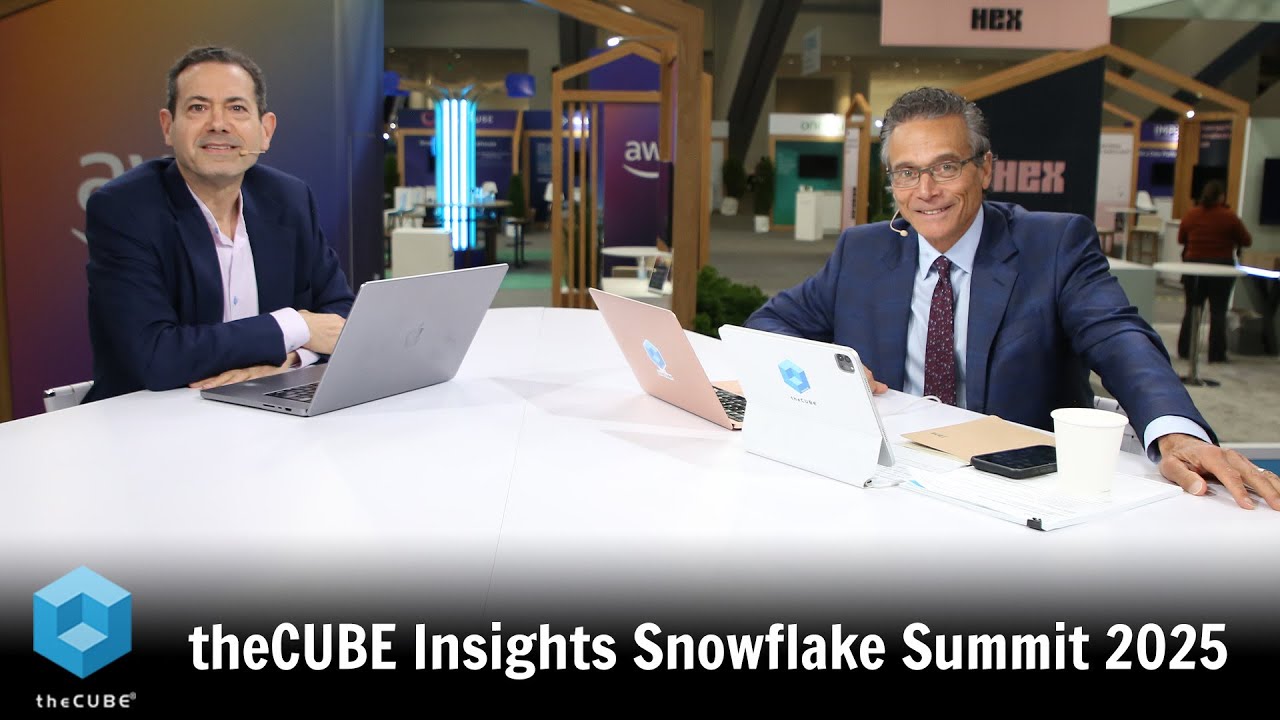
>> Hello everyone and welcome back to theCUBE's live coverage of the Snowflake Summit 2025 here at Moscone Center in San Francisco. I'm your host, Rebecca Knight alongside my co-host and analyst George Gilbert. I would like to welcome two new guests to the show. We have Liam Hynes, head of new product development at S&P Global. Thanks so much for coming on, Liam.
Liam Hynes, PhD
>> Thanks, Rebecca.
Rebecca Knight
>> And Baris Gultekin, head of AI at Snowflake. Thank you so much, Baris.
Baris Gultekin
>> Thank you.
Rebecca Knight
>> So before the cameras were rolling, you were talking a little bit about the ways in which S&P Global Market Intelligence is using Snowflake AI. Share it with our viewers and tell us just in broad brushstrokes how you're using it and we'll get into the product soon?
Liam Hynes, PhD
>> Sure, sure. So, absolutely. So S&P Global Market Intelligence is a division of S&P Global. Essentially what we are is the data provider and the analytical solution provider to capital markets. So we provide data, financial data and solutions to academics, asset managers, sovereign wealth funds, corporates and law firms. So a broad-based array of clients. Our data sits on the Snowflake platform and it's one of our delivery platforms for our clients, and it enables our clients to be able to, first of all, seamlessly get all the data essentially from Snowflake, and then we can tap into things like the Cortex AI and all of that functionality that Snowflake has in order for our clients to, at the end of the day, extract the value that they need from our data. That's the end goal, right? Data is data, but you need to be able to tell a story and pull the narrative out of the data, and that's what Snowflake offices do.
George Gilbert
>> Maybe Baris, you can give us some context for the viewers who haven't heard all the announcements, the new functionality with the Cortex agents and AI SQL search analysts, and then Liam can tell us how they're applying that.
Baris Gultekin
>> Absolutely, that sounds great. Yeah, so super excited about the announcements today. I'll say we've focused a lot on enabling all the data personalities of everyone that's working on data to work with AI plus data together. So we have Snowflake Intelligence that was announced today where business users can directly interact with data democratizing their access to both structured and unstructured data. We have AI SQL that allows analysts to have really powerful tools to work with multi-modal data, to work with operators in the comfort of their SQL language so that they can write very powerful analysis without having to write long pipelines or work with the complex data science tools. Then we built a series of agents for data scientists as well so that they could build ML models really easily right out the bat. So overall, we're basically bringing more and more AI capabilities with the models like OpenAI and Anthropic running directly on Snowflake so that our customers can directly use these to build applications across the board.
Rebecca Knight
>> So go ahead. Now explain-
Liam Hynes, PhD
>> That's a perfect segue to what we did. So one of the data sets that we have on Snowflake that our clients can access is machine readable transcripts. So basically if you think about a public company's earnings call, we transcribe those earnings calls and we put them into a machine readable format. And in that machine readable format, we have all of the metadata associated with those calls. So we know that it's Tim Cook that's speaking on the call and we've got a professional ID from him. We know that when he's speaking, he's speaking in the presentation section. We know that there's a question section and an answer section. When a Morgan Stanley analyst is asking a question, we know it's the Morgan Stanley analyst asking the question, we can map that Morgan Stanley analyst back to his recommendations to see the estimates that he's done on the company. So it's just this big massive infrastructure data frame that you have access to. But like Baris said, we can now pluck these large language models, these vector embeddings and these summarization tools off the shelf from Snowflake, and we can actually start building these really interesting POCs. So one of the things that we did was we tried to identify specific executive behavior when they're on earnings calls, right? At the end of the day, it's kind of funny, we're in a technological revolution, but the earnings call is one of the last instances where you have direct access to a human being speaking on a call, and there's tons of really interesting things that you can analyze. So one of the things we wanted to know was, so when an analyst is asking a question on the call, the topic of that question, has that already been covered in the presentation section by the executive? If it has been covered in the presentation section, then we say that that executive is being proactive with that information, they're preemptively giving that information to the analyst, and the analyst doesn't have to go looking for it. Whereas if that topic wasn't covered in the presentation, then that means that the executive is being forced to be reactive. So if the topic was in the presentation, the executive is being proactive. If it wasn't in the presentation, they're being reactive. And what we found was that firms with proactive executives outperformed firms with reactive executives. So i.e., firms are rewarded if they are proactive and preemptively give the market the information that they're looking for rather than the market having to look for it.
And then one other behavior that we had was well let, let's go in and analyze the Q&A section. Very simple behavior. When an executive is answering a question, do they remain on topic to the question asked or do they go off topic? And if they do go off topic, then why are they going off topic? And again, what we found was that firms with executives who stay on topic to the questions asked, outperform their off topic peers.
Rebecca Knight
>> I feel as though this could become a whole new training manual in terms of how to be a CEO who outperforms because you are essentially giving tricks of the trade. This is what you need to do to be an effective leader. This is how you need to communicate. This is fascinating. Baris, when you hear how your technology is being applied in this way and really has so much power to revolutionize and transform, I mean, how does it-
Baris Gultekin
>> I love hearing all of this. I feel like it's the perfect combination of data and AI coming together, being able to analyze a large amount of data, all the earnings calls for instance, with just a few lines of SQL in this case, but getting such valuable insight is incredibly valuable. So I love seeing all these use cases come alive.
George Gilbert
>> So I have to ask a question. As a former securities analyst, beyond just analyzing the behavior on the call, tying into the original core strength of Snowflake with the quantitative analytics, but it's more than just SQL. It's bridging the structured analytics and the unstructured or semi-structured data, but to go into the financial statements themselves and not just look at the surface level line items, but where they try to hide stuff in the footnotes, can you do that in addition to the behavior on the call? In other words, can you help an analyst who would've had to stay up all night writing an earnings report so that this now becomes automated and then the analyst is up-leveled to do the higher-level work talking to the institutional investors or the companies who are out doing more research?
Liam Hynes, PhD
>> Definitely. Yeah. So it makes the process much more efficient and quicker for, let's say an equity analyst who's analyzing the call. I remember 15 years ago I was a fundamental equity analyst on the buy side, and I would be listening to the calls. I would be transcribing them and trying to get those key components from the call and embed them into my model. Whereas now, you can stand up an agent basically that you can drop that knowledge onto that agent about, "Here are the key components I'm looking for, here's what I need to listen to." And then you can generate this report essentially from the earnings call and save a ton of time. And it means that I remember I used to cover maybe 40 or 50 stocks, and of course in earnings season, you've got calls that might be happening at the same time and you're very busy for kind of a short period of time updating your models. Now I can just hit run on all these agentic models that I have to spit out this report for me, and then I can really focus on the interesting things within that report.
George Gilbert
>> So what of the current Snowflake products are you using to do that sort of?
Liam Hynes, PhD
>> Sure. So for the piece of research that we're... So even though I just came out with a statement and I said proactive managers outperform reactive managers, that's a one line. But the amount of work that went into that was massive because you've got structured data, which is the financials of the company, the estimates that the analysts have on the company. You've got unstructured data, which is the text that's being gleaned from the earnings calls and all the metadata associated with that. Then in the same playground or sand pit, I've got vector embedding models that I can put into the text so that I can vectorize the text and make that easily searchable. I've got summarization tools in Snowflake that I can summarize the question and answers so that I can be more computationally efficient when I'm piping those in to do analysis on them. And then also I can pluck all the LLM APIs off a shelf. So when we did that analysis, if I have a analyst that's asking a question and the executive answers, the first thing that you have to do is, well, I have to match that question and answer pair. And actually in the corpus of earnings calls, I think we looked at 192,000 earnings calls across 17 years. There's 4 million question and answer pairs. So we had to first of all, build the data frame to say, "Here your 4 million question and answer pairs." And then we had to vector embed the question, vector embed the answer, and then we had to compare both the question and answer to see, okay, if a manager or an executive is on topic, it means that he's using the same language and the same concepts that are in the question that are in the answer. And actually, without getting too technical, essentially what you do is you come up with a thing called a cosine similarity score. And if you remember high school trigonometry, when you're looking at two vectors, if I have two vectors that are the exact same, a cosine looks at the angle between those two vectors. So if I have two vectors that are the exact same, the angle between them is zero and the cosine is zero is one. So essentially if I have a score that's close to one, it means that my manager or executive is using concepts and topics and themes that are similar to the question, meaning he's on topic. A score lower than one means that he's off topic. So now I basically have a numerical representation of this text that gives me the behavior of this executive, and then you can build these long portfolios and short portfolios from those scores to see if those executives outperform.
Rebecca Knight
>> So Baris, you had said earlier just how much this is music to your ears in terms of hearing how a customer is applying Snowflake technology. What is your bigger vision for Snowflake AI and what's the broader strategy here?
Baris Gultekin
>> So AI and data always go hand-in-hand together. So what we want to do is we want to bring AI right next to the data so that it's all running in a secure governed environment. And then on top of this, we want to build highly powerful capabilities to glean insights out of AI. Ultimately, the goal is to democratize access to insights. Today, as maybe yesterday you only have analysts who are working with text in limited amounts and gleaning insights that way. Now more and more people are able to glean insights from more and more documents and data, images, audio and making all of that super easy to do is what we'd like to do. So we say Snowflake AI makes everything easy, efficient, and trusted. So we want to bring AI capabilities to run right next to the data so that it's super easy to use for all personas and it's also highly capable. And of course, all of this runs inside the Snowflake security boundary, so it's all trusted.
George Gilbert
>> Let me ask Baris, because this is something that's always on my mind that the models are improving so fast unlike anything we've seen in tech, the algorithmic advances, more data, more compute, and the different scaling laws. 12 months out I mean, all the pieces have come together now to empower the different personas. That was a big takeaway from all the announcements, but what's it going to look like in 12 months and have you shared the roadmap so that you're thinking about what you might build in 12 months?
Baris Gultekin
>> So there's a couple of things that I'm super excited about. One is bringing context into the data is really important for AI. For agents to really understand the data you need the semantic context. So we're investing heavily in building semantic views, semantic models so that these agentic systems can understand the data structure, what's in the data so that they can build more and more powerful reasoning capabilities. So that's one. We're investing heavily in-
George Gilbert
>> On the structured side.
Baris Gultekin
>> On structured side, understanding all of the semantics of the data and automating generation of that semantics. Then there is the reasoning capabilities. All of these models, again, are getting so much better. We now have OpenAI Anthropic and their reasoning models are all running inside Snowflake that will keep getting better, which means the amount of tasks that can be automated, the amount of steps that can be automated will increase, and that's already been steadily increasing. So we're seeing, for instance, with Snowflake Intelligence, when you ask a complex question like, "Why is the trend going down?" Snowflake Intelligence can ask five, six different follow-on questions to get to the bottom of that, and I expect that to continue and to get more and more complex.
George Gilbert
>> So a deep research kind of pattern where the multi-hop reasoning is invoking also multiple tools to answer those questions.
Baris Gultekin
>> Exactly. Exactly. And this research capability is applied to company's data, both structured data, unstructured data, and then the ability to also bring in public data, the most recent news bring in data from the marketplace. All of this is now possible.
George Gilbert
>> Okay.
Rebecca Knight
>> So Liam, what is it about Snowflake that makes it your go-to partner and what gives you the confidence in this relationship?
Liam Hynes, PhD
>> Well, for our clients, essentially you want to be able to scale up data quickly. You want to be able to onboard it very, very easily. I want to be able to take that data and I want to be able to pluck loads of different functions and loads of different tools off the shelf to be able to do the analysis on the data. One of the things in the research that we did was we were able to pull a summarization tool off the shelf and be able to, because if you think about it, executives potentially will waffle. There's a lot of air time, there's a lot of words that they use that we don't necessarily need to analyze, and we want to be computationally efficient. So we took a summarization model off the shelf from Snowflake, and we summarized all of the questions and the executive responses, that standardized everything across the board. That meant we have this standardized text that we can analyze and then we can pull the vector embeddings off it and things like that as well. It's just being able to have it everything in one ecosystem to be able to do the analysis on it. Then like you said, the thing about it is it's getting extremely specialized now. So large language models and the first wave a couple of years ago was analyzing all of the text that's available on the internet, but you forget that earnings calls is financial text. The way you perceive that language is different to where you would perceive a normal conversation. Loughran and McDonald came up with a research paper back in 2011 and they said, "When is a liability not a liability?" So if I'm describing myself at the weekend when I was playing football on the football team and I said I was a total liability for my team, well, that's a negative connotation. But if I'm speaking about a liability on a balance sheet, that's just an object on a balance sheet. There's no positive or negative connotation with that. So the next layer is the context. It's the fact that we can train models now that know they're engaging with earnings call text, or even filings text or footnote text, and we're able to skill and up-skill those agents to be able to interpret that financial text properly so that we can push that down to our clients and they can make sense of the financial text rather than just the regular text.
Rebecca Knight
>> And know the difference between an out of shape soccer player and a financial liability.
Liam Hynes, PhD
>> Exactly. Yeah. So essentially what it would mean is that an executive on an earnings call isn't penalized when he says liability a few times, right. As in it just needs to be context aware like that.
Rebecca Knight
>> Exactly. Liam, Baris, thank you both so much for joining us. A really fascinating conversation.
Liam Hynes, PhD
>> Thanks for having us. Absolute pleasure. Thank you so much.
Baris Gultekin
>> Thank you.
Rebecca Knight
>> I'm Rebecca Knight for George Gilbert stay tuned for more of theCUBE's live coverage of the Snowflake Summit. You're watching theCUBE, the leader in enterprise tech news and analysis.













 Rebecca Knight
 George Gilbert