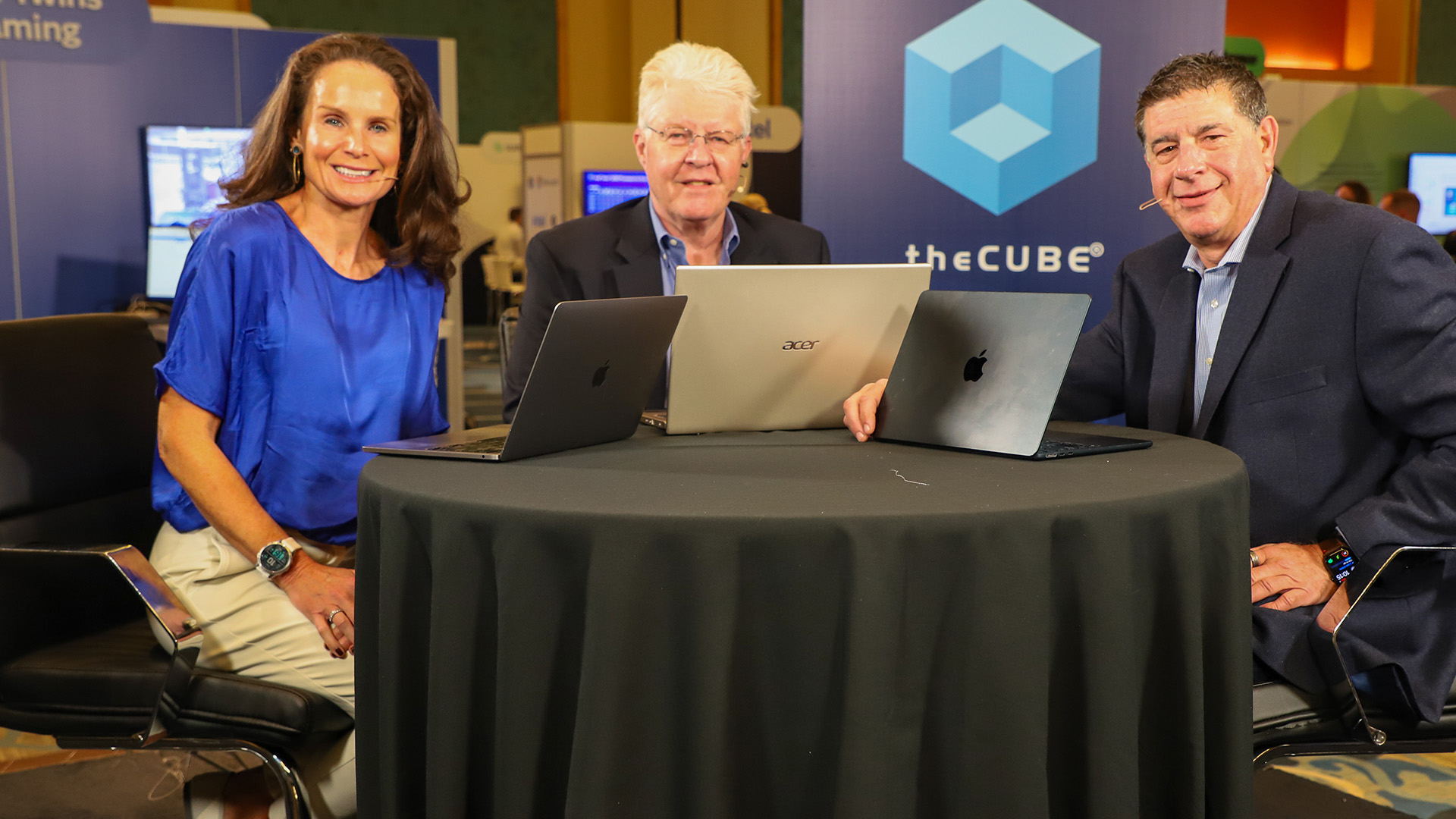
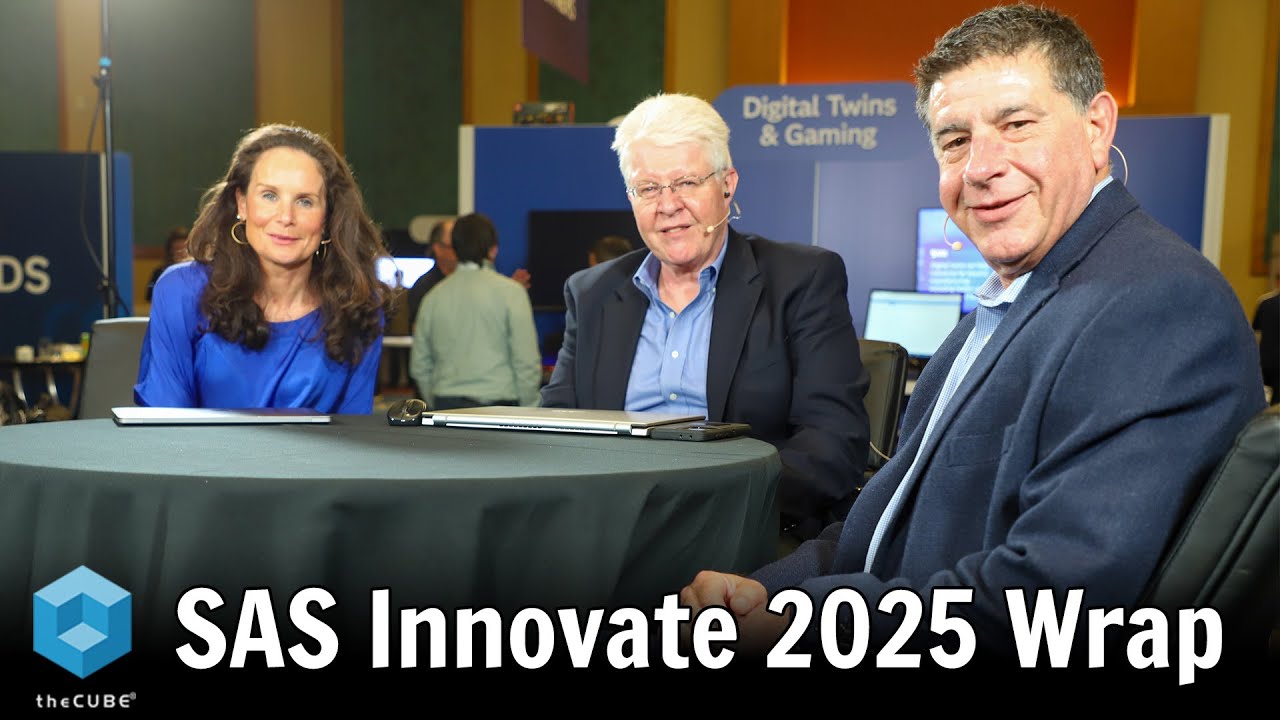
Scott Hebner, principal analyst of theCUBE Research, joins our distinguished hosts, Rebecca Knight and Paul Gillin of SiliconANGLE Media, at SAS Innovate 2025 in Orlando, Florida. This insightful video features key discussions on SAS's strategic direction, focusing on integrating advanced technologies such as artificial intelligence, digital twins, and quantum computing in business operations and decision-making processes.
The video begins with an introduction to the expertise of Scott Hebner as a principal analyst at theCUBE Research, alongside co-hosts Paul Gillin and Rebecca Knight. They highlight insights shared by Bryan Harris, Chief Technology Officer, and other SAS executives. Topics include the evolution of AI beyond generative models, with a focus on innovative solutions such as quantum AI and its implications for productivity and efficiency across various industries.
The discussion highlights SAS's unique approach to digital transformation, emphasizing the importance of trust in AI-driven processes. Hebner notes that the event underscores "decision intelligence" as a key theme, illustrating how SAS’s solutions enhance governance, risk management, and customer collaboration by utilizing real-world use cases. Furthermore, Hebner and Gillin analyze the practical applications of quantum AI and digital twins in industries such as manufacturing and consumer goods.
Forgot Password
Almost there!
We just sent you a verification email. Please verify your account to gain access to
SAS Innovate 2025. If you don’t think you received an email check your
spam folder.
In order to sign in, enter the email address you used to registered for the event. Once completed, you will receive an email with a verification link. Open this link to automatically sign into the site.
Register For SAS Innovate 2025
Please fill out the information below. You will recieve an email with a verification link confirming your registration. Click the link to automatically sign into the site.
You’re almost there!
We just sent you a verification email. Please click the verification button in the email. Once your email address is verified, you will have full access to all event content for SAS Innovate 2025.
I want my badge and interests to be visible to all attendees.
Checking this box will display your presense on the attendees list, view your profile and allow other attendees to contact you via 1-1 chat. Read the Privacy Policy. At any time, you can choose to disable this preference.
Select your Interests!
add
Upload your photo
Uploading..
OR
Connect via Twitter
Connect via Linkedin
EDIT PASSWORD
Share
Forgot Password
Almost there!
We just sent you a verification email. Please verify your account to gain access to
SAS Innovate 2025. If you don’t think you received an email check your
spam folder.
In order to sign in, enter the email address you used to registered for the event. Once completed, you will receive an email with a verification link. Open this link to automatically sign into the site.
Sign in to gain access to SAS Innovate 2025
Please sign in with LinkedIn to continue to SAS Innovate 2025. Signing in with LinkedIn ensures a professional environment.
Are you sure you want to remove access rights for this user?
Details
Manage Access
email address
Community Invitation
Keynote Analysis
Scott Hebner, principal analyst of theCUBE Research, joins our distinguished hosts, Rebecca Knight and Paul Gillin of SiliconANGLE Media, at SAS Innovate 2025 in Orlando, Florida. This insightful video features key discussions on SAS's strategic direction, focusing on integrating advanced technologies such as artificial intelligence, digital twins, and quantum computing in business operations and decision-making processes.
The video begins with an introduction to the expertise of Scott Hebner as a principal analyst at theCUBE Research, alongside co-hosts Paul Gillin and Rebecca Knight. They highlight insights shared by Bryan Harris, Chief Technology Officer, and other SAS executives. Topics include the evolution of AI beyond generative models, with a focus on innovative solutions such as quantum AI and its implications for productivity and efficiency across various industries.
The discussion highlights SAS's unique approach to digital transformation, emphasizing the importance of trust in AI-driven processes. Hebner notes that the event underscores "decision intelligence" as a key theme, illustrating how SAS’s solutions enhance governance, risk management, and customer collaboration by utilizing real-world use cases. Furthermore, Hebner and Gillin analyze the practical applications of quantum AI and digital twins in industries such as manufacturing and consumer goods.
Scott Hebner, principal analyst of theCUBE Research, joins our distinguished hosts, Rebecca Knight and Paul Gillin of SiliconANGLE Media, at SAS Innovate 2025 in Orlando, Florida. This insightful video features key discussions on SAS's strategic direction, focusing on integrating advanced technologies such as artificial intelligence, digital twins, and quantum computing in business operations and decision-making processes.
The video begins with an introduction to the expertise of Scott Hebner as a principal analyst at theCUBE Research, alongside co-hos...Read more
exploreKeep Exploring
What event are the speakers attending and where is it taking place?add
What was the focus of the keynote this morning and how has this company shifted its vision to embrace AI technology?add
What were your thoughts on the keynote presentation and the importance of human involvement in AI governance?add
What is Quantum AI and how is it being used to solve complex problems more efficiently?add
>> Hello everyone and welcome to theCUBE's live coverage of SAS Innovate 2025, here in Orlando, Florida. I'm your host, Rebecca Knight, and I have with me, not one but two CUBE analysts. We have Paul Gillin, who is my colleague from many years back. We go way back, Paul.
Paul Gillin
>> We do, I can't remember how long it's been.
Rebecca Knight
>> But it's a pleasure to be working with you again.
Paul Gillin
>> Always.
Rebecca Knight
>> And my first time working with-
Scott Hebner
>> Yeah.
Rebecca Knight
>> Scott Hebner, he joined theCUBE in September.
Scott Hebner
>> In September, yeah.
Rebecca Knight
>> So your first ever show, so this is-
Scott Hebner
>> This is the first show, first live show, yeah.
Rebecca Knight
>> It's going to be a ball.
Scott Hebner
>> It's going to-
Rebecca Knight
>> It's going to be a ball.
Scott Hebner
>> Yeah, it's going to be fun.
Rebecca Knight
>> So all three of us are fresh from the main stage, where we heard Bryan Harris, CTO, as well as a number of SAS executives, talk about SAS's vision, the portfolio. We heard about how models and via Copilot, other products are empowering people to be more productive, to make their lives easier. We heard Agentic AI, digital twins, Quantum AI. I want to hear, first, your thoughts, your impressions. Are you buying what they're selling? Paul, I want to start with you.
Paul Gillin
>> Well, SAS is always a fascinating company to me. I mean, I've been covering this company since the eighties. It will celebrate its 50th anniversary next year. How many software companies can say they've been around for 50 years and are not just around, but are actually growing and thriving? And you can see from the size of the crowd here, have an enthusiastic customer base. I thought it was interesting, in the keynote this morning, the focus on AI. This is of course a company that has had a long grounding in analytics but has really pivoted to a futuristic vision of AI. They're beyond generative, they're focusing on stuff like Quantum AI, that I wasn't even familiar with until this morning. They have a knack for looking out, looking around corners, looking over the edge and continuing to be relevant in a market that moves at light speed.
Rebecca Knight
>> Breakneck speed. Scott, how about you?
Scott Hebner
>> Yeah, I mean, I agree with Paul. I mean, they start off with a really good position here, right? They are a establishment in the world of data, and you see the signs around here that are saying, "Your AI future runs through your data." And I thought they did a really nice job in bringing that all to life today. And if there was one phrase that I thought defined it all, it was, "Decision intelligence." So they took everyone on a tour, right? Start with the data, they talked about Generative AI and what it's good for and what some of its limitations are. That led to a Agentic AI, into digital twins, and then, Paul, as you said, into Quantum AI. And then they brought it all to life through use cases, industry vertical. So it was a nice tour, from where they are now and what they're building, and they brought it to life with real customers, real demos, real use cases. I thought it was really good.
Paul Gillin
>> I agree with that.
Rebecca Knight
>> Yeah, I would agree with that, because in a way, the company's almost dismissive of Gen AI.
Paul Gillin
>> It really was.
Rebecca Knight
>> Exactly.
Paul Gillin
>> I mean, there was a slide they showed at the beginning that almost said we're in the post-Gen AI era and they focus more on the weaknesses than the potential. Which I thought was good, because we're seeing the real value of AI, is now entering more of these Agentic and digital twin realm. And generative, it's one use case, but it's not game changing.
Scott Hebner
>> It's building blocks. And actually, one of my predictions for AI this year was that Generative AI is going to meet the same fate as the browser wars 25 years ago.
Paul Gillin
>> Yeah.
Scott Hebner
>> Just like the browser became just a gateway into the world of the internet and people built around it to get the value out of it, Gen AI is kind of the same thing. It's a gateway into the world of AI, but it doesn't really allow you to make decisions. And that's what I thought was the real focus here was, we're going to build on Gen AI and agents are going to help you make decisions, digital twins are going to give you the what-if simulations to really figure out what to do. Quantum's going to help solve these highly dimensional, super complex data intensive workloads, because you need that compute power. And then we're just going to optimize it through our pre-built models and agents and services around your industry, your use case. Again, very nice tour that they brought the customers on that were in the audience.
Paul Gillin
>> And it did a good job of integrating the customers into the mix. Very often at these keynotes, customers are brought on stage just to deliver a soundbite, these customers actually had demos of what they're doing and how P&G is tackling the problem of mixing thousands of different ingredients in a way that one doesn't contaminate the other. And it's a problem of exponential complexity, and they showed how they're using Quantum AI to tackle that. And that was a really interesting example.
Rebecca Knight
>> Absolutely, because it's about the safety of the products that we are purchasing and imbibing in some cases. But then she also had a good point about making sure inventory was efficient. Some TikTok trend blows up a Pantene product.
Paul Gillin
>> Yeah.
Rebecca Knight
>> They've got to make sure that those shampoos are on the shelves when customers want to buy them.
Scott Hebner
>> Yeah, I thought they did a nice job too on emphasizing governance and risk management as a foundational message and human in the loop and human outside the loop sometimes, when it came to the agent. So they had the right mix and the right dimensions on things. And to your point about them mixing in customers and real use cases, it should be said without, even though they weren't on stage, but they're not going alone. They have sponsors like Microsoft, AWS, Deloitte, HPE, just to name a few, Red Hat. So they're doing it in partnership with others, which I think even further lowers the risk of moving down this journey with them.
Rebecca Knight
>> So Paul, you had mentioned the digital twins, which were a big buzzword on the main stage, and there are a growing number of digital twin solutions out there. What do you think makes the digital twin solutions that SAS is promoting, different and uniquely positioned to tackle some of the problems today?
Paul Gillin
>> I think they, or well, because they're statistically grounded. It's not just creating a digital model, they have use cases that are grounded in statistical analysis. The one they showed today was what Georgia-Pacific is doing with digital twins to maximize manufacturing productivity and to minimize accidents on the floor. And that's a case where a digital twin, that's a real useful application. I thought a vivid application of how digital twins can pay off in a manufacturing setting today. We see a lot of use of digital twins in construction, in product design, which are excellent use cases, but I thought how they differentiated today was showing how this technology can be used to improve existing processes.
Rebecca Knight
>> Exactly.
Scott Hebner
>> I think they had a different angle on it than I've been seeing from others. A lot of people talk about digital twins as a process thing on how digital workers work. This was very focused on simulations, what-if scenarios, again, in the realm of decision intelligence. And I thought the other thing that was interesting was the partnership with Epic Games. So they're bringing in someone who really knows how to do simulations in dynamically adaptable things based on what people are doing. So it not only brings an engine to it, but it brings an interface or an experience. So I thought it was a really nice take on digital twins, which of course are going to build on the agents that make the decisions.
Paul Gillin
>> Right.
Scott Hebner
>> So it's-
Paul Gillin
>> Digital twins are one manifestation of agents and agents should be turbocharging the use of digital twins in all types of different contexts, not just in product design.
Scott Hebner
>> Right.
Paul Gillin
>> But in modeling processes and improving processes.
Scott Hebner
>> Right.
Rebecca Knight
>> Exactly. So, as we discussed, they really talked about times when agents can work on their own and when you really need a human in the loop too, to either review what the AI is telling you and make sure that in fact you are getting the right information and flag issues that might be arising. How do you think SAS is working with its customers and working with the organizations to help them understand, okay, here's how we are going to implement this in our business. Here are times when we need a human in the loop and here are times when we can have the agent working on its own.
Scott Hebner
>> Yeah. I can jump in on that one.
Rebecca Knight
>> Yeah.
Scott Hebner
>> It brings me back to the governance and risk management angle that they really emphasized in the keynote. Because in the end, agents are only going to be as good as people trust them. If they're supposed to be digital coworkers, and you're going to be partnering to make decisions, and in some cases, if human workers aren't feasible or warranted, go off and make decisions and take actions on their own, people have to trust it. Trust is becoming the currency of innovation. No trust, no ROI. So the focus on governance is really key and they're making sure the agents are trustworthy. And I thought there was a really nice proof points behind what they're doing in that realm.
Paul Gillin
>> I thought the whole keynote was pragmatic, is the term I'd use. On governance, human in the loop, there was an article in New York Times yesterday about how reasoning agents, which are sort of the latest iteration of Generative AI, are actually more prone to hallucinations, as much as 70% in some models. That's concerning. This is a problem that we should be making progress on, not backsliding. And I think information like that just raises the concerns about reliability and doubles down on the importance of human in the loop. And I thought they did a good job of emphasizing that humans are not getting out of this process anytime soon.
Rebecca Knight
>> Particularly at a time where there are a lot of humans, i.e. workers, who are concerned about jobs displacement.
Scott Hebner
>> Yeah, yeah. Well, look, obviously, like I said before, AI decision intelligence, I think was the overriding theme here. So it's not just about trust. It does go back to the unicorn sitting on the rainbow and what they said about Generative AI. And they're a hundred percent right, 'cause a prediction is not a judgment, you need judgments to make decisions, and LLMs in Generative AI are really about predictions.
Paul Gillin
>> Right.
Scott Hebner
>> That's what they're about, the statistical probabilities. They don't have the understanding of what a judgment really is, and I think that's what they were writing about in the New York Times, I think you said, right?
Paul Gillin
>> It was in The Times yesterday.
Scott Hebner
>> Yeah. I think they clearly understand that.
Paul Gillin
>> I wanted to ask you about Quantum AI.
Scott Hebner
>> Yeah.
Paul Gillin
>> I was not even familiar with that term until this morning. They had a powerful example of what P&G use Quantum AI for, to solve a problem that had more permutations than there are atoms in the universe. Do you understand what... And the CTO said, "Quantum is right here right now," which I was unaware of. What do you know about this?
Scott Hebner
>> Yeah, it's starting to emerge out there, I mean, I think the big impact is yet to come. Without going too technical, it's a total reset on how a computer is architected and how it works, with some serious physics involved in it. I mean, it really resets everything and it unleashes a lot of limitations of what we have today. I would just think of it as, if you have highly complex, lots of permutations and combinations involved in a problem, and it's highly dimensional, meaning there's so many variables that are involved, like high dimensional spaces, and you need really intense compute, because you're working on massive, like huge amounts of data, that's what it's good for. And they pointed out that the traditional approach took six hours to do the work, where, what was it, three minutes?
Paul Gillin
>> Well, they got it down to two minutes with pure Quantum.
Scott Hebner
>> Pure Quantum.
Paul Gillin
>> But there were reliability problems, so they did a hybrid approach that got it down to 12 minutes, where the data quality was sufficient and the speed was-
Scott Hebner
>> Yeah.
Paul Gillin
>> Acceptable.
Scott Hebner
>> Look, the way I put it all together on their tour was, Gen AI is going to give you the ability to get into AI and to interact with it. Agents are going to help you make decisions. The digital twins are going to help you simulate what-if scenarios. And then Quantum's going to deal with your compute resources and your ability to get things quicker, at lower cost. And you're right, there's some quality issues that they pointed out with Quantum, and that's why they went with that hybrid model, where it gets you closer, faster, and then you finish it off with the traditional AI.
Paul Gillin
>> Yeah.
Scott Hebner
>> So again, they brought that all together into one holistic strategy, which was smart, differentiated, actually, I think.
Rebecca Knight
>> So both of you are overwhelmingly positive about the keynote, saying that it was pragmatic, practical, helped you understand, a great tour of where we are now and what's to come. Are there any questions remaining? We have a lot of great guests today, we're going to be talking to Jenn Chase, the CMO, Amy Stout, who is the Quantum computing expert, Amy McClure of product strategy, in addition to many others. What are some burning questions that you have that you'd like SAS to answer?
Paul Gillin
>> I think solving the reliability problem. As Scott noted, governance is a huge issue. I think trust is the major gating factor right now to broader use of AI in enterprises, and a legitimate one, and vendors have got to prove these models can be trusted.
Rebecca Knight
>> Excellent. How about you, Scott?
Scott Hebner
>> I won't repeat what you just said, I agree with that. I would say two things. One is, I think AI has become the ultimate team sport in technology. It's all about the ecosystem, 'cause these digital workers are going to have, you can't just hire from one place, right?
Paul Gillin
>> Right.
Scott Hebner
>> It has to work together, so. And I mentioned earlier when we were talking here, about the partnerships and the sponsorships. I want to hear more about what they're doing with the ecosystem, so it's not a SAS-only solution. Then the second thing is, I'd like to dig deeper into the technology behind the decision intelligence. Because that is, I think, the next frontier of AI over the next three to four years. Like the New York Times was writing about, you've got to be able to make reliable decisions, otherwise no one's going to trust this stuff.
Rebecca Knight
>> Exactly.
Scott Hebner
>> So I want to dig deeper into that.
Rebecca Knight
>> Exactly. Excellent. Well, this is a great conference, it's so many big names in technology, but also, Frank Abagnale, who is the bestselling author and the subject of Catch Me If You Can. Satya Nadella, Brené Brown, of course, Jim Goodnight, who is the founder and CEO of SAS. Stay with us, this is going to be a really fun show today. I'm excited to be working with both of you.
Scott Hebner
>> .
Rebecca Knight
>> I'm Rebecca Knight, for Scott Hebner and Paul Gillin, stay tuned for more of theCUBE's live coverage of SAS Innovate 2025. You're watching theCUBE, the leader in tech news and analysis.