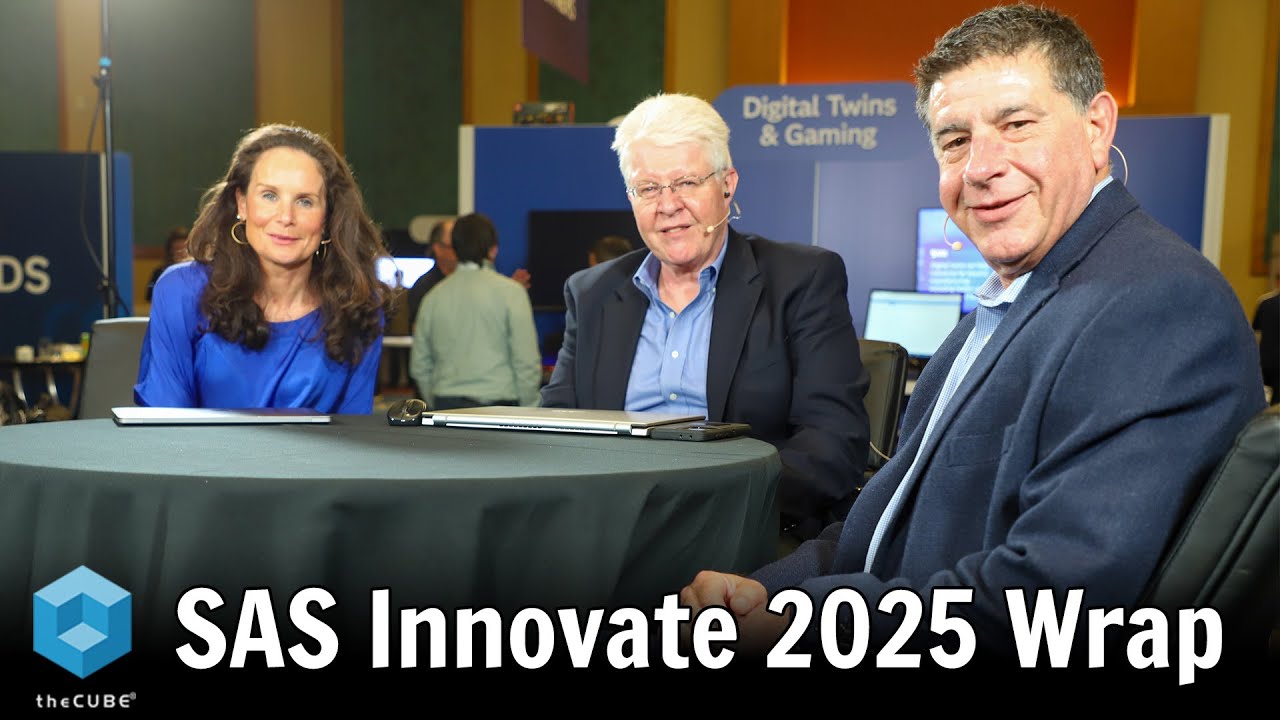
William Collis, head of games at SAS Institute; Paul Gavin, head of games analytics at SAS Institute; and Roshan Shah, vice president of AI and products at Georgia-Pacific LLC, join theCUBE’s Rebecca Knight at SAS Innovate to explore the surprising overlap between gaming and industrial AI. Their discussion spotlights how gaming technologies such as simulation engines and digital twins are driving smarter, safer and more scalable enterprise solutions.
Collins, Gavin and Shah discuss their collaboration with Epic Games and SAS, examining how realistic simulations and synthetic data are reshaping the way organizations optimize operations. Shah points to enhanced safety and quality through digital training environments, while Gavin details how simulation precision is fueling stronger AI models across the board.
The conversation also addresses Automated Guided Vehicle advancements and the value of game-derived analytics in high-stakes industrial settings. The discussion offers a grounded look at how creative tech crossovers are giving rise to powerful new use cases in AI deployment and process innovation.
Forgot Password
Almost there!
We just sent you a verification email. Please verify your account to gain access to
SAS Innovate 2025. If you don’t think you received an email check your
spam folder.
In order to sign in, enter the email address you used to registered for the event. Once completed, you will receive an email with a verification link. Open this link to automatically sign into the site.
Register For SAS Innovate 2025
Please fill out the information below. You will recieve an email with a verification link confirming your registration. Click the link to automatically sign into the site.
You’re almost there!
We just sent you a verification email. Please click the verification button in the email. Once your email address is verified, you will have full access to all event content for SAS Innovate 2025.
I want my badge and interests to be visible to all attendees.
Checking this box will display your presense on the attendees list, view your profile and allow other attendees to contact you via 1-1 chat. Read the Privacy Policy. At any time, you can choose to disable this preference.
Select your Interests!
add
Upload your photo
Uploading..
OR
Connect via Twitter
Connect via Linkedin
EDIT PASSWORD
Share
Forgot Password
Almost there!
We just sent you a verification email. Please verify your account to gain access to
SAS Innovate 2025. If you don’t think you received an email check your
spam folder.
In order to sign in, enter the email address you used to registered for the event. Once completed, you will receive an email with a verification link. Open this link to automatically sign into the site.
Sign in to gain access to SAS Innovate 2025
Please sign in with LinkedIn to continue to SAS Innovate 2025. Signing in with LinkedIn ensures a professional environment.
Are you sure you want to remove access rights for this user?
Details
Manage Access
email address
Community Invitation
William Collis & Paul Gavin, SAS & Roshan Shah, Georgia-Pacific
William Collis, head of games at SAS Institute; Paul Gavin, head of games analytics at SAS Institute; and Roshan Shah, vice president of AI and products at Georgia-Pacific LLC, join theCUBE’s Rebecca Knight at SAS Innovate to explore the surprising overlap between gaming and industrial AI. Their discussion spotlights how gaming technologies such as simulation engines and digital twins are driving smarter, safer and more scalable enterprise solutions.
Collins, Gavin and Shah discuss their collaboration with Epic Games and SAS, examining how realistic simulations and synthetic data are reshaping the way organizations optimize operations. Shah points to enhanced safety and quality through digital training environments, while Gavin details how simulation precision is fueling stronger AI models across the board.
The conversation also addresses Automated Guided Vehicle advancements and the value of game-derived analytics in high-stakes industrial settings. The discussion offers a grounded look at how creative tech crossovers are giving rise to powerful new use cases in AI deployment and process innovation.
William Collis & Paul Gavin, SAS & Roshan Shah, Georgia-Pacific
William Collis
Head of GamesSAS
Paul Gavin
Head of Games AnalyticsSAS
Roshan Shah
Vice President - AI & ProductsGeorgia-Pacific LLC
William Collis, head of games at SAS Institute; Paul Gavin, head of games analytics at SAS Institute; and Roshan Shah, vice president of AI and products at Georgia-Pacific LLC, join theCUBE’s Rebecca Knight at SAS Innovate to explore the surprising overlap between gaming and industrial AI. Their discussion spotlights how gaming technologies such as simulation engines and digital twins are driving smarter, safer and more scalable enterprise solutions.
Collins, Gavin and Shah discuss their collaboration with Epic Games and SAS, examining how realistic si...Read more
exploreKeep Exploring
What is the collaboration between Epic Games, SAS, and Georgia-Pacific regarding optimization of fleet of AGVs and simulation technology for better solutions?add
What are some of the primary uses of game engine technology and how has it evolved over time?add
What are some benefits of using automated guided vehicles (AGVs) in manufacturing and industrial settings, and how can this technology help streamline operations and increase efficiency on the ground?add
What are the potential future plans for expanding the partnership beyond AGV or manufacturing, and what areas could digital twins have a significant impact on?add
William Collis & Paul Gavin, SAS & Roshan Shah, Georgia-Pacific
search
Rebecca Knight
>> Hello, everyone, and welcome back to theCUBE's live coverage of SAS Innovate here in Orlando, Florida. I'm your host, Rebecca Knight, filling in also for Scott Hebner and Paul Gillin. We've got a great segment for you. I'd like to introduce our next guests. We have William Collis and Paul Gavin, both of SAS Game Analytics. Thank you so much, William and Paul, for coming on the show.
Paul Gavin
>> Thank you.
Rebecca Knight
>> And also Roshan Shah. He is the VP of AI at Georgia-Pacific. Thank you so much for coming on the show.
Roshan Shah
>> Thanks for having me.
Rebecca Knight
>> So we're actually going to be talking about video games. Like I said, it's a cool one, you guys. Why don't I start with you, Paul, and have you walk us through the collaboration with Epic Games and SAS and the larger vision behind it?
Paul Gavin
>> Absolutely, yeah. So we have had this vision of how can we use SAS's analytic technology, but in a new way, with new front ends or with new enhanced capabilities around simulation? So we had talked to GP about a use case in their plant where we wanted to optimize the fleet they have of AGVs. Traditionally, we would use optimization solvers for this, and they are still part of the solution in the back end on Viya, and we would like to have some sort of simulated environment where we could validate these analytical solutions. In the real world, things don't always end up working out how you think they will when you have a model for them. So in this simulated environment, you can show how, for example, traffic patterns slow things down when AGVs get too close to each other, or if someone walks around, in front of one, they have to slow down for safety, it makes them delayed on their route, they don't deliver the goods fast enough, and it backs up the whole system. So you can simulate these things in this realistic environment and feed that back into your optimization solver to get better solutions and to know whether they will actually work in the real world.
Rebecca Knight
>> Because that's the thing. Games, video games, actually are a really great potential and way for companies to understand what a dynamic environment is like.
William Collis
>> If you think of the legacy of games, they've basically been improving, since the entire generation to today, tried to become better and better, more complex simulations of reality. And so of course the entertainment uses were the primary uses historically, but now engines that are at such a point that they can really accurately simulate these complex, real-world processes, and again, you also get perfect data out of them, unlike sensors in the real world, we were saying like with an engine when you run something through, when you simulate, all of that data is instantly and accurately captured and can be used to feed really advanced AI and analytics in a way that just isn't possible with real-world experimentation.
Paul Gavin
>> Yeah. And the other great advantage is that you can then use these beautiful 3D assets we have... It's very photorealistic if you've seen the demo-
Rebecca Knight
>> You keep looking over there. The demo is right by.
Paul Gavin
>> I apologize. Yeah, our demo booth is right there, so you can actually see it. But you can use this same facility setup that you've already had to build for this simulated use case we're talking about and also use it to make synthetic training data for computer vision models. For example, worker safety is the big application that we're really interested in. In the real world, you have a lot of class imbalance when you're trying to build this sort of model. There's only little footage of dangerous things and there's millions of hours of just boring, nothing happening. That makes it hard to make a model that's balanced and able to classify things properly. So using this same setup that we have here, we can stream footage from these cameras straight into ESP, which is one of these SAS products, and you can both train and score these models in stream. So you don't need to scrub PII from the footage, which is very time-consuming. You don't have to hand-label all the images for human pose estimation. As you guys might know, a human being will go through every frame and click on every joint, every shoulder, elbow, knee.
William Collis
>> It's a nightmare.
Paul Gavin
>> It's crazy, right? Yeah, use Mechanical Turk for this often or whatever, but it's just thousands of hours of human labor to label these data sets. In a game engine, you obviously know the ground truth of all these things. You know exactly where everyone is in 3D space, can adjust the lighting to make a more robust data set or, say, add a blur filter, add different camera angles. All this stuff is pretty trivial to do in engine. It can make as much rich data as you need to train better models.
Rebecca Knight
>> So, Roshan, with that brilliant setup and explaining how it all works, tell us a little bit about... Well, actually, why don't you start by telling our viewers a little bit about Georgia-Pacific and what you do and then how you are piloting this approach?
Roshan Shah
>> Sure. So Georgia-Pacific, one of the largest pulp and paper companies out there, we make everything from toilet paper and paper towels to napkins and actually a lot of building products and cellulose, fluff pulp boxes, like liner board. And when you buy something from Amazon and it shows up in a brown box, quite often we make those. So that's us, GP. We're a privately owned company, about 140-ish facilities across North America. It's a fairly large company. We've been around for a bit, and we've got quite a bit of data that we can leverage to do data science machine learning on. In this particular instance, as we just heard, we generally have a lot of data off things running safely, and then very few instances, unfortunate incidents where we have unsafe conditions, it's very difficult to train those models. So we're really looking at this to help us generate more synthetic data such that we can train those models, and that's a game-changer. No pun intended there, but it's a pretty big opportunity for us to be able to leverage that, and that's what we're piloting with these guys here.
William Collis
>> . And I just want to kind of add, how cool is it that the same tool that is used to do, sort of as Paul touched on earlier, AGV and plant optimization is also used to generate synthetic data for worker safety? You would not a priori think those two things are linked at all, but digital twins are just so powerful and encompassing that once you invest in the upfront cost to build it, you really do get these multi-factor use cases.
Paul Gavin
>> Yeah, and particularly when you're using an engine that has such high fidelity, this is why we're using Unreal. You can build these truly photorealistic worlds. So really a lot of credit here, too, goes to the great guys at Epic and then Unreal.
Roshan Shah
>> Yeah. Huge point. I might even take that a step further and say, consider all the quality things that happens, quality defects. If the only way you learn that lesson of how quality defects occur is if it already happens and your customers are telling you, it's not ideal. Our thought process here... We're going to try it out. We've not done it yet. But thought process is, could we use this technology to generate less than ideal quality and be able to train our models so we know when that's occurring in real time? That's just another use case, and we can come up with countless examples. But safety, productivity, quality, we see applications across the board.
Rebecca Knight
>> So for manufacturers and industrial players, optimizing the performance of these AGVs, which are automated guided vehicles, is a really big deal. Roshan, can you describe a little bit about how this technology is helping streamline that and what exactly it does to help you manage and make these more efficient on the ground?
Roshan Shah
>> Yeah. So far, to be candid, what we've done is we've deployed this at one facility, and we're still testing, but the promise we see from it is that... It's evident right now is that we can use this capability to help us figure out, how do we guide those vehicles in the right places? And when we inevitably have unforeseen instances, so for example, say one AGV is moving and it accidentally drops something because of whatever reason, right? Well, every other AGV that comes behind it, nobody knows what to do with it unless a person gets involved and say, "Well, go do this instead." Well, then that is dependent on person. One could argue, is it really, truly autonomous? The thought process here is, well, what if we could simulate all different possible combinations and then train a model so we can kind of figure out how to guide the vehicles, what's the right number of vehicles, and what are the different situations we can think of, and simulate that versus having to go through with all of those... That becomes a huge opportunity for us.
Rebecca Knight
>> And how does it affect the teams on the ground? I'm thinking of the plant managers and the operations leads. How does having these digital twins make their day-to-day lives easier, safer, and also more productive?
William Collis
>> I'll give a short answer. I'm sure Roshan can expand, but I think bluntly it just makes managing and acting and plant and manufacturing or whatever setting you've deployed to digital twin in more intuitive because now you don't have to navigate through panels of tables and two-dimensional... You're literally seeing representations of what is actually happening in the plant right in front of your screen. That just makes it much easier to identify, diagnose, and solve problems.
Paul Gavin
>> Absolutely. Yes, you see some error that says there's a problem on sensor 213. Maybe you know roughly what building it's in, but it's not very intuitive how to find it and go fix it for predictive maintenance and application. But in digital twin, it would be blinking red, you could see it from the top-down view, and you would know exactly where it is if it's behind a machine in a corner, wherever, because you have this full realistic simulation.
William Collis
>> And also I think this is a bit of maybe a shallow point, but I think it's important, it just makes it more fun, too, to interact with your data, honestly. It makes it more like a video game, and video games, as we said, they're one of the most popular forms of entertainment today. Anything that kind of gamifies data I think also drives corporate productivity.
Rebecca Knight
>> That is not a shallow point because if work is more fun, then people are deriving more enjoyment and more satisfaction out of it, they're going to be more loyal to the organization, they're going to be a better colleague, they're going to be a better employee.
William Collis
>> Yeah.
Paul Gavin
>> Yeah. And I think the engineers of the future are going to expect these more intuitive UIs. The UI and UX in games is great because that's the core of the experience. Often enterprise software, maybe it's not as fun to interact with or quite as obvious as with how you should interact with it. I think that's one of the other great advantages here is that we're sort of building a product that is how people would like to interact with software in the future.
William Collis
>> Mm-hmm.
Rebecca Knight
>> So this collaboration brings together gaming tech with industrial AI. How do you bridge those worlds? Or maybe those worlds aren't too dissimilar in terms of the people who occupy those spaces. But how do you make sure that these tools are in fact usable to people who aren't necessarily engineers or data scientists, or frankly, gamers?
William Collis
>> Well, part of it is just obviously interface. So you saw, I think, or maybe the viewers or listeners will be able to see some of the online demos SAS will post. We don't just have a traditional 3D plant representation. There's also a rich 2D interface that we built out that allows for sort of more basic, tablet-driven customization and adjustments. So that's part of it. But I think another part of it is just honestly... Again, when you're modeling the real world, you just need less education and training to get people to interact with the data because it behaves... The simulation you have built behaves just like the real world.
Rebecca Knight
>> Roshan, what kind of setup or infrastructure do companies need to get started with this? Is it only for large enterprises, would you say, or could it scale down?
Roshan Shah
>> My opinion would certainly be that I don't think you'd need a large organization to be able to do this. It certainly helps having access to resources, but candidly, these capabilities are available and achievable, or within reach rather, so I don't think you need large enterprises. You might have use cases or examples that are relatively smaller, we may have slightly larger, and others may have even larger, but I think it's a bit more on a linear scale, in my opinion, so I think it's within reach for just about anybody out there that sees value in it.
Rebecca Knight
>> Yeah. And what have you learned so far from the experience? Anything that's surprising to you or something that you hadn't expected?
Roshan Shah
>> We've kind of been in a bit of a habit that when we ask these guys to come help us, partner with us, we'd normally think of throwing a large opportunity, a large problem at them. And in our case, we were kind of pleasantly surprised in terms of how quickly this proof of concept has been stood up. So in some ways the surprise has been, "Hey, did we think big enough, and do we need to rethink our strategy?" Again, that's a good problem to have. But we're pretty optimistic and pretty excited in terms of what's next, and so far it's been pretty promising.
Rebecca Knight
>> And what are your greatest hopes for this in terms of worker productivity, but also, importantly, worker safety? Because I think on the main stage this morning, there was a really staggering statistic that someone dies from a workplace incident every 90 minutes, which is tragic. These things can be avoided. What would you say are your greatest hopes for this collaboration?
Paul Gavin
>> Absolutely. I think the ability to deploy low-latency models on the edge, meaning in a facility, this is really one of the great strengths because these fractions of seconds matter for safety. One of the nice things about ESP is we can train these models in stream, as I was mentioning, so you stream data from the engine, you build better and better computer vision models to tag unsafe behaviors or people not wearing PPE, but you can deploy that straight into a security camera now. And so you have this immediate, no latency, nothing going to the cloud, slow things down, ability to get scoring in real time.
Roshan Shah
>> What I would add to that would be, for me, beyond the technology element of it is purely if we can partner and use this capability to solve a problem for us, that makes it safer. And look, this is not going to be the solution, or the only solution rather, that solves... This doesn't replace training and awareness and everything else that goes with it, but this is a critical element of helping us make our communal workplaces safer, not just within GP, but anywhere else. So for that matter, the pure application of this technology that gives us anybody in manufacturing an advantage to making the workplace safer, candidly I don't know that we need more reason than that to kind of go after it, and that's pretty exciting.
Rebecca Knight
>> So looking ahead, what is next for this partnership? Are there plans to expand beyond AGV or manufacturing or areas where digital twins could have a big impact?
Roshan Shah
>> Absolutely. However, what I'm focused on right now, kind of heads down in terms of... What we've been able to see so far from a pilot standpoint, we'd love to continue building and seeing that truly come to fruition here. We're very excited with what we're seeing, but we've got some work to do ahead. But certainly, beyond that, I think that's a rather large list in terms of what we might be able to do, quality of course being number one. We can also think about from a process simulation, like, "Hey, if we were to change our process in this way, what can we expect from an output standpoint," whether that's on manufacturing or beyond. So those are quite a few ideas we've kind of been simmering, but we're just trying to not get ahead of ourselves right now. It's pretty exciting.
Rebecca Knight
>> Yeah. Excellent. Well, William, Paul, Roshan, thank you all for coming on theCUBE. A really fun conversation involving video games of all things. I love it. I'm Rebecca Knight. Stay tuned for more of theCUBE's live coverage of SAS Innovate 2025. You're watching theCUBE, the leader in enterprise tech news and analysis.









 Rebecca Knight