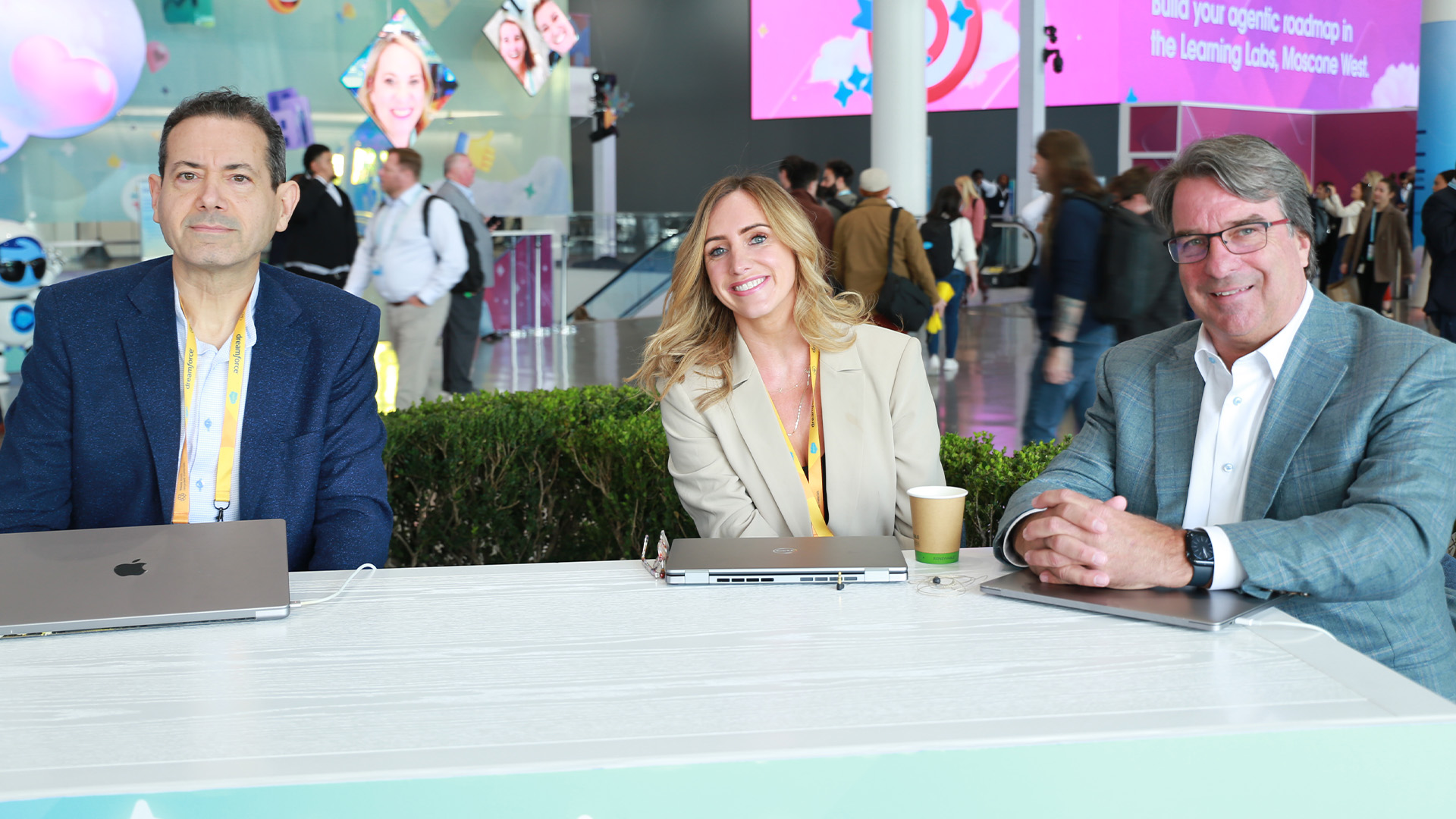
In this Dreamforce 2025 keynote analysis, theCUBE’s John Furrier is joined by analysts George Gilbert and Gemma Allen to unpack Salesforce’s next leap into the agentic enterprise era. The trio breaks down how Agentforce, Salesforce’s unified platform for intelligent agents, combines real-time Data Cloud context, Slack as the agent surface and integrated governance through MuleSoft to transform AI hype into operational reality. Gilbert explains why this moment may mark the biggest enterprise software shift in 50 years – unifying customer data, actions and observability under one stack.
The discussion explores Agentforce’s fourth release, new Command Center capabilities and the rise of “Datadog for agents” observability that captures reasoning traces and decisions for real-time analysis. They dive into how Agentforce and Data Cloud bridge business and IT roles, enabling organizations to deploy agents faster while maintaining guardrails around data, actions and governance. Allen offers a grounded view from Wall Street, emphasizing how enterprise buyers are shifting from AI demos to measurable business outcomes, while Furrier highlights the ecosystem effect that keeps Salesforce’s innovation grounded in customer reality.
From Klarna’s early agentic success to Dell’s new supply chain use case, the conversation captures Salesforce’s evolution from customer 360 to a full-scale data infrastructure and enterprise application platform company. It’s an essential watch for anyone tracking how data, trust and automation are converging into the next generation of enterprise productivity.
Forgot Password
Almost there!
We just sent you a verification email. Please verify your account to gain access to
Dreamforce 2025. If you don’t think you received an email check your
spam folder.
In order to sign in, enter the email address you used to registered for the event. Once completed, you will receive an email with a verification link. Open the link to automatically sign into the site.
Register for Dreamforce 2025
Please fill out the information below. You will receive an email with a verification link confirming your registration. Click the link to automatically sign into the site.
You’re almost there!
We just sent you a verification email. Please click the verification button in the email. Once your email address is verified, you will have full access to all event content for Dreamforce 2025.
I want my badge and interests to be visible to all attendees.
Checking this box will display your presense on the attendees list, view your profile and allow other attendees to contact you via 1-1 chat. Read the Privacy Policy. At any time, you can choose to disable this preference.
Select your Interests!
add
Upload your photo
Uploading..
OR
Connect via Twitter
Connect via Linkedin
EDIT PASSWORD
Share
Forgot Password
Almost there!
We just sent you a verification email. Please verify your account to gain access to
Dreamforce 2025. If you don’t think you received an email check your
spam folder.
In order to sign in, enter the email address you used to registered for the event. Once completed, you will receive an email with a verification link. Open the link to automatically sign into the site.
Sign in to gain access to Dreamforce 2025
Please sign in with LinkedIn to continue to Dreamforce 2025. Signing in with LinkedIn ensures a professional environment.
Are you sure you want to remove access rights for this user?
Details
Manage Access
email address
Community Invitation
Editorial: Day 1 Keynote Analysis
In this Dreamforce 2025 keynote analysis, theCUBE’s John Furrier is joined by analysts George Gilbert and Gemma Allen to unpack Salesforce’s next leap into the agentic enterprise era. The trio breaks down how Agentforce, Salesforce’s unified platform for intelligent agents, combines real-time Data Cloud context, Slack as the agent surface and integrated governance through MuleSoft to transform AI hype into operational reality. Gilbert explains why this moment may mark the biggest enterprise software shift in 50 years – unifying customer data, actions and observability under one stack.
The discussion explores Agentforce’s fourth release, new Command Center capabilities and the rise of “Datadog for agents” observability that captures reasoning traces and decisions for real-time analysis. They dive into how Agentforce and Data Cloud bridge business and IT roles, enabling organizations to deploy agents faster while maintaining guardrails around data, actions and governance. Allen offers a grounded view from Wall Street, emphasizing how enterprise buyers are shifting from AI demos to measurable business outcomes, while Furrier highlights the ecosystem effect that keeps Salesforce’s innovation grounded in customer reality.
From Klarna’s early agentic success to Dell’s new supply chain use case, the conversation captures Salesforce’s evolution from customer 360 to a full-scale data infrastructure and enterprise application platform company. It’s an essential watch for anyone tracking how data, trust and automation are converging into the next generation of enterprise productivity.
Principal Analyst, Data & AISiliconANGLE & theCUBE
In this Dreamforce 2025 keynote analysis, theCUBE’s John Furrier is joined by analysts George Gilbert and Gemma Allen to unpack Salesforce’s next leap into the agentic enterprise era. The trio breaks down how Agentforce, Salesforce’s unified platform for intelligent agents, combines real-time Data Cloud context, Slack as the agent surface and integrated governance through MuleSoft to transform AI hype into operational reality. Gilbert explains why this moment may mark the biggest enterprise software shift in 50 years – unifying customer data, actions and obse...Read more
exploreKeep Exploring
What insights has George Gilbert provided regarding Salesforce and the evolution of data as a strategic resource?add
What is the significance of Salesforce in the context of enterprise software transformation?add
What is significant about Salesforce's approach and its impact on the market?add
What are the challenges and considerations surrounding the practical adoption of AI in enterprise settings, particularly in relation to data management?add
>> Hello, I'm John Furrier, host of theCUBE. We are live here in San Francisco, California for Dreamforce 2025, where the next three days, we'll dive deep into the heart of Salesforce's AI revolution with leaders who are going to explain how intelligent applications are being developed out of the agentic infrastructure. We'll explore Agentforce, that's redefining productivity. I'm joined by co-host, Gemma Allen. Thanks. Good to see you. Great to see you From New York City, up here in San Francisco.
Gemma Allen
>> So excited to be here, John.>> And George Gilbert, the industry-leading analyst who's been digging deep into Salesforce over the past multiple years, as well as covering the data transformation, the data layers from how the infrastructure and then applications will change. Body of work is legendary. George, great to see you. Thanks for joining us this week.
George Gilbert
>> Good to be here, John.>> George, I want to just talk about this keynote analysis segment because first, the work you've been doing, the last year you published, with The Economist, a bunch of series of groundbreaking stories around digital twins, and that was the beginning of what I saw as that the pre-agentic tell signs of how data was going to evolve and be such a strategic resource, really key part of the programming side of it. And then, the work you've done over the past two years, specifically with respect to Salesforce, you identified the opportunity that they had in terms of how they could rethink or refactor or just create a future with data. Agentforce is a lot on that path. So, I have to ask you, as someone who's been following it, what's your take on the keynote? Obviously, Agentforce, agent this, agent builder, agent voice, agent agent insert word was the strategy. Michael Dell even made a cameo, which I thought was compelling. Both two executives the same age, but really the top story here is Agentforce is plowing ahead and they're laying down some announcements and changes. What's your analysis?
George Gilbert
>> So, the reason that I have been so high on Salesforce for so long is in the agent revolution, it's really the biggest transformation in enterprise software that we've gone through since the relational database, and maybe bigger than that, so that's 50 years. We've been building islands of applications and even analytic data. Even when you have one big data lake, you have islands of data within that. And Salesforce is the first major application vendor, or platform vendor, really, of any stripe who has all the pieces put together to be able to start unifying that. Now, it's not unifying everything end to end, but all the customer related data and processes, and that's really significant because it's like no more islands. Now, last year was all about agents. Now, we heard about agents this year, but the change was an emphasis more on customers and deployment because the pieces are so close to being all put together, mature and easy to use, that they can start to become transformative. What we're really looking for is that Klarna moment. I don't know if you guys remember reading about, I think it was like 18 months ago, the Swedish pay now, pay-
Gemma Allen
>> Buy now, pay later?
George Gilbert
>> Buy now, pay later. Thank you.
Gemma Allen
>> I'm a big online shopper, George.
George Gilbert
>> It was like a wildebeest moment, when all one of them stampedes across the river and then they all follow. That's the moment where everyone stood up and took notice that agents can really be transformative for a business. But Klarna was one of those tech-forward companies that could do it, they could build all the pieces themselves.>> They built it from the ground up.
George Gilbert
>> Right. Not everyone else can do that. So, what's so special about what Salesforce has done is they've packaged up all the pieces and they're almost ready to go where everyone else can have that Klarna moment.>> And the data that they have, I've always been not critical of Salesforce, but they grew by a lot of acquisitions. Some would say they had little stovepipes, as Dave Vellante would say, but they can abstract that away. And the underlying infrastructure is changing, as well as the apps and Product2 is obviously the top line. Gemma, you and I were at the HumanX conference, and then RAISE, I think you moderated like 15 panels. That's what I call the real end market. So, you see AI hype is right there now, but the hype is being met by actual solutions. I think the agents are seeing the change to data anywhere. What's your take on the keynote? Because you have the market shifts, we saw that at the RAISE Summit in Paris in July. The market is frothy for answers. What's your analysis?
Gemma Allen
>> I think the hype side of AI, I mean it's hard to underestimate how many times a day we say AI, right? We've been at the NYSE together for the last few weeks, John, and I think we probably say it maybe sometimes 20 times a minute. But I think what's really interesting about the enterprise adoption space, and I really would love to get your take on this too, George, is there is definitely still a layer of skepticism, like what does this mean in practice? And for Salesforce and their ecosystem and the customers that use those products every day, how actionable is it to go from work automation to AI orchestration in such a short pace of time? And you mentioned data, and one thing we know about data is it's the fuel for AI, but it's also very, very difficult to clean. So, how will that play out in practice? Where do you see that conversation around skepticism versus reality? What's your thoughts?
George Gilbert
>> Well, the key point you made in there was data. What a lot of people lose sight of is in the age of AI, you program agents with data, not with code. And so, the data that you have and how it's shaped and how fresh it is determines how effective your agents are. I know this is going to sound a little maybe colloquial, but there are more agent development tools than there are fleas on a camel. What distinguishes your agents-
Gemma Allen
>> I'm going to rob that, George.>> A lot of fleas.
Gemma Allen
>> There's a lot of fleas.>> out there.
George Gilbert
>> There are.>> I mean, it's early. People don't know how to do it.
George Gilbert
>> But the point is, what differentiates it is the scaffolding around... The scaffolding is the data model that you have and the actions in your applications to operationalize the decisions that the agent takes. So, for all those 200,000 customers who have Salesforce applications, there's only one way to really get it done simply, and that's the Agentforce and Data Cloud.>> Okay. I want to ask you because I think this comes up a lot. The hype side, which is the market. Clearly agents is a line of sight into how agents can work. I think there's a ease of use. How do I do... Everyone has a, "Okay, how do I get started?" It's very techy, very under the covers. But George, I have to ask you, with this keynote, obviously, I mean Salesforce lays out the messaging beautifully, they back it up with the product. What's the key change from last year? Because last year we were here at the NYSE doing interviews. We met all the SVPs of engineering. The data cloud was hot. We saw them really digging in. They were making change. They were engineering. What's the big change this year from last year? Can you point to anything?
George Gilbert
>> Okay. Yes, some critical things. One, we are on the fourth release of Agentforce since last year, but just as important in Data Cloud, there is a testing center, which is like an observability platform. It's like Datadog for agents. But unlike Datadog, which logs metrics, events from your microservices, this captures the reasoning traces and the data and the decisions and the actions that each agent takes, and it captures that fine thread. It's the new big data. The old big data was clickstream analysis of your website interactions. Now, it's all the data related to all your agents in operation, but it's merged with all the other data you have, in this case that Salesforce captured about the customer journey. So, it's having both of those together. So, now you can analyze the customer journey and your agents and you've unified it all in one platform. Then, there's also Command Center, which is a way to govern your agents and to track their performance. So, it's a much more mature platform this year. And so, the emphasis of the keynote was less on, "Oh, here are all the new features and products," and more on, "Let me show you five big showcase customers and what they're doing." Not quite yet at the Klarna sophistication, but getting closer.
Gemma Allen
>> We have some great guests coming on today. I think we're going to get some great examples and use cases around that. But one thing that was so evident to me flying out from New York last night where it was just a plane of Salesforce merch. I don't know if you had that in the boarding lounge, it was... And even today, coming in here, Salesforce has done an incredible job of building an ecosystem. It's huge, right? The trailblazer effect. It's hard to deny how successful they are, but in this agent world, in this Agentforce world, how do you keep that same ethos and that collegiality for an industry like this when it's changing so fast?
George Gilbert
>> Well, as with any platform, their value is as much in the ecosystem as in the application and platform itself, but they're also trying to reach out to a new audience. When you talk about the ecosystem, the critical new part of the ecosystem they have to reach is it they've been very strong in the business, the head of sales, head of customer service, head of field service. And now, a lot of the first implementations for agents, the CEOs give it to IT, and either the CIO or chief data officer or chief technology officer, but those guys are not always connected to the business, and success requires bridging both of those.>> And that's why we're here-
George Gilbert
>> And so, the ecosystem has to help them.>> And that's our tribe too. That's our ecosystem. Gemma brings up a good point. I want to get both your thoughts on the word data 360. At first, my reaction was, "Oh, just another 360. Is it 365? That's Microsoft. That's theCUBE 365." But 360 gives that 360-degree view. George, I know it's a name change, but I had some questions from last year. I watched your analysis last year and I watched all your podcasts. The big theme I heard was unifying structured, unstructured data, did that remove any hurdles? And then, two, you talked last year a lot about harmonization. So, the question is, does the data 360 actually do the job of unifying structured, unstructured data? And are there examples where you can see that the harmonizing makes the automation smarter? Because at the end of the day, the agents have to do work.
George Gilbert
>> Yeah. No, it's a good point because unstructured data has been the dark matter of enterprise information for a long time. And I don't know how far along... They mentioned it, but we got to get more of the details. But yes, and they showed in one of the demos, shredding a 250-page document, so they could answer a customer support question. So, just as you were saying, it's not just harmonizing the structured data, it's mining the unstructured data to be able to answer those difficult questions that used to be buried. So, it's more than a name change. This has been maturing rather rapidly. And just to be clear, it's not a replacement for the Databricks or Snowflake. Those are the repositories for your data from all your processes and applications here. This is like the customer data platform. So, rather than having a customer data mart, this is much, much richer because it models not just the customer, but the engagement processes and that is expanding, and I know just I'm running on a little long on the five customers they brought and showcased. The last one was Dell, and Michael Dell himself delivered the testimonial. And what was really revealing, and I can't overemphasize how important this was, their ambitions were revealed in that customer reference because they didn't stand them up to talk about customer 360. They stood them up to talk about the supply chain company they just bought. And one of the things that we learned when we talked actually to MK and Alice Steinglass, who's the engineering lead and the->> At Salesforce, yeah....
George Gilbert
>> product lead for the entire Agentforce platform and the data platform. MK's like, "You know, we're not stopping at customer data." And getting Michael Dell to stand up here and say, "We have 17,000 people on the new supply chain app," that is a signal of their ambition, along with the Informatica buy, to go well beyond the customer->> George, what you're saying is they're a data infrastructure company, that's what Salesforce is.
George Gilbert
>> They are transforming from a customer 360 application company to an enterprise application platform company and the new platform is data and agents.>> And I would submit and take the position that in order to do that, they have to be a data infrastructure company, sit on top as a shim layer on top of the GPUs and all that. Gem, I want to bring you in because we're hosting down at the NYSE, our new CUBE Studios. I'll see with NYSE Wired and Brian Baumann, the program we're powering. You connect Wall Street and Silicon Valley, which we've done with theCUBE, and bring those two communities, as we bring tech content to New York and then New York content to Silicon Valley. What is your perspective? Because the New Yorkers were like, "Well, show me the money." Where out here it's like, "Wow, shiny new toy."
So, as you bridge, and George was an analyst, he knows this game too. I'd like to get his perspective. What is the New York vibe on this? Because they're going to look for results, and I think that's something that we're seeing here. This isn't a rah-rah Salesforce conference like it normally is, certainly have that. It's beautiful out here, great celebration, but they got to have meat on the bone here.
Gemma Allen
>> Yeah. Well, I think for AI, especially for enterprise, it's not, "Show me what you say. Show me where you spend," right? So, I think that's a really, really big factor on Wall Street, as we know, John, that's all anyone really thinks about is where the money is flowing to and from. So, I think there's been a huge, huge, huge investment in enterprise adoption this year. I think though, to the point that George made earlier, people really want to see the value now. You want to actually see those use cases play out, right? You want to see those examples. There were some great speakers there in that keynote, like Giovanni and others. So, I think we need to see it and visualize it in real life.>> George, what's your take.
George Gilbert
>> In fact, I think I was talking to Marc a few months ago and he was like, "I want to show just talking to customers, this keynote, not lots of demos." And we did not see lots of demos of just raw product. What we saw were like William Sonoma getting up and showing an agent that they had on their website that they got live in 30 days. And then, we did see demos of the vibe coding product where Patrick Stokes from Salesforce coded up a map of Dreamforce and how to deploy mascots, but->> That whole vibe coding is going to put a lot of pressure on the agent market because you're going to have people saying, "I want this. I just built it." But to make it truly bulletproof, you got to have state, you got to have a good data architecture. It's got to work end-to-end. It can't fail in production.
Gemma Allen
>> But also, security, right? That's also a very important part of this conversation is in a world where everyone's a developer, how do you manage that from a guardrail perspective? I think that's a huge, huge question right now.
George Gilbert
>> You're going back to their core strength, which is this common platform that gives you governance of the data, richly-modeled data, common governance of the actions the agents can take and governance of the agents themselves. And if you had to cobble that together, just like trying to manage security over MCP. Anyway, that's part of this all-in-one. It reminds me of 30 years ago when I was covering SAP, when they're just taking off in the US and everyone was saying, "Oh, well, we have a better app for this little module," or, "that little module." And Hasso Plattner got up at this small offsite. I don't know if you remember reading about it. He goes, "We're going to grind you all into dust because we have this one integrated data and process model, and customers just cannot stitch this stuff together themselves." And after 10 years, he was right.>> Of course, he's going to start grinding everyone into the dust. We'll leave it there. George, great to kick it off with you on your announcement. We'll be seeing you all throughout the day. If you're watching theCUBE, three days here, we'll be exploring all the action. Gemma and I will be hosting with the leaders within the Salesforce ranks, their customers, partners. Of course, we'll be bringing that all to you live. We're going to grind this place into the dust. I'm John Furrier with Gemma Allen and George Gilbert. Thanks for watching and stay tuned.