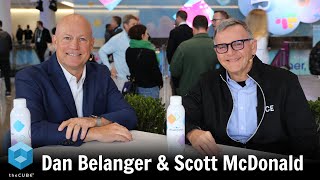
In this Dreamforce segment, PepsiCo leaders Dave Dohnalik (senior vice president of technology strategy and enterprise products) and Johannes Evenblij Garza (senior vice president of global sales and marketing transformation) join theCUBE’s John Furrier and George Gilbert to share how a decade of AI work and a 10+ year Salesforce partnership are converging with Agentforce. They outline unifying ~100 contact centers on one system and consolidating data for a 360° customer view across more than 6 million customers who reach billions of consumers weekly – shifting from reactive service to proactive, “next best action” engagement.
The conversation breaks down the operating model: roughly 50/50 traditional ML and agents working with humans, frontline reps using mobile “digested briefs” to tailor assortments and promotions and automation removing routine work so teams can focus on higher-value tasks. They also detail five foundational bets over the past five years – enterprise data standards/quality, a strengthened transactional backbone, forward-leaning cybersecurity, simplified apps and platform standardization – that enable agents end-to-end across make-move-sell.
PepsiCo shares adoption lessons (e.g., suggested orders often taking ~10 cycles to fully land) and why they pivoted from scattered POCs to growth-anchored use cases. Developer response has been enthusiastic, with agents offloading repetitive tasks and unlocking more “brain cycles” for impact as deployments expand from Latin America and North America into Europe.
Forgot Password
Almost there!
We just sent you a verification email. Please verify your account to gain access to
Dreamforce 2025. If you don’t think you received an email check your
spam folder.
In order to sign in, enter the email address you used to registered for the event. Once completed, you will receive an email with a verification link. Open the link to automatically sign into the site.
Register for Dreamforce 2025
Please fill out the information below. You will receive an email with a verification link confirming your registration. Click the link to automatically sign into the site.
You’re almost there!
We just sent you a verification email. Please click the verification button in the email. Once your email address is verified, you will have full access to all event content for Dreamforce 2025.
I want my badge and interests to be visible to all attendees.
Checking this box will display your presense on the attendees list, view your profile and allow other attendees to contact you via 1-1 chat. Read the Privacy Policy. At any time, you can choose to disable this preference.
Select your Interests!
add
Upload your photo
Uploading..
OR
Connect via Twitter
Connect via Linkedin
EDIT PASSWORD
Share
Forgot Password
Almost there!
We just sent you a verification email. Please verify your account to gain access to
Dreamforce 2025. If you don’t think you received an email check your
spam folder.
In order to sign in, enter the email address you used to registered for the event. Once completed, you will receive an email with a verification link. Open the link to automatically sign into the site.
Sign in to gain access to Dreamforce 2025
Please sign in with LinkedIn to continue to Dreamforce 2025. Signing in with LinkedIn ensures a professional environment.
Are you sure you want to remove access rights for this user?
Details
Manage Access
email address
Community Invitation
Dave Dohnalik & Johannes Evenblij Garza, PepsiCo
In this Dreamforce segment, PepsiCo leaders Dave Dohnalik (senior vice president of technology strategy and enterprise products) and Johannes Evenblij Garza (senior vice president of global sales and marketing transformation) join theCUBE’s John Furrier and George Gilbert to share how a decade of AI work and a 10+ year Salesforce partnership are converging with Agentforce. They outline unifying ~100 contact centers on one system and consolidating data for a 360° customer view across more than 6 million customers who reach billions of consumers weekly – shifting from reactive service to proactive, “next best action” engagement.
The conversation breaks down the operating model: roughly 50/50 traditional ML and agents working with humans, frontline reps using mobile “digested briefs” to tailor assortments and promotions and automation removing routine work so teams can focus on higher-value tasks. They also detail five foundational bets over the past five years – enterprise data standards/quality, a strengthened transactional backbone, forward-leaning cybersecurity, simplified apps and platform standardization – that enable agents end-to-end across make-move-sell.
PepsiCo shares adoption lessons (e.g., suggested orders often taking ~10 cycles to fully land) and why they pivoted from scattered POCs to growth-anchored use cases. Developer response has been enthusiastic, with agents offloading repetitive tasks and unlocking more “brain cycles” for impact as deployments expand from Latin America and North America into Europe.
SVP, Global Sales and Marketing TransformationPepsiCo
In this Dreamforce segment, PepsiCo leaders Dave Dohnalik (senior vice president of technology strategy and enterprise products) and Johannes Evenblij Garza (senior vice president of global sales and marketing transformation) join theCUBE’s John Furrier and George Gilbert to share how a decade of AI work and a 10+ year Salesforce partnership are converging with Agentforce. They outline unifying ~100 contact centers on one system and consolidating data for a 360° customer view across more than 6 million customers who reach billions of consumers weekly – shifti...Read more
exploreKeep Exploring
What event is being covered, and who are the guests being interviewed?add
What are the perspectives and significance of Agentforce for individuals who have been involved in its development and implementation?add
What steps are being taken to improve customer service and data management in the organization?add
What steps were taken in the technology transformation over the past five years?add
>> Welcome back everyone. I'm John Furrier, hosting theCUBE here in San Francisco. We're live at Dreamforce 2025 with George Gilbert, theCUBE research industry that's covering the area. I got two great guests here and the marquee, I won't say sponsor of the show, but they're here in person. We've got Pepsi on the desk. PepsiCo is here. They were on stage in the keynote. Longtime customer of Salesforce, massive data estate, big enterprise. They've got a lot of transformation, doing a lot of great things. Dave's here, SVP of technology, strategy of Enterprise Products. Thanks for coming out. And Johannes, senior vice president, Global Sales Marketing Transformation. Welcome to theCUBE. Thanks for coming on.
Johannes Evenblij Garza
>> Thank you for having us.
Dave Dohnalik
>> Thank you for having us. Really appreciate it.>> First of all, I love the Pepsi. I love the keynote. Really one of the marquee set pieces in the keynote, talking about one, the journey you guys had with Salesforce, but the modernization, some of the things you're doing is pretty compelling. First question is what do you think about Agentforce as you've been on the journey? What does it mean to you guys? Give us a quick hit on what it means for you guys.
Dave Dohnalik
>> Yeah. I can start. So we've been on our AI journey for about 10 years, and so I would say it was very traditional transformation, a lot of focus on data, et cetera. And over the last year we've had a 10-year relationship with Salesforce, and as we introduced Agentforce, we've seen a massive unlock in terms of some of the capabilities that we've been able to think and frankly stretching our thinking in terms of the art of the possible around how we interact with our consumers and our customers around the globe.>> Johannes, what's your take?
Johannes Evenblij Garza
>> We're very excited and we're going to talk a lot more about the different use cases, but I think as Dave is saying, we've had a very long relations with Salesforce. We've implement it in Latin America and North America, now expanding into Europe, and now we're seeing a huge growth unlock. So we're going to talk a little bit more.
George Gilbert
>> So maybe elaborate. What we saw a hint of, on the keynote was this way to sort of have touch points with millions of retailers who themselves then have touch points with billions of consumers. Walk us through the system to support that and what that enables now that you can have a more unified conversation.
Johannes Evenblij Garza
>> As you're saying, PepsiCo is a very complex ecosystem. We have more than 6 million customers who, every week, deal with billions of consumers and more and more, everybody wants a personalized experience. So managing this very complex system requires a back office that can have all that information readily available so we can provide great service to our customers. And that's exactly what we're doing now. We're consolidating all the data in this new ecosystem. We have about a hundred contact centers in the world. We're putting them together under one system with one playbook, one tech backbone, one way of interacting with the customers. And that's allowing us then to really offer one consistent and very productive way of interacting with them. It also is allowing us to take routing work out of our Salesforce, our front line, automate it, and then our front line can then focus on having higher value added work and perfect the in-store execution and also deliver better insights to our customers.
George Gilbert
>> So there's a theme we've heard multiple times where it's not downsized an entire organization so much as up-level the type of work they do. But tell us when you've unified the contact center, it sounds like the tech stack and the policies, the processes, but then it also sounds like the information that a retailer might come to PepsiCo for, they can see through another channel. I assume that's part of it is that you've got multiple touch points that are now harmonized.
Johannes Evenblij Garza
>> Yeah. Exactly that. When we put all the data together, you get really a 360 point of view of all the touch points that we have with the customer being credits, the delivery, the order, the loyalty program, the promotions, all of that comes together. When we get a request for service from our customer, we're able to then answer it. But then what's very interesting is that level of interaction because now we know you get that intimacy with the customer, then that interaction becomes a next best action. So what is the best promotion that we can offer to that customer? What is the assortment that is missing with that customer? And then we offer that at a very tailored and localized level, and our customers just love that.
George Gilbert
>> So break out for us, how much of that is traditional sort of machine learning where you're saying the next best action is a prediction of you're classifying or could be a classification, like this is the context, this is the state of the customer, which of these actions should we recommend next? And then how can agents facilitate the integration and processing of all that work?
Dave Dohnalik
>> It's about 50/50 in terms of what I would consider traditional machine learning models and then the agents on top of it and our journey, we've had some of these capabilities in place for a while, but I think the unlock we've seen is this idea, as you said, of agents working in conjunction with our human workforce to really uncover some insights maybe they weren't seeing in the data, but more importantly for our customers and getting to very proactive suggestions that they can act on themselves real time. And it's everything from my order is late, how do you want me to handle that situation, and interacting with them versus them calling a contact center, what they do today and having the human agent have the information, which is very reactive. So we had those insights, but it's how do you unlock that with Agentforce and really bring that dynamic, more proactive interaction, not only for our internal employees from a contact center perspective and field sales, but also directly with the customers.
Johannes Evenblij Garza
>> And it's a step change. If you think about it, the customers love when we tell them, "Hey, this product is selling very well in all the stores around your store, but you don't have it, right?" So they love when we say that, but also our own frontline people because typically they go 15, 20 stores a day, they don't really have time to understand, "Hey, what do you need customer? And can I understand all the shoppers that you're having around?" Now they go and they can see in their mobile app a digested brief on exactly what is needed and then they talk and they can discuss it in just in a couple of minutes with the customer. And it works really well.>> You guys are trailblazers, obviously the theme that they call their elite, but you guys had made good bets. So two questions. What was the bet you made a decade plus ago that put you in a position to take advantage of the new step function change with agents? Because most companies, especially consumer goods companies, data lives in silos, point of sale, e-commerce, CRM, marketing, automation, all partial truths. What did you guys do? Because this is not easy.
Dave Dohnalik
>> No.>> I mean you're at scale.
Dave Dohnalik
>> Yes.>> Okay, so what were the bets? When did you make them, and then when did you know that, "Oh, wow, we made a good bet," or "We did it by accident on purpose." Take us through, Dave.
Dave Dohnalik
>> Yeah. We started our technology transformation five years ago, and there were five big bets that we made. One was our enterprise data foundation. To your point, being a global company in 200 countries, we had data everywhere. No standards. So we brought all of that together, data quality, data standards, number one. Number two, we lacked a basic transactional backbone. And so we've been on that journey for the last five years. From a cyber security perspective, knowing that AI was going to play a bigger role, started to invest ahead of the curve in terms of just not traditional threat protection, but where is this heading and making sure we're architecting for success and then simplifying frankly, our application portfolio. So in order to transform, we knew if we didn't get some of the complexity out of our system and have one way that we could operate processes so that it could be a human and agent interaction to execute that end-to-end process, we knew we wouldn't get there. And so we've been working hard making significant investments over the last five years. And so I would say it was about 18 months ago when we really saw all of this starting to come together in conjunction with a business transformation that says, "Here's the big idea.">> Complexity first and architecture's in parallel. So you were going after what? Complexity?
Dave Dohnalik
>> Complexity, standardization, platforms. And so we've had a long history with Salesforce, as Johannes was mentioning, over 10 years. But frankly, the way we were using them was also very siloed. So how do we bring that together, work with them to invest in the platform in the right way for a big unlock?>> Okay. So there's a famous quote. Thomas Edison said, "I failed 2000 times before I invented electricity." Now, George had quoted in a segment early about the famous MIT study that most AI projects fail.
Dave Dohnalik
>> Oh, sure.>> I'm like, okay, first of all, I think it's BS. I call out that out and I check the surveys, not really have a lot of meat to it, but what did you guys learn? What were some of the things that came out of this? Because not everything goes to production. So talk about that dynamic of how you guys would look at that, incubate projects, when 18 months ago when you say, "Oh, wow, we got lightning in a bottle here." What do we do? What were some of the thoughts? Can you share?
Johannes Evenblij Garza
>> And I would add to what Dave was saying, change management has been a huge journey. So we've been on this journey for about more than 10 years, and every step adds to it. So now people in the company are very used to working with apps to accessing things on a mobile solution, to calling and getting data from the system. So that allows us then to go to the next level because you have that trust that actually the system work. We've had that with, for example, suggested order. We have millions of customers out there and salespeople go there. And when we started to implement the suggested order, yes, the suggested order was taken, but really it was a sales guy adjusting it to whatever he thought was the right thing. So we know now that it takes about 10 cycles for actually the customer to start using the suggested order and get used to it. So now we know that and we put it into accounting. Every time we have the learning curve, we know that that's what's going to happen. So we know there's a certain adaption. So we had a lot of learnings that make it now easier to adapt it because let's say we know we need to be patient and we know that there's a learning curve that needs to happen.
Dave Dohnalik
>> And I think the other piece is early days, like every other company, there were a lot of experimentation, POCs, which I think go a lot to that 93% denominator. And so we quickly pivoted and said, "What are the use cases that are going to be the big incremental growth driver for the company?" And that's where we put our focus to Johannes's point and what is the set of ingredients from an architecture perspective, from a data perspective, from a change management, from a user experience to really bring those to life like you would with any transformation initiative?
Johannes Evenblij Garza
>> It's a never-ending process. We always have a pipeline of things we're testing out to see the... And honestly, we always say, "If half of them are working well, hey, we're doing great because we need to fail, because otherwise, we're not really pushing the boundaries.">> Right. Yeah. AB test cut. I heard someone say, "AB tests are so passe. Just put it out there. If the active users are up, sales are up, it, okay, works. Try something else."
Johannes Evenblij Garza
>> Exactly.>> Sorry, George, I didn't mean to interrupt your line of question.
George Gilbert
>> I wanted to come back to that big transformation that you guys were talking about. Did you start with the notion that you wanted to work back from sort of enabling, almost like unified self-service for the retailers and then start to integrate the data and applications first that supported that and then spread from there? Because the first thing you mentioned was the data foundation. I'm curious what that looked like before and then what were the steps to start unifying that?
Dave Dohnalik
>> And some of it has been an evolution. I mean, we reserved the right to learn along the way. We started from a position where there was not a single source of truth for the company in terms of where we were because we didn't have a common set of data. And so that began the journey in terms of how do we want to run our make, move, sell operations? And then as we were going through that process, then you start to get some of these insights in terms of, oh wow, I can really automate more. Oh, wow. Some of these insights, much more from a predictive, proactive perspective. And so I wouldn't say day one. We knew that was going to happen, but a couple of years in, we started to see the power of having all this data harmonizing together.
George Gilbert
>> I don't imagine you did an enterprise-wide sort of data modeling effort. Did you start with one use case in mind?
Dave Dohnalik
>> No, we went large.
Johannes Evenblij Garza
>> We went bold.
Dave Dohnalik
>> Yeah. Because our-
Johannes Evenblij Garza
>> We went bold. It's a big investment.
Dave Dohnalik
>> Because if you think about our operations, I mean, we sell seeds to farmers, we buy the potatoes, we make the product, we sell the product, we ship the product, and we put the product on the shelf.>> That's huge.
Dave Dohnalik
>> Correct. And so the idea of solving data for one area of that wasn't going to drive value for us as a company. We had to solve it across the end-to-end value chain.
Johannes Evenblij Garza
>> Throughout many years. And really, we're now at a point that where we now can put AI through it because we've done the->> The data works....
Johannes Evenblij Garza
>> investment into the pipeline to get access to the data.>> Well, you guys are a great customer of Salesforce, now a partner with theCUBE. Appreciate you guys coming on. Thanks for sharing the story. I guess my final question to wrap up is obviously you got the enablement, you got the agility, got the mindset, change management, developers, big part of the community here. You mentioned simplifying the portfolio, very critical path. Now that you got that, what are some of the things you're seeing with the vibe coding and the enterprise? What line of sight on anything you could share around what you see as benefits? What you guys are thinking about?
Dave Dohnalik
>> Yeah. No, honestly, early days we thought there would be a pushback from the developer community in terms of self-preservation. All those things has been quite the opposite, the excitement and the unlocking. I thought the keynote did a great job in terms of this idea of I see how technology can help me and I can have more brain cycle times not doing the mundane stuff. It's been fantastic.>> Yeah. Awesome. I'm sure it's going to render itself in business performance. The unlock and the extraction comes in business performance. Thanks for coming on.
Dave Dohnalik
>> Absolutely.>> Appreciate your time.
Dave Dohnalik
>> Thank you for having us.
Johannes Evenblij Garza
>> Thank you for having us.>> All right. We're making it all happen here with PepsiCo. Again, an example of transformation at scale, A big part of where agents will take advantage of that unified data, zero copy. These are the things that are going to unlock productivity and value, value creation, and value unlock here. Of course, we're doing our job in theCUBE to unlock the data for you. I'm John Furrier with George Gilbert. We'll be right back after the short break.







 George Gilbert