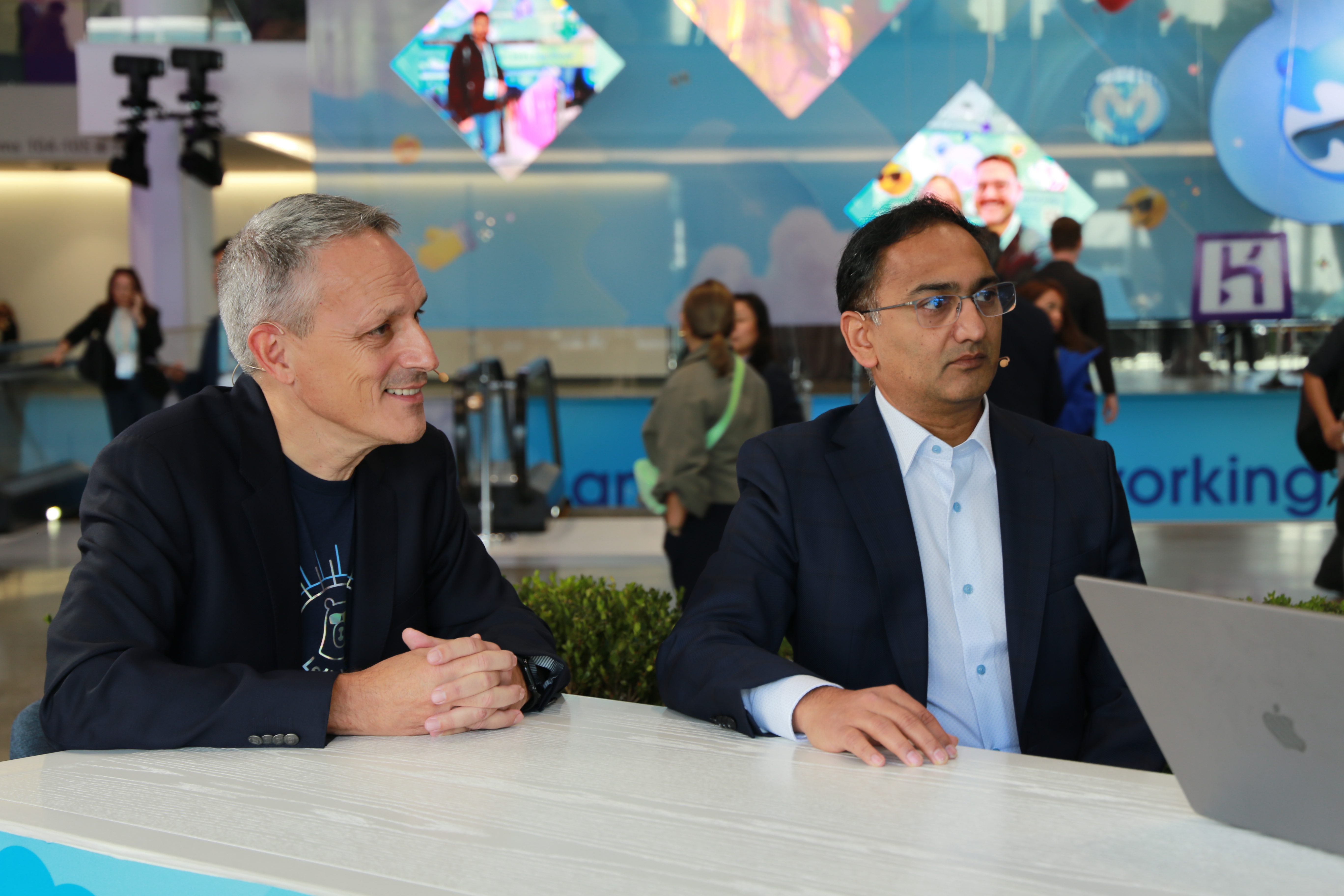
In this Dreamforce segment, Salesforce leaders Jayesh Govindarajan, executive vice president of software engineering, and Christophe Coenraets, senior vice president of technical audience relations, join theCUBE’s John Furrier and George Gilbert to unpack how enterprise-grade “vibe coding,” grounded in trust, security and governance, is reshaping developer productivity. The discussion dives into the craftsmanship required to take agents from demo to production, including context engineering, persona design and an emerging agent development life cycle spanning Studio, Testing Center and Agent Observability. Govindarajan shares adoption momentum and lessons from getting agents reliably into production with the right balance of determinism and creativity, while Coenraets explains how enterprise vibe coding aligns generated code with org metadata, validation rules and security models.
The conversation also explores Agentforce in action – highlighting role-based workflows, deterministic orchestration via an agent scripting language and “fleets of agents” coordinating across sales and service tasks. Real-world patterns come to life through examples like a Williams-Sonoma “sous chef” agent moving from creative recipe assistance to transactional commerce, and through developer-facing extensions such as MCP resources for external data and actions. The team closes by framing the shift to conversational UX as a default experience and connecting it to Salesforce’s data foundation with Data 360 – all pointing to how agentic automation becomes reliable day-two operations.
Forgot Password
Almost there!
We just sent you a verification email. Please verify your account to gain access to
Dreamforce 2025. If you don’t think you received an email check your
spam folder.
In order to sign in, enter the email address you used to registered for the event. Once completed, you will receive an email with a verification link. Open the link to automatically sign into the site.
Register for Dreamforce 2025
Please fill out the information below. You will receive an email with a verification link confirming your registration. Click the link to automatically sign into the site.
You’re almost there!
We just sent you a verification email. Please click the verification button in the email. Once your email address is verified, you will have full access to all event content for Dreamforce 2025.
I want my badge and interests to be visible to all attendees.
Checking this box will display your presense on the attendees list, view your profile and allow other attendees to contact you via 1-1 chat. Read the Privacy Policy. At any time, you can choose to disable this preference.
Select your Interests!
add
Upload your photo
Uploading..
OR
Connect via Twitter
Connect via Linkedin
EDIT PASSWORD
Share
Forgot Password
Almost there!
We just sent you a verification email. Please verify your account to gain access to
Dreamforce 2025. If you don’t think you received an email check your
spam folder.
In order to sign in, enter the email address you used to registered for the event. Once completed, you will receive an email with a verification link. Open the link to automatically sign into the site.
Sign in to gain access to Dreamforce 2025
Please sign in with LinkedIn to continue to Dreamforce 2025. Signing in with LinkedIn ensures a professional environment.
In this Dreamforce segment, Salesforce leaders Jayesh Govindarajan, executive vice president of software engineering, and Christophe Coenraets, senior vice president of technical audience relations, join theCUBE’s John Furrier and George Gilbert to unpack how enterprise-grade “vibe coding,�� grounded in trust, security and governance, is reshaping developer productivity. The discussion dives into the craftsmanship required to take agents from demo to production, including context engineering, persona design and an emerging agent development life cycle spanning Studio, Testing Center and Agent Observability. Govindarajan shares adoption momentum and lessons from getting agents reliably into production with the right balance of determinism and creativity, while Coenraets explains how enterprise vibe coding aligns generated code with org metadata, validation rules and security models.
The conversation also explores Agentforce in action – highlighting role-based workflows, deterministic orchestration via an agent scripting language and “fleets of agents” coordinating across sales and service tasks. Real-world patterns come to life through examples like a Williams-Sonoma “sous chef” agent moving from creative recipe assistance to transactional commerce, and through developer-facing extensions such as MCP resources for external data and actions. The team closes by framing the shift to conversational UX as a default experience and connecting it to Salesforce’s data foundation with Data 360 – all pointing to how agentic automation becomes reliable day-two operations.
In this Dreamforce segment, Salesforce leaders Jayesh Govindarajan, executive vice president of software engineering, and Christophe Coenraets, senior vice president of technical audience relations, join theCUBE’s John Furrier and George Gilbert to unpack how enterprise-grade “vibe coding,” grounded in trust, security and governance, is reshaping developer productivity. The discussion dives into the craftsmanship required to take agents from demo to production, including context engineering, persona design and an emerging agent development life cycle spanning...Read more
exploreKeep Exploring
What event is being discussed and who are the main participants?add
What are the key concerns of developers when it comes to vibe coding in an enterprise environment?add
What significant developments have occurred since the launch of Agentforce a year ago?add
What does "fleet of agents" refer to in the context of handling different tasks?add
What are the key components of an agentic workflow as described in the context of Salesforce?add
>> Welcome back, everyone. I'm John Furrier, host of theCUBE. We're live here in San Francisco with Dreamforce '25. We've got a great lineup, three days, as we dive deep into the Salesforce's value proposition and technology around agents, Agentforce. George Gilbert, industry analyst, co-host with theCUBE Research. Great to see you, George. We're going to go deep here. We got a little Trailblazers and Agentforce. We have two great guests. CUBE alumni, Jayesh Govindarajan, EVP of Salesforce AI, Agentforce and Christophe Coenraets, senior vice president, Trailblazers relations. Two great people. Talk about the developer side and how this impacts and also on the infrastructure and the app side. Good to see you guys. Thanks for coming back on theCUBE.
Christophe Coenraets
>> Pleasure to be here.
Jayesh Govindarajan
>> Thank you for having us.>> All right. So first of all, Christophe, I have to go to you first, because I've been loving the vibe coding. I've vibe coded all the apps over the summer and they look great except some of the database calls don't work. I'm not putting that into production. So vibe coding's hot, but the serious question is what is the difference between vibe coding the work that needs to get done out on the just general purpose versus the enterprise? It's the number one question we get.
Christophe Coenraets
>> Yeah. Totally. When I speak to developers, that's what they want to know. Vibe coding is going to give you the quick prototype, but in the enterprise, developers want security, they want trust, they want governance and they also want the code to be grounded in the metadata that they have and all the security features. So enterprise vibe coding is really filling that gap and what we are showing here with Agentforce Vibes is exactly that. Vibe coding for the enterprise.>> I want to get into the developer impact, because obviously, productivity is the top line of the value proposition. There's a lot going on there and you started to see IT-like platform engineering bring in with the Salesforce community. We'll get to that. I want to put a pin in that. But Jayesh I want to get back to you. on theCUBE, we talked a lot about what's going with the data layer, harmonization. Agentforce is the center of the action. This is what the show's about. All the gravity's around what you're working on. You're the EVP. What's changed since last year? Give us the quick highlights.
Jayesh Govindarajan
>> Yeah. So we started on this journey a year ago. Seems like a lot longer than that, but it's just been a year since we launched Agentforce. And a year ago, we launched a framework that has really taken off. A simple framework that brings together actions, it brings together data, it brings together language model instructions and pulls this together into an agentic framework that developers, as well as our customers can go build agent themselves and they've really with coming onto Agentforce. We have about 12,000 customers on Agentforce now. 6,000 of them are paid. We've learned a lot in this one year that we've been working with customers on. We've learned what works. We've learned what doesn't. We've learned the craftsmanship that's needed to make agents work in production. Getting to a demo, as you were saying is super easy. But then being able to get this into production, being able to observe it live in production, being able to test it, making sure that it's actually doing the actions it's supposed to do with determinism where needed and with a little bit of creativity where it's needed, that spectrum has been a big learning with our customers.>> Yeah. I really am glad you brought up craftsmanship, because I think we've been seeing this trend for I'd say about eight years. Agile and iterate, that's vibe coding. Okay. Craftsmanship was an old school concept around how you build software. In the old days, it's coming back and agents have to be crafted. Craft is like it looks good, it works good, it's reliable. So you got the blend of Agile with vibe coding. My example. This looks great, so feel great about it, but making it work. So connect that dot. What does craftsmanship mean to you when you're developing? And Christophe, you weigh in too, because I think this is a huge trend, a cultural shift.
Jayesh Govindarajan
>> It is and I think one of the things that is just incredible about the technology we are seeing is that it's really, really easy to get started. So the day one problem is how do you bring together all the data and the actions? How do you define a persona that you're building an agent for? The work that's needed for building an agent that does sales work is significantly different in functionality than what would be needed for a marketing campaign manager. Being able to understand that persona, that's craftsmanship. Being able to break that into actions that they would do on a daily basis, that's craftsmanship. Understanding and engineering the context that's needed to go get that job done is craftsmanship. Having a platform that brings all of that together lets you then test it in a production-like environment before you launch it to your customers. These are all elements that are coming together. We are seeing the birth of a new development life cycle, an agent development life cycle if you will and pretty much all the tools that we are building around it, studio for creating agents, a testing center for testing them, an observability command center for seeing fleets of agency in action and then being able to run that loop to make them better over time. That's the iterative cycle. Developers are operating at a much higher level than before, so don't make the mistake of thinking that this is the same work that used to happen before. The kind of work is much more higher order, much more higher level. That said, that is still the same degree of craftsmanship that's needed to get it into production. Christophe?>> Christophe, you want to weigh in, because you've got the vibe piece.
Christophe Coenraets
>> Sure.>> My comment is a little bit over the top, but I wanted to put it-
Christophe Coenraets
>> Oh, no. Totally and it makes sense. And that's why on the vibe coding side, it's really important to be able to give your own rules and that's what makes a good vibe coding solution as well. How do you want that code to be crafted? So don't let the AI just generate code. In any way you want, you define all your rules. Now, there is another point that I think is really important, because Jayesh mentioned it. When you create these agents, they can perform tasks that you didn't anticipate. So how do you build the UX from a developer point of view for something that you didn't anticipate? And the big shift there I think that we're hearing from developers, that is the reason we think the future of UX is conversational, because these agents can perform things at design time you didn't know and now, we are getting into the conversational aspect of UX, which is a big shift for developers.
George Gilbert
>> So let me drill down on... There's two things. Both of you are talking about products that we've seen many other examples and both of you have emphasized the grounding, but I want to unpack that a little more. Let's start with agents. We're moving from day one problems to day two problems. And with testing center, I don't know if it's called observability or observability center.
Jayesh Govindarajan
>> Observability. Yeah.
George Gilbert
>> Agent observability. So testing, so it's for the part of the new life cycle. Can I get it to work? I assume there's essentially evals in there. And then observability is an extension of evals with analytics to feed back into the learning cycle. And before, customers had to string this stuff together and worry about security and data formats and so how much you farther does this get customers to getting into production? And then we come back to the issue of change management and alignment across functions to get that done.
Jayesh Govindarajan
>> Yeah. Let's take a very, very simple example of someone building an agent for recruitment. We have a customer of ours, Adecco. Large recruiting agency. Before they put a recruiting agent in production, there's a lot of work that needs to go in before that can happen. You touched upon this a little bit. Often, recruiting policies are captured in documents, they're captured in policy statements and they're often tacit. Not exactly available in a document which is well-structured. It might be in some image of a picture someone took. All of that sort of information that's deeply within the enterprise, that then needs to be operated on by an LLM for some logic, needs to be crafted in the right way. That's context engineering in essence. So a lot of that context engineering is really the very first step to getting really good quality answers, really good quality decision making. Step one, having done that, you get to a pretty good first step of an agent, which is usable in many ways, but it requires guardrails. There are things and questions you can toss at it and it can come back with an answer which is hallucinated and this is the classic problem, because we're working with a system that's inherently probabilistic. And a lot of work that needs to go around that to be able to make that more deterministic, more rule-oriented where needed and at the same time, creative, open-ended and more creative in a sense where it's required. So being able to thread that needle is important.
George Gilbert
>> So just to be clear, we had the deterministic components in the flows and other transactions that the agents could invoke, but now you have rules within an agent's workflow tasks, so you can have some deterministic, some adaptive and then even within a process or even between agents. But maybe help us understand how that helps us to get past the customers who were in pilot and into production.
Jayesh Govindarajan
>> Yeah. Great question. So today, Mark and the executive team demoed Williams-Sonoma, who are a marquee customer of Salesforce. If you go to Williams-Sonoma today, you can go onto their website and there's a sous chef agent, which is basically built on Agentforce. And there's a creative element to it, which is you can ask it for a recipe for a party that you're planning and it uses the magic of the LLM, grounded on the recipes that are part of Williams-Sonoma's portfolio to give you really wonderful recipes. Having done that, the next step is you ordering some things to go make that recipe happen, to buy some cookware. Now you're going from a creative process to a more lockdown process, which is now, you're exchanging monies, you're going from insight to commerce. So when you're-
George Gilbert
>> And from the website, when we just read the webpage to pushing the button, do something.
Jayesh Govindarajan
>> Do something for me.
George Gilbert
>> Yeah.
Jayesh Govindarajan
>> New, there's a change right here. There's a shift of gears that the agent needs to go through when that happens, right? You've gone from a flow that is quite creative in how it should work to something which is more locked down and deterministic. Why is that? Maybe it needs to know what cookware you already have. Maybe you purchased stuff on Williams-Sonoma before, so it should not recommend to you something->> Or payment .
Jayesh Govindarajan
>> ... you already have, or payment as an example. This is where the programmatic elements need to come in. So we've designed something called agent scripting language that lets you, in plain English, write this logic which compiles into a set of deterministic steps that go as instructions to the agent.
George Gilbert
>> And how did they complement the flows that we had before? Is it that these are within the context of the agent's native planning ?
Jayesh Govindarajan
>> Yeah. This is nothing to do with flows, which is linear in nature. The scripting language basically opens up the planning and the reasoning layer with constructs that are programmable.
George Gilbert
>> Okay.
Jayesh Govindarajan
>> Programmable means programming data that's needed for context, programming logic that you might be calling, programming functions that you might have white-coded before.
George Gilbert
>> Oh, it's the orchestration. It's the deterministic orchestration in natural language that's compiled into something more familiarly .
Jayesh Govindarajan
>> Exactly. Exactly.>> So you're segmenting the agent piece role and just not to get nerdy here, but is it like an MCP connection, or how's the data state maintained? Because once you come from ideation or concept, tactical, transactional, you're in transaction mode. That's an OLTP kind of concept.
Jayesh Govindarajan
>> That's right. So customers, to your point, want to be able to bring in external data via MCP resources, external actions via MCP, but they need to be orchestrated in context of the job that the agent is being programmed to do. And that programming language, to be able to describe agents in a way that can then be executed deterministically where needed and probabilistically where needed, that's the work .>> So I'm going to zoom out and try to pack this together. So you guys have basically figured out a way to have a set of steps based upon what happens with the agents handing off to other agents. Is this a fleet of agents? Is this where fleet of agents comes together? Because what's happening is that it's almost a value chain that's generative.
Jayesh Govindarajan
>> Sure. Sure.>> With lack of probably a better description, but you don't know what's going to happen until it happens.
Jayesh Govindarajan
>> Yeah.>> So is this where different agents get the hand off?
Jayesh Govindarajan
>> Absolutely. Absolutely.>> So is this what fleet of agents means?
Jayesh Govindarajan
>> Yeah.>> Tell us what that all means.
Jayesh Govindarajan
>> Every agent comes with the metadata. Imagine you've built an agent that is great at doing sales conversations. You have another agent that's doing great at service and customers don't really need to distinguish between them. They can just talk to a Uber agent and that agent is able to orchestrate between these two agents to go get that job done. In essence, the determinism comes in in the rules on what to invoke at what point in time and when to invoke the agent with the right resource.>> You guys mentioned something earlier in my example that I had on the intro about vibe coding over the summer, which right, I did a lot of vibe coding. The database were easy to set up, but it was the APIs that I didn't do the work. I'll get to it later. But what you're saying is the AI will do that for me.
Jayesh Govindarajan
>> The AI will do that for you.>> So pretend that I got the Agent Script, Agent Studio. How's it work? Will it figure out that it's an API call? I can give it the API endpoint and then it might be just a REST API. Doesn't have to have state. So do you guys help facilitate some of those?
Jayesh Govindarajan
>> Absolutely. So if you go into the studio, you register a bunch of functions that you want to come together to build the agentic flow. You set up the rules, you bring in the data, you test the context that it has the right quality and then you build the very first agent. Again, that's not the agent that goes into production. And this is the emerging agent development life cycle I was talking about. So having built that very first agent, you want to put it through its paces. You want to be able to have a regression suite that lets you test it at some degree of scale before you launch it to your end users, so that they're getting the value that they desire.>> All right. Christophe, this is now back to you. I want to come back, because you guys have the most impressive community. The Trailblazers, it's well known. Salesforce has built the most epic community and it's been in Salesforce, but now you have IT. The ecosystem's growing outside of Salesforce. You guys have done great work there on the tech side. We've been covering that like a blanket, but I'm a developer and we're seeing this in the cloud where there's one module for AI and then it goes under the hood. Then there's a ease of use developer playground. Every cloud has their own version of it where it's like you turn knobs down here, so you got to be really sophisticated and then the general purpose. What does it mean for the developers in the Trailblazer world, one, and two, how do someone who's maybe a mini Trailblazer, has Salesforce, customer, but they're also doing a lot of other stuff? Take us through those two impacts areas.
Christophe Coenraets
>> Well, so first of all, you mentioned before the productivity that developers and the entire community's going to see with the vibe coding approach. We spoke about grounding before. That's going to only increase that productivity, because the code that we're going to generate is going to be aware of your validation rule, your security models and things like that. And then you spoke briefly about MCP servers, because that's what extends the developer tool set in a way. That's what gives you access to the entire development life cycle. So it's not only going to be about coding, generating code like we mentioned, but it's going to be about the full life cycle. Testing, debugging, deploying in production. So overall, I think what I'm hearing, especially here, when people really experience it, it's difficult not to feel really empowered and really want to do more.>> .
Christophe Coenraets
>> So I think it's really exciting for developers.>> It's a dream scenario for the developers.
Christophe Coenraets
>> Yeah. Absolutely.>> Pun intended.
Christophe Coenraets
>> Absolutely.>> But what's the big aha? What's jumping off the page to developers this year? What's the top three things that's kicking butt?
Christophe Coenraets
>> In our developer community?>> Yeah. Yeah.
Christophe Coenraets
>> Well, so agentic AI completely changing how you build software. IT shops, they have incredible backlogs, and I think what you're seeing is that because the productivity is much higher, it means more software is being built and I think developers are really feeling that. Jayesh spoke about predictable agents. I think->> I love that part. Yeah.
Christophe Coenraets
>> ... developers really love that, because they've been playing the last few years or the last year at least with agents and they love to see also a developer-centric approach to agent development with Agent Script. And then the last big shift that I'm seeing, and I spoke about it before, is really the shift from rich UI that you had to build in advance to really conversational UX and really, conversational UX becoming your default UX. That is a big shift for developers that they are really starting to see and being really excited about.>> Jayesh, you're building a data infrastructure-
Jayesh Govindarajan
>> Absolutely.>> ... under the covers for the developers. Reminds me of the old shift left days in DevOps. A lot of stuff had to go on to get that security right. In a way, there's a lot of that happening under the covers that you're enabling. How should we think about this as an infrastructure? I love the artisan thing. I love craft. You know that, but you're a data company at the end of the day too at scale.
Jayesh Govindarajan
>> Yeah.>> What's really going on here? How would you describe this shift.
Jayesh Govindarajan
>> Yeah. I think if you really think about what an agentic workflow looks like, it breaks into three parts for me. One is really high quality data for decision-making. Not that different from humans really. We need that as well. A set of capabilities, actions, business logic that works, that's been tested and the goal and a plan on what it is that you want to do. All three are front and center for us here at Salesforce. With Data 360, our goal is to bring that in, bring that high-quality data in with processing needed for agentic systems to work better. And the same with actions as well.>> Well, we'd like to catch you guys back. We're hitting on time here. Let's do a follow-up. We'd love to do a deeper dive in the studio, or certainly, if you're in New York, come check out our new NYSE studio. We got Silicon Valley connected, so you guys are open invite. Thanks for coming on. Appreciate it. Got a big day ahead of you-
Christophe Coenraets
>> A pleasure. Thank you.>> ... of meetings. You guys have the big dogs here, the big executive leaders. The AI revolution is changing productivity, but it's transforming data and how you put data into action for results. We're doing our part here on theCUBE by streaming the data to you. Thanks for watching.>> Thank you.










 George Gilbert