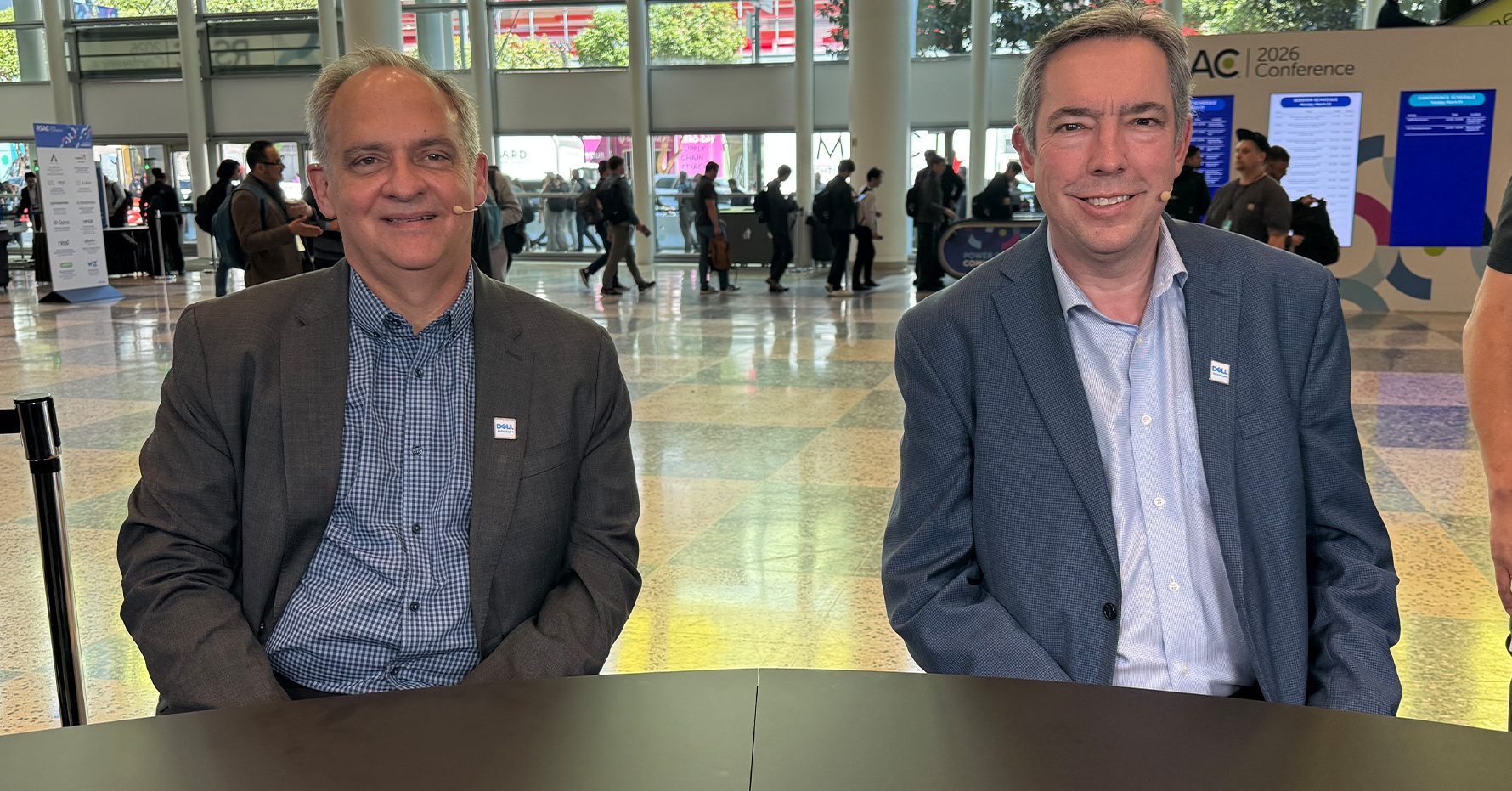
In this interview from RSAC 2026 in San Francisco, Jim Shook, director of cybersecurity and compliance practice at Dell Technologies, joins Rob Emsley, director of cyber resilience marketing at Dell Technologies, to talk with theCUBE Research's Christophe Bertrand about why securing AI infrastructure demands the same resilience foundations enterprises have long applied to traditional workloads. Dell timed three announcements to the conference's opening day, spanning quantum-ready PC capabilities, PowerProtect Data Manager enhancements with a new entry-level Data Domain appliance, and managed detection and response expansion to PowerScale. Shook underscores that threat actors will inevitably target AI factories and training pipelines, yet most organizations have yet to back up their AI environments — a gap Dell aims to close by treating resilience as a design principle across the full stack.
The conversation also touches on how AI is being embedded into PowerProtect Data Manager itself — through a unified dashboard and AI-assisted troubleshooting — to help administrators manage increasingly complex environments. Emsley details the expansion of anomaly detection from backup copies to PowerStore storage snapshots, moving threat visibility higher in the data center stack. A Palladium Hotel Group case study illustrates the cross-segment reach of Dell's portfolio: the European luxury hotel chain deployed software-defined PowerProtect appliances across 40 locations to orchestrate backup, recovery and compliance under GDPR. Shook weighs in on the regulatory uncertainty surrounding agentic AI, noting that while governments oscillate on policy, the underlying risk remains constant. Emsley closes with findings from Dell's new Cyber Resilience Insights research, warning that overconfidence in recovery readiness remains one of the most overlooked vulnerabilities organizations face as they race to deploy AI.
Forgot Password
Almost there!
We just sent you a verification email. Please verify your account to gain access to
RSAC 2026 Conference. If you don’t think you received an email check your
spam folder.
In order to sign in, enter the email address you used to registered for the event. Once completed, you will receive an email with a verification link. Open the link to automatically sign into the site.
Register for RSAC 2026 Conference
Please fill out the information below. You will receive an email with a verification link confirming your registration. Click the link to automatically sign into the site.
You’re almost there!
We just sent you a verification email. Please click the verification button in the email. Once your email address is verified, you will have full access to all event content for RSAC 2026 Conference.
I want my badge and interests to be visible to all attendees.
Checking this box will display your presense on the attendees list, view your profile and allow other attendees to contact you via 1-1 chat. Read the Privacy Policy. At any time, you can choose to disable this preference.
Select your Interests!
add
Upload your photo
Uploading..
OR
Connect via Twitter
Connect via Linkedin
EDIT PASSWORD
Share
Forgot Password
Almost there!
We just sent you a verification email. Please verify your account to gain access to
RSAC 2026 Conference. If you don’t think you received an email check your
spam folder.
In order to sign in, enter the email address you used to registered for the event. Once completed, you will receive an email with a verification link. Open the link to automatically sign into the site.
Sign in to gain access to RSAC 2026 Conference
Please sign in with LinkedIn to continue to RSAC 2026 Conference. Signing in with LinkedIn ensures a professional environment.
Are you sure you want to remove access rights for this user?
Details
Manage Access
email address
Community Invitation
Jim Shook & Rob Emsley, Dell Technologies
Jim Shook, Director, Cyber Security and Resilience Practice, Dell Technologies & Rob Emsley, Director, Cyber Resilience Product Marketing, Dell Technologies, join Christophe Bertrand in San Francisco, CA for RSAC 2026.
Director, Cybersecurity and Compliance PracticeDell Technologies
Rob Emsley
Director of Cyber Resilience MarketingDell Technologies
In this interview from RSAC 2026 in San Francisco, Jim Shook, director of cybersecurity and compliance practice at Dell Technologies, joins Rob Emsley, director of cyber resilience marketing at Dell Technologies, to talk with theCUBE Research's Christophe Bertrand about why securing AI infrastructure demands the same resilience foundations enterprises have long applied to traditional workloads. Dell timed three announcements to the conference's opening day, spanning quantum-ready PC capabilities, PowerProtect Data Manager enhancements with a new entry-level D...Read more
exploreKeep Exploring
What is Dell Technologies announcing at the RSA Conference regarding security, cyber resilience, and quantum-ready capabilities for its products?add
What are the recent updates to Dell's PowerProtect Data Manager, and how do they use AI to improve management, speed resolution, and expand anomaly/threat detection across backup and storage (including PowerScale and PowerStore)?add
Yes — the excerpt answers this question:
"Which customer was highlighted in the release, and why did they implement PowerProtect?"add
How does Dell Technologies secure its PowerProtect appliances and backup infrastructure to ensure cyber resilience?add
>> Hello, everyone. Welcome back to RSAC 2026 in sunny San Francisco, our coverage from theCUBE back to back. Lots to talk about today, and I'm very, very pleased to be joined by two CUBE alums, who you've probably seen them many times with us. Jim Shook, Rob Emsley, welcome.
Jim Shook
>> Thank you.
Rob Emsley
>> Good to see you, Christophe.
Christophe Bertrand
>> Great to have you here. So let's talk a little bit about the topic, but first, Jim, please reintroduce yourself to our audience.
Jim Shook
>> So Jim Shook, I'm the director for our cybersecurity and compliance practice globally in our security and resilience platform division.
Christophe Bertrand
>> And Rob.
Rob Emsley
>> I'm the director of product marketing for our cyber resilience portfolio, so our PowerProtect portfolio of cyber resilience products.
Christophe Bertrand
>> Right, and I think you have just announced some very interesting new capabilities today at RSAC 2026. So could you walk us through the announcement and really what it means for customers?
Rob Emsley
>> Yeah, absolutely. I mean, certainly you know that Dell Technologies, with the portfolio that we have from edge to core to cloud, we really have a requirement to deliver both security and resilience across the infrastructure. And our announcement today that we timed to be on the first day of RSAC, it's been a while since we've been here, but certainly our history is very long with our partner, I would say. Security and resilience, the enhancements are really all about making people more confident in their ability to protect and recover from any eventuality, especially in the era of AI and in the era of quantum computing, so our announcements are really threefold. First, we're bringing new quantum-ready capabilities to our commercial PCs. I think you're going to be talking to one of my colleagues later on in the week focused about that, but really Jim and I are here to really talk about our cyber resilience enhancements. Those are twofold. Enhancements to PowerProtect, both from new capabilities for our PowerProtect data manager software, but also announcing the availability of an entry-level PowerProtect Data Domain appliance, really bringing that cyber resilience foundation to more customers, not just large enterprises, but all the way down to small, medium businesses. And then last but not least, in the area of detection, we're expanding our managed detection and response service, which we have always had support for endpoints for many years. Last year we expanded to provide managed detection response for PowerProtect, and today we're announcing the expansion to a platform that's very dear to our heart when it comes to looking after AI data, PowerScale. So very important for us to not only protect the backup infrastructure, but really protect and detect the infrastructure that many of our customers have in their data centers.
Christophe Bertrand
>> Absolutely. And Jim, I'd like to follow up with a question about what does this mean for customers. Obviously, building the AI infrastructure is very critical. Building it correctly is even more critical, because it's about de-risking the environment. Yet, I wonder to what extent people wake up in the morning thinking they have to do that, they have to approach it that way. So with your background in cyber resilience and compliance, how do these two announcements really change the nature of how you can approach the portfolio now and what you can do with the Dell technology?
Jim Shook
>> We've been through this a couple of times now, right? We start something new. We want privacy by design, we want security by design, and then push comes to shove. Everybody's moving very quickly to deliver results, and sometimes the infrastructure and the key concepts and the basic building blocks get left behind, so we want to make sure in the AI world that that's not the case. So if you have an AI factory or you're doing development, you need to have those infrastructure pieces in place. You want to have data protection. You want to have cyber resilience. I hear sometimes at this point that, "Well, we're not getting attacked." Maybe you are, maybe you don't know, but certainly it's coming, because if it's a valuable asset, the threat actors will target it, so do that work now. Our announcements mean that we're making sure that we're out ahead of all this for our customers, so they have the tools that they need to deploy to be resilient in those areas.
Christophe Bertrand
>> Right. And so I talked about de-risking the infrastructure, and Rob, I'd like to follow up with that. So now we're talking about from the mid-market all the way to the enterprise, especially with the appliance introduction, but also the whole PowerProtect portfolio. So really what you're doing is, if you're a Dell customer or considering the Dell portfolio, you're offering this soup-to-nuts set of capabilities. And I imagine it's only the beginning, there will be more in the future, but how significant is the announcement today when you think about it from a marketing impact perspective? As we see data protection for AI and AI for data protection, two sides of the same coin are becoming more critical.
Rob Emsley
>> Yeah, for sure. And if you think about the three elements of our PowerProtect data manager news, the first part is really providing the ability to make it easier for customers to manage their environment. We're introducing a new unified dashboard into PowerProtect Data Manager that initially will provide an on-premises management solution, but with the intent of really allowing customers to get that functionality from a Dell managed cloud in the future. At the same time, we're also bringing AI into the PowerProtect Data Manager solution, really to provide a quicker path to resolution, especially with the magnitude of what customers are being asked to protect nowadays and the rapidity of how quickly things can change within the environment. So bringing AI and AI assistance into PowerProtect becomes very important, to make that as simple as possible to deliver a solution. And then last but not least, I mentioned that we're very uniquely positioned not only being in the backup market, but being in all of the other data center markets that exist, so it's very important for us to make PowerProtect not only be a backup infrastructure solution, but really become more of a resilience management solution across the entire data landscape. So the ability to bring solutions for other parts of our infrastructure, specifically PowerScale, becomes very important. So we introduced anomaly detection natively into the PowerProtect portfolio to look at indicators of compromise within the backup copies, but we're now expanding that, not only for our backup infrastructure but expanding it to PowerStore, so the ability to analyze storage snapshots for any indicators of compromise. So really moving the detection higher into the stacks that customers have.
Christophe Bertrand
>> Right. And I know there are a bunch of other things we'll talk about with your colleagues in the future around other initiatives to further protect the hardware itself at the most microscopic level almost, I would say. Now, Jim, I'm curious about something here. Data protection for AI, I get it. It makes sense. It's going to help optimize some workflows. It's going to help make the administrator maybe more strategic as a business partner, but yet we're seeing all of these attacks that are themselves AI-powered, so what can we do to protect the AI infrastructure? Because my research, and I think some of your research as well, shows that the infrastructure itself, the systems, are getting attacked. The models are getting poisoned, and they're not backed up. Right now, literally nobody's really backing up their AI infrastructure. To me, that's a big problem. Maybe people are a little bit ahead of their skis here. What are your thoughts?
Jim Shook
>> Yeah, it's a difficult problem, and it's new in some respects, and in some respects it's old hat. So thinking about things like data poisoning or exceeding the guardrails, those are pretty unique to AI, and models like OWASP for AI are really good and useful to think about those things. I feel like I see people focusing on those attack vectors right now. I don't know how prevalent the attacks are, but we're missing the ones that are still there, which is the attack on the infrastructure. So as amazing as AI is, it's still running on infrastructure, and if that infrastructure isn't resilient ... and it extends pretty far ... if that isn't resilient, then you're not going to be very safe. You're not going to be able to meet risk or governance or compliance issues. And we're in a unique position at Dell that we can look across all of that, like Rob was talking about, from the start. The training data, where does it reside, running the models, the infrastructure, logs, services, all of those pieces, and we want to bring all those to bear to make this easier for our customers to address the challenge.
Christophe Bertrand
>> Yeah. It makes a lot of sense, because at the end of the day, you cannot really trust AI unless you can trust the infrastructure that manages and produces the data, that is supposed to secure that data as well. Let's talk about maybe a couple of customer examples. You have so many customers, both on the resiliency and the infrastructure side. Do you have a couple of examples that come to mind that, in the light of the announcements, would be great to cover for our audience?
Rob Emsley
>> Yeah. One of the customers that we highlight in our release today is the Palladium Hotel Group, which is a European chain of luxury hotels. Certainly, they, like many customers, are looking to improve their customer experience. They're looking to deploy AI to help them analyze really the customers that are coming through their hotel chain. And certainly they have over 40 locations around Europe, and needed a solution that would give them both the flexibility and the assurance that they could protect all of their projects, all of their new assets. So they implemented PowerProtect, both from a software and hardware appliances perspective, but also more importantly, from a software-defined perspective. Those 40 locations required the ability to not only have backup and recovery orchestration, but also have the ability to have copies of their important data in those locations. So they made use of our software-defined PowerProtect appliances to deliver a company-wide solution that really allowed them to get a lot more confidence and generally sleep better at night.
Christophe Bertrand
>> Well, which is important. You like to sleep pretty well in a hotel at night, ideally.
Rob Emsley
>> Yes, exactly.
Christophe Bertrand
>> So 40 hotels in Europe. So a quick follow-up question, I imagine compliance is not that simple. Although there's GDPR, there may be non-European Union locations. Training is probably an interesting challenge for a variety of reasons. And this is an interesting use case that is an enterprise use case, but really it's more of a collection of mid-market size type of organizations, the hotel.
Rob Emsley
>> Absolutely.
Christophe Bertrand
>> And I remember covering the announcement of the software-defined appliance, so it's great to see it in full action here. So my quick follow-up question is, do you see that with the new announcement, is it for mid-market, is it for enterprise, or do you see a commonality of problems across the spectrum? And isn't that a challenge, at the same time?
Rob Emsley
>> Yeah. I think the announcement is definitely cross-segment. Certainly the availability of our entry-level PowerProtect appliance becomes very important for the entry-level part of the market. It's providing support for between eight and forty terabytes of usable capacity in a very small form factor, but then really delivering all of the same capabilities that all of our customers that have been using PowerProtect appliances around the world.
Christophe Bertrand
>> With the ease of AI now.
Rob Emsley
>> Absolutely. Absolutely. So certainly for us, our PowerProtect appliances continue to be the foundation of our cyber resilience capabilities. Certainly we have invested a lot of time in securing that infrastructure. As you know, the backup infrastructure continues to be an attack vector for many bad actors, unfortunately. They recognize that going after the backup infrastructure and compromising that infrastructure allows them to then do their worst within the production data sets, without any really recourse to the customer. So we have always looked at our PowerProtect appliances as the storage of last resort. Certainly from our perspective, we've built in security by design, really across all of the Dell Technologies infrastructure solutions, all the way from the software development of the solutions and the software that runs on our hardware infrastructure, all the way to the manufacture and the delivery through supply chain, to make sure that customers have great confidence that what they're deploying is good and secure.
Christophe Bertrand
>> Right. Yeah, because clearly there is no AI without secure infrastructure, secure data, compliant data as well, and of course that cyber resiliency component is a key part of that. So I think all of these investments, all these announcements, are very critical at a time when there's a lot of talk about AI, but nobody really knows what they're actually really doing with all those agents running around. And Jim, I'm looking at you now because we talked about this earlier, and maybe as you think about what advice you would provide people with agentic AI, what should they think about? What should they do next, and what is going to be the impact of regulations and all of these new policies? We got some new announcements recently from the White House on the topic, great. Europe goes back and forth on AI regulations. What's your take as a professional in this space?
Jim Shook
>> I think the compliance space is interesting in AI. Nobody really wants to slow down the development process, so you have sovereign countries. The U.S. doesn't want to regulate too much. Europe has, but has taken a step back. For me, it's more about looking at the risks. So driving in today, every billboard is something about an agent and agentic, and it's important, so you need that flexibility to protect and to be resilient. Think about all these little machines running around, talking to each other and doing work. If you think about a rogue employee, there's other employees. There's pieces in place that you could shut them down after a certain amount of time. With agents, it's going to be a little bit trickier. So thinking about that resilience now, deploying and understanding what's happening at the infrastructure level, will put you in the best position for whatever comes later, which none of us can predict. The regulations could end, they could ramp up tomorrow, but I think the risk will be there regardless.
Christophe Bertrand
>> And Rob, what are your closing thoughts? What would you recommend our customers, your customers, our listeners, do next?
Rob Emsley
>> Yeah, we've certainly continued to survey our customers on a regular basis. This year we introduced a new body of research called Cyber Resilience Insights, and one of the things that that really surfaced was the overconfidence that many of our customers have about their ability to recover. And one of the things I would certainly recommend is that people relook at their recovery plans, relook at their cyber resilience plans, because really I think with the changing landscape that we see, the ability to bring your business back continues to be so, so critical, with all of the uncertainty that exists within the market.
Christophe Bertrand
>> Right. So prove your recovery. Your traditional backup and recovery still doesn't go away. Prove the recovery and the compliance of the data you want to use for AI, and prove the recoverability of your AI infrastructure. That's a tall order, but that's what is needed. And by the way, I think it's going to make the administrators in charge of all of these functions, because of the use of AI in your newest introductions here, better business partners for those AI deployments.
Rob Emsley
>> For sure.
Christophe Bertrand
>> Because I think again, when AI gets deployed, you can't have a risk be introduced by not having the right infrastructure and you're delivering that, so I think that's really, really great news. Well, Jim, Rob, thank you so much. It was great to have you again on theCUBE.
Rob Emsley
>> Great to be on.
Jim Shook
>> Thank you.
Christophe Bertrand
>> And to our viewers, thank you very much for watching us. Stay tuned for more. Christophe Bertrand here, principal analyst with theCUBE Research, RSAC 2026 in San Francisco.












 Christophe Bertrand