We just sent you a verification email. Please verify your account to gain access to
RSA Conference 2024. If you don’t think you received an email check your
spam folder.
In order to sign in, enter the email address you used to registered for the event. Once completed, you will receive an email with a verification link. Open this link to automatically sign into the site.
Register For RSA Conference 2024
Please fill out the information below. You will recieve an email with a verification link confirming your registration. Click the link to automatically sign into the site.
You’re almost there!
We just sent you a verification email. Please click the verification button in the email. Once your email address is verified, you will have full access to all event content for RSA Conference 2024.
I want my badge and interests to be visible to all attendees.
Checking this box will display your presense on the attendees list, view your profile and allow other attendees to contact you via 1-1 chat. Read the Privacy Policy. At any time, you can choose to disable this preference.
Select your Interests!
add
Upload your photo
Uploading..
OR
Connect via Twitter
Connect via Linkedin
EDIT PASSWORD
Share
Forgot Password
Almost there!
We just sent you a verification email. Please verify your account to gain access to
RSA Conference 2024. If you don’t think you received an email check your
spam folder.
In order to sign in, enter the email address you used to registered for the event. Once completed, you will receive an email with a verification link. Open this link to automatically sign into the site.
Sign in to gain access to RSA Conference 2024
Please sign in with LinkedIn to continue to RSA Conference 2024. Signing in with LinkedIn ensures a professional environment.
play_circle_outlineAddressing the problem of human error in cybersecurity breaches
replyShare Clip
play_circle_outlineEnhancing Security Awareness: Training, Compliance, and Fake Phishing as Catalysts in the Industry, Fueled by KnowBe4's Acquisition of Egress
replyShare Clip
play_circle_outlineThe role of AI in detecting and mitigating behavioral-based threats
replyShare Clip
play_circle_outlineThe potential of AI to train individuals to recognize and defend against new cyber attacks
>> Welcome back to RSAC 2024. You're watching theCUBE's
Continuous Coverage. My name's Dave Vellante. Shelly Kramer is here,
as is David Lenticum. We got a really interesting
story to share with you. It's a company called KnowBe4.
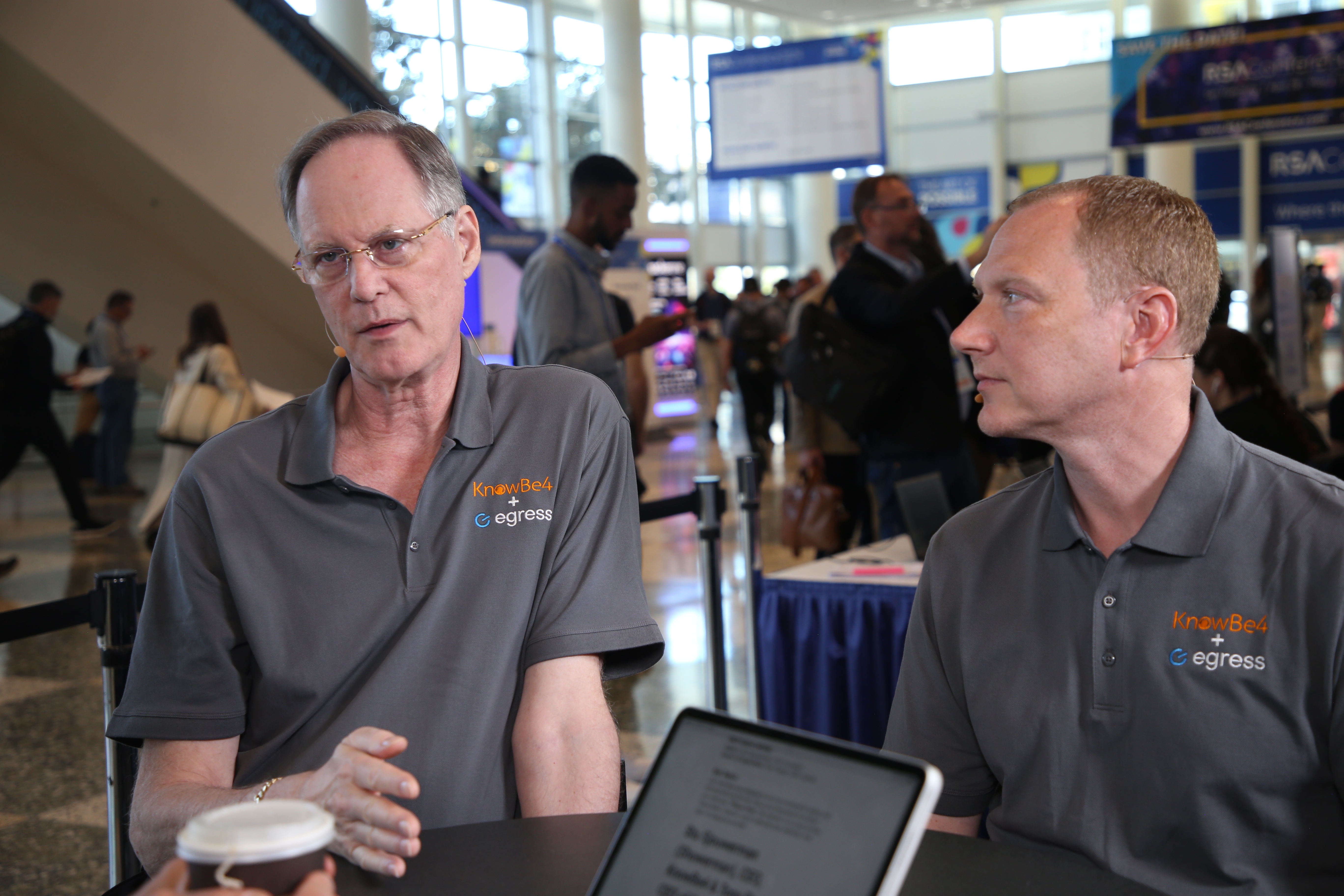
You may have heard of him. Stu Sjouwerman is here. He is the CEO and Tony
Pepper is the CEO of Egress, a company that KnowBe4
just recently acquired. KnowBe4 in late 2022, it
was announced Vista... They exited the Vista about 4.6 billion. I think it was closed in early 2023. And the premise behind
it is the vast majority, let's call it 80% of breaches
are based on human error. And so rather than just throwing
technology at the problem, KnowBe4 has a really
interesting story here. Guys, welcome to theCUBE.
Thank you very much- >> Good to see, Dave. >> For coming on. So what's
the founding premise? You started to tell a story, share that with us. It was fascinating. >> Just before me was
the CTO of CrowdStrike >> and I was like, "Wow! " We kind of did that
similar. I'm an InfoSec guy. We built an AV engine from scratch and we had a couple of
million endpoints out there and a whole floor full
of tech support people and constant trouble tickets
with infected workstations. So I was going, "What
on earth is happening? " We did the ask-why-five-times, the Lean Six Sigma approach and ultimately, the root cause of all those penetrations
was social engineering. Is the end user letting a bad
actor in, clicking on a link, opening up an infected attachment? And so then I looked, "Well, who is doing something about that? " And practically, no one, a few small players way
up in the Global 2000. And I said, "Okay, this is a problem that nobody really has been managing. " I don't call it the solution because if you stop doing
this, the problem comes back. So this is a great way to
manage the ongoing problem of social engineering. >> Yeah, this being the way you take what I call security awareness and you bring in training,
compliance, testing, you do fake phishing to
try to fake people out. I know Lena Smart from Mongo does some of this stuff.
I don't know if you know Lena. >> I've heard of her. >> She's the C-server of Mongo.
She says to me, "That's easy. >> Just don't ever click on a link. " I go, "Well, wait a
minute. What if I send you? " She goes, "Well, if I know you, but I still think about it. " And then the other thing
that she shares is she takes... You're an InfoSec guy. She takes deep InfoSec people and pairs them up with business people that don't have a clue on cyber and say, "Talk to each other. " And so through that process,
both sides get educated. The hardcore InfoSec guys can
communicate better instead of in mumbo jumbo acronyms, and then they can also see how uneducated the
average business person is and then good things happen. But you have an extremely novel
way of humanizing security and you've just made
an awesome business out of it. Congratulations. >> Thank you so much. And
it's only the beginning because we now have this
platform with almost 70,000 customers and 60,000 users. But we did find that advanced threat actors
make it through the old security email gateways that
make it through the filters. And you need an ICES, and this is where Tony
comes in, that lives and catches those very super sophisticated phishing attacks so you can provide a whole platform and decrease your vendors. This is a recurring theme and I'm sure that Tony can tell you a little bit more about that. >> Yeah. Tell us about Egress, what the company's founding
premise was all about and what the fit is with KnowBe4. >> Well, the fit's perfect, right, Dave? Every customer we spoke to,
every analyst we spoke to, they say the same story. It's not often you see M&A
where it's the perfect fit, where you are looking
at one of the largest, the largest
training company in the world that helps educate,
assess, really help build that security culture
within an organization. But then when you couple
that with a business that is obsessed about ultimately
detecting behavioral based threats, and that could
be inbound or outbound, and email is still one of those
challenges where actually, fundamentally, that's what
the threat actors are using. There are other channels, but ultimately, email's
really the number one threat that is a real concern. But the threat landscape's changed and now what we see in the world, and you talked about
it a second ago, David, the world is struggling with
behavioral based threats. The old days of payload-based
attacks, they're kind of gone. It's all using highly
sophisticated models. Crime as a service is now an
industry which you can fire up incredibly sophisticated
attacks at low cost and serve them up to the world. So I think we need to
move on to a new approach. When you think about combining
a platform that uses AI to look for behavioral-based
attacks or threats, and when you combine that with a business that's been training more
employees in business than anyone in the world and understands
how you resonate, how you can connect with
an employee business and serve up relevant content, you can build something different
that can then personalize that training and couple
it with real time threats. Why would I train you, Dave, on something that isn't a threat that you normally see? Why don't we train you on
something you received today or yesterday or the week before? I think we've got a personalized content. We've got a personalized training
based on real life threat telemetry, but you can't do that if you don't see those attacks. It really is a combination that Stu and I are phenomenally excited about. >> It's so true what you're saying, Tony. >> I've said many times,
any knucklehead today can be a ransomwarest. I can go in the dark web,
ransomware as a service, and if I want to commit a
crime, it's not that hard to do. I can get very sophisticated access to very sophisticated
techniques, tools, and technology >> For $50 a month. >> Yeah, it's so true. This is scary. Okay, >> so email, obviously, big problem. Now they're going after our text. That's the other same humanizing security, whether it's text, like
you said, other channels. Is that a TAM expansion for you? >> Yeah, of course it is. I mean,
this is just the beginning. >> The advantage of email
is if you understand an organization's email and communication patterns, you really have a deep understanding of who you normally communicate to, who's relevant in your universe. It's a key channel, but
it's one of many channels. So for us, it's about
building out a platform with AI at its core that
you can then detect threats, you can mitigate risk, and then you can
ultimately join up the dots and actually bring people
along with that journey through that security culture that
Stu's been so passionate about. And that's the thing that connects us. It's about not demonizing
employees in business. It's about taking them on a
journey so they're part of that security ecosystem. >> You want to build a
strong security culture and that only gets accomplished by almost real time or near time, this is happening,
you get relevant training and you help these people understand what truly is risky behavior, which also helps them
stay safe at the house. Very often, after they go through a
module, the first thing that comes out of their mouth is, "How do I share this with my family?" >> Yeah, yeah. I was just thinking the same thing. I want a family culture
that's security aware. >> Yes. Yeah, yeah. Absolutely. Well, we have modules for that. >> Yeah. Okay. >> I would love to do a phishing
exercise with the family. I'd be embarrassed and afraid to take it, but I do kind of do want to take it because I'm sure you can fake me out. >> We could. How sophisticated do you go? The trick is to slowly build it up. That is the individualized approach. You started a one-star and you migrate up to
two, three, four, five- star level difficulty phishing tests. >> My face is out there. I do a lot of content
and I have some "fans" and sometimes I'll get
emails from them saying how much they love the program and they like my weekly analysis
and they'll put a link in and I'm like, "Whoa, wait a minute. I'm not touching that. I
don't know this person." >> No. >> Also, you can be deep faked- >> Big time. >> In two minutes.
- Speaking of deep fakes, >> obviously, we should be
very concerned about it, more concerned than ever. We had John Chambers on here last year. He was saying he has
a startup that's doing detecting voice fake, which
I think is pretty good. What are your thoughts on that and the state of fakes these
days and how to combat them? >> Obviously, the same thing
is true of any new technology. You can use it for good or for bad. You can use AI to detect deep fakes, but it's the old game of
chess; bad actors move first and then you have to counter. It just brings up the whole battle on a whole new level. It's AI against AI, ultimately. >> I presume you're able to
compress that move speed chess. You play speed chess, yes? >> Yes, we do. With 16 boards. >> Yeah. Okay. >> So you had said you're
just getting started when we talked earlier. >> Yeah. I like to just, this
is more a fun observation, >> but walk around in any city in
the United States over here, wherever, one to 10 people
gets trained by KnowBe4. >> Really?
- Nationwide. >> There's still nine to go. >> Yeah, yeah. Okay. >> You got to look at that,
Dave, from a data perspective. If you've got that level
of data in the world and you can use that data to train a model to then understand how you detect and prevent some of
those advanced attacks. They often say about AI it's
like garbage in, garbage out. It's the classic adage. But to be able to deliver
something at scale that's truly something
different, you need scale data. And that's what's super
interesting about, ultimately, a KnowBe4 customer, is if
you can take that data, that information you
have on how they react to phishing campaigns, how
they report, ultimately, the KnowBe4 is
the most downloadable Outlook plugin in the Microsoft store. So when you've got that data and you can plug that into
a whole series of models, and then you can use that
to flip it on its head to then build better
detection, which, of course, then is self-trained, then you've got something really different. >> Yeah, because the attacker's
technique is not your customer's IP. Your customer doesn't care if
you're sharing that technique to make their competitors even more safe. >> No, that's all metadata. And we do see huge amounts of attacks coming in. That little button that was
just mentioned is indeed the number one installed
button in Outlook globally. Most people don't know that
either, but Tony was right. Tens of millions of people
report those attacks. We see all that and we have a global block
list that just filters out that stuff from the get-go,
but there's always delays. That's why you need the
kind of AI, the adaptive systems that live in the ICS. This is a new term I only
recently learned. The internet... >> Integrated cloud email security. >> That's a email protocol, right? >> Integrated cloud >> email security, but specifically for
the three-sixty-fives of this world. >> Who?
- The integrated cloud email security. >> And that's an open standard? >> Yeah. Gartner ultimately came up with >> that in the market guide
prior to the Magic Quadrant >> that's actually imminently
due to be announced, bringing back the email security quadrant, which was retired in 2017. >> Really? - And I think that
tells you a story. Back in >> 2017, ultimately, >> Gartner retired the secure
email gateway quadrant because it felt it was
a little bit old hat, had the same old players. Those same players existed
for several years after, but it was deemed so mature and not interesting that
it was actually retired. Several years ago. They
brought back the market guide because lots of new players were starting to come into the market
taking a different approach. Imminently, you'll now see
a new Gartner market guide for email security, which
tells you itself, it's back with a vengeance now because customers are asking,
"We've got real challenges, we've got stuff getting
through the sec, getting through Microsoft, landing
in people's inboxes. They're super complex and they're costing billions of dollars. How do we figure this
behavioral-based problem out? " So email security's had a
resurgence, I guess, really. And actually, this
combination fully intends to capitalize on that. >> Elon was speaking or being interviewed at the
Milken Institute conference that's going on, and he said something to the effect, I forget the timeframe. Let's assume within five years, let's say. Easily, probably knowing
Elon, he said next week, but within five years, only 1% of intelligence will be
biological human intelligence. 99%'s going to be machine intelligence. So I was like, "Okay." As you guys help humans get more cyber aware, AI could come up with
new creative attacks. Are we seeing that? We must
be seeing that already. >> Oh, yeah.
- And it's just asymptotic >> actually, exponential. >> Exponential.
- Yep. >> Yeah. It is, >> but the interesting thing is
that you can use that same AI >> to train the people to recognize those. The funny thing is we're coming
out with a module, actually, this quarter where the
program administrator can say, "I want to create a phishing
email with this topic, and the tone needs to be aggressive and it needs to have a picture and two or three more pull downs," and we are generating a
custom-made phishing template that they can then send
out to their users simply to get those users aware of,
"Oh, this is state-of-the-art. Okay." >> When you started the company, you could have taken a different direction as an InfoSec person, a technologist. You could have said, "I'm going to invent some new technology,
plug a hole, sell my company. " I'm really curious. This is such a novel thing. At the time, what was
out there at the time? Was it consulting companies
doing this type of training and then you created this platform? Or was nobody doing it? >> In 2010, my startup number four got acquired by Insight Partners. I looked around for a week and I said, "Nobody is
addressing this problem. " There were two small
companies at that point. One was called Wombat, the
other one was called PhishMe. Wombat sold itself to Proofpoint. PhishMe renamed itself to
Cofense and is still out there. But what I decided was, if you really ask why five times and you have a correct
root cause analysis, this human risk management had
never really been addressed. And so we're still in the early stages because there's many millions
of organizations out there that need to do this. And so us teaming up makes it much easier to pull that trigger. >> Had you guys partnered
before the acquisition? >> We had integrated already for it. >> So that made it really
easy to get to market. >> had really
great integration. >> Two-way, we see their
data, they see our data. Well, we like to say it's better together and it's really true. >> And it's just a line extension
to the KnowBe4 platform? >> Yeah, we fit. >> Call it another product, but I really like to call it a platform because it all is truly
integrated together. >> Guys, congratulations
on such an exciting and creating such an exciting business and getting to the next stage. I wish you the best. Last word, what's happening
at RSA for you guys? What's the conversation
like? The buzz is here. >> Everyone is super excited about the >> merge. Everybody loves it. >> Yeah. Fantastic. Give you the last word. >> Same. Every customer,
every partner, they just want >> to know when they can
get their hands on it, when we can start getting through our regulatory approvals,
which we need to get through. But yeah, the remainder of the year is
going to be a real blast. >> So when do you expect the deal to close? >> It should be a quick close. >> This year.
- Oh, yeah. >> For sure.
- This year. >> Lina Khan's not coming after
you. Come on. That's not... >> No. Regulatory, it's
UK, it's other countries. >> Yeah, right. Yeah. >> Competition Committee has
to make sure it's all good, >> But we expect this to go right. >> Yeah, yeah. This is all
good for this community >> and the world. >> So thank you guys. Really
appreciate your time. >> Thanks so much.
- Really a pleasure. >> Thank you.
- Okay. >> All right. Okay. Keep it
right there. We'll be back. >> RSA Conference 2024.
You're watching theCUBE.
>> Welcome back to RSAC 2024. You're watching theCUBE's
Continuous Coverage. My name's Dave Vellante. Shelly Kramer is here,
as is David Lenticum. We got a really interesting
story to share with you. It's a company called KnowBe4.
You may have heard of him. Stu Sjouwerman is here. He is the CEO and Tony
Pepper is the CEO of Egress, a company that KnowBe4
just recently acquired. KnowBe4 in late 2022, it
was announced Vista... They exited the Vista about 4.6 billion. I think it was closed in early 2023. And the premise behind
it is the vast majority, let's call it 80% of breaches
are based on human error. And so rather than just throwing
technology at the problem, KnowBe4 has a really
interesting story here. Guys, welcome to theCUBE.
Thank you very much- >> Good to see, Dave. >> For coming on. So what's
the founding premise? You started to tell a story, share that with us. It was fascinating. >> Just before me was
the CTO of CrowdStrike >> and I was like, "Wow! " We kind of did that
similar. I'm an InfoSec guy. We built an AV engine from scratch and we had a couple of
million endpoints out there and a whole floor full
of tech support people and constant trouble tickets
with infected workstations. So I was going, "What
on earth is happening? " We did the ask-why-five-times, the Lean Six Sigma approach and ultimately, the root cause of all those penetrations
was social engineering. Is the end user letting a bad
actor in, clicking on a link, opening up an infected attachment? And so then I looked, "Well, who is doing something about that? " And practically, no one, a few small players way
up in the Global 2000. And I said, "Okay, this is a problem that nobody really has been managing. " I don't call it the solution because if you stop doing
this, the problem comes back. So this is a great way to
manage the ongoing problem of social engineering. >> Yeah, this being the way you take what I call security awareness and you bring in training,
compliance, testing, you do fake phishing to
try to fake people out. I know Lena Smart from Mongo does some of this stuff.
I don't know if you know Lena. >> I've heard of her. >> She's the C-server of Mongo.
She says to me, "That's easy. >> Just don't ever click on a link. " I go, "Well, wait a
minute. What if I send you? " She goes, "Well, if I know you, but I still think about it. " And then the other thing
that she shares is she takes... You're an InfoSec guy. She takes deep InfoSec people and pairs them up with business people that don't have a clue on cyber and say, "Talk to each other. " And so through that process,
both sides get educated. The hardcore InfoSec guys can
communicate better instead of in mumbo jumbo acronyms, and then they can also see how uneducated the
average business person is and then good things happen. But you have an extremely novel
way of humanizing security and you've just made
an awesome business out of it. Congratulations. >> Thank you so much. And
it's only the beginning because we now have this
platform with almost 70,000 customers and 60,000 users. But we did find that advanced threat actors
make it through the old security email gateways that
make it through the filters. And you need an ICES, and this is where Tony
comes in, that lives and catches those very super sophisticated phishing attacks so you can provide a whole platform and decrease your vendors. This is a recurring theme and I'm sure that Tony can tell you a little bit more about that. >> Yeah. Tell us about Egress, what the company's founding
premise was all about and what the fit is with KnowBe4. >> Well, the fit's perfect, right, Dave? Every customer we spoke to,
every analyst we spoke to, they say the same story. It's not often you see M&A
where it's the perfect fit, where you are looking
at one of the largest, the largest
training company in the world that helps educate,
assess, really help build that security culture
within an organization. But then when you couple
that with a business that is obsessed about ultimately
detecting behavioral based threats, and that could
be inbound or outbound, and email is still one of those
challenges where actually, fundamentally, that's what
the threat actors are using. There are other channels, but ultimately, email's
really the number one threat that is a real concern. But the threat landscape's changed and now what we see in the world, and you talked about
it a second ago, David, the world is struggling with
behavioral based threats. The old days of payload-based
attacks, they're kind of gone. It's all using highly
sophisticated models. Crime as a service is now an
industry which you can fire up incredibly sophisticated
attacks at low cost and serve them up to the world. So I think we need to
move on to a new approach. When you think about combining
a platform that uses AI to look for behavioral-based
attacks or threats, and when you combine that with a business that's been training more
employees in business than anyone in the world and understands
how you resonate, how you can connect with
an employee business and serve up relevant content, you can build something different
that can then personalize that training and couple
it with real time threats. Why would I train you, Dave, on something that isn't a threat that you normally see? Why don't we train you on
something you received today or yesterday or the week before? I think we've got a personalized content. We've got a personalized training
based on real life threat telemetry, but you can't do that if you don't see those attacks. It really is a combination that Stu and I are phenomenally excited about. >> It's so true what you're saying, Tony. >> I've said many times,
any knucklehead today can be a ransomwarest. I can go in the dark web,
ransomware as a service, and if I want to commit a
crime, it's not that hard to do. I can get very sophisticated access to very sophisticated
techniques, tools, and technology >> For $50 a month. >> Yeah, it's so true. This is scary. Okay, >> so email, obviously, big problem. Now they're going after our text. That's the other same humanizing security, whether it's text, like
you said, other channels. Is that a TAM expansion for you? >> Yeah, of course it is. I mean,
this is just the beginning. >> The advantage of email
is if you understand an organization's email and communication patterns, you really have a deep understanding of who you normally communicate to, who's relevant in your universe. It's a key channel, but
it's one of many channels. So for us, it's about
building out a platform with AI at its core that
you can then detect threats, you can mitigate risk, and then you can
ultimately join up the dots and actually bring people
along with that journey through that security culture that
Stu's been so passionate about. And that's the thing that connects us. It's about not demonizing
employees in business. It's about taking them on a
journey so they're part of that security ecosystem. >> You want to build a
strong security culture and that only gets accomplished by almost real time or near time, this is happening,
you get relevant training and you help these people understand what truly is risky behavior, which also helps them
stay safe at the house. Very often, after they go through a
module, the first thing that comes out of their mouth is, "How do I share this with my family?" >> Yeah, yeah. I was just thinking the same thing. I want a family culture
that's security aware. >> Yes. Yeah, yeah. Absolutely. Well, we have modules for that. >> Yeah. Okay. >> I would love to do a phishing
exercise with the family. I'd be embarrassed and afraid to take it, but I do kind of do want to take it because I'm sure you can fake me out. >> We could. How sophisticated do you go? The trick is to slowly build it up. That is the individualized approach. You started a one-star and you migrate up to
two, three, four, five- star level difficulty phishing tests. >> My face is out there. I do a lot of content
and I have some "fans" and sometimes I'll get
emails from them saying how much they love the program and they like my weekly analysis
and they'll put a link in and I'm like, "Whoa, wait a minute. I'm not touching that. I
don't know this person." >> No. >> Also, you can be deep faked- >> Big time. >> In two minutes.
- Speaking of deep fakes, >> obviously, we should be
very concerned about it, more concerned than ever. We had John Chambers on here last year. He was saying he has
a startup that's doing detecting voice fake, which
I think is pretty good. What are your thoughts on that and the state of fakes these
days and how to combat them? >> Obviously, the same thing
is true of any new technology. You can use it for good or for bad. You can use AI to detect deep fakes, but it's the old game of
chess; bad actors move first and then you have to counter. It just brings up the whole battle on a whole new level. It's AI against AI, ultimately. >> I presume you're able to
compress that move speed chess. You play speed chess, yes? >> Yes, we do. With 16 boards. >> Yeah. Okay. >> So you had said you're
just getting started when we talked earlier. >> Yeah. I like to just, this
is more a fun observation, >> but walk around in any city in
the United States over here, wherever, one to 10 people
gets trained by KnowBe4. >> Really?
- Nationwide. >> There's still nine to go. >> Yeah, yeah. Okay. >> You got to look at that,
Dave, from a data perspective. If you've got that level
of data in the world and you can use that data to train a model to then understand how you detect and prevent some of
those advanced attacks. They often say about AI it's
like garbage in, garbage out. It's the classic adage. But to be able to deliver
something at scale that's truly something
different, you need scale data. And that's what's super
interesting about, ultimately, a KnowBe4 customer, is if
you can take that data, that information you
have on how they react to phishing campaigns, how
they report, ultimately, the KnowBe4 is
the most downloadable Outlook plugin in the Microsoft store. So when you've got that data and you can plug that into
a whole series of models, and then you can use that
to flip it on its head to then build better
detection, which, of course, then is self-trained, then you've got something really different. >> Yeah, because the attacker's
technique is not your customer's IP. Your customer doesn't care if
you're sharing that technique to make their competitors even more safe. >> No, that's all metadata. And we do see huge amounts of attacks coming in. That little button that was
just mentioned is indeed the number one installed
button in Outlook globally. Most people don't know that
either, but Tony was right. Tens of millions of people
report those attacks. We see all that and we have a global block
list that just filters out that stuff from the get-go,
but there's always delays. That's why you need the
kind of AI, the adaptive systems that live in the ICS. This is a new term I only
recently learned. The internet... >> Integrated cloud email security. >> That's a email protocol, right? >> Integrated cloud >> email security, but specifically for
the three-sixty-fives of this world. >> Who?
- The integrated cloud email security. >> And that's an open standard? >> Yeah. Gartner ultimately came up with >> that in the market guide
prior to the Magic Quadrant >> that's actually imminently
due to be announced, bringing back the email security quadrant, which was retired in 2017. >> Really? - And I think that
tells you a story. Back in >> 2017, ultimately, >> Gartner retired the secure
email gateway quadrant because it felt it was
a little bit old hat, had the same old players. Those same players existed
for several years after, but it was deemed so mature and not interesting that
it was actually retired. Several years ago. They
brought back the market guide because lots of new players were starting to come into the market
taking a different approach. Imminently, you'll now see
a new Gartner market guide for email security, which
tells you itself, it's back with a vengeance now because customers are asking,
"We've got real challenges, we've got stuff getting
through the sec, getting through Microsoft, landing
in people's inboxes. They're super complex and they're costing billions of dollars. How do we figure this
behavioral-based problem out? " So email security's had a
resurgence, I guess, really. And actually, this
combination fully intends to capitalize on that. >> Elon was speaking or being interviewed at the
Milken Institute conference that's going on, and he said something to the effect, I forget the timeframe. Let's assume within five years, let's say. Easily, probably knowing
Elon, he said next week, but within five years, only 1% of intelligence will be
biological human intelligence. 99%'s going to be machine intelligence. So I was like, "Okay." As you guys help humans get more cyber aware, AI could come up with
new creative attacks. Are we seeing that? We must
be seeing that already. >> Oh, yeah.
- And it's just asymptotic >> actually, exponential. >> Exponential.
- Yep. >> Yeah. It is, >> but the interesting thing is
that you can use that same AI >> to train the people to recognize those. The funny thing is we're coming
out with a module, actually, this quarter where the
program administrator can say, "I want to create a phishing
email with this topic, and the tone needs to be aggressive and it needs to have a picture and two or three more pull downs," and we are generating a
custom-made phishing template that they can then send
out to their users simply to get those users aware of,
"Oh, this is state-of-the-art. Okay." >> When you started the company, you could have taken a different direction as an InfoSec person, a technologist. You could have said, "I'm going to invent some new technology,
plug a hole, sell my company. " I'm really curious. This is such a novel thing. At the time, what was
out there at the time? Was it consulting companies
doing this type of training and then you created this platform? Or was nobody doing it? >> In 2010, my startup number four got acquired by Insight Partners. I looked around for a week and I said, "Nobody is
addressing this problem. " There were two small
companies at that point. One was called Wombat, the
other one was called PhishMe. Wombat sold itself to Proofpoint. PhishMe renamed itself to
Cofense and is still out there. But what I decided was, if you really ask why five times and you have a correct
root cause analysis, this human risk management had
never really been addressed. And so we're still in the early stages because there's many millions
of organizations out there that need to do this. And so us teaming up makes it much easier to pull that trigger. >> Had you guys partnered
before the acquisition? >> We had integrated already for it. >> So that made it really
easy to get to market. >> had really
great integration. >> Two-way, we see their
data, they see our data. Well, we like to say it's better together and it's really true. >> And it's just a line extension
to the KnowBe4 platform? >> Yeah, we fit. >> Call it another product, but I really like to call it a platform because it all is truly
integrated together. >> Guys, congratulations
on such an exciting and creating such an exciting business and getting to the next stage. I wish you the best. Last word, what's happening
at RSA for you guys? What's the conversation
like? The buzz is here. >> Everyone is super excited about the >> merge. Everybody loves it. >> Yeah. Fantastic. Give you the last word. >> Same. Every customer,
every partner, they just want >> to know when they can
get their hands on it, when we can start getting through our regulatory approvals,
which we need to get through. But yeah, the remainder of the year is
going to be a real blast. >> So when do you expect the deal to close? >> It should be a quick close. >> This year.
- Oh, yeah. >> For sure.
- This year. >> Lina Khan's not coming after
you. Come on. That's not... >> No. Regulatory, it's
UK, it's other countries. >> Yeah, right. Yeah. >> Competition Committee has
to make sure it's all good, >> But we expect this to go right. >> Yeah, yeah. This is all
good for this community >> and the world. >> So thank you guys. Really
appreciate your time. >> Thanks so much.
- Really a pleasure. >> Thank you.
- Okay. >> All right. Okay. Keep it
right there. We'll be back. >> RSA Conference 2024.
You're watching theCUBE.