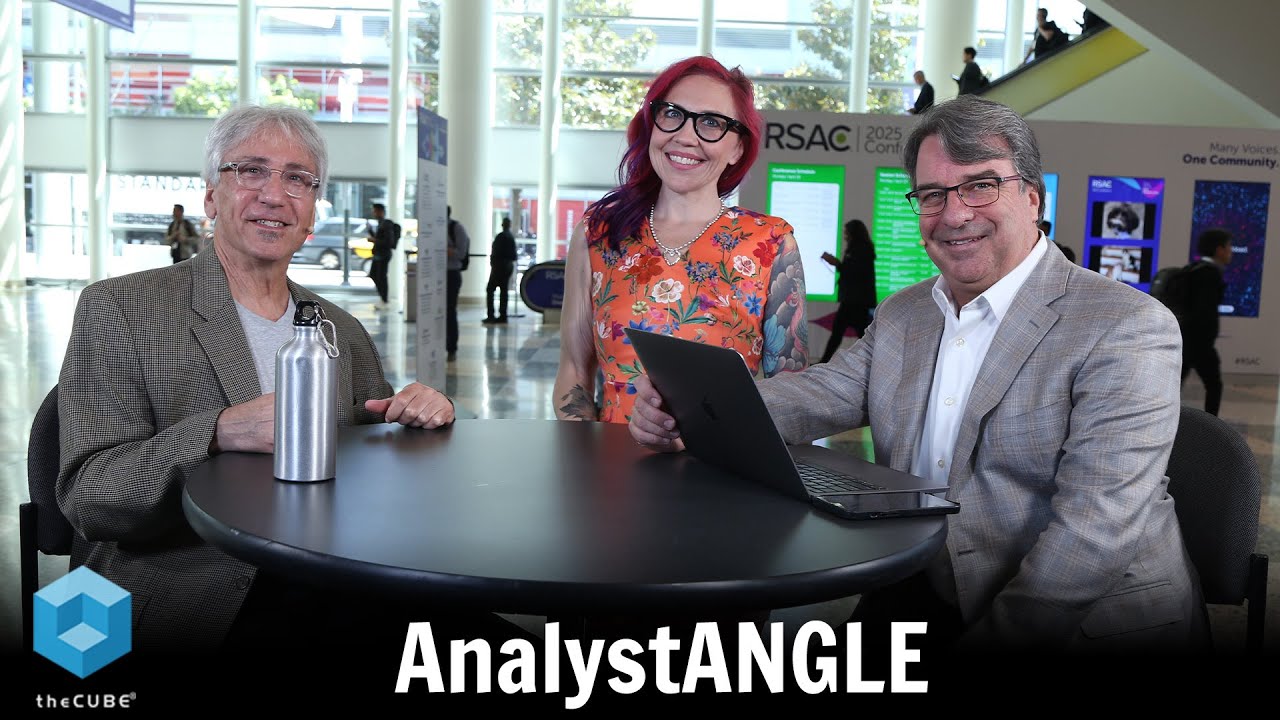
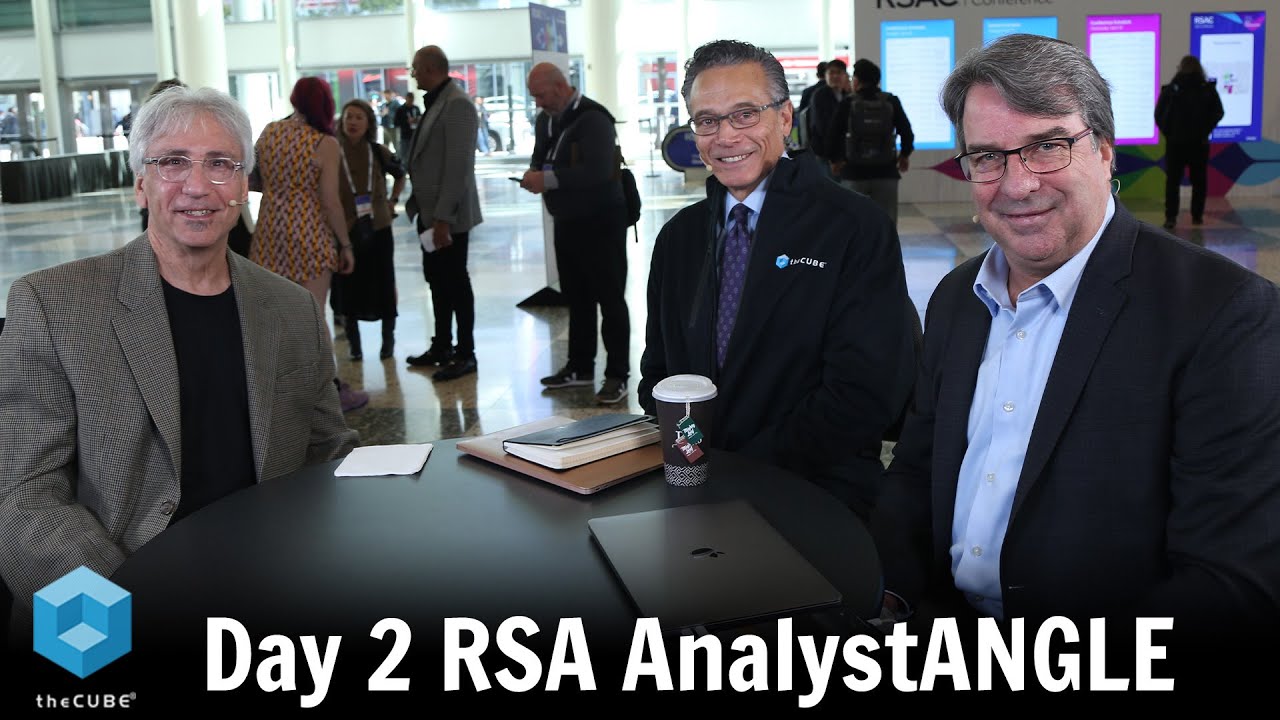
Roger Grimes of KnowBe4 joins theCUBE Research hosts Dave Vellante and Jon Oltsik at RSAC 2025 to discuss the evolving landscape of cybersecurity. This detailed discussion centers on the rise of agentic artificial intelligence and its implications for both defending and attacking within the cybersecurity domain.
In the video, Grimes brings extensive expertise, exploring the integration of data-driven strategies in cybersecurity. They emphasize the industry's oversight in failing to use available data to fortify defenses against threats such as social engineering and unpatched software. The discussion, guided by theCUBE Research hosts, also explores how agentic AI transforms the tactics and speed of cyber threats and the necessity for companies to adapt and evolve their defenses.
Attendees gain insights into how these technological advancements translate into practical applications, emphasizing the importance of companies adopting agentic AI to maintain robust defenses. According to Grimes, organizations must focus on customizable and personalized security training to efficiently allocate resources and mitigate risks. Throughout the dialogue, participants gain a nuanced understanding of evolving cybersecurity dynamics, highlighting both the challenges and opportunities presented by agentic AI.
Forgot Password
Almost there!
We just sent you a verification email. Please verify your account to gain access to
RSAC Conference 2025. If you don’t think you received an email check your
spam folder.
In order to sign in, enter the email address you used to registered for the event. Once completed, you will receive an email with a verification link. Open this link to automatically sign into the site.
Register For RSAC Conference 2025
Please fill out the information below. You will recieve an email with a verification link confirming your registration. Click the link to automatically sign into the site.
You’re almost there!
We just sent you a verification email. Please click the verification button in the email. Once your email address is verified, you will have full access to all event content for RSAC Conference 2025.
I want my badge and interests to be visible to all attendees.
Checking this box will display your presense on the attendees list, view your profile and allow other attendees to contact you via 1-1 chat. Read the Privacy Policy. At any time, you can choose to disable this preference.
Select your Interests!
add
Upload your photo
Uploading..
OR
Connect via Twitter
Connect via Linkedin
EDIT PASSWORD
Share
Forgot Password
Almost there!
We just sent you a verification email. Please verify your account to gain access to
RSAC Conference 2025. If you don’t think you received an email check your
spam folder.
In order to sign in, enter the email address you used to registered for the event. Once completed, you will receive an email with a verification link. Open this link to automatically sign into the site.
Sign in to gain access to RSAC Conference 2025
Please sign in with LinkedIn to continue to RSAC Conference 2025. Signing in with LinkedIn ensures a professional environment.
Are you sure you want to remove access rights for this user?
Details
Manage Access
email address
Community Invitation
Roger Grimes, KnowBe4
Roger Grimes of KnowBe4 joins theCUBE Research hosts Dave Vellante and Jon Oltsik at RSAC 2025 to discuss the evolving landscape of cybersecurity. This detailed discussion centers on the rise of agentic artificial intelligence and its implications for both defending and attacking within the cybersecurity domain.
In the video, Grimes brings extensive expertise, exploring the integration of data-driven strategies in cybersecurity. They emphasize the industry's oversight in failing to use available data to fortify defenses against threats such as social engineering and unpatched software. The discussion, guided by theCUBE Research hosts, also explores how agentic AI transforms the tactics and speed of cyber threats and the necessity for companies to adapt and evolve their defenses.
Attendees gain insights into how these technological advancements translate into practical applications, emphasizing the importance of companies adopting agentic AI to maintain robust defenses. According to Grimes, organizations must focus on customizable and personalized security training to efficiently allocate resources and mitigate risks. Throughout the dialogue, participants gain a nuanced understanding of evolving cybersecurity dynamics, highlighting both the challenges and opportunities presented by agentic AI.
Roger Grimes, data-driven defense evangelist at KnowBe4, joins theCUBE’s Dave Vellante and Jon Oltsik at the RSAC 2025 Conference. The conversation examines the dual role of agentic AI in both advancing cyberattacks and enabling stronger defenses.
Grimes emphasizes the need for companies to leverage the data they already have to counter threats such as social engineering and unpatched vulnerabilities. He explains how agentic AI accelerates threat evolution and demands smarter, faster detection and response.
The discussion also explores personali...Read more
exploreKeep Exploring
What is the disconnect between the data we have on successful cyber attacks and how we allocate resources to protect against them in the IT and IT security industry?add
What is the impact of AI on social engineering attacks in cybersecurity?add
What is the effectiveness of allowing AI to select simulated phishing templates compared to human administrators?add
What are some common misconceptions about cybersecurity compliance and risk management?add
What are some observations about the current state of cybersecurity insurance and its potential impact on the industry in the future?add
>> Hi, everybody. Welcome back to Moscone West. This is Wednesday, hump
day here at RSAC 2025, but it's going by fast. You're watching theCUBE's
continuous live coverage of RSAC, the biggest security
conference in the industry. I'm Dave Vellante. Jon
Oltsik is my co-host here. John Furrier is also in the
house along with Jackie McGuire. We'll be wall-to-wall coverage today, all the way through Thursday. Check out thecube.net, siliconangle.com. It's got us Rob Hof and team have a special section up there. Thecuberesearch.com has
all the deep dive research. Roger Grimes is here. He is a data- driven defense evangelist. Yes, I love that title. No before Roger. Good to see you. Thanks
for coming on theCUBE.
Roger Grimes
>> So glad to be here.
- I love this title. Everybody's data-driven but
data-driven defense security. You look at security as a data problem?
Roger Grimes
>> Well, what's interesting
is that we're the industry that is supposed to protect all the data, but we do not use the data to actually help us protect that industry. A long time ago, I realized that social engineering's involved in 70 to 90% of all successful data
breaches, unpatched software. According to Google mandates, about 33%. Those two causes social
engineering and unpatched software and firmware account for about 90 to 99% of successful attacks. Yet the IT and IT security
industry doesn't spend 3% on those resources to fight against it. So, we really know how we're
being successfully attacked the most, but we don't use data to drive how we then set up defenses. And it's that fundamental misalignment that has allowed attackers to
be so long-term successful.
Dave Vellante
>> So, you wrote this blog. This is a mouthful, but I'm
going to share it with people. Autonomous Agentic AI- Enabled Deepfake Social
Engineering Malware is Coming Your Way, coming to a theater near you. And so, that is pretty cool. Then it basically indicated
that it was, you forecast that you're going to have
these modular, self-directed, autonomous AI malwares that
are going to come after and exploit these social
engineering efforts. So, explain why you wrote that blog. And what was the
fundamental premise there?
Roger Grimes
>> Yeah, let me say, I was
a bit of an AI skeptic, or not a skeptic, at least
not on the bandwagon of, oh my God, it's going
to take over the world and become self-aware
and kill all the humans. And last year a really common
sentence I would say is, "Hey, AI's coming. It's not AI attacks are coming, but how you're likely to
be compromised this year is probably not going to be AI. It's going to be the
same attacks have been working for decades. " This year, we're absolutely
seeing AI come in a big way. 70 to 90% of social
engineering attacks now seem to have some indicator
that AI has been involved. The spearfishing and kits and things like that are using AI enabled. It's a big deal. And
really what we're seeing, and this is kind of interesting, is the good guys invented AI, 1955. The good guys really made
the explode late October 2020 with ChatGPT and all this stuff. And the bad guys for the first
time ever in our industry, are kind of following about a year or two. So this year, we're
seeing just an explosion of agentic AI, right? These somewhat autonomous
operating modules that will do things faster,
faster detection, faster, better patching, and that sort of stuff. So if I look at the past history, and I'm a big believer that past history is a
good indicator of future-
Dave Vellante
>> Certainly rhymes.
- ... yeah, it seems like that
there's a really good chance that I would say within a year or two, that the whole
malware hacking model is going to be really heavily agentic AI. Just meaning that they're going
to vastly increase the speed at which they detect
things that are on patch. They're going to vastly detect how quickly they can do an AI deepfake. Perry Carpenter, one of my
co-workers, literally he can say, "Who do you want me to be right now? Do you want me to be Burt Reynolds or Britney Spears or something like that? " Click a button, and now he's talking and everything he's doing is
being as that personality. Not only that, but he
can set up LLM models where he literally can use
this LLM AI to call somebody and do a social engineering scheme that is really kind of scary to see. Thank God Perry's on our side. But you're like, okay, if
we've got the technology that can do that now it's
only a matter of half a year or a year to the bad guys
who are using that routinely. And I don't think there's anything that's going to stop that. Two years from now, it's basically going to be good AI bot against bad AI bot. And the best algorithm will win.
Dave Vellante
>> So when we interviewed Marc
Benioff a couple of weeks ago, he was basically saying, "I'm
the last generation of CEOs that are going to be
managed human only workers. " So to Roger's point,
you got good guy bots and bad guy bots, good
guy AI, bad guy, AI. How's that going to play out?
Jon Oltsik
>> I think we're seeing it already. I think to your point,
Roger, we've seen LLMs and things like chat GPT being brought in for malicious purposes,
in fact malicious LLMs. And so, the ability to do the research before you do the attack has
been automated and accelerated. What's the next step? Get
the human out of the way. So agentic, that makes a ton of sense. The data's there, we know
how to make the model. So just weaponizing, that
is absolutely the next step. I wouldn't be surprised
if there's already kind of beta testing of that.
Have you seen that?
Roger Grimes
>> Yeah, I mean we've definitely
seen indications of that. And let me say some people
go, "Oh my God, it's going to create a better phishing attack. " That's not really the scary part. Yeah, it's going to make
a very good simulated spear phishing attack. But the part that I think
where it's really going to excel is that when you send
an attack into a particular company or industry, that industry and company has its own way of talking. Whether you're in the
healthcare industry... Like in the hotel industry where I work, they'd have this thing called a census. And every day, every hotel
front desk manager's going to get called, "What's your census? " Which means, how many people, how many beds do you have
subscribed, and how full are you? And that sort of stuff. Well, these AI bots are going to be able to look at the industry,
use industry vernacular and terminology with people just to... At first, you have
these people doing a lot of spear phishing attacks that aren't in the native language. And there's typos and they don't know how to respond when someone
asks them a question. Well, this AI bot is going to
know how to perfectly respond. And we're already seeing that. We're already seeing indications
that they're testing it. You're right, they have malicious LLMs. Every good LLM seems to be jailbroken like every single day. It seems like almost
a losing battle trying to keep them secure and
away from being used. And we're going to lose that war. And it used to be a decade or two decades ago, if you had a kid that was a mathematical
genius in college, he would go to Wall Street and become an
algo, an algorithmic person for helping make stock trades. I think if my kid is a mathematical
genius, I'm sending them to the cybersecurity company so he can create good
algorithms for these AI bots.
Dave Vellante
>> So-
- Well, from your... I'm sorry-
Dave Vellante
>> No, please.
- ... but from your mouth to
God's ears, 'cause I have a kid who's looking for a job. So Sorry, Dave, go ahead.
Dave Vellante
>> No- >> Algo.
- ... let's help him out. >> Just tell him to go look
into to being an algo. >> Tell him.
- He looking. >> We're going to have
to help him out here, Jon. Let's tease that.
Jon Oltsik
>> Sounds good to me.
- So we talk a lot about critical infrastructure, how exposed it is. We've seen the future of war. I mean, it clearly involves cyber. We have nuclear arms treaties. Do we need cyber arms treaties? Is that something that we're going to see?
Roger Grimes
>> Yeah. Part of the reason, if we could ever identify hackers, and that's the reason
why they're so pervasive, is we can't really readily identify them. But if we could, well,
we can't prosecute them because we don't have large international agreements agreeing to prosecute. Our warrants and judicial
system in America are not going to be accepted and apply
in China and Russia. And let me say vice versa. If China and Russia's saying, "Hey, we need you to arrest your hackers
and send them to us. ", we're not doing it. But just recently, the UN signed the first
global cybersecurity treaty defining what is allowed and legal, what should be off
bounds, that sort of stuff. And there's certainly a lot of issues. But let we say that for
the first time ever, as far as I'm aware, United States, China, and Russia signed the same
cybersecurity agreement. And I've been watching for 20
years for the UN saying, "Hey. ", and the French and
all these other people and Geneva trying to
create a Geneva Convention for the cybersecurity
world, and seeing it. Everyone's like, "Oh, it's
going to happen, it's going to happen. " And it just fails
because either the U.S. , China, or Russia saw something that was against their interest and said, "We're not going to sign on. " So, the UN just did this
a couple of months ago. It's even got some concerns
for privacy. It could be used. Some people are worried that
China could use it to go after human rights people
and that sort of stuff. It's the first time we got
an international agreement. It's a start, it's a base, and so there's some positivity there.
Jon Oltsik
>> And there are two things
that are always of a concern. One is surveillance, because spying and surveillance is sort of allowed in the international community. And the second thing, everyone's
concerned about any kind of guardrail or hurdle to
their offensive operations. Because NSA and what is it, total... I forget the name of the acronym, but we believe our offensive
capabilities are the best, china believes its offense. So, no one wants to
limit those capabilities.
Roger Grimes
>> Agreed. Absolutely agreed. Great point.
Dave Vellante
>> I interviewed Robert Gates, it was at a ServiceNow conference. It might've been the same
one that, it was year after I think police
threw the water on me. And I asked him about that. And I said, "Don't we have the best offensive cyber capabilities? " He said, "Yeah, but we
also have the most to lose, so we have to be very careful."
Jon Oltsik
>> That's always true. >> And so that was, I
thought, telling Comet. Okay, so what can organizations
do to protect themselves and how does KnowBe4 before help?
Roger Grimes
>> Well, certainly
embracing the agentic AI, although I oftentimes tell
people you really should be interested in feature sets and whether that's getting
accomplished by a basic if- then statement or whether it's agentic AI shouldn't really... We shouldn't be excited
about agentic AI by itself. But if the feature is going
to better detect something, better stop something, be more efficient and quicker, well then
you need to embrace it. And it does look like
autonomous agentic AI has a lot of those factors in there. I mean, part of that is like right now with patch management, you're like, "Well, I've got patch management and
you go out and take a look. " And then, "Oh, this is what I'm missing. I'm going to patch."
Agentic AI is the idea that you send out this autonomous bot, it analyzes this device. It's like, "Oh, I get a patch
this." And it's doing it and there's nobody pushing a
button telling it to do it. It already has the parameters to know what should be patched, what
hours should be done, maybe that it has to do a backup first
to do testing or something. So, the idea is that it should
be kind of more taken out of your hands and the AI
making better decisions. At knowBe4, we've been doing
AI going on seven years, and we've got a ton of AI and agentic AI. And we already have data to show us that if you rely upon the AI, it's actually better than a human admin. For example, one of the things we have is that if you allow the AI, agentic AI to select the simulated phishing template, the example phishing thing,
you're going to send someone, that if you let AI do
it's 17% more effective at tricking the person into
clicking on something. And let me say it's not
necessarily a bad thing, because when someone fails
a simulated phishing test, you're getting a chance to educate them, let them know they're susceptible. So, we see it as a positive
learning experience. And I think you're going to
see that just all throughout cybersecurity software, where the autonomous agentic AI is going to be more efficient, faster. And it's got to result in better outcomes. If it doesn't result in better outcomes, you shouldn't go there. Well, I think the evidence is showing that just from our limited testing, that agentic AI is being more successful, it's what it's doing. Even I think during a political campaign, they were talking about the
agentic AI doing the call campaigns resulted in like 7% more donations or something like that. I mean, across the board,
I'm not hearing a lot of people talk about, "Oh, we're seeing more failures this year. " Last year we saw more failures, this year we're seeing
a lot more successes. It's matured to a point to it really does seem to be adding value. So, what would I say to most companies? Agentic AI is coming to attack you. There's probably a good
chance you need agentic AI to help better defend you.
Jon Oltsik
>> Yeah. And what I like about
what you're saying, Roger, is it's not peanut buttering
solutions over your entire staff, all your employees. It's using the AI to understand
who's strong, who's weak, what does Dave need versus what Jon needs, and customizing your training, or in this case, your synthetic
phishing to that person. That's a force multiplier for
the organization rather than-
Roger Grimes
>> .
- ... just treat Dave and Jon the
same and we're all bored because we know all this stuff.
Roger Grimes
>> You said it better than... You said what I should have said, which is-
Jon Oltsik
>> That's my job.
- ...
Roger Grimes
>> it's going to allow more
personalized training on a person. And if you had a human
admin that had to do that and make that happen, it's going to be-
Jon Oltsik
>> be slow. >> Yeah, it's going to slower. And so absolutely, we're going to see this more personalized approach. All humans are different, although there's probably some class types that you could probably say. But we know that we have people
that never click on stuff, and we have people that
seem to click on everything. And they're going to need
different types of training and treatment and nudging,
coaching, as we call it, to help protect, better
protect the organization.
Jon Oltsik
>> And what that does is it
gives you better security because you can apply your
resources to those who need it. But it also frees, if Dave and I don't need a strong security, that makes us more productive because now we don't have
security hurdles in the way.
Roger Grimes
>> Yeah, yeah, absolutely. And I would say also, I
consider myself a person that doesn't get tricked a whole lot, but I have been tricked. And it takes a different
type of phishing campaign, simulated phishing campaign to trick me. And every time I get the
ones that are all simple, like click here to get a
free Dunkin Donuts coupon or some fake email from my supposed boss or something like that, it's so easy it's not teaching me anything. I need to have a little bit, the maturity of the attack against me
needs to be ramped up. And occasionally I would
say if you have someone that never fails a test, you're probably not giving
them all the education that you should be giving them.
Jon Oltsik
>> That's true.
- So you're advocates of using tools, and I see a note in here on Perry's fake following those suggestions. I think you're talking
about Perry Carpenter-
Roger Grimes
>> Perry Carpenter.
- ... who wrote the book on deepfakes.
Roger Grimes
>> F-A-I-K. I
think Perry is the penultimate person talking about how AI
can be used in a bad way. He was here yesterday giving a talk, and he had an evil Santa Claus
doing a kidnapping request and cursing at the person on the phone. And it was all automated. And I got to tell you, a lot
of the people in the audience were kind of on their phones. And when he had the evil Santa
doing a kidnapping hostage ransom negotiation, cursing and yelling and stuff like that, I tell you, everybody in the audience put
down their phone, looked at that, what was happening in real time, and went, "Oh, this is here. " And it was amazing to
see the AI just interact to anything he said. He even tried to throw some things to trick it and stuff like that. And it responded quite well using things that he did not give it ahead of time. I even know he could do
it, I've watched his demos, and it still never kind of... Gives me a little chill to
know this is what's coming.
Dave Vellante
>> I want to come back to the
good bot, bad bot battle. Are the measurements to
determine success going to change, or are they going to be the same? And what are they?
Roger Grimes
>> No. So as a data-driven
defense evangelist, I think we need to use the data. And we need to make sure we're
measuring the right thing, which I think ultimately the
right thing is your decrease in cyber security risk in a
real measurable way, meaning that you're actually
getting less breaches, less likely to be breached. A lot of times, the measurements
will be, Hey, I want to have less bugs for a
thousand lines of code. Or I want to have more testing
or something like that. Ultimately, it comes down to, am I more or less at risk this year than last year or the previous time period? That's the ultimate measurement. So, we need to make sure we're
measuring a real decrease in cyber security risk. And that's some compliance
checklist. Am I using MFA? Do I have a complex password
or something like that? That's great, but it doesn't
get to the ultimate risk.
Dave Vellante
>> Well, that's always my two biggest. My number one question is,
what's with all the acronyms? My second question in
cyber is, I spend more, but I don't feel safer. Why am I not safer? And I think there are
reasonable answers to that.
Jon Oltsik
>> And I think to Roger's
point, what we're going to have to do is take what you
just said, those metrics, and put them in business terms. Because the board and
the executives are scared and they don't understand this stuff. And we can't throw a
bunch of technical jargon or acronyms at them. We have to say, "Here's
the business risk, here's how we can mitigate that business risk. Here are the metrics we
can use to measure that."
Dave Vellante
>> And here's what it costs to do that, and here's the return.
Roger Grimes
>> And let me give you just two quick, like a compliance thing would be, are you doing security awareness training, human risk management?
Dave Vellante
>> Yes, no. - And someone's
like, "Yeah, I'm doing it once a year 'cause that' what the
compliance guideline HIPAA or PCI DSS requires. " That's almost ineffective. We've got the data to show that- >> Oh, not almost. It's ineffective.
Jon Oltsik
>> Yeah. It's like training
someone once a year to drive a car when they're learning. Or MFA. Are using MFA? Yes, but 90% of MFA is as
easy to bypass as a password. You need to use phishing-resistant MFA. And just a little tiny term, a phishing- resistant means a whole lot
to your cybersecurity risk. So, we need to get people educated that using MFA is not enough. Just using SAT once a year is not enough. We need to do the real
things the right way. So compliance is, I met this thing and now I, oh, I don't have to
worry about it in the audit. Cybersecurity is I really am
decreasing cybersecurity risk and I'm less likely to be compromised.
Jon Oltsik
>> Got it. I have a killer
question for Roger.
Dave Vellante
>> Go.
- Is cyber insurance going to drive this?
Dave Vellante
>> Interesting.
- Because if all that data's available and we have AI working
for us, all of a sudden an insurance company can have exposure to risk like never before. So, do you see that on the horizon?
Roger Grimes
>> Yeah, well, I'd say
it's already done it. And I would say that it's
already done the movement that it's going to do a year or two ago.
Jon Oltsik
>> Really? - And let me say
cybersecurity insurance is moving it in a big way, but I really thought it was
going to be even better. And it was. It was able to
tell companies that they have to use MFA, that they have to do security awareness training. But they are missing the
devils in the details.
Jon Oltsik
>> That's what I mean.
- And when I look at cybersecurity insurance applications and stuff, they've all
got different questions, they all are very vague, and they're just missing
these fine points. What I missed was that they didn't have
enough cybersecurity experts to ask the right actuarial questions. But yeah, I think
cybersecurity insurance has already done a big movement. It made its big movement. Also today, much harder
to get cyber insurance. It used to be you could
get $5 million of insurance for like $15,000 a year. And they only ask you three
questions, which is name, email, address, and check, what's
your check number or something. Now, really tough to
get a hundred thousand, a million dollars of insurance. There's a lot of exclusions in there. But it absolutely helped
mature the industry. My only question would
be is it really going to be a driver in the future
and make it even more? I think there is a sense that it will as it gets the data in,
figures out what we need. Data-driven. And who has better data for driving risks than
an insurance company?
Dave Vellante
>> I was watching the
Berkshire Hathaway annual meeting last year. I won't be watching this year
'cause it's on Derby Day. I'll be handicapping horses.
But I think it was Ajit Jain. I think Ajit Jain runs that practice. And he said, "We don't like
the cyber insurance business. We're not participating in that. " And I've talked to a lot
of companies who are in that business say, "We disagree. We really love that business. " So it's going to be
interesting to see if that comes up again, because I know those dynamics are in flux. And so maybe it's not as profitable for the Berkshire Hathaway model, but I think a lot of
companies really rely on that.
Roger Grimes
>> We have a partnership with a couple of insurance industry groups and a couple insurance companies that actually offer a discount. So I would say if you don't
do cybersecurity awareness, human risk management, you'd have a hard time getting
a cyber insurance policy. Even if you could, you're certainly going to get a discount if you do. So, that's the good thing.
If you're not using MFA and you're not doing good
training, you're going to have a hard time getting the policy.
Jon Oltsik
>> Right. - As a small company,
our cyber insurance provider audits us and tells us, "You
got to plug these holes, you got to put MFA here, here, and here. And thank you." I mean, it's fantastic.
Roger Grimes
>> And again, the only thing I
do, and I'm trying to educate them working
with them, is say, "Hey, phishing resistant MFA. Everybody, not just the admins." Right? 'Cause if ransomware breaks into your... Most of the time they're breaking-
Dave Vellante
>> .
- ... end user, then
they're getting to the service and admin passwords. So, you can't just protect admins. And the same thing with training. It's got to be effective training that really does reduce risk.
Dave Vellante
>> All right. Hey, thank you. Got to go.
Roger Grimes
>> Thanks.
- I really appreciate your time. And by the way, check out this blog, Autonomous Agentic AI Enabled
Deepfake Social Engineering Malware is Coming Your Way. Nice job. I mean, you really
gave a lot of thought to this.
Roger Grimes
>> Thank you.
- It's not just a hundred-fifty word blog. It's meaty. So, thanks for that.
Roger Grimes
>> Thank you.
- All right. And thank you for watching. This is Dave Vellante for Jon Oltsik. John Furrier is also here, as is Jackie McGuire, the whole CUBE team. You're watching our
coverage, theCUBE's coverage of RSAC 2025. And we'll be right back
right after this short break.




















 Dave Vellante
 Jon Oltsik