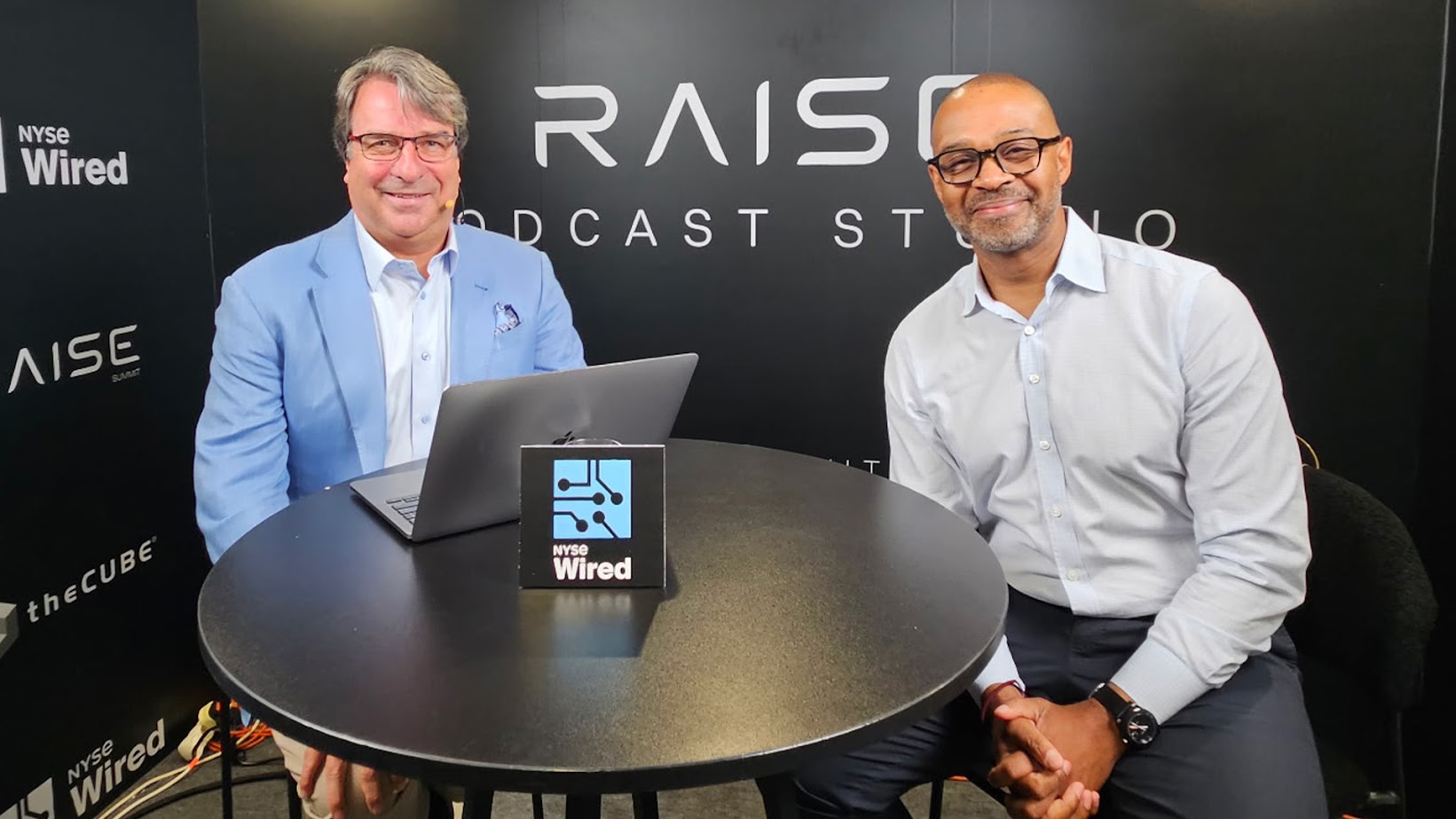
In this RAISE Summit 2025 interview, theCUBE’s John Furrier sits down with Benoit Dageville, co-founder and president of product at Snowflake, to explore how the data-cloud pioneer is scaling for the next era of AI. Dageville details Snowflake’s push to make unstructured data first class alongside structured and semi-structured information, explains why AISQL is “SQL for AI,” and shares under-the-hood advances that squeeze every GPU cycle for cost-efficient performance. He also lays out the three-layer blueprint of data, semantic views and governance that is powering search, RAG and agent-based workloads while keeping security tight.
The conversation digs into Snowflake’s roadmap of semantic views, now shipping at over 95 percent accuracy, and its twin governance engines, Horizon for full-platform assets and Polaris as an open protocol for industry collaboration. Dageville compares real-world TPC-DS benchmarks that counter competitive cost claims, outlines how customers can future-proof architectures for a twenty-mile AI horizon and shares why direct natural-language interaction will democratize data access for every business user. Filmed live at the Carrousel du Louvre, this session offers a front-row look at how Snowflake is blending analytics and gen AI to drive the agentic economy forward.
Forgot Password
Almost there!
We just sent you a verification email. Please verify your account to gain access to
RAISE Summit 2025. If you don’t think you received an email check your
spam folder.
In order to sign in, enter the email address you used to registered for the event. Once completed, you will receive an email with a verification link. Open this link to automatically sign into the site.
Register For RAISE Summit 2025
Please fill out the information below. You will recieve an email with a verification link confirming your registration. Click the link to automatically sign into the site.
You’re almost there!
We just sent you a verification email. Please click the verification button in the email. Once your email address is verified, you will have full access to all event content for RAISE Summit 2025.
I want my badge and interests to be visible to all attendees.
Checking this box will display your presense on the attendees list, view your profile and allow other attendees to contact you via 1-1 chat. Read the Privacy Policy. At any time, you can choose to disable this preference.
Select your Interests!
add
Upload your photo
Uploading..
OR
Connect via Twitter
Connect via Linkedin
EDIT PASSWORD
Share
Forgot Password
Almost there!
We just sent you a verification email. Please verify your account to gain access to
RAISE Summit 2025. If you don’t think you received an email check your
spam folder.
In order to sign in, enter the email address you used to registered for the event. Once completed, you will receive an email with a verification link. Open this link to automatically sign into the site.
Sign in to gain access to RAISE Summit 2025
Please sign in with LinkedIn to continue to RAISE Summit 2025. Signing in with LinkedIn ensures a professional environment.
Are you sure you want to remove access rights for this user?
Details
Manage Access
email address
Community Invitation
Benoit Dageville, Snowflake
In this RAISE Summit 2025 interview, theCUBE’s John Furrier sits down with Benoit Dageville, co-founder and president of product at Snowflake, to explore how the data-cloud pioneer is scaling for the next era of AI. Dageville details Snowflake’s push to make unstructured data first class alongside structured and semi-structured information, explains why AISQL is “SQL for AI,” and shares under-the-hood advances that squeeze every GPU cycle for cost-efficient performance. He also lays out the three-layer blueprint of data, semantic views and governance that is powering search, RAG and agent-based workloads while keeping security tight.
The conversation digs into Snowflake’s roadmap of semantic views, now shipping at over 95 percent accuracy, and its twin governance engines, Horizon for full-platform assets and Polaris as an open protocol for industry collaboration. Dageville compares real-world TPC-DS benchmarks that counter competitive cost claims, outlines how customers can future-proof architectures for a twenty-mile AI horizon and shares why direct natural-language interaction will democratize data access for every business user. Filmed live at the Carrousel du Louvre, this session offers a front-row look at how Snowflake is blending analytics and gen AI to drive the agentic economy forward.
Explore AI integration at RAISE Summit 2025 with Benoit Dageville
Join a compelling discussion with Benoit Dageville, co-founder and president of products at Snowflake, as they delve into the intricacies of AI integration and infrastructure at the prestigious RAISE Summit 2025. The event brings together global leaders to discuss the rapidly evolving world of AI and its impact on data infrastructure.
In this interview with theCUBE's John Furrier, Dageville shares insights into Snowflake's journey and significant advancements in data processing. T...Read more
exploreKeep Exploring
What recent advancements has Snowflake made in integrating different types of data?add
What advancements have been made regarding AI capabilities and performance optimization in the data platform?add
What are the roles of AI in processing unstructured data within a data platform?add
What are the critical features to consider when evaluating a data platform?add
>> Welcome back everyone to theCUBE's live coverage here in Paris, France. I'm John Furrier, your host of theCUBE, the RAISE Summit 2025, two days of leaders all around the world coming together to talk about the future of AI, future of AI infrastructure. More importantly, as agents come in, the continuing growth of the markets now expanding. Obviously, theCUBE Global's here, of course with the NYSE Wired, our team there as well. Part of theCUBE powers that. We have another co-founder here, president of the Process. Benoit, great to see you, CUBE alumni. Thanks for coming on.>> Yes, great seeing you.>> Dave Vellante tends to do all the interviews because I have to... He hogs you. So I got my shot. We've both been covering data since theCUBE started 16 years ago. The Hadoop wave, we saw that happen there. Just watching Snowflake rise up and just be so successful from day one. It's been a great testament to what you guys have done, so congratulations.>> Thank you.>> Now the market is going kind of next level and Snowflake Summit. You guys talked a lot about how you guys are looking at that platform. Give us a taste of what's happened in the past, we're at the midpoint of the year. Take us through what the first half was like for you guys internally, the company, the customers, we're in a transformative mode. What were some of the key highlights from the first half of the year?>> Yeah, so what is great is when we started, just to go back a little bit more than half a year ago when we started, Snowflake was really to integrate structured data with semi-structured data and now it's about unstructured data. It's all making that data first class in the platform. So a lot of our customers, they want to know how to integrate this new type of data and I said like structure and semi-structure being on the same roof, unstructured needs also to be part of your full data assets because you might join information which are unstructured data with information which are structured. So it's very important like Hadoop and Data Warehouse should have been combined and that's what Snowflake did. We really want to do the same thing with unstructured data. So a lot of capabilities have been added to the platform AI capabilities. The AI is the SQL for this type of data and of course RAG and search. So a lot of activity on that part. We are also AI SQL, so bringing elevating SQL to be also the language to query unstructured data. And that's really fascinating because it's more than just a language. It's also the way you get all the performance. You really need to pack a lot of usage to your GPUs. You don't want to leave any idle cycle on your GPUs. This is very important. So optimization, a lot of work has been on performance optimization costs.>> On the SQL side. So you're optimizing infrastructure as part of your product roadmap to make sure that the utilization->> Yes, that is part of data platform is efficiency and efficiency, it'll say to cost. So with GPU it's even more important. When we started Snowflake, there was no... We structure data, there is no need for GPUs, but still CPU cycle is a really important currency. So you have to use every cycle and how you vectorize execution. So it's the same thing for GPUs, how you bring data to GPUs, how you do that efficiency, how you overlap the different stage of a pipeline is->> So there's a lot of innovation under the hood going on that you guys are spending time on. It doesn't get the sexy headlines, but it's really the must-needed work.>> I mean it goes bottom up. You need to have that before you do the sexy thing.>> So one of the things that I loved about Snowflake, you did combine the data where as you guys really pioneered data cloud, which we covered, but the market of analytics is operationalized or it's out there. The gen AI hype came up very... Well, gen AI was not really kind of a thing, but it got hyped up so fast people confused operational analytics with the magic of gen AI. So as those two years have happened, where are you now on the product side saying, "Okay, there's an intersection between analytics and gen AI," what's that look like to you because now it's starting to get real. You mentioned RAG, you could mention some of those use chatbots and those use cases, but now when agents start to get in there, what's on the roadmap? What needs to happen? What's the sequence of events?>> So AI has three aspects, as I said, without AI, there is no unstructured data in the data platform. So AI is really the tool to understand unstructured data and to extract that information to be able to process it. You talk about search and RAG, that's also very important, right? In structured data you need workloads to search data. So RAG is the equivalent for unstructured data. Now that's why AI is so important for the data platform. Unlike any other products, we need AI for unstructured data. Then there is the part which is more common is how to interact with data in natural language. So how to leverage the AI and the capability of AI to translate and to convert natural language to potentially SQL or natural language to a search query and agent is the layer on top of that, which is about creating very focused AI product agents and integrate many agents together to perform complex tasks. And so that's where the platform is going. One thing which is critical and maybe you are going to mention about that is the semantic aspect.>> That was my next question. Yeah. So at Snowflake Summit you announced semantic views.>> Yes.>> So define what that is and why is it important?>> So why it's important is... So semantic is about not the definition of data, the definition, the cataloging of data is a table. And I have columns and these are the name of this object, but it is not the semantic, the understanding. And oftentimes an analyst or human being will have that in his head or an application, complex application, have a semantic model embedded in the application. But now if you want AI to replace the human and be able to ask in a direct question to the AI, the AI needs to have this understanding. So you need to push that inside the platform. So really modern data platform is one layer, level zero if you want is the data, structure, semi-structure, unstructure level one is the semantic is really adding the semantic views. So semantic views not only defines what these tables are about in more precise term, but what are the metrics, how to compute metrics, what are the different aggregation, how these tables relate to each other such that AI has a simpler view of->> Is that just metadata about the data?>> It's metadata and computation.>> Got it.>> Metrics is computation. For example, if I tell you I'm a financial and I want to compute revenue, how you compute revenue when you stop, when is the day define, what do you do with vacation? You need to have the semantic. It's not like a definition of revenue is not the same depending on the industry, depending on the company. So->> That's what you mean by metrics.>> Yes, exactly. It is pushing this computation inside the model such that the AI, when as a human being, you ask for revenue over that time, it knows what to use.>> And the advantage there is what, speed and the relevance, right?>> It's quality and speed because you can also optimize the underlying, and we do a lot of the optimization based on... You can metalize the semantic too. You can pre-build that because these are obviously oftentimes asked questions. So you can play games like that.>> So where are we with semantic views right now, shipping?>> Yes, yes. It ships.>> And you feel good about the products.>> We are super good and they are going to evolve. Of course we had new capabilities because semantic can be complicated how relationships, but it's a very good, and this is the way the quality of AI has really increased. We are beyond 95% quality, which is important. We want to get to 100%, don't get me wrong.>> Of course you got a roadmap. So you're building a roadmap on that. And what's the priority on the roadmap?>> The priority is really twofold. One is, as I said, bringing unstructured data to the platform. So how to build connectors with infrastructure data, how to bring all the accords. It's not only connecting to your SharePoint and bringing that data inside Snowflake, but it's also preserving all the security and you cannot see all the documents. So we need this layer governance. I say that our platform is three layers, right? Level zero is data semantic and then governance is super important.>> Yeah, I'll get the covers a second. I wanted to ask about graph databases, because we're seeing these surges of graph. Is graph unstructured to you or is it a different animal for you? How do you view graphs?>> Graph is a relationships, right? Everything is graph. If you define our current life, we are connected, right? We exchange. So this is a connection. So this is a graph and a rational database is a graph here. You have connection when you join. This is graph relation. Now this graph can be materialized. You have really a pointer to an object or you have ideas that you join with, but you need to describe what relation, how do you relate. And defining this is part of the semantic model. It can be materialized, but it can be just defined.>> So talk about the third layer. Let's talk about governance. That layer, you got two approaches. Horizon, Polaris, the competition has Unity Catalog.>> Competition has two Unity Catalogs. So the difference with competition, as you mentioned is really names. We decided that our open source are going to be really a protocol. We want to really bring the industry around open source protocol for catalog, and that was Polaris. And we have of course our Horizon with all the assets that Snowflake has, which goes beyond tables. As you know, everything in Snowflake, every asset is part of the catalog. Even compute is part of the catalog. So we wanted to have different names. The competition has two things, a closed catalog, which is Unity, and another one which is Unity 2, the same name but is open source, which is a fraction of what you have in the->> Just call it Polaris 1, Polaris 2.>> We should have maybe call it Horizon and Horizon, but we wanted not to deceive. I mean->> Yeah, that's the difference.>> ... that's the difference. It is just a name. So because you cannot open source everything, right? Because people will not be able to interact with our compute, it doesn't really make sense.>> I mean there's headlines. People like to do the headline-grabbing the competition. We've seen that. The competition always says Databricks, says that they're faster and less expensive. That was a claim that was made. I mean you could slice and dice things.>> Yes.>> How should customers understand what's real and what's not? How would you->> No, this is actually very easy because we do it every day actually.>> Good.>> You run and they are competitive benchmarks. TPC-DS is one of them. You can run them on both platform, see the performance and compare the price. And I can tell you the statement is very wrong. So you're right, you can say... And it is very interesting because there is performance as how efficient you are. And then there is cost, which is a different metric. Price performance is very important. So we are very competitive, I can tell you.>> All right, well, you're very assertive. I like that. I like that mojo. And also the market is confusing. If you could summarize in your mind to a customer, and you do this every day you said, as they plan the generational platforms, because you guys came in, took the market by storm, the data cloud, again, we talked about that at length many times. But now people are looking at a 20-mile stair for their future. They're putting their foundations together, their system architecture, we're going to call it from an infrastructure, from horsepower. It's a generational decision.>> Yes.>> How should they think about how they architect it? What are some of the guiding principles you might have to share? Knowing what you know, you got the roadmap, you get the keys to the kingdom, you're the co-founder, you're the product leader. Help me understand what I need to do to set myself up so I don't foreclose my opportunities.>> No, it is a very good question. So I would say the most important thing with a platform is does it support all my deeds, all my data? As I said, all data is super critical. Structure, semi-structure, unstructured data should live in under same roof because you want to join this data together. So that's one. All workload is another one, right? It's not only about analytics, it's transactional. I want to do AI, I want to run my application, running all the things that you need today and tomorrow is a critical part. And then after that there is the characteristic of the platform. If you look at an iPhone and Android, you could say they are doing the same. It is the same, but you have a philosophy in the platform. Snowflake is about simplicity. Not taking complexity and not pushing complexity out. Complexity as a lot of cost, has a lot of you go slow. So we like to say Snowflake can do more. You can do more with your data with Snowflake. So that's how to quantify. It's not... But you can see it, right? When you use both products, you will see it.>> Frank on my team is an Android. You never text me because he's not on->> Actually, I'm using an Android. I should not say that as an analogy.>> All right, so I have to ask you about Paris because we're here in France, international conference here, it's very crowded. What's your->> This is great. I love it. I have to say I love it. I am still French at heart and I love Europe, the energy, creation, innovation. So it is really good. It's really fun. When I heard about RAISE and I was asked to attend, I say, "Oh, yeah, .">> It's in Paris. Great wine list here. Good food.>> I'm coming from the South of France, so Paris .>> A little chill. . Now you're in this big city.>> Europe, right? I like to think about Europe.>> Benoit, great to have you on. And again, congratulations. And final question for you as a co-founder, I love companies where founders are still driving the agenda. What's exciting you right now? Obviously competition makes you better. I love that. What's your mind right now leaning into the products? What are you optimizing for? How are you feeling? Share your thoughts.>> Yeah, to me, what is super exciting of course is AI, but everyone will tell you that answer. So it is not an amazing answer. But AI, as I said in my lifetime, I would never have thought that data platform could bring unstructured data. So this is a huge revolution in my mind. And we are just at the beginning of that revolution. And the other part, which I'm very passionate, I gave this example with iPhone, is direct interaction with the data platform. Democratization of access to data and AI as a huge role. You can now talk to your data. Any business user can directly use this data platform. It used to be only for gigs and now everyone can use it. And we are working on that and that's super exciting to me.>> Yeah, I have two computer science degrees and one of them was databases and I never really talked about, I was talking about the . "Hey, what do you do?" "I'm a database person." I mean you go back in the '90s, it wasn't really fashionable to be like a database. It was very small industry. Now it's mainstream.>> You're right. I did my PhD in databases. So I was really born in databases and I love databases because it was both operating system, it had performance polarization, it had language, a lot of language in databases. So it's very complete as a science and computer science. So that's what I liked about data.>> Well, congratulations. And again, thanks for coming on theCUBE, always great to see you at the summits. Great to spend some time with you personally. Dave Vellante, shout out to Dave, Dave's on vacation. I get my time. Thanks for coming on.>> That's great.>> Appreciate you.>> Thanks a lot.>> All right.>> Okay, bye-bye.>> the co-founder of Snowflake, one of the first data cloud provider leader in unstructured, structured data, powering the gen AI and the analytics revolution as data goes mainstream and AI takes over the world. I'm John Furrier, your host. Thanks for watching.