In this interview from Phi Moments @ Google Cloud Next 2026, Mehul Trivedi, group vice president of technology at John Wiley & Sons, joins Debopriyo Nag, practice lead for data and analytics at Quantiphi, to talk with theCUBE's Rebecca Knight about how a 219-year-old publishing company is dismantling a decade of fragmented data infrastructure to build a unified, AI-ready lakehouse on Google Cloud. Trivedi details how Wiley's legacy ecosystem — built across disparate business units over 10 years — created a data debt that blocked meaningful AI and analytics work. He outlines the three-part case for choosing Google Cloud and BigQuery: cost consolidation, a fully integrated AI and ML stack and open-source flexibility through formats such as Parquet and Iceberg. Nag explains how Quantiphi deployed its in-house AI agent platform, Codeaira, to automate query translation, validation and migration across 300 terabytes of data and 30,000 tables — compressing what typically takes two years into six to nine months.
The conversation also explores how the migration is reshaping Wiley's workforce. Rather than displacing engineers, Trivedi notes, Gemini-assisted tooling frees teams from routine pipeline and reporting work so they can focus on building semantic models, uncovering new data relationships and developing future-ready products. Nag reinforces a lesson drawn from years of enterprise migrations: lifting and shifting data to the cloud without first contextualizing it will not unlock AI value. From piloting a scalable lakehouse architecture to positioning Wiley for the next decade of AI competition, both guests make clear that data readiness — not model selection — is the decisive factor in enterprise AI success.
Forgot Password
Almost there!
We just sent you a verification email. Please verify your account to gain access to
Phi Moments @ Google Cloud Next '26. If you don’t think you received an email check your
spam folder.
In order to sign in, enter the email address you used to registered for the event. Once completed, you will receive an email with a verification link. Open the link to automatically sign into the site.
Register for Phi Moments @ Google Cloud Next '26
Please fill out the information below. You will receive an email with a verification link confirming your registration. Click the link to automatically sign into the site.
You’re almost there!
We just sent you a verification email. Please click the verification button in the email. Once your email address is verified, you will have full access to all event content for Phi Moments @ Google Cloud Next '26.
I want my badge and interests to be visible to all attendees.
Checking this box will display your presense on the attendees list, view your profile and allow other attendees to contact you via 1-1 chat. Read the Privacy Policy. At any time, you can choose to disable this preference.
Select your Interests!
add
Upload your photo
Uploading..
OR
Connect via Twitter
Connect via Linkedin
EDIT PASSWORD
Share
Forgot Password
Almost there!
We just sent you a verification email. Please verify your account to gain access to
Phi Moments @ Google Cloud Next '26. If you don’t think you received an email check your
spam folder.
In order to sign in, enter the email address you used to registered for the event. Once completed, you will receive an email with a verification link. Open the link to automatically sign into the site.
Sign in to gain access to Phi Moments @ Google Cloud Next '26
Please sign in with LinkedIn to continue to Phi Moments @ Google Cloud Next '26. Signing in with LinkedIn ensures a professional environment.
Are you sure you want to remove access rights for this user?
Details
Manage Access
email address
Community Invitation
Mehul Trivedi, Wiley & Debopriyo Nag, Quantiphi
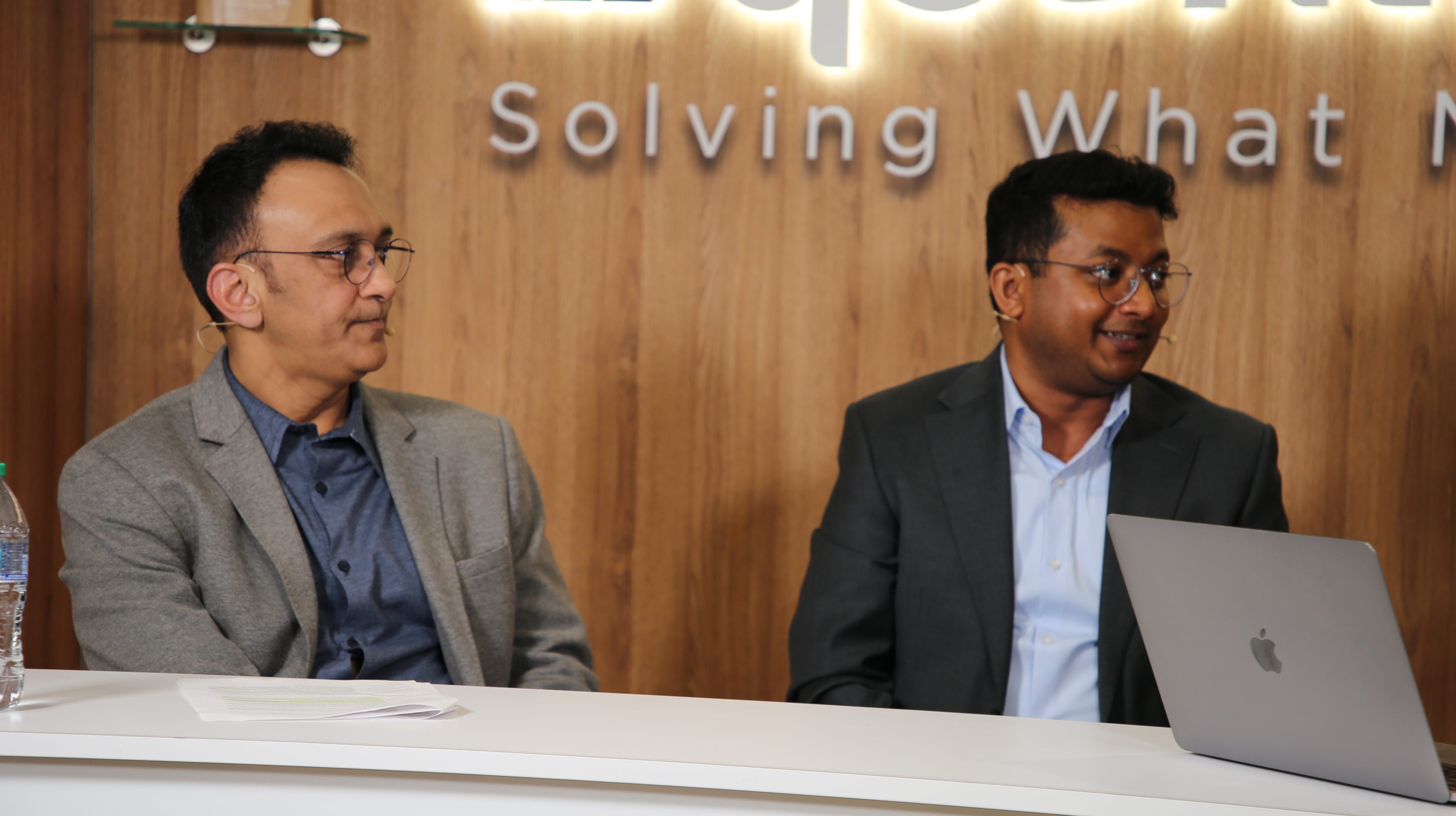
Mehul Trivedi, Group Vice President Technology, Wiley & Debopriyo Nag, Practice Lead - Data & Analytics, Quantiphi, join Rebecca Knight in the Quantiphi booth at Google Cloud in Las Vegas, NV
In this interview from Phi Moments @ Google Cloud Next 2026, Mehul Trivedi, group vice president of technology at John Wiley & Sons, joins Debopriyo Nag, practice lead for data and analytics at Quantiphi, to talk with theCUBE's Rebecca Knight about how a 219-year-old publishing company is dismantling a decade of fragmented data infrastructure to build a unified, AI-ready lakehouse on Google Cloud. Trivedi details how Wiley's legacy ecosystem — built across disparate business units over 10 years — created a data debt that blocked meaningful AI and analytics wo...Read more
>> Hello everyone and welcome back to theCUBE's live coverage of Phi Moments here at Google Cloud Next 2026 in Las Vegas, Nevada. I'm your host, Rebecca Knight. We have a terrific segment for you. I would like to welcome our guests. We have Debopriyo Nag. He is the practice lead data analytics at Quantify. Welcome Debo.
Debopriyo Nag
>> Thank you. Excited to be here.
Rebecca Knight
>> And Mehul Trivedi, group vice president of technology at Wiley. Thank you so much.
Mehul Trivedi
>> Thank you so much.
Rebecca Knight
>> So this conversation is really about how Wiley is reshaping its approach to publishing toward a more unified AI ready architecture on Google Cloud with of course the help of Quantify. So I'd love to start out with you, Mehul, because this is a storied company here, 219 years old, a great legacy, rich educational content. But of course the pace of knowledge today in 2026 is immediate. Talk to me a little bit about what the impetus was for Wiley to transform its data strategy.
Mehul Trivedi
>> No, absolutely. Very good question. And thank you so much first for giving an opportunity to come here and speak and sharing our Wiley's experience and the learning here. To answer your question, we are in a very, very exciting time and in the knowledge of the history of the knowledge. And there were two reasons why we started to look out for this journey. One was more towards the business pressure. And the second one was what was our aspiration. Right? To support the business pressure, we started off by looking at our current ecosystem and the vendor renewal were also coming along the way. So we said, okay, this might be the right time to take a step back and take a look what exactly we should be doing. Is it the ecosystem that we have it today, is it the right ecosystem? Is this something that we really should be investing or should we be preparing ourselves for the AI, ML-based new era? And when we started looking out for our ecosystem and more and more we realized that it has been the fragmented ecosystem. We've been no fault to anything, but we had built our ecosystem over many, many years. We had segmentations, we had number of business problems we had solved individually or in silos. So this was our opportunity. It gave us the clarity. And then we started thinking about that if this is something that we want to build, what would be the new ecosystem would look like? And then we started thinking about that we should be looking out for holistic data ecosystem where we have the trusted ecosystem where we are right way of garnering our data, right way of thinking about that. What are the knowledge that we want to build off of this ecosystem? Not only that we want to build the KPIs and the report, but we wanted to go step further building the new relationship out of our data. And that's all actually transpired us to start looking out for the new ecosystem. And that's what we felt that Google was the right ecosystem where not only does the data lake to data lake migration, but it's giving you the entire picture from the lake to the ecosystem to the AI, ML foundation.
Rebecca Knight
>> So Debo, I want to bring you in here a little bit. Talk about... Because you've been on a lot of these transformations.
Debopriyo Nag
>> Yes.
Rebecca Knight
>> How did what Mehul was just talking about in terms of the fragmented data ecosystem, how did that prevent Wiley from doing what it needed to do with AI?
Debopriyo Nag
>> Absolutely. And I would like to start by thanking Mehul for giving us this opportunity for such a large scale transformation that we did with Wiley. Having said that, I just wanted to tell what was the problem. So when we started with the journey, we realized that there is data, huge amounts of data across 30,000 tables lying around different business units, and they all were running in their own fashion. Like the sales unit, the publication unit, everything had their own data warehouses and own data to deal with. So what the problem was, that was creating a data debt. We were not able to contextualize the data for downstream AI or BI. We were not able to bring in the connections across data from different domains. So that was creating the technical debt that we would call it. Now, what is the solution to it? The solution is get the data as close as to your AI and BI where it resides, as close as to the users where they can traverse across data, business units, as well as different kinds of data. It's not just structured data. It's also unstructured data that is required for the users to work on their business use cases. So that was the primary driver for doing this kind of transformation. And once we achieved this unified lakehouse, which has all kinds of data, now users, researchers can have more power in order to get value out of that data into the organization. So that was it. Now, what is the vision that drove us for building this kind of lakehouses, building the right architecture? As Mehul mentioned, that foundations are key. So having the right foundations, having the right architecture, proving out that architecture is scalable for future AI is basically what we thrive for. And that's how we do the transformation across organizations.
Rebecca Knight
>> So speaking about foundations here, Mehul, why when you were embarking on this journey and making these decisions, why did Google Cloud specifically BigQuery, why did it become the non-negotiable for this?
Mehul Trivedi
>> Yeah, no, I think that's a very good question. And I would say the answer would be all threefold. First, what we started looking at the economics, like managing the multiple ecosystem, we have multiple data cloud that we are supporting. So what was the economical picture? That'd be how we started. The second one was on the technology side of it, that the tools and technologies that we are using, would it be the right tool and technology for the future? And when we started looking out, the Google ecosystem was bringing the cost down. Not only that, it is the one place where you can actually do the analytics of your data, you can do the machine learning models off of your data, and you have the storage, which is all native. And you don't need to really have any of the overhead to manage this data ecosystem. You don't have any complexity you need to manage. You can start off with building the Vertex AI, which is kind of building your models much, much faster. Then you have the machine learning models and entire operation. And then you have a Gemini which is already integrated part of your ecosystem. So you can have an entire suite, which we can actually leverage with the data that we are going to be building. So that was a technology reason. And third one was data ecosystem is rapidly changing. So every day you are finding the new tools and technology available in the market. So while we are building the migration and building the new ecosystem, we really want to strive towards plug and play architecture. So this means that we really want to stay close to the open source. And Google also offers us that like whether we want to go towards the Parquet, whether we want to go towards the Iceberg, any of the open source can be very easily be plug and play. So for all those reasons, Google would be able to support what we need to do. So that was the choice.
Rebecca Knight
>> And then of course you brought in Quantify as-
Mehul Trivedi
>> And that's where we actually work very close with the Quantify. And as Debo said, like one is the Google, which was the really right tool and when we started looking out about the implementation. So it's not about that we wanted to have the really good architecture or we really wanted to have the good platform, but we wanted to have somebody who really be the true partner. And that's where the Quantify came into the picture. This is not a very simple migration. We have built this ecosystem over the last 10 years. Right? Our current ecosystem is running off of last six to 10 years. So we wanted to have somebody who come here and understand how best we should be approaching that, what tool and technology we should be using, how should we be sequencing our effort. Because this is not an easy ecosystem that we are migrating from Snowflake to the BigQuery. As you heard, like 30,000 tables, there are multiple schemas, inconsistency across the schemas, multiple business domains and the models that we have part of our ecosystem. So we really needed to have the true partner. And then the last thing I would say is usually this migration takes about year, two year journey, but we were actually working against very, very aggressive timeline and we were thinking about achieving this target in six to nine months. And this is where Quantify came into picture. They gave us the comfort, they gave us the confidence, and it's all working out through and through. And we are very blessed by partnership with the Google and partnership with the Quantify in supporting this migration.
Rebecca Knight
>> So as Mehul was saying, the scale of this is enormous. We're talking about 300 terabytes of data, 30,000 tables. That is no small task. Can you talk a little bit about the implementation of this and in terms of using your AI factory and how it gave you the precision you needed?
Debopriyo Nag
>> Absolutely. And thank you, Mehul, for the kind words for our partnership. So starting, as you mentioned, it's a huge scale and most of it needs a proper planning. So what we started is that we started with a pilot, which helped us understand and validate the architecture Mehul was talking about. Because having the right tools, having the right solution and design in place was very much key. So what we did is that we took one of the most important use cases for Mehul and then we started with the pilot and proved out the architecture. So that was a quick six week, six to 10 weeks pilot that we executed and that gave us success. That gave us early success in order to ensure that this particular architecture will scale. So then went to execution. Now, as Mehul said, we have like one or two years to do such kind of migrations of that scale, but we had around six to nine months in order to complete everything. So then we brought is AI agents, which is our in house tool, Codeaira. So now the AI agents is there across all the data life cycles starting with discovery, execution, as well as validation. So for any typical migration like this, we start with the initial design and then we go into the execution like how do we understand what kind of transformations, what kind of logic that is written in the existing organization. As he mentioned, it's like 10 years worth of systems. So how do we automatically translate each of these queries into the native queries of Google? And how do we validate the data? It's not just getting the data in the right format that is needed, but also to validate the data and ensure that the downstream use cases are not impacted. So that's where we used heavily AI agents to meet the timelines as well as the accuracy of what we needed.
Rebecca Knight
>> Excellent. Well, I want to ask you now, Mehul, because a lot of this comes down to the people, to how the people who are tasked with implementing these changes are in fact working differently, working with AI differently and how it's changing their jobs. Can you talk a little bit about how it transformed the day-to-day work of your team and also answer some of the anxiety around AI and what it will do to the future of jobs and jobs displacement?
Mehul Trivedi
>> No, definitely. That's a very good question. And I think this is the back of everybody's mind. So first, I'm very proud of the team that working on this among my team itself. A lot of our time in the past have gone into building the pipelines, bringing the data into the lake, building the KPIs and the report. That where the majority of our people's time were going into, supporting the data lake. Right? And when we are really looking out for our future of data ecosystem, is it the right time and energy that our engineers should be spending their time? So part of this migration, we also have started to look out for quite a few AI tools and capabilities. We have started using the AI Gemini as our assistant so that we can actually accelerate some of this migration. And I'm very fortunate about my team that actually just started to learn new tools and technology. We started to use about the AI tools, how best we should be doing the pipeline. How should we be templatizing using the AI tools and technology? What are the KPIs and the report that used to be the manual effort, but using the AI, how can we really accelerate some of these things? And data validations, data qualities, all that can be done by the AI tools and technology. But that doesn't mean that we are actually replacing the humans part of this ecosystem. The places where we started to learn about that, they are very valuable, their institutional knowledge is very valuable. And now they have an opportunity not spending time onto the pipeline and the reporting, but what they are starting to do it, what more can we do with our data? Where exactly we can start building the new connections and the relationship between the data sets? What are the new semantic model that we can develop part of this new ecosystem so that model can be more accurate, models can be more effective? And that's something that actually allows you to build the new AI tools, technologies, and the platform for the future. So I would not say that the humans or the engineers going to be replaced. What I'm saying is now we have an opportunity to really align our human resources to the right place, which actually can allow us to build a new product at the scale.
Rebecca Knight
>> Right. It gives them the time to be creative and to be more strategic. At Quantify, there's this thing called Phi Moments, and it's the moment when something moves from experiment to real business impact and value. I'm curious, Mehul, what was that moment for you? Was it a metric? Was it a shift in how your team worked? Can you describe it?
Mehul Trivedi
>> Yeah. I would say like probably, I would say the human agency is the wow moment. We call it as a wow moment and you call it as a Phi Moment. But like how our teams have adapted to the new tools, technologies, how our teams have started to learn AI and trying to be more creative about building the new future state of the ecosystem. Right? And building the ecosystem which actually allows us to build for the future and not that problems that we were solving in the legacy in the past is the same thing we want to continue to do over and over again. So I think that would be, I would say is a place where I have seen team have matured enough, they have started to learn new tools and technologies. And I would say that's something, again, thanks to the Quantify, they also brought in quite a few tools and technology. But I would not say that like it was all slam dunk. Part of this exercise, we have learned a lot that like many of those AI tools and capability didn't work out out of the box. So we had to actually learn quite a few new models and add up to it. So again, it's a good journey that I would say that like probably we're going to continue to invest in.
Rebecca Knight
>> But you don't have success right out of the box now?
Mehul Trivedi
>> Yeah, yeah.
Debopriyo Nag
>> Absolutely. And I can vouch for what he said. Like both the teams learn together like how AI is evolving. And I would like to say that one of their team members built one of the tools, AI tools, which actually transformed from their existing BI environment to the new environment with Google. So that's one of the use cases that we saw as success as together as a team.
Rebecca Knight
>> Right, right. Well, on that note, as we wrap up our interview, I'm interested in your advice to other senior leaders who are watching this and want what Wiley has and what they've achieved in terms of this tension in addressing the technical debt and really going in on AI innovation. What are some of the best practices? What's your practical advice, Debo? I'm going to start with you.
Debopriyo Nag
>> Awesome. So I have been doing this migrations for the last six, seven years with customers. And I think we really need to change our mindset from moving, lifting and shifting our existing environments just to put on cloud so that they can do AI. It's not a secret sauce like AI will come and fix everything, whatever is there that is in the cloud. So what we really need to do is that we really need to first have the right scalable architecture, whether we can pilot it, whether we can do a small POC, but we should definitely first see if this architecture is scalable. And it can keep on evolving, but the first architecture needs to be scalable. And then once that is built, then you can just start contextualizing the data because that is more important. Like just getting in data into the lakehouse will not do the job. You need to give some thought process to that data. What does the data do? What are the decisions that we can take with that data? That's how I would like to approach such migrations in future.
Rebecca Knight
>> Excellent.
Mehul Trivedi
>> Yeah. And I think I would give a twofold answer to this question. One is like about the data depth we talked about. Right? This is the industry problem. And this is something that we can always say that like, okay, we can just put the best AI model on top of the data that we have and we can have the result out of it. But if you don't go back and solve your data problem, you don't solve your fragmented data ecosystem, the models that you're going to build off of it, it's not going to be effective. The AI is going to be as effective as your accuracy of your data. So I would encourage everyone to just take a look at your data, try to see like how best you want to organize your ecosystem and your architecture, because that's a foundational capability. Then it becomes much easier for you to build the model off of it and then plug in the new AI capabilities on top of it so that you actually you can build the new products and the platforms. Right? So I would say like invest in your technology. And on your second part of the question is about the AI. We are all under the pressure. Board is asking for it, our ELT is asking for it, customers are expecting it. And we are investing so much into the AI with our current ecosystem. But nobody's going to win this battle if they're going to be looking out for 2025, 2026. This is not the people who's going to be winning this battle. The people who are going to be the organization who going to be preparing themselves for the long game, that how am I going to build my organization for the next 10 years to compete in this kind of environment, are the places where companies going to succeed. And this is where we really need to make sure that we are investing in our talent, investing in our people, and making sure that the people are being guided in the right way.
Rebecca Knight
>> I love to hear that. And for the next 200 years, of course.
Mehul Trivedi
>> Absolutely.
Rebecca Knight
>> You're thinking about the people, the people who are the engines. Well, Mehul and Debo, thank you both so much. A really interesting conversation.
Mehul Trivedi
>> Thank you.
Debopriyo Nag
>> Thank you so much for hosting us.
Mehul Trivedi
>> Thank you.
Rebecca Knight
>> I'm Rebecca Knight. Stay tuned for more of theCUBE's live coverage of Phi Moments at Google Cloud Next. You're watching theCUBE, the leader in enterprise news and analysis.








 Rebecca Knight