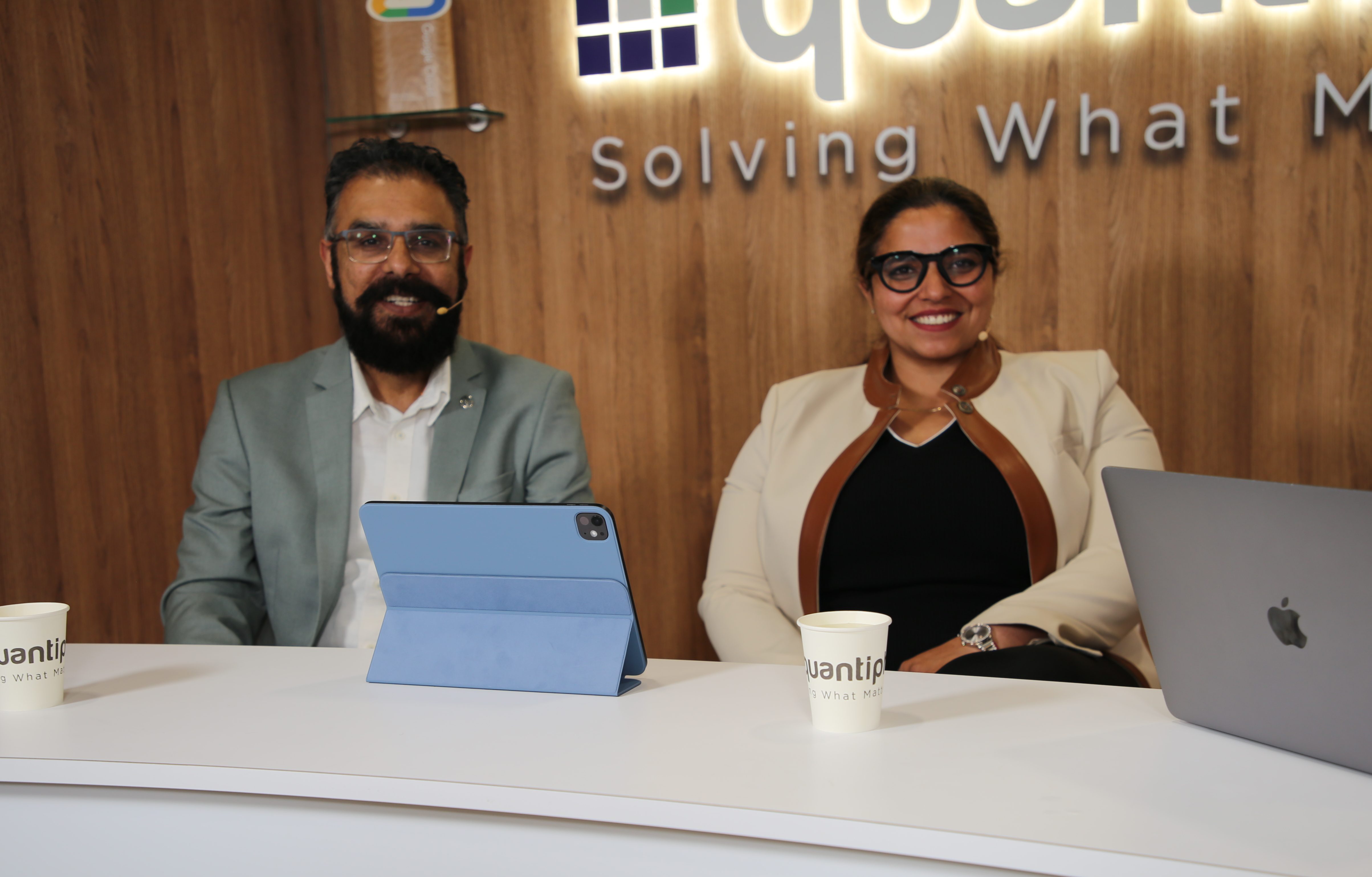
In this interview from Phi Moments at Google Cloud Next, Arunima Gautam, head of global FSI, GTM and products at Quantiphi, joins Gaganpreet Randhawa, assistant vice president of enterprise architecture at CNA Insurance, to talk with theCUBE's Rebecca Knight about how a unified data foundation is enabling the shift from AI pilots to production-ready intelligent automation in commercial insurance. Randhawa grounds the conversation in CNA's scale — a commercial P&C carrier operating across 11 countries, where data lives in multiple systems, formats and geographies. The core challenge, he explains, is not a shortage of data but making it consistent, trusted and available so underwriters worldwide can evaluate risk from a single source of truth. Gautam maps three layers of complexity unique to commercial insurance: unstructured broker submissions, bespoke risk analysis and a long handoff chain that runs from intake to policy issuance.
The conversation also explores how Quantiphi helped CNA build a layered data architecture — mapping existing systems, centralizing international data and structuring it to be scalable and real-time for AI consumption. Randhawa describes a clear signal for when the foundation is ready: when teams stop debating whose data is correct and start asking what to do with the insights the data delivers. That workforce shift, he notes, is the green light for AI acceleration. Gautam connects data quality directly to agentic AI readiness, arguing that agents fed siloed or inconsistent data will hallucinate and contradict themselves — while organizations like CNA, which have spent years standardizing their data, are positioned to lead the next wave of agentic implementations. The partnership's defining Phi Moment, according to Randhawa, is speed to market: delivering data to business customers in minutes and hours rather than days and weeks. From the principle that momentum matters more than perfection to the conviction that business buy-in is as essential as any technology choice, the conversation offers a practical roadmap for enterprises navigating complex data transformation at scale.
Forgot Password
Almost there!
We just sent you a verification email. Please verify your account to gain access to
Phi Moments @ Google Cloud Next '26. If you don’t think you received an email check your
spam folder.
In order to sign in, enter the email address you used to registered for the event. Once completed, you will receive an email with a verification link. Open the link to automatically sign into the site.
Register for Phi Moments @ Google Cloud Next '26
Please fill out the information below. You will receive an email with a verification link confirming your registration. Click the link to automatically sign into the site.
You’re almost there!
We just sent you a verification email. Please click the verification button in the email. Once your email address is verified, you will have full access to all event content for Phi Moments @ Google Cloud Next '26.
I want my badge and interests to be visible to all attendees.
Checking this box will display your presense on the attendees list, view your profile and allow other attendees to contact you via 1-1 chat. Read the Privacy Policy. At any time, you can choose to disable this preference.
Select your Interests!
add
Upload your photo
Uploading..
OR
Connect via Twitter
Connect via Linkedin
EDIT PASSWORD
Share
Forgot Password
Almost there!
We just sent you a verification email. Please verify your account to gain access to
Phi Moments @ Google Cloud Next '26. If you don’t think you received an email check your
spam folder.
In order to sign in, enter the email address you used to registered for the event. Once completed, you will receive an email with a verification link. Open the link to automatically sign into the site.
Sign in to gain access to Phi Moments @ Google Cloud Next '26
Please sign in with LinkedIn to continue to Phi Moments @ Google Cloud Next '26. Signing in with LinkedIn ensures a professional environment.
This Phi Moments session at Google Cloud Next 2026 examines structuring international insurance data to enable agentic artificial intelligence, ensure consistent underwriting decisions and scale analytics across global commercial insurers. The discussion focuses on data standardization, AI readiness and cloud integration as foundations for reducing underwriting complexity and improving decision consistency.
Arunima Gautam of Quantiphi and Gaganpreet Randhawa of CNA Insurance appear in this theCUBE Research segment. Gautam explains that agentic AI depends on standardized high-quality data to avoid hallucination and enable reliable automation; they emphasize business buy-in and momentum over perfection for successful transformation. Randhawa demonstrates how a unified trusted data foundation and AI-ready analytics reduce time to market by transforming analytics processes from days to minutes; they underscore the role of cloud integration and enterprise architecture in operationalizing analytics across jurisdictions.
This session provides practical guidance for insurers on data governance, data modeling, cross-border data mapping and common data language, and on building AI-ready platforms that support consistent underwriting decisions and faster deployment of analytics. Watch to learn strategies for international data standardization, data modernization and operationalizing analytics for commercial underwriting.
Assistant Vice President Enterprise ArchitectureCNA Insurance
Arunima Gautam
Head - Global FSI GTM and ProductsQuantiphi
In this interview from Phi Moments at Google Cloud Next, Arunima Gautam, head of global FSI, GTM and products at Quantiphi, joins Gaganpreet Randhawa, assistant vice president of enterprise architecture at CNA Insurance, to talk with theCUBE's Rebecca Knight about how a unified data foundation is enabling the shift from AI pilots to production-ready intelligent automation in commercial insurance. Randhawa grounds the conversation in CNA's scale — a commercial P&C carrier operating across 11 countries, where data lives in multiple systems, formats and geograph...Read more
>> Welcome back everyone to theCUBE's coverage of Phi Moments here at Google Cloud Next 2026 in Las Vegas, Nevada. I'm your host, Rebecca Knight. We have two fantastic guests for this next segment. I would like to welcome to the show Arunima Gautam. She is the head global FSI, GTM and Products at Quantiphi. Welcome.
Arunima Gautam
>> Rebecca.
Rebecca Knight
>> And we also have Gaganpreet Randhawa, Assistant Vice President Enterprise Architecture, CNA Insurance. Welcome.
Gaganpreet Randhawa
>> Thanks, Rebecca.
Rebecca Knight
>> Yeah.
Gaganpreet Randhawa
>> Glad to be here.
Rebecca Knight
>> Why don't you start, Gaganpreet, to just ground us and tell our viewers a little bit about CNA and what your day-to-day reality is like?
Gaganpreet Randhawa
>> Yeah. No. Thanks for having us. CNA is one of the largest commercial PNC carrier. We do business across the globe. We have offices in 11 countries. The headquarters is based out of Chicago US. And we do commercial and specialty insurance. Given our scale, we have so many places so many things, so many different kind of businesses that we insure. The data problem is a huge problem for us, and it's not something small to solve for.
Rebecca Knight
>> And it's a highly regulated industry, highly diverse, as you say. So Arunima, you have been working in partnership with CNA for quite some time now. How would you describe the nature of your partnership and the journey that you're on together?
Arunima Gautam
>> Sure. Thanks for that question, Rebecca. Our journey with CNA is a highly collaborative one. We have covered a lot of milestones together. One of the large initiatives we have with CNA is around structuring their international data. CNA being a commercial insurance company at one point in a submission, they could be looking at a construction company in Denmark or a healthcare company in Texas. So the diversity of what they cover and the way they analyze risk does generate a lot of data at many handoffs and interaction points. What we do for CNA is bringing that entire data across different operations, centralize them, structure them, and deliver it back to the business team so that they can use it for analytics, for artificial intelligence, for many other initiatives that keep the lights on activities on the business side running. So the relationship has been extremely collaborative and has been highly enriching for an organization like ours to work with the creative community within CNA, who is always excited about stabilizing things and newer things and bringing in that structure within their ecosystem.
Rebecca Knight
>> So Gaganpreet, if you could describe the core data challenge that you are trying to solve day in day out at CNA, how would you define it?
Gaganpreet Randhawa
>> Yeah. As I mentioned before, right? So the insurance industry is very highly regulated and very complex. We have grown organically, and we have also grown through acquisitions or introducing new products into new markets. Given our scale, our data resides everywhere. We have multiple systems, multiple formats, multiple geographies, multiple governmental regulations. It's not that we don't have data. We have data. Our biggest challenge is how do we make it consistent, trusted, and available to our business customers so that they can make informed decisions. An underwriter sitting in Chicago or an underwriter sitting in Toronto, or London, or Copenhagen, they may be looking at the same risk. And we want to make sure that when they're making that decision, they have the right information in front of them so that they all consistently can make the same decision across the globe.
Rebecca Knight
>> Making it crystal clear though at a business level, why does that matter so much, that level of consistency that you're talking about?
Gaganpreet Randhawa
>> Absolutely. For an insurer carrier, underwriting is like a heart. So the underwriting discipline is the discipline that generates profitability, and you want to make sure that the information that they have at their fingertips, they're writing the right kind of risk, they're able to evaluate it consistently. That's so core to our business. And that's one of the most, I would say, the fundamental important thing for a carrier to be able to do so.
Rebecca Knight
>> Arunima, I'd love you to jump in here to talk a little bit about the uniquely complex situation that commercial insurers are in. Because I mean, what he's describing at CNA, you see across financial services, but yet there is something particularly special about this.
Arunima Gautam
>> Yeah. Commercial insurance is very uniquely complex because of the nature of the business. I will ground this at three levels. First off, submissions that come to the underwriters, from brokers, from relationships in the market, extremely unstructured. So you're talking about emails coming in, PDFs coming in, your loss runs getting coming from the brokers. Every single loss run will be its own unique... It'll have its own unique nature. So that whole idea of complexity at the first level comes the moment you receive a new submission from a broker. The next step of it would be the risk in itself is very bespoke. I quoted an example upfront. You could be insuring a construction company in Denmark or a healthcare company in Texas. You could be insuring a company which is global in its nature. The customer is global and your US teams are looking at that business. So that bespoke nature of risk analysis, all the way from your submission to being able to quote that, further analyze the risk, issue a policy, issue the final paperwork, then get the claims and other aspects serviced. All of that is so bespoke that it adds another layer of complexity. And third and the most important point is the chain is long. Unlike personal insurance where the company is insuring a commodity, here you're talking about ensuring a very diverse business in itself. So that long value chain of the same submission going through different hands, leading all the way to the pricing team, where they are making the final click of the button decision that, okay, this is going to be my premium that is going to cover for this risk. I think that entire value chain, every handoff that happens in that value chain creates a huge risk if the quality of the data does not exist and your foundation is not powerful. So commercial insurance, the nature of business makes it very complex and these are three key tenets where you can differentiate it from personal line insurance across the group.
Rebecca Knight
>> So Gaganpreet, when you think about CNA's global footprint, and as you said, you're in 11 countries around the world, what will really change if the data foundation is not unified? How does that change the way you do business day-to-day?
Gaganpreet Randhawa
>> Yeah. So if we don't have a unified data foundation, then you can think about we are making business decisions in silos, right? A person underwriting something in France may be looking at just a very specific segment of information, but the decision he or she's making can have a global impact because we are ensuring assets across the globe. We ensure small businesses, middle market, and we ensure very highly complex risks, which are global risks. So if you're ensuring a global risk, we want to make sure that we have that data, not for that localized segment, but the data is available for every place within the globe so that the underwriter can make the right decision. So for us, that's really absolutely critical.
Arunima Gautam
>> Yeah. And to add to that, a catastrophe in one region can create a supply chain crisis in another. So again, going by the nature of the business, that complexity exists because you are covering businesses out there. So just to add to Gaganpreet's point.
Rebecca Knight
>> Arunima, what did Quantiphi specifically bring to this journey and what did you help CNA unlock in its business?
Arunima Gautam
>> Gaganpreet can attest to this better, but when we started on this international data journey, he did touch upon a point, there are multiple geographies, multiple systems running in these geographies. We started off with discovering what's the lay of the land, figuring out all those data hops, what are the systems that exist, how do they generate data? Who are the user base of that data? How is that data moving between people? That was the starting point. And then we came in, CNA has a very robust global architecture organization, which looks at things in a unified way. So we spoke through the different ways in which this architecture can work. It needs to have a layered architecture. You're talking about not just ingesting the information into a general data warehouse, but how do you structure it, move it to the final layer where your business teams are consuming it, the data is scalable enough, real time enough for AI usage. So that is how we went about in a very collaborative fashion working with the global teams and the local teams all together, bringing in that idea and implementing it such that the journey of data access and availability to the point Gaganpreet made earlier for the business teams becomes simpler and higher quality and more robust and more real time in that matter. So while we do a lot of exciting work with CNA, this was one of the major initiatives because we were touching a lot of lives through this initiative and a lot of teams within these businesses that got involved in making this whole initiative a success with huge support from business teams and everybody. So that's how we went about bringing in that uniformity. And we are still in the journey, we have done this significantly enough, but data standardization is a continuous journey. We are still on that journey, but the journey is going great by shared collaboration between the different parties.
Rebecca Knight
>> From your seat in architecture, Gaganpreet, how do you know when the foundation is ready for AI?
Gaganpreet Randhawa
>> Yeah. There are very, I would say, very tangible signals. When people start talking about whose data is right, to talking about what do we do with the information that the data is giving me, to me, then you know that your journey is real. When underwriters start believing in the data, when the compliance folks start believing in the data, when you're making decisions from a single source, rather than trying to reconcile multiple reports and figure out what's going on, then you know that your journey is real, right? So once you are at that stage, that's when you can actually pick up the acceleration. That's where you can start using AI and AI can accelerate your journey and not be a risk because you already have well curated information that you can trust.
Rebecca Knight
>> Well, that's what's so interesting. And from what I'm hearing from you is that the signal is the workforce itself saying, "We trust this. We have confidence in this. We can work with this."
Gaganpreet Randhawa
>> Yeah.
Rebecca Knight
>> So it's really all about the workforce itself sending you that information.
Gaganpreet Randhawa
>> Absolutely. Absolutely.
Rebecca Knight
>> Okay. So Arunima, how does this foundation connect to where AI is heading next, particularly within the context of insurance?
Arunima Gautam
>> Yeah. From my perspective and being on the side where we are doing this for a lot of customers, I think agentic AI has a direct correlation to setting up the right foundation for an organization. Reason being agents today can take actions for you, they can perform multi-step actions and create final triggers for those final decisions in a business. When you're trying to build something that robust and tangible, having the right foundation seriously matters, otherwise if you're trying to feed that agent with siloed data, it'll start hallucinating, it'll start contradicting itself so that uniformity and quality of information becomes extremely crucial for building an agentic system that can give uniform, similar answers, that can suggest similar things and essentially unify that entire risk analysis for an organization as large CNA who is covering such large businesses out there. So I think that whole agentic landscape that organizations will build on, companies who have invested in the last few years in modernizing their data are going to be the clear leaders when it comes to agentic AI implementations at the heart of business and kudos to companies like CNA who have long been taken that journey and today are sitting on that massively standardized data that can help businesses in different formats.
Gaganpreet Randhawa
>> And maybe just to add to that, as Arunima mentioned earlier, we have so much unstructured data. We get data in a lot of different formats. So our philosophy is let's automate the things that we can automate, but then for all of this unstructured data, how do we leverage agentic AI so that our business customers don't have to circle through all of this information, and it can be summarized for them so that they can make those decisions quicker, right?
Arunima Gautam
>> Yeah.
Gaganpreet Randhawa
>> To me, that's the third point and that's what we're aspiring for.
Rebecca Knight
>> Well, its decisions made more quickly, but then you also started this conversation by describing underwriting as the beating heart, which I liked. How does it actually make the decisions not only quicker, but better in terms of on the ground decision making?
Gaganpreet Randhawa
>> Absolutely. So there's a lot of unstructured information that people, if there's no agentic AI, then they will have to manually go through, read those documents and make business decisions, right? What we're trying to do is how can I leverage that unstructured data and the power of AI and summarize that content for the underwriter so that they can actually make that decision more effectively, efficiently, and in a more timely manner, right?
Arunima Gautam
>> Yeah.
Gaganpreet Randhawa
>> So that's where our fundamental focus and shift has been.
Rebecca Knight
>> So here on Phi Moments, we're talking about these times in the life of a transformation when you move from experimentation pilot to something with real measurable business impact. What has been the Phi Moment for you in terms of working with Quantiphi and Google Cloud?
Gaganpreet Randhawa
>> Yeah. So I would say the finest moment for us is speed to market. We have been able to work together to get the data in front of our customers that would take for them maybe days or weeks to get to, now in minutes and hours. And that's huge for an organization of our scale.
Rebecca Knight
>> How about you? What have you seen? I mean, the B to market is pretty incredible.
Arunima Gautam
>> Yeah. Nothing beats that segment. I'm so proud of myself and my team that a customer is saying something like that. I think my Phi Moment was the leadership within this organization is so open to ideas and on the flip side is still so grounded that if you hear leaders like Gaganpreet and others from CNA talking at public forums, you will realize the company has that spirit of innovation in their DNA, which becomes extremely important for a company like ours and SI to even share those ideas and be able to build something tangible for our customers. So I think that openness to ideas and the support that the broader CNA business teams and others have provided in the journey in making this a reality has been impeccable. And it's just very enriching to be in that stage where ideas can move into reality as long as you're covered on other grounds of structure, security, and the business is comfortable and everybody, right? So I think that my Phi Moment is the, for lack of better words, the kick I get working with leaders within the organization, it's just massively enriching
Rebecca Knight
>> And the leaders are so open to new ideas and creativity.
Arunima Gautam
>> Yeah.
Rebecca Knight
>> So as we wrap up here, I would love to hear your advice and counsel for leaders who are watching this segment saying, "I want what CNA is doing." And for those who are really challenged by their data environments, what would you say?
Gaganpreet Randhawa
>> Yeah. I would say a data journey is not only a technical journey. The organizational structure, the business buy-in, the key stakeholders onboarding is highly critical. Technology, we can all solve for, but if you don't have the business buy-in, if you don't have the trust and you are not working together, you will not be able to make the meaningful change. For us, we are lucky to be in that environment. CNA culturally is one of the great place to work with. And as Arunima mentioned, even from our SI perspectives, we value each and every moment that we have together, right? So to me, that's more important. It's the human aspect of the work is equally important as compared to a technology aspect of it.
Arunima Gautam
>> Wow. Love that.
Rebecca Knight
>> Yeah. And how about you?
Arunima Gautam
>> I think it's important for us to internalize that momentum is more important than perfection. It's important to find that impactful segment of the business, or it could be any segment and with commercial insurance, it would typically be underwriting or claims. Pick up a data domain and get started. That would be important, right? Get started, and then a lot of things will perfect in the journey of doing it, but getting started is extremely important because what will happen in the near future is organizations like CNA who have invested in building up that foundation are going to become clear leaders in the market compared to other organizations who have not invested that time or energy or effort into building something like this. So it's extremely important to get started than build the perfect blueprint for a perfect future would be my suggestion.
Rebecca Knight
>> Yeah. So invest in your people, momentum is better than perfection and start. Simply start.
Arunima Gautam
>> Yes.
Gaganpreet Randhawa
>> Incremental delivery, right?
Arunima Gautam
>> Yes.
Gaganpreet Randhawa
>> Small moments you've got to enjoy and celebrate.
Arunima Gautam
>> Yes.
Rebecca Knight
>> Excellent. Well, this was a really terrific conversation, Gaganpreet and Arunima. Thank you so much for joining me here.
Gaganpreet Randhawa
>> Thank you for having us.
Arunima Gautam
>> Thank you for having us.
Gaganpreet Randhawa
>> I appreciate it.
Rebecca Knight
>> I'm Rebecca Knight. Stay tuned for more of theCUBE's coverage of Phi Moments here at Google Cloud Next. You're watching theCUBE, the leader in enterprise tech news and analysis.








 Rebecca Knight