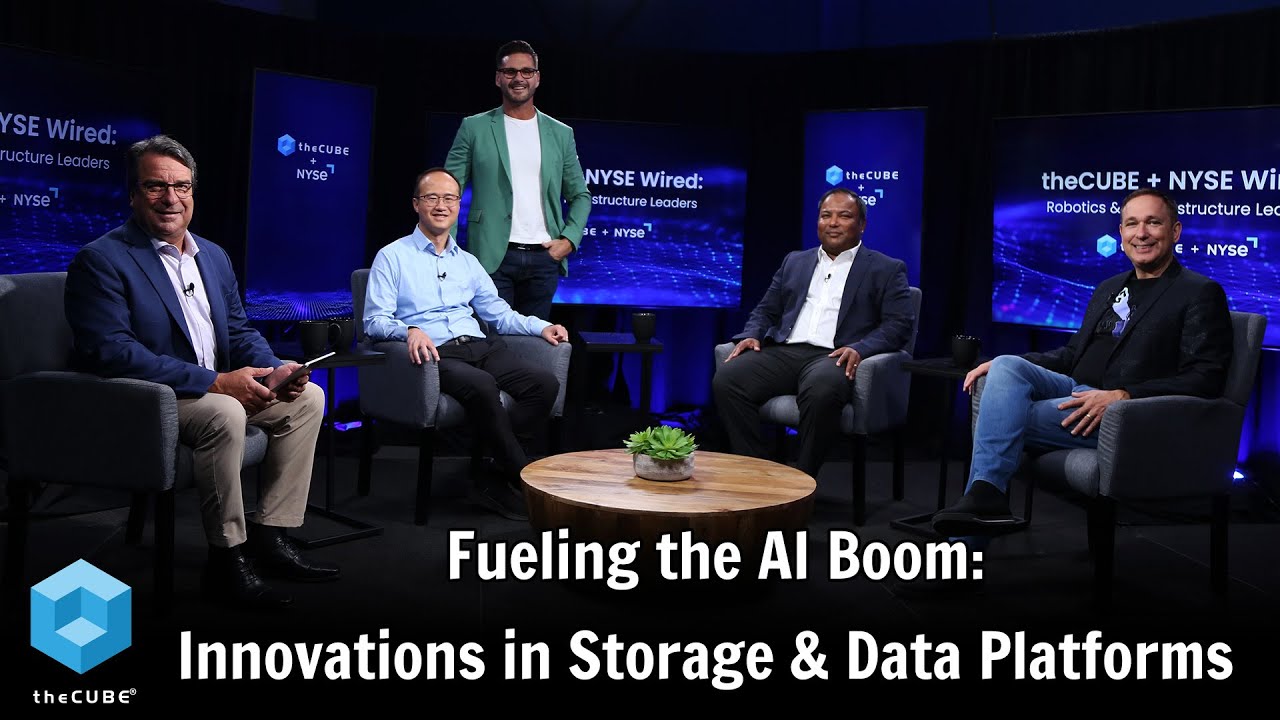
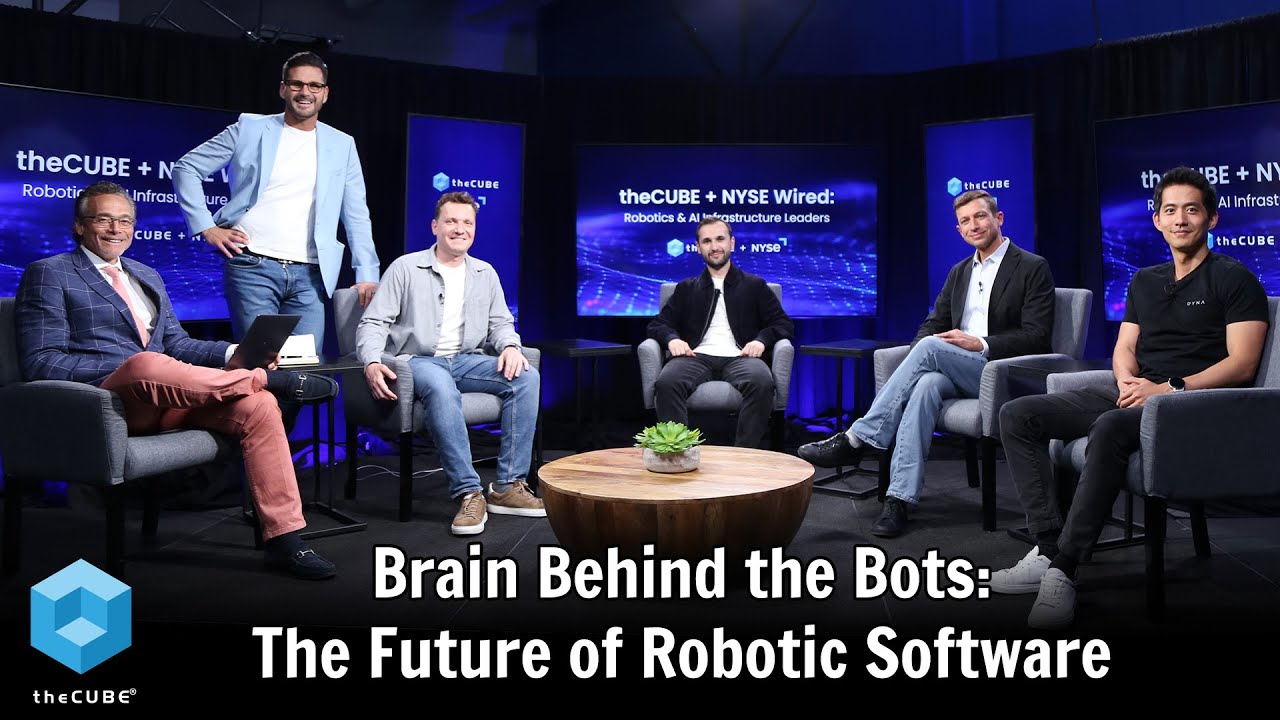
In a revealing panel discussion, industry leaders gather at theCUBE’s Palo Alto studios to explore the transformative world of robotics and AI infrastructure. This session, part of the NYSE Wired event, offers rich insights into current trends, challenges and future prospects of AI infrastructure on a global scale.
Featured experts include Shehram Jamal of NVIDIA, Kevin Cochrane of Vultr, Joseph S. Spence of NativelyAI, and Andy Hock of Cerebras Systems. John Furrier of SiliconANGLE Media moderates the discussion, which delves into the interplay between global infrastructure upgrades and the burgeoning robotics and AI sector.
Panelists explore the phased approach in deploying AI infrastructure, highlighting significant shifts and emerging trends. The dialogue covers the cultural and geographical implications as AI technologies permeate diverse markets and the role of sovereign AI strategies. As noted by the panelists, countries worldwide race to develop AI capabilities to remain competitive, focusing on integrating culture-specific innovations and expanding their talent pool.
Jamal and Hock emphasize the crucial need for substantial advancements in AI compute capabilities and collaborative innovation to fuel growth. Cochrane highlights the importance of broadening access to AI infrastructure to foster innovation globally. Spence addresses the strategic significance of AI as a public good and its potential to reshape economic landscapes. As AI technologies continue to evolve, their potential to proactively address economic, social and technological challenges cannot be overstated.
Forgot Password
Almost there!
We just sent you a verification email. Please verify your account to gain access to
theCUBE + NYSE Wired: Physical AI & Robotics Leaders QA2. If you don’t think you received an email check your
spam folder.
Sign in to theCUBE + NYSE Wired: Physical AI & Robotics Leaders QA2.
In order to sign in, enter the email address you used to registered for the event. Once completed, you will receive an email with a verification link. Open this link to automatically sign into the site.
Register For theCUBE + NYSE Wired: Physical AI & Robotics Leaders QA2
Please fill out the information below. You will recieve an email with a verification link confirming your registration. Click the link to automatically sign into the site.
You’re almost there!
We just sent you a verification email. Please click the verification button in the email. Once your email address is verified, you will have full access to all event content for theCUBE + NYSE Wired: Physical AI & Robotics Leaders QA2.
I want my badge and interests to be visible to all attendees.
Checking this box will display your presense on the attendees list, view your profile and allow other attendees to contact you via 1-1 chat. Read the Privacy Policy. At any time, you can choose to disable this preference.
Select your Interests!
add
Upload your photo
Uploading..
OR
Connect via Twitter
Connect via Linkedin
EDIT PASSWORD
Share
Forgot Password
Almost there!
We just sent you a verification email. Please verify your account to gain access to
theCUBE + NYSE Wired: Physical AI & Robotics Leaders QA2. If you don’t think you received an email check your
spam folder.
Sign in to theCUBE + NYSE Wired: Physical AI & Robotics Leaders QA2.
In order to sign in, enter the email address you used to registered for the event. Once completed, you will receive an email with a verification link. Open this link to automatically sign into the site.
Sign in to gain access to theCUBE + NYSE Wired: Physical AI & Robotics Leaders QA2
Please sign in with LinkedIn to continue to theCUBE + NYSE Wired: Physical AI & Robotics Leaders QA2. Signing in with LinkedIn ensures a professional environment.
Are you sure you want to remove access rights for this user?
Details
Manage Access
email address
Community Invitation
FutureProof: Designing the NextGen Data Center
In a revealing panel discussion, industry leaders gather at theCUBE’s Palo Alto studios to explore the transformative world of robotics and AI infrastructure. This session, part of the NYSE Wired event, offers rich insights into current trends, challenges and future prospects of AI infrastructure on a global scale.
Featured experts include Shehram Jamal of NVIDIA, Kevin Cochrane of Vultr, Joseph S. Spence of NativelyAI, and Andy Hock of Cerebras Systems. John Furrier of SiliconANGLE Media moderates the discussion, which delves into the interplay between global infrastructure upgrades and the burgeoning robotics and AI sector.
Panelists explore the phased approach in deploying AI infrastructure, highlighting significant shifts and emerging trends. The dialogue covers the cultural and geographical implications as AI technologies permeate diverse markets and the role of sovereign AI strategies. As noted by the panelists, countries worldwide race to develop AI capabilities to remain competitive, focusing on integrating culture-specific innovations and expanding their talent pool.
Jamal and Hock emphasize the crucial need for substantial advancements in AI compute capabilities and collaborative innovation to fuel growth. Cochrane highlights the importance of broadening access to AI infrastructure to foster innovation globally. Spence addresses the strategic significance of AI as a public good and its potential to reshape economic landscapes. As AI technologies continue to evolve, their potential to proactively address economic, social and technological challenges cannot be overstated.
Andy Hock, senior vice president of product & strategy at Cerebras Systems Inc.; Shehram Jamal, chief product officer for data & models at HUMAIN (Al-Mustaqbal Lil-Thaka Al-Istinai Company, also known as Future Artificial Intelligence Company); Kevin Cochrane, chief marketing officer at Vultr, a registered trademark of The Constant Company LLC.; and Joseph S. Spence, chairman, chief investment officer at NativelyAI, join theCUBE’s John Furrier at theCUBE + NYSE Wired: Robotics & AI Infrastructure Leaders 2025 event. The panel explores how robotics and AI infr...Read more
exploreKeep Exploring
What is the context and lineup of the special presentation taking place at the Palo Alto studios?add
What are the current stages of the generative AI infrastructure build-out and the plans for future development?add
What are the main factors influencing the global impact of AI technology?add
What impact do software acquisitions have on the spread of technology and value in communities globally?add
What is the current status of AI adoption in enterprises, and what factors might influence its progress?add
What are the key components and considerations of distributed computing?add
What are the potential roles of commercial enterprises, government, and public-private partnerships in the development of infrastructure for AI systems?add
What is the significance of sovereign AI in relation to data privacy and control in different countries, particularly in Europe?add
What are the differing opinions on the impact of automation and AI on job availability?add
What is the significance of the current advancements in AI technology compared to past technological milestones?add
What are the anticipated trends in AI deployment and token consumption within enterprises, as well as concerns regarding access to AI infrastructure?add
FutureProof: Designing the NextGen Data CenterJune 20, 2025
search
>> Hey, welcome to theCUBE here in the Palo Alto studios for a special presentation. We're having a special three days of wall-to-wall coverage, but this is day zero, extending it out early to get all these experts to really talk about the future of the large scale infrastructure around the world being built out. This is part of the Robotics AI Leader series. I'm John Furrier, host of theCUBE. We'll be hosting all these conversations across the week. We've got a great distinguished lineup. We've got Joseph S. Spence, Chairman and Chief Investment Officer of NativelyAI. Welcome, welcome to the program. Thanks for coming on. Kevin Cochrane, CMO of Vultr. Got a great value proposition. Andy Hock, SVP Product Strategy at Cerebras, breaking records and all kinds of speed. And Shehram Jamal, Chief Product with Humane AI, as well as managing the models and all the data. Gentlemen, thank you for coming in. First of all, it's an honor to have you here because the hottest story in technology right now is the billions of dollars being spent on large scale infrastructure. I think Andrew Feldman said at Cerebras on theCUBE once, "It feels like the '90s, but it's much a whole nother level of growth infrastructure." Speeds and feeds. We are seeing a demand for large scale infrastructure because the demand for tokens that's powering the software requires large scale system reconfigurations, rethinking around the size and scope for what's needed, but also to set the table for a generation of infrastructure that will power the wave of AI and certainly we've seen the agentic world come in. So I got to set the stage, the acceleration wave is here. What is the view from you guys in terms of where we are? Just scope the progress, are we still early innings? How early is it? How would you scope? We're seeing 20 billion, 10 billion, another 20 billion being deployed in the news with releases. Where are we on the scope? Who wants to jump in?>> So there's three stages that we need to go through and we're currently at stage zero. Stage zero is all of the initial build out of infrastructure for generative AI to train all your large scale foundational model, which mostly occurs in core geographies, currently. We're just moving to stage one where enterprises are going to start deploying for production inference, open source LLMs, to start adding efficiencies to all of their enterprise workflows. This is all of the new innovation that's happening around reasoning model. That's stage one. Stage two, we need to go global. We need to actually start deploying infrastructure at scale in geographies all around the planet so we can start building up digital ecosystems because each digital ecosystem is going to add their own cultural aspects, their own unique innovations, and contribute that to the broader open source community. And of course, stage three, which we're already seeing some part of which is we need to go beyond just LLMs and we need to start looking at some of the newer open source models that are starting to actually enable the interactions with the physical world, with things like robotics and more.>> Yeah, denial, acceptance. We've all been through those stages of innovation, grief. The pace of play, Andy, is so high. The geography piece, you guys are doing a lot globally. Shehram, I want you to weigh on this too. It's not just about the chips and the software. There's a lot of geography impact. What are you guys seeing on the global scale? Can you share your thoughts on that?
Andy Hock
>> Yeah, look, I would just first echo the first point. I think we are witnessing as technologists and as participants in the market and as members of society, a tipping point. There was broad recognition over the past several years of the transformative potential for AI, both for enterprise businesses, for fundamental research, for science and society, but there was also recognition first that we needed a different kind of compute engine, and we can come back to that, but I think the short version of that story is AI is different than graphics. AI is different than database or web serving, and if we recognize that this work is important and different, then probably we needed a different kind of engine. But we are now seeing with large language models, with autoregressive transformers, with emerging model architectures, we're seeing the value of these workloads first for things like consumer chat, we all had that ChatGPT moment around the dinner table. But now to your point, we're also seeing broad enterprise adoption, not just of simple chat-based models, but of reasoning models of agentic workflows that can fundamentally change how we process data, how we make decisions, how we operate. So that's the tipping point I think that we're seeing is from an interesting technology into a globally valuable technology. To your point about geography then, what we're seeing is broad global adoption both in international enterprise, but also by national governments who recognize the economic transformational power of AI and are beginning to invest in both infrastructure programs and data programs and model development programs to bring that home, capture that value, and also use it to help drive their governments and societies forward.>> Shehram, You've been in the community for generations, Broadcom, NVIDIA, now Humane. As a community member, the models now play into this, it's the chips, it's the software, it's the hardware all working together. What's your view on how this kind of goes outside the US and starts spreading the value, pour the value in the cup all around the world?
Shehram Jamal
>> Yeah, so I think as I said, for example, if I were to take right now, I think the software plays an important role and if you see the recent news from Meta where they actually bought a stake and scaled out AI for almost 49%. So basically we're that it's more like acquihire. And also if you look at Google as well, they actually did the same acquihire for, there was another company actually, I'm forgetting. character.ai? Yes. So they actually did the same thing as well. So specifically I think if you look at these acquihires, these acquihires are more important than the IP itself because you're spending billions of dollars. So specifically, yes, the chips are important, but of course these companies are important, these acquihires are very important as well because you need these leaders who will be leading the next big thing.>> The culture's huge. I mean, this is a cultural change.
Shehram Jamal
>> Yes.>> It's the people are involved, are driving the innovation. Joseph, you're on the enterprise side. Well, I wouldn't say you're on the enterprise side, but the enterprise side is accelerating. I'll see faster on the large scale, but we have stats that show that only 1% of enterprise data is being used. So there's going to be a massive wave in the enterprise. Where are we there? It sounds like stage minus zero or maybe it's zero plus one. How would you peg the enterprise opportunity? Because that infrastructure, those leaders are dealing with manufacturing, that's robotics. You've got other factors in there. Where would you peg the progress?
Joseph S. Spence, II
>> Clearly, once we can unlock the enterprise, AI enterprise, we're really going to hit an inflection point. You can say that we've hit one to some degree with popular use in society, but it hasn't, to your point, really penetrated into the enterprise to the degree that we may have thought it would've to date. So we do have some work to do and it's a huge opportunity. So that's going to go beyond, let's say you can have the data services, you can have the chips, and certainly as a sovereign, there's some unique leverage points that they may have in order to push adoption into the enterprise, in particular geographic, geographies. But that's the rodeo ride. Once we get there, we're going to hit another inflection point.>> You guys are all providing services to cloud and to enterprises to some degree, because business and consumer are blurring right now. To what extent are the lines blurring between cloud and sovereignty, for instance? Because an enterprise multinational will need to run their business in a country that might say, "Hey, all the workload stays here in France." Or, "I want to have a language in my country that doesn't have a good model yet, but needs to up level up." Where are the lines blurring between cloud and sovereign? Because we're talking about distributed computing here, which is not like rocket science. It's like we know the science behind distributed computing. Where's the lines blurring between old school cloud thinking, old school cloud thinking, I shouldn't say, modern legacy cloud and modern AI because it's almost one of the same to me. What's your thoughts? Anyone want to jump on that?>> Yeah, I mean, I think to your point, it's about distributed computing. And so what does that mean? Distributed computing first and foremost means that you have distributed talent, which means that you need to actually broaden the ecosystem. You need to be able to lift up new digital leaders. You need to empower students in universities all around the globe to start building up a new talent pool of people that can contribute to new open source projects, new open source models, and can innovate at global scale. The second aspect of distributed computing is you have different data sets that you're generating from business operations all around the globe, and we need to actually make sure that we have the security and compliance so that we can enforce things like data residency and data sovereignty for mission-critical data. So the new cloud model needs to say it is a distributed computing model, but we need to recognize that each region needs to be uplifted with its own infrastructure, its own ecosystem, its own local talent pool, compliant with local laws. I think that this is the critical next stage that we need to get to when we move beyond just enabling enterprises here in North America or in select geographies in Europe, we need to go truly global with this in order for us to really unlock the true potential for AI.
Joseph S. Spence, II
>> What I would add to that is it's going to look very different per geography. Geographies have different needs. So if you look at emerging markets, for example, and what their needs are and what their resources are. In many cases you have lots of resources, you have lots of electricity, but they don't necessarily have the billions of dollars to pour in. And so I think different types of models are going to work there. So more distributed models, maybe more favor them. You'll have some typical standard type centralized models, but you also have distributed models there because they're less capital intensive for these countries and they can still come to the table and play.
Andy Hock
>> And maybe just two things to add to this. I know this wasn't exactly your question, but I think there is both a role for commercial enterprise to build as they're building infrastructure, whether it's for on-premise clusters or for commercial clouds, and there's also a complimentary role for say, nation states and governments to play. And there's also I think a strong opportunity for public-private partnerships. As we talk to commercial partners, of course, they're building for commercial purpose, whether that's first party or third party. When we talk to government partners, they're recognizing that primary research for AI systems, for science and society and security and on sovereign data sets is extremely, extremely important. And so I think there's big opportunities in both of those spaces and at the intersection. The last, second point I'll make just to resonate on that sort of infrastructure theme is that we've also observed that these infrastructure projects serve as sort of nuclei and rallying points for things like data set, model development, and workforce development. So they become these regional hubs, if you will, that I think are just really exciting to see the sort of growth in technology and excitement around it.>> Rise of regional AI and sovereignty opens up kind of almost makes the multi-cloud obsolete because it's one thing. Shehram, what are your thoughts?
Shehram Jamal
>> Yeah, I think for example, if I would take of Microsoft, Azure, and the GCP, they have done similarly things actually in Europe, in Germany and France as well. And specifically sovereign AI is an next big thing, which means that you are responsible for your own data, responsible for your own privacy, and you want to be in full control. So I think now all these big cloud providers are actually working with regional countries to make sure that you can have these multi cloud in the country specifically as per the local laws as well. So you can have the best of the world in the specific making sure that you have the full privacy, you have the full control, and the data resides in the country.
And specifically I think sovereign AI is extremely important for every country because it's probably, for example, look at an example of power grid, we want a power grid to be available 24/7. It's like, the basic necessity. So I think sovereign AI for any country is a basic necessity as well because everything, your critical infrastructure, all the critical intelligence, they need to be running on it. And that's why I've seen specifically every country right now from Southeast Asia to the Middle East and Europe as well as specifically on all over the world, I see that it's taking an important role.>> Yeah, I mean-
Joseph S. Spence, II
>> To double click on that->> Go ahead.
Joseph S. Spence, II
>> Double click on that. So today, certainly the privacy is an important issue and control of data, but one of the things we're still trying to figure out is what is an economy going to look like five, 10 years from now? As we get to that point, nations know we know at least one thing AI is going to be a major catalyst for the change and be an important element of it. So the nations must then have control so that they can even have an economy and direct their own economy. And so that's what we're seeing. We work with nations and we opened up on the enterprise, but what we didn't touch on that is that we work with nations also to help them map out what an AI strategy looks like and develop talent.
Shehram Jamal
>> The most important thing I was going to say as well, the geopolitical situation plays an important role as well. So specifically if you look at China actually, they were building, they were getting chips so that at least they're self-sufficient. Specifically, that's why sovereign AI is very important for the countries all over the world as well, because due to geopolitical situation, there might be a scarce, you won't be able to actually get all those chips. So it's better just to build that infrastructure as quickly as possible so that at least you are independent. So I think that's the other thing as well, which I mean, I see specifically for example in Southeast Asia, I see that people are copying the China model as well because they're in close contact with Taiwan. And so that from a procurement perspective, they can procure the chips easily and then it's pretty critical.>> And I also think there's also a human element to this as well, which is when you look at digital ecosystems all around the planet, the types of models they develop, the types of solutions that they come up with look very, very different. So depending on the geography, we run hackathons all around the world and it's absolutely amazing to see the types of things people build and how they differ in Brazil versus India versus South Africa. Things that we don't perceive as a problem here in the San Francisco Bay Area are a real world problem in some place like Brazil and some brilliant mind that has access to a YouTube channel learns how to actually build something on cloud infrastructure and they can literally change society. They can literally have a massive impact on societal welfare. And so this also is where sovereign AI becomes so important because how do you unlock innovation within your own local community? How do you uplift your own citizens? Everyone can learn how to do this. This is the benefit of the ubiquity of access to resources in the cloud where you can self-educate, but how do we unlock new ideas and new innovation everywhere? So I think there's a strong human element to this as well.
Andy Hock
>> I've got to jump in on that because I couldn't agree more. And I think the way that I've thought about it previously is that as builders, whether we're building chips or models or services, we fundamentally believe in this transformative and positive potential of AI as a technology. And it's incredibly important, particularly in the domain of language models, that AI language models speak the languages of every nation, every people, such that this technology becomes accessible and effectively conversational with everybody around us. Otherwise, we end up building something that has some asymmetric access and unintentionally can advantage some populations over another just because a language may not be represented. It also opens the door directly to local enterprise applications. At Cerebras, one of the advantages of our machine is that it can be used to quickly build large new state-of-the-art models. Language models are one of the first domains where our team had the opportunity to collaborate and use our systems for that. So we've built a state-of-the-art Arabic language model, Spanish, Catalan, Japanese, of course, multiple in English. And so there is an art and a science to building those language models. But as we grow, we're seeing many, many more opportunities. And a big part of those development initiatives is making language models that can speak the language of a local population that's engaging in commerce for enterprise.>> And as a side note, it might be also in terms of language preservation, this might be the last chance to preserve certain languages that are going ->> Yeah, I mean-
Andy Hock
>> Couldn't agree more.
Joseph S. Spence, II
>> To that point, we've done projects like that in Africa to help preserve languages and help build local AI talent. And what I would say is it's incredibly important in order for AI to become what it can become, it has to be able to get down deep to touch these types of problems.>> I mean, this is why I love this panel because it's a big, big infrastructure, CapEx, build the next big data centers to fuel AI. But we're talking about human impact, we're talking about opportunity, entrepreneurship, talking about language, large language models, LLMs, languages are localized. So I think this whole, I've heard the term data is electricity. People talk about, "Oh yeah, I grew up with no food, no water in my house, no running water. Now I've got electricity." When you have running water and electricity, your opportunities go up as a human. Now with data and AI, now we're seeing entrepreneurship examples. The economic story has not been told yet. So we're now getting into the realm of what's the economic impact of this? There's a lot of geopolitical challenges, you got sovereignty. I would agree., It's huge. We're seeing massive conversations around that. The entrepreneurial opportunities coming are not even yet written. Any thoughts on how that's going to play out? You mentioned the Brazil example. I love that one. Are there other ones you guys are seeing? Because if you could localize AI, distributed computing is backbone, network node, subnets, we've seen this before, it's a networked economy, so what's the impact? Any thoughts on the economic impact? Any templates you guys have seen that would be good, instructive to point to?
Joseph S. Spence, II
>> I mean, just a couple of quick remarks off the back. Most of them qualitative and I'm sure the rest of the panel can jump in, but everywhere our systems are deployed, we observe an innovation and entrepreneurial ecosystem emerge around them. And it's not just foundation model builders. One of the things that's really exciting I think about inference is that it radically expands the envelope of developers and lowers the barrier to entry for people to build AI. Building a new foundation model, need a lot of data, need a lot of compute, even if you're just fine-tuning. And we can make that accessible too. But once you have an inference model endpoint, let's say an LLM like Meta's Llama, once you have an endpoint that's accessible through an API, all of a sudden the development barrier to entry drops. I can code up a quick chatbot or a quick agentic workflow, I can experiment quickly. The tokens through that API might only cost a couple of cents. So almost anybody can build and we've just seen a radical explosion in people building applications on top of models when we make those simple .>> That's a great point. Shehram, you mentioned earlier the acquihires, you mentioned Google and Meta, and now this is happening around because they're buying talent because the talent are a big impact and you guys are involved in building out the big data centers, but there's also producers of AI and there's consumers of AI. You mentioned that, Andy, in your example. Basically I'm summarizing, but I can consume AI, but there's a third pillar data access. So do we open up data so it's producers of AI building the hardcore models, folks that are doing the algorithms, doing the hard stuff, and then there's the consumers, the builders, the enterprises, theCUBE. We consume AI, we don't really build any AI, but we have a lot of data. This is going to open up more opportunity. So there's a big conversation around job loss. Yeah, we're going to see jobs go away, the mundane jobs, but I mean, I just see a huge opportunity, producers and consumers.
Shehram Jamal
>> So yeah, I think there are two schools of taught, and I'm not going to call out people, but I'm going to say for example, so one of the CEOs for a leading a chip design company, he thinks that specifically that it's going to produce more jobs, for example, more opportunities will be created, specifically like prompt engineers, LLM ops, et cetera, et cetera. But then there's another school of thought as well, which is also from a leading CEO for the LLM who's very blunt and say that it will->> know who it is.
Shehram Jamal
>> Okay, yeah. So specifically, I mean, they're of the opinion that it's going to take a lot of jobs and there is going to be a bloodbath. And he's like, "We should be more blunt and we should actually talk more about that."Now, personally speaking from my experience as well, starting almost two years ago, starting from Nokia, my first job as well, yes, I've seen automation and I've seen jobs are getting taken away, but new jobs are being produced. Now the thing is this is something extremely, I would say, this is what you call it, this is a new revolution like the AI revolution. And I would just say that we're just getting started. It's just like I would call it the iPhone 1 moment back in 2007, and right now we have the iPhone 16.>> No app store yet, it just started.
Shehram Jamal
>> Absolutely. So I think specifically right now we're seeing a lot of repetitive tasks getting automated. And then the other stage is actually trying to actually create complex business workflows automated as well. Now you must be seeing that in the industry as well, like the leading FAANG companies I would say. And again, I don't want to pick up any names or something like that, but you could see that they have stop hiring software engineers because for example, you have these tools which can do a far more better job than an software developer. Now, I personally that I'm in the opinion in the middle somewhere because of looking at two different school of thoughts. I specifically think that yes, AI is going to actually take a lot of jobs away as well, plus there'll be more jobs created as well. Specifically, I think the new emerging field is physical AI where I see the robots and everything where mechanical, the software, the computer, all merging. And I think at some point, to be honest with you, yes, everything will be automated. So maybe, perhaps then we can go to Mars. Let's hope.>> I mean, there's a future state where, I mean, the productivity gains, if they continue to get this trajectory, speak to the steady state of less humans in the loop, but they got to do other things. Are they sitting on the beach? What are they doing?>> Yeah, just to bring that up, there's the classic Jevons paradox, lower the cost of compute and you're only going to consume more compute. But it actually applies to human beings as well, because what will happen is you're actually going to need more human beings. The human appetite for asking questions and building novel things is never going to go away. And if you empower human beings to be able to ask more questions and build novel things quicker, faster, easier, you're just going to have more humans doing it. And I liken it to back in the late '80s, early '90s, we went through business process re-engineering because we had, for the first time we had client server applications, we had client server infrastructure. And so we went through this whole wave of business process re-engineering and everyone thought digital is going to take away all of these jobs. People were scared of the computer, they were scared of client server applications, but we re-engineered every single business process. And as a result, we created massive economic growth, massive wealth, massive numbers of new jobs. We're going to go through the equivalent of business process re-engineering from the '80s and '90s, and we're going to do it on a scale that's 100X. And the result of it will be 100X increase in wealth and in employment. The jobs will be different. There will be changes to the types of jobs people have to learn and do. And that's part of the education process to help people with that transition and build the new digital workforce of the future. But we're literally going to actually change every single business process. Every product is going to be touched, every product will be->> I said that in my opening about it feels like the '90s. I would agree with you, but what's different, I like this iPhone moment because what's different now is AIs here. So what happened with those systems? We lived that, complexity reared its ugly head.>> Yeah, true.>> So in comes AI. You say, "Okay, now I got a smart AI assistant or AI workforce or work worker, half a worker. I need a half a worker and I take a half a worker." So the lines are blurring again. So now you have AI to manage complexity. If that could be managed, what does that look like? And again, that's an open question.
Joseph S. Spence, II
>> Well, let's say this. I mean, there's a question of whether or not you have to manage it per se, because creativity and the things that get created are going to go where that need is. So one of the things I want to inject into the conversation, certainly there's a short-term piece, what's going to happen with jobs? It's a real question to ask, et cetera and so forth. But the question I want to get to is what type of society do we want? What do we want? I think the idea of humanity being fully free is fantastic. What will we create then? What type of things can we achieve to then there's an assumption that the certainly we have as we're builders, we do things, AI unlocks everybody's ability to build. It democratizes the ability to build inherently.>> I think that's a great point, democratization. Look at open source software. I mean, if AI takes its course with transparency and access to data, I come from the school of thought of capitalism done right. I mean, if you can measure everything, everything's open and transparent, entrepreneurship flourishes, creativity flourishes, culture flourishes, human potential flourishes. So if that's the case, what's the bottleneck? Now, I'll throw this out there-
Joseph S. Spence, II
>> Figuring out what .>> If no expression in sales, your mind's connected to your wallet, what's the incentives? Is compute going to be the bottleneck? So if behavior is going to be innovation, are we going to be leaning on that compute equation? Because that's one of the things that's happening now is the compute, XPUs-
Joseph S. Spence, II
>> We'll figure out compute. We will figure out compute. Intelligence and will be embedded everywhere.>> Back in the '80s, I used to do our timeshare and we used to wait in line for a terminal going back, old school. So are people going to be metaphorically waiting in line for compute? Is that going to be a pace car innovation?
Andy Hock
>> I mean, I think it is a constraint on innovation today. And in fact, this is, to the point of the panel, this is one of the reasons why we started Cerebras. I still remember actually from work before Cerebras at Google, a great slide that Jeff Dean, one of the founders of Google Brain had, and what it illustrated was the cost on innovation of various processing times and something that we can all sort of identify with that if an experiment, whether it's asking a search engine a question or doing a scientific experiment in a lab, if that experiment takes us a month, probably we're not going to do it. If the cost is just too high, we might not even remember the question that we asked when we get the answer. Then if it takes a couple of weeks in that case, well maybe I'll do one or two experiments, but I won't do all of them. I won't test all the ideas that I have in my head. Okay. So some ideas then just get left on the cutting room floor if instead of months or weeks, it takes me hours or minutes or seconds, and I can interact with, in this case AI or technology on the time scales of my own curiosity, I think that's when we changed the game. And we were talking about the human impact of AI moments ago, I really think of AI as an attention-focusing filter for human creativity. And I think we can test that idea by looking at how people's interaction with the internet has changed since the rise of chat models. Did internet usage go down?>> No.
Andy Hock
>> No. In fact, it got richer. People started asking different questions, more questions and getting deeper answers. So I'm with you guys. I think as I'm interpreting your answer, that in some sense, not to go too philosophical, but I think in some sense we are creative beings that want to build and in this case, I think AI, net-net, it will create some jobs, it will eliminate some jobs, it will change every job, and I think it will result in net-positive for->> If you guys do your job, more compute is coming. So keep peddling as fast as you can.
Andy Hock
>> We don't want you to wait in line.>> If you look at history mentioned the old-school mainframe I got in the '80s, I didn't have to deal with the mainframe era, but I remember the software principles at the time were constrained and there wasn't a lot of coding going on. There was some coding, but it's really when the '80s hit, you had a lot more compute and the engineers didn't know what to do. Software engineering was like, "Go build more stuff." And so they were in that Renaissance moment, Cambrian explosion and then software principles came about. Software, waterfall software, software lifecycle. What's the AI stack? Because software is the critical infrastructure too. You were at NVIDIA, Shehram, you know this. Software and hardware robotics, it's looking at one layer of hardware and software, open source is booming. Is the software stack relevant and what does that look like as it becomes critical infrastructure? One, is it critical infrastructure? But is there new methodologies? Is it just agents watching over it? Is there new disciplines?>> It's more relevant than ever and open source plays a role here, and this is also where democratizing access to AI infrastructure is so critical because one of the things that we learned from the open source movement is that innovation happens everywhere. We wouldn't have the robustness of open source communities and open source technologies if we weren't harnessing an entire global population of developers building and innovating wherever they lived and work. The software stack is critical. We have new frameworks, we have new types of databases or vector databases. We have different variants of those things. We have different data flows that we need to implement. We have different pipelines we need to implement. There's different orchestration layers that we need to implement. The software stack is absolutely critical, and what is needed now more than ever is we need the Apache Software Foundation equivalent for all of the infrastructure projects, the software infrastructure that's required for people to stitch together to build pre-composed cloud stacks that enables different types of workflows, different types of enterprise solutions. It's our primary mission here at Vultr to democratize access to cloud compute. This is why we have 32 data center regions all around the globe. This is why we're so big on sovereign cloud deployments, but moreover, it's hard to say an entire digital ecosystem to start laying the foundation for marshaling an entire open source community to start innovating in that software stack.
Shehram Jamal
>> So I think for example, sovereign AI plays an extremely important role, and that is actually, for example, if you take a step back before the AI revolution, the open source was pretty big. Right now from the open source large language models, you have Llama, but if you look at all the other leading models, they're not open source as well. And specifically that is why all the countries, they realized that in order to actually build their own AI stack, they need to actually have sovereign AI. They will need to actually have full privacy. They need to have full access to their own data so they can build that. So that's why I'm a bit skeptical on the open source. Yes, it's a great fantastic thing that people can contribute, but it also actually becomes of national strategic importance as well because you don't want to actually do all your hard work and somebody actually builds on top of that. We have a classic example of DeepSeek as well, specifically that they're trained on the OpenAI model as well specifically. So I think that's what I'm saying. AI is a bit different because, and that's why there's starting from multi-cloud, now all cloud providers are working with the local countries as well, making sure that they get the best of the breed of cloud technologies in their native environment as well. So I specifically personally think that yes, open source is a great thing, but I think with the sovereign AI it would be a bit difficult.>> I think the sovereign AI is so relevant, because they have to build their own cloud. And again, being a little, going back in history, the picks and shovels, enterprise old school methodology of funding a company was build some software, sell it to someone. If you look at what happened with the iPhone, go back to your comment about the iPhone, Airbnb isn't selling software to hotels, they are the hotel. Uber is taking on the taxis, they're not selling software to the taxi companies. So I think you can be a builder and say, "Okay, I want to build a new car and compete against Tesla. Okay, I can go to open source, I can physically build that into the car and I have my own car. I'm going to need observability, I'm going to need to have all those things." Is that bad to be vertically integrated? Well, it depends. This is kind of the open question of entrepreneurship these days. You can go in and disrupt a category and not just be picks and shovels salesperson.
Joseph S. Spence, II
>> That's an incredible question point that you just made. I want to go back though to what he said, which I think is a hidden point here. When we talk about sovereign AI and we think about DeepSeek and we think about the billions of dollars that have gone into developing all the other models and such and so forth. At a certain point from an investor's perspective, you wonder if you're going get a return on that and Goldman, which where I used to work, pushed a wonderful piece out about whether or not we can get the returns on AI based on the level of investment. I happen to think that's going to be tough, but AI is a public good in this case. And so where you have sovereign AI stepping in to carry some of the work necessary to develop some of these foundation models, it makes that type of model I think is more appropriate for the world that we're stepping into.>> And brings the question of, okay, payback TCO, other old calculations, how do you value a country that is self-sufficient or a project that has new elements of value creation, extraction, productivity, how's that ? New product creation. I mean, that's not in the calculations. Maybe not even this discounted cash flows. If you're a CFO, I mean-
Joseph S. Spence, II
>> It's the theory of what the government is exactly what they're supposed to be doing.
Andy Hock
>> Yeah, it's interesting. I wasn't expecting it to come to this. I think it's not to make a direct correlation between sovereign AI and national space programs, but you wouldn't measure the value of the American space program historically on the invention of Velcro or Tang. So you wouldn't measure the value of that government sovereign initiative by the direct value of the products that it was able to generate into market. The folks that we know that are working on sovereign AI projects are doing incredible work in the stuff we talked about earlier, national languages, cultural significance of languages, maybe even underrepresented languages to make AI more accessible and evolve workforces. It's hard to measure the economic value of that until somebody exposes that language model as an API and starts bringing the cash register. But there's actually value for those models well beyond that sort of transactional value that happens there.>> Yeah, I think this... Go ahead.>> Yeah, I mean, for example, just came back from Copenhagen in Europe and in their sovereign cloud project, the key is the tie to the university. How do you deepen higher education? How do you deepen research and then enable scientists on national grants to basically pioneer new discoveries that can have knock-on effects downstream in industry and actually have a pipeline where your sovereign AI infrastructure is enabling new scientific discoveries and entire pipeline for commercialization through industry. It's actually what we do really fantastically well here in the Bay Area, and I think there's an opportunity with sovereign AI, can there be a model that's put in place in countries all around the globe where they can actually provide that public utility, that public good to start unlocking new->> It's a new equation.
Andy Hock
>> Yeah, we see that 110%. I was just thinking about three isolated examples, but we've done some incredible work with the team at EPCC in Edinburgh at the University of Edinburgh where they're also co-located with some of Scotland and the UK's health data building new models for genomics and healthcare. Incredible work with our partners in the UAE, building large language models to improve clinical healthcare in regional and national and even international hospitals and some work that I think of now as OG work that we did with US Department of Energy back in the pandemic when folks remember that, building large language models to better understand the dynamics of COVID viral mutation and evolution. These are foundational science and health enterprises whose value might not be immediately traceable to industry. It's close, we can all get it, but it's work that was done sort of in the abstract of that and pre-commercial value.>> So do you guys see the emergence of a researcher class akin to founder status? Because what we're getting at here is tie into research. I mean, all the big money goes to the researchers getting poached out of PhD programs. You mentioned acquihires earlier. No, this research is-
Andy Hock
>> PhDs were never worth the money until a few years ago.>> You're nailing the... If you're a PhD, we're hiring at theCUBE. Seriously, a researcher class status, all the top AI companies have not applied research, real research going on in the software stacks.
Shehram Jamal
>> So I think there was a news article that said, for example, the top AI researchers are almost like 2,000 . And right now if you look at the latest from Meta that we're the Meta CEO is personally actually giving offers for nine figures. In some instances they close to $100 million to actually retain top talent. $10 million a year, but some offers are crazy nine figure as well. So absolutely, I think specifically in order to actually have dominance, yeah, because for example, going back to sovereign AI as well, it goes back to the fundamental thing, the compute. The more compute you have, the better, the faster you are in innovation and everything. Specifically, if you look at specific country as well, you might actually have limited access to compute. You might be able to let's say, develop that Airbnb model for that specific country and they can actually reap the benefits. But specifically if you're doing COVID research or some other thing as well, you might actually go to the big companies who have plenty of compute resources. And that's why these researchers would automatically be attracted towards basically depending on what your motivation is, you want to work in a company where there's ample compute resources, you can do innovation as well. And that's what we see specifically that it's extremely difficult. Imagine that you're being offered a nine figure salary and still you're actually trying to actually be with these top large language model. This kind of shows that you are actually motivated by to do your life's work in a company where you have access to a lot of compute resources and you can do a lot of innovation projects as well.>> It's like athletes, they're always in the gym. They're gym rats, they're working out. Here, if you're a researcher, you want to be where the supercomputing is. Why wouldn't you be? That's where you can run faster. That's the new... I mean, that's a big deal.
Andy Hock
>> Yeah, it's huge. And I think to our earlier discussion, if AI compute can unlock people's creativity, another way to think about the question that you framed is maybe yes, there is a new researcher class emerging, but it also lowers the barrier to entry for people to do meaningful research if there's more compute more broadly available. If we just reflect on maybe just a few years ago, most of the world's AI compute was concentrated in a small number of organizations. I still think it's relatively small, but the number of organizations that can now have a world-class AI cluster, let's call it like an Ivy League class cluster that would draw researchers in, draw in the best talent and also serve to develop that talent, I think it's growing->> Will there be a public cluster? I mean, hey, might as well have a public park. We got national parks, create a-
Joseph S. Spence, II
>> Just sort of think about the way the world is evolving a bit. So if you think of the timeline, that describes the initial case, what we see now though is the models themselves are more efficient in getting smaller so they don't take as much resources in order to get the same result. And so you look at our iPhone today, there's more compute in that than what it went to the moon. And I say that I worked at NASA, I like communications and robotics and you got a little bit away from that for a bit here, but the fact that the models themselves are becoming more efficient, you can use a small model and you don't necessarily need as much compute. And then you have in a lot of these emerging markets, they have such great natural resources, you have great hydro, you have great solar, you have great geothermal. There's massive opportunity to have intelligence distributed broadly across our planet. And that's not even including space.>> So you got the enablement side, which is I like the enable inside, but this physical aspect's huge because remember, we go back, the computers set the tone for what the software could do. Now it's flipped around where the software is innovating because the data center is a computer basically, if you have now the ability to configure whether it's a DeepSeek stumbling upon writing software and they can figure out how to use H100s, that's an innovation that's kind of by accident on purpose. So you're starting to see software drive the value. So software is the tail wagging the dog, agree or disagree on that point?
Andy Hock
>> I think of it as a co-design problem, and this is something that's sort of central to our design and development thesis. When we went out and built a chip, a new chip for AI, we didn't just say, "Oh, okay, how have people done it before? Let's just scale that up." It was truly a co-design process where we stopped, we took a step back and we said, "What does AI compute want? What are the compute operations? What are the communication operations? What are the memory access operations and patterns and what does it all require?"
And then used that understanding of the software that would be built in its first principles to then design the right ratio of compute and communication and memory for that work. And I think we've seen that trend continue then when our users are building new models or deploying new models, now on top of that chip, they're thinking to themselves, "Okay, well, I understand that architecture under the hood and I understand that it's a little bit different than the chips from 10 years ago. So how would I design my workload to optimally perform on that?" So I actually think it's a co-design process. If we do it right, they co-evolve.>> And to that point, that's how we view it as well. It's a co-design problem. So when you're looking at building sovereign cloud infrastructure or just public cloud infrastructure in generally, we have to take kind of a systems approach. What is it that developers need to quickly and easily experiment, build, and deploy at scale with all of the safety, security, and governance, particularly around data in order to move forward? And so at Vultr, we take very much a systems approach, which is we work hand-in-glove with every one of our customers to really understand kind of the entire pipeline of innovation. Where are their developers? How are they building today? What is it that they're going to be building tomorrow? And then how do we make sure that the infrastructure is in place, globally available with all of the third party services that they need in order for the developers to get their job done quickly. So it's very much a co-creation process and it's also a systems approach to that co-creation process as well.>> Okay, let's wrap this up, guys. Road to 2030, I picked five years because everyone has benchmarks. All the is going to be deployed->> That's only five years.>> Yeah. Sustainability by 2030, 20 billion in this area for region deployment over the next five years. What worries you guys the most? We'll go each individually to get all your answers individually on this one. What are you excited about in the next 24 months? Because the first 24 months of that trajectory will set the tone. What are you excited about and what fears do you have in the next 24 months? Ram, we'll start with you.
Shehram Jamal
>> Yeah, I think as I said, for example, we're just getting started right now and I think the next 24 months, probably a little bit more compute. So for example, the earlier you mentioned that there are a handful of companies of the computer, for example, Grok, they have 200,000 GPUs, and then you have companies like DeepSeek who have trained their model on 2,200 GPUs. Again, it was not verified, but that's what they said. So specifically I think in 24 months, I believe the compute will increase. For example, for companies like the big tech, they'll have actually from 200,000 to at least 500,000. That means more innovation. And that means from a perspective, from productivity perspective, it'll actually more productivity as well. We'll see more automation as well. We will have more agents, we will have more complex works flow, more automation, and specifically probably maybe more job losses I would say. Because again, it'll actually, you wouldn't be needing entry-level software engineers because if you have GitHub Copilot and the likes of Devin and these other agentic workflows, I think the next 24 months specifically more exciting things to come over. Again, but I think it'll be dictated by the compute because the compute is the backbone because the more compute you have, the more better software you can run and the more innovation you can run.>> Andy?
Andy Hock
>> Look, you mentioned at the beginning, it does feel a little bit like the '90s with the sort of excitement around what this new technology can do for people and what it will mean for society more broadly. We are pick and shovel builders in the world of AI. And as we build more high-performance systems for AI and put them in more users' hands, I'm just most excited to see what people will build. As tool builders, what we really are building for is the creativity of others and to accelerate that. So I cannot wait to see what people will build. On the model training side, we're seeing exciting evolution towards domain-specific models and models for physical AI, which is something that we touched on but we didn't go deep on today. But where AI models actually intersect with the physical world, whether those are robotics or physical materials or engineering. On the inference side, we have the world's fastest inference platform bar none. And it's tremendously exciting to see what the myriad of both startup and established companies and developers at home are building with inference that is fast enough to support things like conversational voice agents and agentic workflows and multimodal models and reasoning models that respond in an instant. So I'm most excited to see what people will build and I think the only thing I might be concerned about is that we have to put that high-performance computing power into more organizations, more developer's hands get that out there in the world.>> We'll certainly talk a lot more about physical AI this week. Kevin, what's your thoughts? Worried about, what are you excited about?>> Yeah, I'm very excited about the exponential increase that we're going to see in AI deployment, specifically in token consumption. Now that enterprises are going to be moving forward with deploying at global scale, new agentic AI solutions. Also, the exponential increase in smaller purpose-built models, models that are domain-specific, that are specific to an individual task, that are specific to operationalizing a key workflow, like whether it's field service automation if you're fixing windmills out in the North Sea, you name it. So I think we're going to see a Cambrian explosion of models and how they're deployed to solve real-world problems in the enterprise. And again, my only concern is that are we democratizing access to AI infrastructure fast enough or is AI infrastructure still too concentrated in specific locations governed by specific companies? And we need to ensure that every nation has a national policy around AI and ensuring that there's a level playing field and that there is a public utility of AI infrastructure that's available to their local digital ecosystem, their local developer pool, their local universities. So everyone has a chance to contribute. Everyone has an opportunity to drive new innovation, to improve societal welfare.>> They have to economically.>> They have to do it.>> dictate it. Joseph, what are you excited about? Or a fear or both?
Joseph S. Spence, II
>> I love all the comments that I heard. I certainly would second everything that I heard here, what I would maybe add that might, not to repeat what was said already, but I think intelligence in compute is going to be ubiquitous. You see how much chips and chips have infiltrated every part of our life. That pace is going to continue and intelligence is going to come right along with it, with systems that are specifically designed for the types of models that we're looking at. Past that I think those systems are going to unlock biology and biological compute systems for us that we'll be able to integrate that will be more analog and we'll have a more complete model. I'm very excited about that. And then past that, we're going to get more into the physical layer, our quantum stuff, our quantum AI, et cetera and so forth. And being able to use atoms and the like to run our own compute. And so that world and how we bridge from where we are today is going to be incredibly transformative for the society that we live in. We have to rethink our economies, and that's the adventure that I am absolutely primed for.>> It's exciting. The transformation story is amazing. You guys are awesome, distinguished guests. Thanks for taking the time out of your busy schedules, flying in and participating. Really appreciate it. We'll take the last minute each of you to talk about what you're working on, what your company does, put a plug in. Joseph, we'll start with you. What are you guys working on? Where are you guys at? Put a plug in.
Joseph S. Spence, II
>> We help countries, organizations, and individuals adopt and use AI. We are tech agnostic. We work with all the different players, the best players to provide compute, to provide data all across the tech stack. And we're really excited about that.>> Awesome. Kevin, put a plug in for what you're working on. What are you excited about?>> Yeah, so we're incredibly excited to work with you on an upcoming hackathon. So we love hackathons. So here at Vultr, we're pioneering AI infrastructure globally. We're a new public cloud operating 32 data center regions around the globe. And we have a simple mission, and it's been our mission since day one, which is to democratize access to world-class cloud compute, to empower developers everywhere they live and work to invent the future. And there is no more critical time to do that than now. And to democratize access to AI and help governments around the globe put in place a national policy for AI so that when we're innovating the future, it's a level playing field for all countries. And that we do that with safety, security, and compliance at the core so that the innovations that we build advance society versus do harm.>> Andy, what are you working on at Cerebras? Put the plug in for Cerebras and what are you excited about?
Andy Hock
>> It's a fun one, and you guys know this and I look forward to the opportunity to do more together with all of you. At Cerebras, we built a completely new class of computer chip and system to transform the AI landscape. They are now the fastest training and inference engines on the planet bar none. And as I said earlier, what gets us most excited is what people build with that, whether it's a revolutionary new compute-efficient domain-specific model for the physical world or building the next great generative AI application for voice or reasoning or healthcare. It's just going to be awesome. And I hope for all the developers out there that we can light it up for you.>> Shehram, what are you working on? What are you excited about? What's on your plate?
Shehram Jamal
>> Yeah, so absolutely. So working on data and models, large language models that can make an impact in people's lives as well. Create opportunities, specifically. Agentic workflows, AI models, et cetera. So to create new opportunities as well, specifically. And again, I said the fundamental thing for that is compute, so of course looking forward to have more compute so that we can build awesome AI models.>> Guys, thank you so much for the contribution. Thanks for sharing. Kicking off our Robotics and AI infrastructure leaders VIP event here at theCUBE and NYSE Wired. Appreciate it.
Joseph S. Spence, II
>> Thank you.
Andy Hock
>> Thank you.
Shehram Jamal
>> Thank you.>> All right. I'm John Furrier, your host of theCUBE. We are here for a three day wall-to-wall covers, a special face-to-face presentation and meetup at the Rosewood with NYSE Wired and the entire community. Thanks for watching.