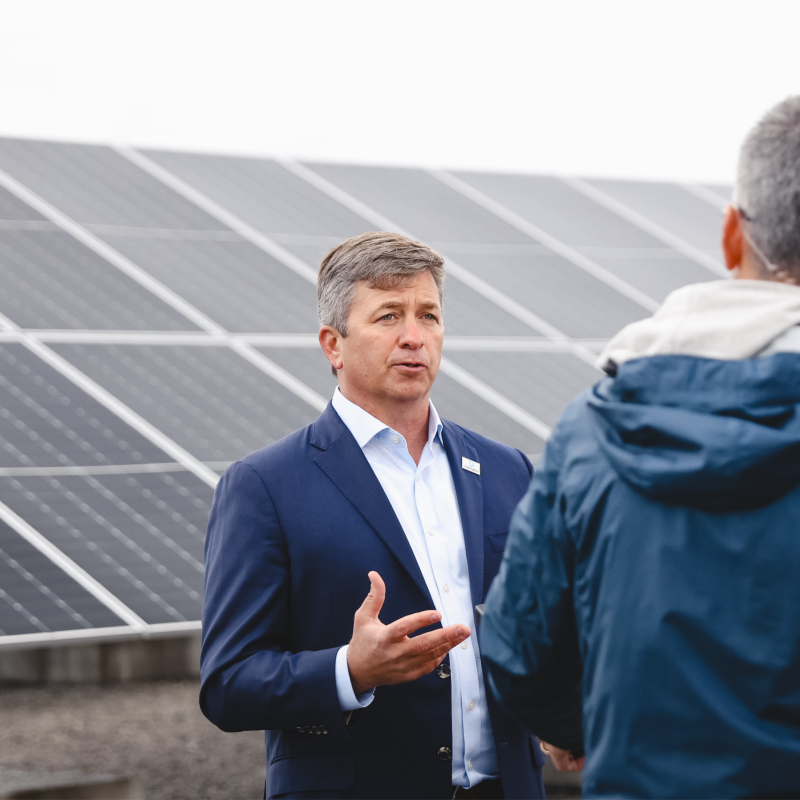
Jon Powers of CleanCapital appears in a theCUBE Research interview on theCUBE + NYSE Wired: Powering Tomorrow to discuss scaling solar and storage to meet accelerating electricity demand. Powers brings deep experience in financing, acquiring and operating solar and storage assets across the United States. They outline CleanCapital's asset-backed investment model, market evolution, customer segments, development hurdles and how solar-plus-storage addresses growing demand from data centers and industrial customers.
Key takeaways include reframing solar from technology risk to infrastructure investment and the critical roles of policy and community engagement. Powers highlights declining project costs and predictable solar feedstock that make long-term power contracts attractive to hospitals, universities and manufacturers. They emphasize storage's contribution to grid stability, supply chain localization via the Inflation Reduction Act, IRA and the need to shape state level policy to scale deployment. The conversation addresses renewable energy deployment, energy transition strategies and financing structures that enable commercial and institutional buyers to procure reliable clean power.
Forgot Password
Almost there!
We just sent you a verification email. Please verify your account to gain access to
theCUBE + NYSE Wired: Powering Tomorrow. If you don’t think you received an email check your
spam folder.
Sign in to theCUBE + NYSE Wired: Powering Tomorrow.
In order to sign in, enter the email address you used to registered for the event. Once completed, you will receive an email with a verification link. Open the link to automatically sign into the site.
Register for theCUBE + NYSE Wired: Powering Tomorrow
Please fill out the information below. You will receive an email with a verification link confirming your registration. Click the link to automatically sign into the site.
You’re almost there!
We just sent you a verification email. Please click the verification button in the email. Once your email address is verified, you will have full access to all event content for theCUBE + NYSE Wired: Powering Tomorrow.
I want my badge and interests to be visible to all attendees.
Checking this box will display your presense on the attendees list, view your profile and allow other attendees to contact you via 1-1 chat. Read the Privacy Policy. At any time, you can choose to disable this preference.
Select your Interests!
add
Upload your photo
Uploading..
OR
Connect via Twitter
Connect via Linkedin
EDIT PASSWORD
Share
Forgot Password
Almost there!
We just sent you a verification email. Please verify your account to gain access to
theCUBE + NYSE Wired: Powering Tomorrow. If you don’t think you received an email check your
spam folder.
Sign in to theCUBE + NYSE Wired: Powering Tomorrow.
In order to sign in, enter the email address you used to registered for the event. Once completed, you will receive an email with a verification link. Open the link to automatically sign into the site.
Sign in to gain access to theCUBE + NYSE Wired: Powering Tomorrow
Please sign in with LinkedIn to continue to theCUBE + NYSE Wired: Powering Tomorrow. Signing in with LinkedIn ensures a professional environment.
Are you sure you want to remove access rights for this user?
Details
Manage Access
email address
Community Invitation
Jon Powers, CleanCapital
Jon Powers of CleanCapital appears in a theCUBE Research interview on theCUBE + NYSE Wired: Powering Tomorrow to discuss scaling solar and storage to meet accelerating electricity demand. Powers brings deep experience in financing, acquiring and operating solar and storage assets across the United States. They outline CleanCapital's asset-backed investment model, market evolution, customer segments, development hurdles and how solar-plus-storage addresses growing demand from data centers and industrial customers.
Key takeaways include reframing solar from technology risk to infrastructure investment and the critical roles of policy and community engagement. Powers highlights declining project costs and predictable solar feedstock that make long-term power contracts attractive to hospitals, universities and manufacturers. They emphasize storage's contribution to grid stability, supply chain localization via the Inflation Reduction Act, IRA and the need to shape state level policy to scale deployment. The conversation addresses renewable energy deployment, energy transition strategies and financing structures that enable commercial and institutional buyers to procure reliable clean power.
>> Palo Alto Studio Connection, Silicon Valley and Wall Street.
Jon Powers
>> I'm John Furrier, co-host of theCUBE here with Gemma Allen, my co-host.
Gemma Allen
>> Welcome back to theCUBE studio here at the New York Stock Exchange. I'm Gemma Allen, co-host of NYSE Wired, Powering Tomorrow. And now we are talking about how the AI boom has created a very old-fashioned problem, that is that we need a heck of a lot more electricity. And suddenly the energy transition isn't just about climate, it's about powering data centers, industrial businesses, and the next gen of this economy. CleanCapital sits right in the collision between capital, infrastructure, and energy, investing in and building solar and storage projects across the US. Joining me now to unpack this is Jon Powers, co-founder and president of CleanCapital. Welcome, Jon Powers.
Jon Powers
>> Thanks so much for having us.
Gemma Allen
>> So maybe help me just understand CleanCapital's business premise and model. Yeah, as 101 as you can give me, Jon Powers.
Jon Powers
>> Yeah. So let's go back 10 years ago when the market was really getting going around a new technology, right? Solar and storage. Solar wasn't a new technology. It's been around since the '70s, but it didn't actually accelerate in terms of deployment until really the last decade. And we were looking at opportunities to bring more effective capital into the asset class. So from the beginning of CleanCapital's life, we actually bought operating projects so we could educate investors beyond private equity. this is what a solar asset looks like. And then as we grew, obviously the financial markets began to understand that technology much better. And now we're backed by Manulife, which is a life insurance company. We've deployed nearly $2 billion in 26 states. We have a lot of operating assets, over 500 megawatts, but we also have a robust pipeline of new projects that we're building as well.
Gemma Allen
>> So let's just get into solar for a minute if you can. It seems to have had a glory moment, then a little bit of a slide from grace. And now a bit of a recurring glory moment again right now, depending on how you look at it. We saw some interesting startups have a really hard time, ultimately going bust in the space.
Jon Powers
>> Yeah.
Gemma Allen
>> Why does solar have such a nuanced depiction in the market, do you think? where is the reality not really landing for folks?
Jon Powers
>> I think the big thing around energy policy in general, energy in general, is it's not just about the technology and finance, policy plays a huge piece of that, right? And so as the industry has matured, policy has ebbed and flowed, right? You've had administrations that support it, administrations that don't support it. So how do you scale and grow continuously? Where we are today, which is like we've never been before, the demand for what we do has skyrocketed, right? So not only is there a huge demand for energy, because we're the second largest— or last year 70% of new power came from solar and storage on the grid. The scale is there, the financing is there. Those early technology blips company-wise were often driven by sometimes bad business models, sometimes bad— the wrong technologies. But now the technology is proven and it's really an infrastructure investment.
Gemma Allen
>> Talk to me about the economics of the model, though, right? Is the sun your only OpEx? How exactly do these models play out? What is the true ROI on this?
Jon Powers
>> So yeah, the sun is a pretty low-cost OPEX for us, right? It is truly about the construction costs of the projects. It's about the long-term contracts you align with the contract, the projects, and then your ability to operate them. Right. So what's changed dramatically over the last decade is the cost of the projects themselves has declined because the cost of panels declined. The workforce became, you know, over 200,000 people work in the industry. The workforce has become educated on how to do it. We've gotten better to be able to build it, to interconnect it. So those costs have come down, financing costs have come down. You sort of put those together and you have the expenditure for the electricity on the back end, right? What people like about solar is the feedstock, the sun, right? Isn't going to ebb and flow with the market, right? You know what those costs are going to be. It'll ebb and flow with the weather. But we've gotten very good at forecasting that and understanding. And now you've added batteries into the mix for the first time in the last few years, and we can really level out the output. And then we sell that output to hospitals, to schools, to utilities. And folks love that repeatable budget line versus today, their OpEx around energy in general is skyrocketing, right?
Gemma Allen
>> Especially right now. People love a fixed cost, right? Yeah, in this economy. It's more important than ever. Stay on the customer profile there. You mentioned hospitals, universities, utilities. Help me understand the true ICP for this model. who are you ultimately selling to? Yeah, buyer.
Jon Powers
>> It depends on the state and how you're allowed to sell it. But truly, if you went back years ago, it was driven by folks wanting to address climate ESG within their portfolio. What's changed now? It's about cost. So we're selling to manufacturing facilities, we're selling to— we sell to a hospital, they want that budget cost. So when we do a long-term 20-year power contract with them, that's what they like about it. With the residential side of this, you know, we are able to sell what's called community solar in some states where we can build a big asset and then sell it to thousands of people across the utility, or we can sell to the utility themselves. But it really depends on the state. How we can sell the power, which makes the scaling of it challenging, right? Because you have literally 50 different energy fiefdoms that you're working in. And how do you create your business model to fit into that?
Gemma Allen
>> And within those fiefdoms, you alluded to it already, but there's a lot of bureaucracy, right? There's a lot of policy regulation, however you want to term it.
Jon Powers
>> Yeah.
Gemma Allen
>> it's a challenge. What sorts of challenges do you see state by state? what is the easiest land and expand for a company like yours?
Jon Powers
>> So the ones that are the easiest, we've already seen a lot of market growth right now. It's where do we grow beyond that? And so I think not only is it the challenge at the state level, it's many times you have a monopoly, which is the utility that's controlling the lever. So can we sell our power directly to a consumer? In some states you can, in some states you can't, right? Depends on how you can. So we have to shape that policy landscape. The opportunity that lies in front of us today is affordability being a top-tier political issue. Electricity affordability is a top-tier election issue for these midterms. How does that transition into policy changes next year? And how do we go into those conversations and help shape that policy environment so that things like solar and storage are the solutions that people understand are coming forward? If you want to build a new natural gas plant today, you're waiting 5 years at minimum just to get the turbines. We can build plants in 18 months and we can build— we need all of it, by the way, not just We need to be able to bring all of that to the market, but we can move fast, we can move efficiently and cost-effectively.
Gemma Allen
>> Help me understand the retrofit on solar. Let's say you're a university, you have a building that's, 100 years old, right?
Jon Powers
>> Yeah.
Gemma Allen
>> Some beautiful architecture, which often meets the profile of these esteemed universities.
Jon Powers
>> Yeah.
Gemma Allen
>> How easy is it to say, you know what, I'm sick of this, I'm sick of energy costs, I want to have a cleaner, more efficient energy policy and structure and here I want to implement solar.
Jon Powers
>> Yeah.
Gemma Allen
>> How quickly can you do that? what are the real challenges of that?
Jon Powers
>> they can move as fast as they want because there's two ways of doing it. There is a contractual arrangement or they can actually put solar on the roofs. Right. So let me give you an example. In Buffalo, we own solar on an old Bethlehem Steel brownfield site that literally is full of asbestos. So nothing else is going to get built there. We sell that electricity to the University at Buffalo. under a contract, right? So they can— as fast as they can contract, we can build and sell to them so they can meet those demands. And University at Buffalo is doing this in a really exciting way, and so are a lot of other universities. But if they want to do a rooftop system, for instance, if I was in their shoes, I'd look at not only are you going to put solar on your roof, but what other retrofits do you— can you do within the building to bring down your demand, right? Whether it be windows, lighting, there's a lot of things they can do from an energy perspective. So solar should just be part of that solution, and they don't need to own it, right? That's the
Gemma Allen
>> trick.They're leasing it, essentially. They're renting it, or they're buying it from any other utility plant. Okay, so your own business model, you do own it though, right? You do. You have a very CapEx-heavy business
Jon Powers
>> here.
Gemma Allen
>> Yes.It's interesting because we're at a time right now where a lot of folks who are also in the kind of energy business or the robotics business or whatever it might be, right, they are very on the fence about what makes more sense, right, longer term. Whether you lease or you own, right? So to go CapEx heavy, it's brave, right? Especially in this
Jon Powers
>> market.
Gemma Allen
>> Yeah.Talk me through the thinking behind that. What— how do you— how valuable are these assets over what length of
Jon Powers
>> time?
Gemma Allen
>> Yeah.And how do you— maybe it's the second question, but I want to go there. Talk about the supply chain element of this
Jon Powers
>> too.Oh, that's interesting. So, well, first of all, let's go to the customer. Yeah. So if you're going to go back to University at Buffalo, just as an example, if they don't want to own solar assets, they don't have a team that knows how to do operation and maintenance. They don't want the risk. So they're much better having a company like CleanCapital come own and operate it. We take that risk and we sell the power. Then what does the return profile look like? We are infrastructure investors backed by life insurance companies. So we have, we don't have private equity-esque returns. We have infrastructure returns and we can build but also have those returns over a significant period of time because they're just paying their bill every month. Right. And people pay their electricity bill. Right. It's pretty critical. So back to the supply chain. It used to be our supply chain was significantly overseas. Because of the Inflation Reduction Act, in the last 2 years we went from being 14th in the world to 3rd in solar manufacturing for panels. And we are actually going to be a solar panel manufacturing exporter in the next year or 2, which is exciting. But there's a lot of pieces to that supply chain that aren't here yet, right? Some of the rare earths, some of the silicon. So that piece is really continuing to develop. And become more and more, US-based again.
Gemma Allen
>> And how much of a bottleneck are those components like, how are those kind of building materials for this overall kind of build-out for you? How detrimental have some of the kind of geopolitical and global supply chain crises that we've seen over the last year been for your business?
Jon Powers
>> Yeah, well, we were able to predict that because we're building projects, we're investing in technology that we're going to build a year from now. Right. So we're okay from a supply chain perspective. The bigger challenge is actually the local side— similar things are facing the data centers, the local zoning permits, the things that have to happen at a community level to get these projects built. That's where a lot of the obstacles we're facing today are, where folks are just hesitant to build, period. So how do we engage a community, get that built? We can bring panels from all over the place. We can bring inverters. That technology is now proven and scaled. But it's getting the projects built, which I think is going to be one of the biggest obstacles moving forward.
Gemma Allen
>> And are you seeing that in areas where you're kind of co-locating next to data centers or what sorts of scenarios are playing out there?
Jon Powers
>> Because it is—
Gemma Allen
>> it seems as though it's kind of a broad sweep of who is the Machiavelli of the future, right? Yeah. But you're essentially also powering them. Is that part of the response, do you think?
Jon Powers
>> I would think they're somewhat separate in the conversation, but they're being brought together in the general public's mind. Yeah. Right. So we're not actually building next to a bunch of data centers, but if you go to rural New York right now and drive upstate, you're going to see a bunch of lawn signs that say no industrial solar, right? And when you break into that, what does that mean? People are talking about— there's a lot of misinformation that's been put out by influencers, honestly, by the fossil fuel industry. That is just— first of all, there's no such thing as industrial solar. And then when you get into the why they don't want it, they don't really understand the reality behind solar. So we have to be out there educating them on, no, actually this is safe, it's fast, it's gonna help bring down your electricity bills. We need to get that message out into communities.
Gemma Allen
>> Help me understand the data and performance engineering side of this business.
Jon Powers
>> Yeah.
Gemma Allen
>> So you are, people are leasing, if you like, or renting power from you, right? Yep. You have a lot of opportunity there to optimize at a performance level, to look at loads, like we see in data centers, right? Absolutely. Again, go that road, but same thing, right? There's a load balancing element to this, right? And you can do that very, very efficiently.
Jon Powers
>> Yeah.
Gemma Allen
>> How does that play out in your model?
Jon Powers
>> It's interesting. So we are able to really look both at the weather curves and what the expectations are. And then we literally go down to the node where we can measure the performance of these systems And then if something goes wrong, we're able to act quickly on those. But the biggest, I think, advancement in the last few years is adding storage. If we can add storage to these facilities or in the area, we can really balance the load. Because if we're producing more than is needed, we can store it. Or we can even pull from the grid at night if necessary and produce more. So Texas just recently had a major moment where storage played an active role in keeping the grid stabilized this summer. For the first time ever, right? Texas is the largest solar state now in the country. And that's all happened in the last few years. And storage as well. What's ironic is Texas politically isn't really a solar state, but the infrastructure build out there has been phenomenal. And it's literally, if you remember just a few years ago, Texas, people in Texas were freezing when the grid went down. That has been stabilized by solar and storage. Even their head of utilities says that's a key piece of it. So that stability that storage adds to solar and wind, by the way, is really helping to level out the production.
Gemma Allen
>> You mentioned battery life and, as a new, kind of entrant or component to this whole space.
Jon Powers
>> Yeah.
Gemma Allen
>> Talk me through that. Again, we are seeing the rise of battery in all sorts of areas of tech, right?
Jon Powers
>> Yeah.
Gemma Allen
>> What is the fundamental shift it's driving in your business and what sort of technology is being built and I guess innovated around it?
Jon Powers
>> Yeah, well, first of all, I think a lot of the technology itself around the battery isn't that different. The Tesla car battery and the one that's going into their system that we're putting into, it's basically the same battery. What it's done for us is, one, it's helped us level load. The biggest challenge, though, is it's a different economic business model than solar, right? Solar, you produce during the day, you sell during the day. You can sort of forecast that storage is based on when is the most efficient to dispatch those electrons. So you have to look at how the grid's working. It's different in July than it is in December. And it really is important that you manage that so you're getting the biggest bang for your buck out of those electrons and helping to level out the utility as well. I would say we're becoming much more sophisticated in that the last few years, and the utilities are really just beginning to understand how to use those resources in a way that, they just didn't exist 10 years ago.
Gemma Allen
>> Interesting. So obviously a very interesting business model at a very interesting time.
Gemma Allen
>> Yeah.Talk about where you guys are at from a commercial perspective. You said you're not PE-backed. Yeah. you guys, how is this funded? Where are you at from a funding perspective, what's the plan here? I presume you're probably very self-sufficient, but help me understand the kind of broader numbers around the
Jon Powers
>> business.Yeah. So if you went back to our old business model, when we would— we started CleanCapital, we actually had a fintech platform. Right. We were sort of— our valuation was based on how we could grow that concept. But our miscalculation at the time is when we were buying assets, we were backed by BlackRock and a couple of other players along the way. We were putting those assets into these partnerships and that value would grow, but the CleanCapital value wasn't growing along with it. So about 5 years ago, we shifted that model. We brought Manulife in from the top down in what is today known as an independent power producer model so we can build the asset base underneath CleanCapital as a holding company and grow the valuation of CleanCapital based on both that valuation of the assets and then the valuation around the future pipeline and the sort of machine driving that pipeline. Right. And that market cap or that market has changed dramatically the last few years. There was a lot of value in that a few years ago, maybe less value in it today. We're betting there's going to be more value in that. And again, in the future, as the demand for power continues to grow. And so then our next phase is as we grow, we make decisions on, we'll have— we still have years of capital still to go. But then where do we go from there, right? Do we go to a pension fund? Do we go public? Like, we have to think about that phase, but we're just not there right now. We're very much in execution mode and making our machine as fine-tuned as we can.
Gemma Allen
>> From a footprint perspective, what's ahead from the perspective of expansion? I know you mentioned those kind of easy land— I call them the hippie states, right? Yeah, right. People embrace solar, they embrace the sun. But what's ahead in terms of your own scale? I presume it's US-centric. Will you remain solely US-centric?
Jon Powers
>> Yeah, at least in this next phase we'll stay US-centric and we're seeing less hippie states adopting solar today, which is awesome because of the power demands. Like Texas is definitely not a hippie state, right? So how do we play in those states. And then what I think is really important is how do we create the policy landscape to grow in new states. So we are actively part of that conversation with other companies, our industry groups, etc. I think 2027 you're going to see a lot of political activity at the state level around affordability, and you're going to see new states opening up for things like solar and storage if we're in there having the conversation we should be having when these are the policies that will scale here. Because you think about a place like Florida, it's big, but it should be much bigger, right? Or across the southern US as a whole, solar is growing, but should be significantly growing more. You should have more down there than you have in Massachusetts, but Massachusetts is a great robust market right now for us.
Gemma Allen
>> Fascinating. Well, we'll certainly be watching from the sidelines and wish you and the team at CleanCapital— I love the name, by the way. Thank you.
Jon Powers
>> Thank you.
Gemma Allen
>> Exactly what it says on the tin. All the best. Thank you so much for joining us.
Jon Powers
>> Thanks for having us.
Gemma Allen
>> I'm Gemma Allen here at theCUBE Studio at the New York Stock Exchange. This is NYSE Wired: Powering Tomorrow. We're talking to some of the folks building this next frontier of energy. Thanks so much for watching.
>> Palo Alto Studio Connection, Silicon Valley and Wall Street.
Jon Powers
>> I'm John Furrier, co-host of theCUBE here with Gemma Allen, my co-host.
Gemma Allen
>> Welcome back to theCUBE studio here at the New York Stock Exchange. I'm Gemma Allen, co-host of NYSE Wired, Powering Tomorrow. And now we are talking about how the AI boom has created a very old-fashioned problem, that is that we need a heck of a lot more electricity. And suddenly the energy transition isn't just about climate, it's about powering data centers, industrial businesses, and the next gen of this economy. CleanCapital sits right in the collision between capital, infrastructure, and energy, investing in and building solar and storage projects across the US. Joining me now to unpack this is Jon Powers, co-founder and president of CleanCapital. Welcome, Jon Powers.
Jon Powers
>> Thanks so much for having us.
Gemma Allen
>> So maybe help me just understand CleanCapital's business premise and model. Yeah, as 101 as you can give me, Jon Powers.
Jon Powers
>> Yeah. So let's go back 10 years ago when the market was really getting going around a new technology, right? Solar and storage. Solar wasn't a new technology. It's been around since the '70s, but it didn't actually accelerate in terms of deployment until really the last decade. And we were looking at opportunities to bring more effective capital into the asset class. So from the beginning of CleanCapital's life, we actually bought operating projects so we could educate investors beyond private equity. this is what a solar asset looks like. And then as we grew, obviously the financial markets began to understand that technology much better. And now we're backed by Manulife, which is a life insurance company. We've deployed nearly $2 billion in 26 states. We have a lot of operating assets, over 500 megawatts, but we also have a robust pipeline of new projects that we're building as well.
Gemma Allen
>> So let's just get into solar for a minute if you can. It seems to have had a glory moment, then a little bit of a slide from grace. And now a bit of a recurring glory moment again right now, depending on how you look at it. We saw some interesting startups have a really hard time, ultimately going bust in the space.
Jon Powers
>> Yeah.
Gemma Allen
>> Why does solar have such a nuanced depiction in the market, do you think? where is the reality not really landing for folks?
Jon Powers
>> I think the big thing around energy policy in general, energy in general, is it's not just about the technology and finance, policy plays a huge piece of that, right? And so as the industry has matured, policy has ebbed and flowed, right? You've had administrations that support it, administrations that don't support it. So how do you scale and grow continuously? Where we are today, which is like we've never been before, the demand for what we do has skyrocketed, right? So not only is there a huge demand for energy, because we're the second largest— or last year 70% of new power came from solar and storage on the grid. The scale is there, the financing is there. Those early technology blips company-wise were often driven by sometimes bad business models, sometimes bad— the wrong technologies. But now the technology is proven and it's really an infrastructure investment.
Gemma Allen
>> Talk to me about the economics of the model, though, right? Is the sun your only OpEx? How exactly do these models play out? What is the true ROI on this?
Jon Powers
>> So yeah, the sun is a pretty low-cost OPEX for us, right? It is truly about the construction costs of the projects. It's about the long-term contracts you align with the contract, the projects, and then your ability to operate them. Right. So what's changed dramatically over the last decade is the cost of the projects themselves has declined because the cost of panels declined. The workforce became, you know, over 200,000 people work in the industry. The workforce has become educated on how to do it. We've gotten better to be able to build it, to interconnect it. So those costs have come down, financing costs have come down. You sort of put those together and you have the expenditure for the electricity on the back end, right? What people like about solar is the feedstock, the sun, right? Isn't going to ebb and flow with the market, right? You know what those costs are going to be. It'll ebb and flow with the weather. But we've gotten very good at forecasting that and understanding. And now you've added batteries into the mix for the first time in the last few years, and we can really level out the output. And then we sell that output to hospitals, to schools, to utilities. And folks love that repeatable budget line versus today, their OpEx around energy in general is skyrocketing, right?
Gemma Allen
>> Especially right now. People love a fixed cost, right? Yeah, in this economy. It's more important than ever. Stay on the customer profile there. You mentioned hospitals, universities, utilities. Help me understand the true ICP for this model. who are you ultimately selling to? Yeah, buyer.
Jon Powers
>> It depends on the state and how you're allowed to sell it. But truly, if you went back years ago, it was driven by folks wanting to address climate ESG within their portfolio. What's changed now? It's about cost. So we're selling to manufacturing facilities, we're selling to— we sell to a hospital, they want that budget cost. So when we do a long-term 20-year power contract with them, that's what they like about it. With the residential side of this, you know, we are able to sell what's called community solar in some states where we can build a big asset and then sell it to thousands of people across the utility, or we can sell to the utility themselves. But it really depends on the state. How we can sell the power, which makes the scaling of it challenging, right? Because you have literally 50 different energy fiefdoms that you're working in. And how do you create your business model to fit into that?
Gemma Allen
>> And within those fiefdoms, you alluded to it already, but there's a lot of bureaucracy, right? There's a lot of policy regulation, however you want to term it.
Jon Powers
>> Yeah.
Gemma Allen
>> it's a challenge. What sorts of challenges do you see state by state? what is the easiest land and expand for a company like yours?
Jon Powers
>> So the ones that are the easiest, we've already seen a lot of market growth right now. It's where do we grow beyond that? And so I think not only is it the challenge at the state level, it's many times you have a monopoly, which is the utility that's controlling the lever. So can we sell our power directly to a consumer? In some states you can, in some states you can't, right? Depends on how you can. So we have to shape that policy landscape. The opportunity that lies in front of us today is affordability being a top-tier political issue. Electricity affordability is a top-tier election issue for these midterms. How does that transition into policy changes next year? And how do we go into those conversations and help shape that policy environment so that things like solar and storage are the solutions that people understand are coming forward? If you want to build a new natural gas plant today, you're waiting 5 years at minimum just to get the turbines. We can build plants in 18 months and we can build— we need all of it, by the way, not just We need to be able to bring all of that to the market, but we can move fast, we can move efficiently and cost-effectively.
Gemma Allen
>> Help me understand the retrofit on solar. Let's say you're a university, you have a building that's, 100 years old, right?
Jon Powers
>> Yeah.
Gemma Allen
>> Some beautiful architecture, which often meets the profile of these esteemed universities.
Jon Powers
>> Yeah.
Gemma Allen
>> How easy is it to say, you know what, I'm sick of this, I'm sick of energy costs, I want to have a cleaner, more efficient energy policy and structure and here I want to implement solar.
Jon Powers
>> Yeah.
Gemma Allen
>> How quickly can you do that? what are the real challenges of that?
Jon Powers
>> they can move as fast as they want because there's two ways of doing it. There is a contractual arrangement or they can actually put solar on the roofs. Right. So let me give you an example. In Buffalo, we own solar on an old Bethlehem Steel brownfield site that literally is full of asbestos. So nothing else is going to get built there. We sell that electricity to the University at Buffalo. under a contract, right? So they can— as fast as they can contract, we can build and sell to them so they can meet those demands. And University at Buffalo is doing this in a really exciting way, and so are a lot of other universities. But if they want to do a rooftop system, for instance, if I was in their shoes, I'd look at not only are you going to put solar on your roof, but what other retrofits do you— can you do within the building to bring down your demand, right? Whether it be windows, lighting, there's a lot of things they can do from an energy perspective. So solar should just be part of that solution, and they don't need to own it, right? That's the
Gemma Allen
>> trick.They're leasing it, essentially. They're renting it, or they're buying it from any other utility plant. Okay, so your own business model, you do own it though, right? You do. You have a very CapEx-heavy business
Jon Powers
>> here.
Gemma Allen
>> Yes.It's interesting because we're at a time right now where a lot of folks who are also in the kind of energy business or the robotics business or whatever it might be, right, they are very on the fence about what makes more sense, right, longer term. Whether you lease or you own, right? So to go CapEx heavy, it's brave, right? Especially in this
Jon Powers
>> market.
Gemma Allen
>> Yeah.Talk me through the thinking behind that. What— how do you— how valuable are these assets over what length of
Jon Powers
>> time?
Gemma Allen
>> Yeah.And how do you— maybe it's the second question, but I want to go there. Talk about the supply chain element of this
Jon Powers
>> too.Oh, that's interesting. So, well, first of all, let's go to the customer. Yeah. So if you're going to go back to University at Buffalo, just as an example, if they don't want to own solar assets, they don't have a team that knows how to do operation and maintenance. They don't want the risk. So they're much better having a company like CleanCapital come own and operate it. We take that risk and we sell the power. Then what does the return profile look like? We are infrastructure investors backed by life insurance companies. So we have, we don't have private equity-esque returns. We have infrastructure returns and we can build but also have those returns over a significant period of time because they're just paying their bill every month. Right. And people pay their electricity bill. Right. It's pretty critical. So back to the supply chain. It used to be our supply chain was significantly overseas. Because of the Inflation Reduction Act, in the last 2 years we went from being 14th in the world to 3rd in solar manufacturing for panels. And we are actually going to be a solar panel manufacturing exporter in the next year or 2, which is exciting. But there's a lot of pieces to that supply chain that aren't here yet, right? Some of the rare earths, some of the silicon. So that piece is really continuing to develop. And become more and more, US-based again.
Gemma Allen
>> And how much of a bottleneck are those components like, how are those kind of building materials for this overall kind of build-out for you? How detrimental have some of the kind of geopolitical and global supply chain crises that we've seen over the last year been for your business?
Jon Powers
>> Yeah, well, we were able to predict that because we're building projects, we're investing in technology that we're going to build a year from now. Right. So we're okay from a supply chain perspective. The bigger challenge is actually the local side— similar things are facing the data centers, the local zoning permits, the things that have to happen at a community level to get these projects built. That's where a lot of the obstacles we're facing today are, where folks are just hesitant to build, period. So how do we engage a community, get that built? We can bring panels from all over the place. We can bring inverters. That technology is now proven and scaled. But it's getting the projects built, which I think is going to be one of the biggest obstacles moving forward.
Gemma Allen
>> And are you seeing that in areas where you're kind of co-locating next to data centers or what sorts of scenarios are playing out there?
Jon Powers
>> Because it is—
Gemma Allen
>> it seems as though it's kind of a broad sweep of who is the Machiavelli of the future, right? Yeah. But you're essentially also powering them. Is that part of the response, do you think?
Jon Powers
>> I would think they're somewhat separate in the conversation, but they're being brought together in the general public's mind. Yeah. Right. So we're not actually building next to a bunch of data centers, but if you go to rural New York right now and drive upstate, you're going to see a bunch of lawn signs that say no industrial solar, right? And when you break into that, what does that mean? People are talking about— there's a lot of misinformation that's been put out by influencers, honestly, by the fossil fuel industry. That is just— first of all, there's no such thing as industrial solar. And then when you get into the why they don't want it, they don't really understand the reality behind solar. So we have to be out there educating them on, no, actually this is safe, it's fast, it's gonna help bring down your electricity bills. We need to get that message out into communities.
Gemma Allen
>> Help me understand the data and performance engineering side of this business.
Jon Powers
>> Yeah.
Gemma Allen
>> So you are, people are leasing, if you like, or renting power from you, right? Yep. You have a lot of opportunity there to optimize at a performance level, to look at loads, like we see in data centers, right? Absolutely. Again, go that road, but same thing, right? There's a load balancing element to this, right? And you can do that very, very efficiently.
Jon Powers
>> Yeah.
Gemma Allen
>> How does that play out in your model?
Jon Powers
>> It's interesting. So we are able to really look both at the weather curves and what the expectations are. And then we literally go down to the node where we can measure the performance of these systems And then if something goes wrong, we're able to act quickly on those. But the biggest, I think, advancement in the last few years is adding storage. If we can add storage to these facilities or in the area, we can really balance the load. Because if we're producing more than is needed, we can store it. Or we can even pull from the grid at night if necessary and produce more. So Texas just recently had a major moment where storage played an active role in keeping the grid stabilized this summer. For the first time ever, right? Texas is the largest solar state now in the country. And that's all happened in the last few years. And storage as well. What's ironic is Texas politically isn't really a solar state, but the infrastructure build out there has been phenomenal. And it's literally, if you remember just a few years ago, Texas, people in Texas were freezing when the grid went down. That has been stabilized by solar and storage. Even their head of utilities says that's a key piece of it. So that stability that storage adds to solar and wind, by the way, is really helping to level out the production.
Gemma Allen
>> You mentioned battery life and, as a new, kind of entrant or component to this whole space.
Jon Powers
>> Yeah.
Gemma Allen
>> Talk me through that. Again, we are seeing the rise of battery in all sorts of areas of tech, right?
Jon Powers
>> Yeah.
Gemma Allen
>> What is the fundamental shift it's driving in your business and what sort of technology is being built and I guess innovated around it?
Jon Powers
>> Yeah, well, first of all, I think a lot of the technology itself around the battery isn't that different. The Tesla car battery and the one that's going into their system that we're putting into, it's basically the same battery. What it's done for us is, one, it's helped us level load. The biggest challenge, though, is it's a different economic business model than solar, right? Solar, you produce during the day, you sell during the day. You can sort of forecast that storage is based on when is the most efficient to dispatch those electrons. So you have to look at how the grid's working. It's different in July than it is in December. And it really is important that you manage that so you're getting the biggest bang for your buck out of those electrons and helping to level out the utility as well. I would say we're becoming much more sophisticated in that the last few years, and the utilities are really just beginning to understand how to use those resources in a way that, they just didn't exist 10 years ago.
Gemma Allen
>> Interesting. So obviously a very interesting business model at a very interesting time.
Gemma Allen
>> Yeah.Talk about where you guys are at from a commercial perspective. You said you're not PE-backed. Yeah. you guys, how is this funded? Where are you at from a funding perspective, what's the plan here? I presume you're probably very self-sufficient, but help me understand the kind of broader numbers around the
Jon Powers
>> business.Yeah. So if you went back to our old business model, when we would— we started CleanCapital, we actually had a fintech platform. Right. We were sort of— our valuation was based on how we could grow that concept. But our miscalculation at the time is when we were buying assets, we were backed by BlackRock and a couple of other players along the way. We were putting those assets into these partnerships and that value would grow, but the CleanCapital value wasn't growing along with it. So about 5 years ago, we shifted that model. We brought Manulife in from the top down in what is today known as an independent power producer model so we can build the asset base underneath CleanCapital as a holding company and grow the valuation of CleanCapital based on both that valuation of the assets and then the valuation around the future pipeline and the sort of machine driving that pipeline. Right. And that market cap or that market has changed dramatically the last few years. There was a lot of value in that a few years ago, maybe less value in it today. We're betting there's going to be more value in that. And again, in the future, as the demand for power continues to grow. And so then our next phase is as we grow, we make decisions on, we'll have— we still have years of capital still to go. But then where do we go from there, right? Do we go to a pension fund? Do we go public? Like, we have to think about that phase, but we're just not there right now. We're very much in execution mode and making our machine as fine-tuned as we can.
Gemma Allen
>> From a footprint perspective, what's ahead from the perspective of expansion? I know you mentioned those kind of easy land— I call them the hippie states, right? Yeah, right. People embrace solar, they embrace the sun. But what's ahead in terms of your own scale? I presume it's US-centric. Will you remain solely US-centric?
Jon Powers
>> Yeah, at least in this next phase we'll stay US-centric and we're seeing less hippie states adopting solar today, which is awesome because of the power demands. Like Texas is definitely not a hippie state, right? So how do we play in those states. And then what I think is really important is how do we create the policy landscape to grow in new states. So we are actively part of that conversation with other companies, our industry groups, etc. I think 2027 you're going to see a lot of political activity at the state level around affordability, and you're going to see new states opening up for things like solar and storage if we're in there having the conversation we should be having when these are the policies that will scale here. Because you think about a place like Florida, it's big, but it should be much bigger, right? Or across the southern US as a whole, solar is growing, but should be significantly growing more. You should have more down there than you have in Massachusetts, but Massachusetts is a great robust market right now for us.
Gemma Allen
>> Fascinating. Well, we'll certainly be watching from the sidelines and wish you and the team at CleanCapital— I love the name, by the way. Thank you.
Jon Powers
>> Thank you.
Gemma Allen
>> Exactly what it says on the tin. All the best. Thank you so much for joining us.
Jon Powers
>> Thanks for having us.
Gemma Allen
>> I'm Gemma Allen here at theCUBE Studio at the New York Stock Exchange. This is NYSE Wired: Powering Tomorrow. We're talking to some of the folks building this next frontier of energy. Thanks so much for watching.






 Gemma Allen