This theCUBE Research interview features Ariyan Kabir of GrayMatter Robotics, chief executive officer and co-founder. Host John Furrier speaks with Kabir about deploying physical artificial intelligence in manufacturing. Kabir outlines GrayMatter's focus on autonomous tool-manipulation applications, multimodal sensing, manufacturing world models, real-to-sim-to-real learning and software-defined robotics to address high-mix, high-variability production across aerospace, shipbuilding, specialty vehicles and defense. They describe how AI-enabled systems provide adaptable automation that integrates with NVIDIA compute and commercial robots to improve throughput and reduce cost per unit across end-to-end value streams.
Kabir states that GrayMatter's core differentiator is multimodal data and a manufacturing world model that enables robots to adapt autonomously to tool–material physics and deliver exceptional precision. They report that this hardware-agnostic approach can increase throughput by twofold to tenfold and reduce cost per unit by 30–50% when applied across production value streams, offering significant benefits for industrial automation and defense manufacturing.
Forgot Password
Almost there!
We just sent you a verification email. Please verify your account to gain access to
theCUBE + NYSE Wired: Physical AI & Robotics Leaders. If you don’t think you received an email check your
spam folder.
Sign in to theCUBE + NYSE Wired: Physical AI & Robotics Leaders.
In order to sign in, enter the email address you used to registered for the event. Once completed, you will receive an email with a verification link. Open this link to automatically sign into the site.
Register For theCUBE + NYSE Wired: Physical AI & Robotics Leaders
Please fill out the information below. You will recieve an email with a verification link confirming your registration. Click the link to automatically sign into the site.
You’re almost there!
We just sent you a verification email. Please click the verification button in the email. Once your email address is verified, you will have full access to all event content for theCUBE + NYSE Wired: Physical AI & Robotics Leaders.
I want my badge and interests to be visible to all attendees.
Checking this box will display your presense on the attendees list, view your profile and allow other attendees to contact you via 1-1 chat. Read the Privacy Policy. At any time, you can choose to disable this preference.
Select your Interests!
add
Upload your photo
Uploading..
OR
Connect via Twitter
Connect via Linkedin
EDIT PASSWORD
Share
Forgot Password
Almost there!
We just sent you a verification email. Please verify your account to gain access to
theCUBE + NYSE Wired: Physical AI & Robotics Leaders. If you don’t think you received an email check your
spam folder.
Sign in to theCUBE + NYSE Wired: Physical AI & Robotics Leaders.
In order to sign in, enter the email address you used to registered for the event. Once completed, you will receive an email with a verification link. Open this link to automatically sign into the site.
Sign in to gain access to theCUBE + NYSE Wired: Physical AI & Robotics Leaders
Please sign in with LinkedIn to continue to theCUBE + NYSE Wired: Physical AI & Robotics Leaders. Signing in with LinkedIn ensures a professional environment.
Are you sure you want to remove access rights for this user?
Details
Manage Access
email address
Community Invitation
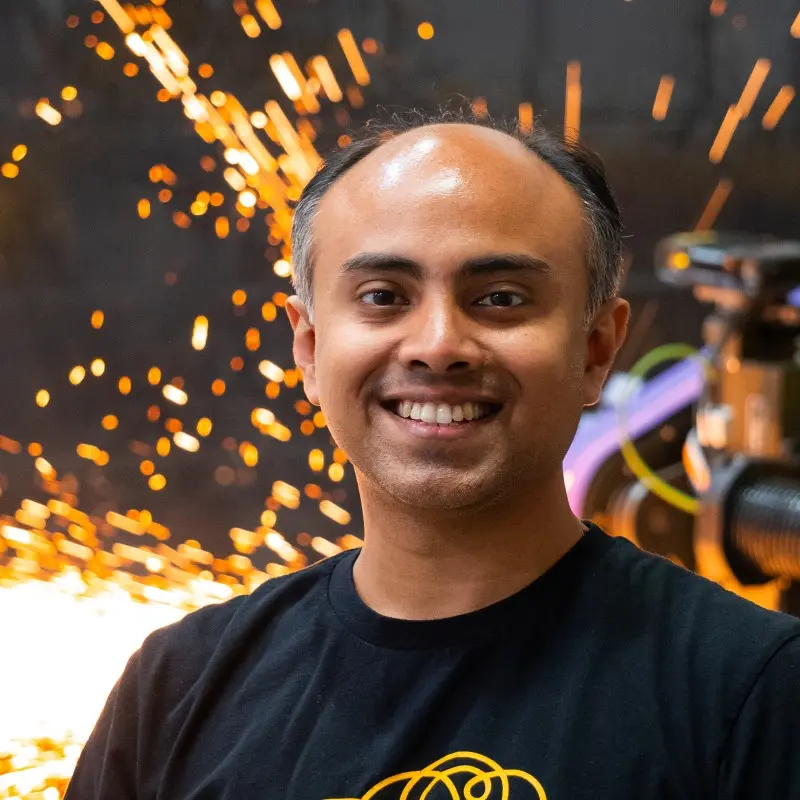
Ariyan Kabir, GrayMatter Robotics
This theCUBE Research interview features Ariyan Kabir of GrayMatter Robotics, chief executive officer and co-founder. Host John Furrier speaks with Kabir about deploying physical artificial intelligence in manufacturing. Kabir outlines GrayMatter's focus on autonomous tool-manipulation applications, multimodal sensing, manufacturing world models, real-to-sim-to-real learning and software-defined robotics to address high-mix, high-variability production across aerospace, shipbuilding, specialty vehicles and defense. They describe how AI-enabled systems provide adaptable automation that integrates with NVIDIA compute and commercial robots to improve throughput and reduce cost per unit across end-to-end value streams.
Kabir states that GrayMatter's core differentiator is multimodal data and a manufacturing world model that enables robots to adapt autonomously to tool–material physics and deliver exceptional precision. They report that this hardware-agnostic approach can increase throughput by twofold to tenfold and reduce cost per unit by 30–50% when applied across production value streams, offering significant benefits for industrial automation and defense manufacturing.
play_circle_outlinePhysical AI transforming manufacturing and bridging skilled worker shortage
replyShare Clip
play_circle_outlinePhysical AI and GrayMatter Robotics: Solving Skilled Labor Shortages to Secure Manufacturing Sovereignty in Aerospace, Defense, Shipbuilding
replyShare Clip
play_circle_outlineGrayMatter Robotics: autonomous manufacturing solutions for high-mix, variable parts
replyShare Clip
play_circle_outlineWorld Models, Multimodal Sensing, and Real-to-Sim-to-Real for Autonomous Surface Manipulation and Manufacturing Data Flywheel
replyShare Clip
play_circle_outlineSelf-Programming Robots and the Real-to-Sim-to-Real Data Flywheel Transforming Manufacturing
replyShare Clip
play_circle_outlineRobots self-programming/autonomous lab generating hypotheses and experiments
replyShare Clip
play_circle_outlineSoftware-defined, hardware-agnostic stack using off-the-shelf robots and NVIDIA compute
replyShare Clip
play_circle_outlinePartnerships and deployments: Huntington Ingalls, US government, 16 US states
>>Palo Alto Studio Connection, Silicon Valley and Wall Street. I'm >>John Furrier here with my cohost.
John Furrier
>>Hello, I'm John Furrier, your host of the Cube here at the Cube's NYSE Studio. Of course,
John Furrier
>> we have our Palo Alto Studio connecting Silicon Valley and Wall Street Technology is the market and physical AI is hot. This is our robotics series, part of the NYSE Wired program and open community. We've got a great guest, Ariyan Kabir, CEO and co-founder of GrayMatter Robotics. Thanks for coming on remotely from la. Really appreciate it. Thanks. Thanks for taking the time.
Ariyan Kabir
>>Thanks for having me John.
John Furrier
>>So obviously robotics and physical AI are kind of one and the same, but it's really broad. Physical AI is, is everything autonomous? We see autonomous vehicles, but the robotics piece of ai, it's been the centerpiece of all the keynotes, certainly from an Nvidia standpoint for the past three years, if not four. And you start to see the advancements of robotics. But you know, I just love this AI wave 'cause we're injecting intelligence, whether we're talking about agents in the enterprise or robotics, it's essentially an AI factory, kind of like in a device. It's not an IOT device, it's, it's an intelligent device. So first, explain what you guys are doing and, and the key tech you're building
Ariyan Kabir
>>Sounds good as you have shared, right, physical AI is the next frontier. Physical AI is transforming many different aspects of the world as we live today. And you know, at GR Robotics, our primary focus is in manufacturing. Manufacturing as you know, is the upstream of everything else. You stop making parts, you cannot sell them, you cannot run advertisement, you cannot run any services. So manufacturing, when manufacturing stops, it has a cascading catastrophic effect on the whole economy. Now the reality is the demand for physical goods are soaring. However, the availability of skilled workforce that's declining over time. And at GrayMatter Robotics, we are delivering solutions to manufacturers to bridge that gap. We deliver autonomous solutions to transform the existing factories and bring in AI native manufacturing within the existing factories. We work across national security, aerospace, specialty vehicles, industrial equipment, ship building, consumer products, and a range of different industries.
John Furrier
>>It's interesting, the competitiveness in the US is an example in all countries. Sovereignty's huge. So people want to control their manufacturing, but there's a transition, we've crossed the threshold. I mean you think about manufacturing, robotics, old school, you know, it's machines, they're statically programmed. So what's changed? What's the big driver here? Is it the tech? Is it the form factor? All the above. What's changed? What's been the biggest change that's enabling this acceleration?
Ariyan Kabir
>>You're right, John. Traditionally, if you look at, you know, automotive industry, electronics industry, food and beverage and a few others, they have been using robots for decades now. But on the other hand, the vast 90% of manufacturing has been dependent on manual labor. Anything from football helmets to fire trucks to fighter jets to civilians and whatnot, right? Millions of man hour going into it. And the reason those industries like vast 90% of manufacturing has been dependent on manual labor is because it's high mix, high variability. There are part to part variation. Material distribution can be different, SKUs can be different, which disables all the hardcoded pre-programmed robots to be useful in this kind of scenario. Now as a result, people have been doing it by hand, but there's not enough people to do it anymore. In the US we have half a million skilled worker short. In the next seven years, that number is going to become 4 million. So the way we are bridging that gap is by bringing physical AI into manufacturing by combining physical AI with industrial robot sensors and tools and then creating these autonomous solutions that's driving this throughput and reducing cost per unit. In manufacturing, we create these solutions where the robots can program themselves on the fly, adapt to those variations and variabilities. So now you are free from limitations of traditional robots that needed to be programmed.
John Furrier
>>So talk about the, the advances on the robots, obviously software's key. You mentioned that programmability, that's huge. Software defined, I love that term. There's a lot of physics involved, but also the dexterity comes up a lot around robotics is like ranges of of capabilities. What's been some of the advances on some of the use cases that you're seeing?
Ariyan Kabir
>>Yeah, so, so John, we primarily focus on tool manipulation problems, applications. Wherever you take a tool, you make some value added change to an object using the tool. Applications such as sanding, grinding, painting, blasting coating, inspecting, you name it. Very broad set of applications. The common theme over there is that there's a complex physics involved between the tool and material interaction. There's process physics involved and the minute details of those process physics, those are not visible under camera. And those are there, there are details of those physics that are not even captured in ideal equation. So we could not even simulate them. So therefore, to solve that problem, the approach we had taken was going from real to simulation to real, real-to-sim-to-real. We started deploying real robots out in the world, across industries, environments, materials, geometries and applications to understand and then equip those robots with range of sensing modalities, 14 to 18 different sensing modalities and then captured those multimodal sensor data. >>And then from there we built a world model for manufacturing processes to understand that nuanced details of the tool and material interaction physics. And from there now we have been able to turn these robots into autonomous systems that can figure out on their own how to deliver that right quality. How do you remove the right amount of material? How do you add that right amount of material? How do you guarantee that your munition or the drone is going to be in that tight 40 micron tolerance or finer, right? So those details we have to figure to learn that we have to deploy robots with multimodal sensing capabilities, build a world model for manufacturing processes, and then transfer that capability into robots to deliver superhuman performance.
John Furrier
>>You mentioned world models. Explain that because this comes up a lot when Nvidia has got Omniverse, a lot of the simulation synthetic data as you fill the gaps in. 'cause computer vision is a big part of this, it's not language, there's a lot of environmental talk about that piece of it and why that's important.
Ariyan Kabir
>>Yeah, absolutely. So I'll give you a couple of examples. Let's take two examples. Let's take grinding as an example. Let's take painting as an example and I want to talk about why vision alone is not sufficient, right? So let's take grinding. When you're grinding a material, you're taking a grinding disc grinding tool, you're applying a lot of force, a lot of friction, a lot of heat gets generated and the grinding disc itself is wearing down over time, right? Yeah. The performance is changing, those nuanced details are not visible under camera, right? On top of that, the ideal physics equations don't capture those nuanced details. So, but then on the other hand, if you look at humans, us humans, we are very amazing. We are amazing creatures. We not only leverage our visual sensing, we leverage our auditory sensing, we leverage our thermal sensing, haptics vibration. Some people even leverage their smell to kind of understand what's going on. >>And similar thing, it applies to painting as well. When you're painting something, the, the viscosity of the material changes with respect to environmental temperature, humidity, so on and so forth. Now if you don't capture all of those factors and if you don't really understand the physics, you cannot really control your controllable. You cannot adjust your controllable variables and deliver the right outcome or deliver the right quality. So that's where we, we start to build our world model for manufacturing processes. We have the largest data flywheel and the largest dataset when it comes to manufacturing processes in real world. And leveraging that, we built a world model augmenting with ideal physics equations using our data-driven approach to understand the nuanced physics of tool and material interaction. And from there now we are able to turn our robots into autonomous agents or an autonomous lab environment where robots can generate their own hypothesis. What's the right set of parameters I can apply to drive this high speed, high payload and high precision all three at the same time. How do I deliver that superhuman performance? And then the robot can run its experiments, pre-production, figure out those ideal set of parameters and then we deploy that in production.
John Furrier
>>So a lot going on this, you got a lot of data coming in to feed intelligence, then you got the robots themselves as its own system sensors. Take us through the mechanics of that because it's got the data, great, I can see them what I'm painting, humans know when they've gone too far, they've stroked too far and you can get a feel that's a human kind of vibe. How so? They take the world model and then what happens next with the robots? 'cause they gotta have the ability to sense understanding mean if anyone was grinding in construction knows if you grind too hard, it's gonna be perfect. Yeah, I mean there's a level of of balance there. That's huge. Take us through and scope that tech. >>Yeah, no, you're, you're correct. I mean that's why we, you know, depending on the use case and the applications,
Ariyan Kabir
>> right, we leverage a range of sensing modalities. Maybe I, I'll, I'll give you an example. Let's take an example of a of a work we are doing with the Air force, US Air Force. So we are doing a lot of operations on the fighter jet canopies, right? So these transparent canopies, if they have distortion, if they have scratches or dings, that can be deadly for the fighter pilot even, right? Because you're, you're not gonna have like, you know, clear line of visibility. So now this is a transparent canopy. You have to understand there if there's distortion or not. And this distortion can be at micron level. If you touch them it'll feel smooth. But due to the micron level distortion, optics are gonna tell you that hey, there's a light distorting through the, through the canopy. >>So over there we have to leverage our sensing modality that we use. You know, it's a confocal lens to understand the distortion at micro level on transparency and then the passing back the data to the robot and enabling the robot to autonomously detect the scratches or defects on the surface and then take another repair operation to take them out. So it's a sequence of steps and operation that goes on in, in reality. So these autonomous robots, we not only need them to be able to do the motion, but also figure out the right sequence of tasks, figure out the right outcome. They have to drive at every stage, be able to measure them in a quantifiable way and be able to declare that okay, this was successful versus not. And if this was not successful, what's the recovery steps that we can take? So it is a sequence of complex activities, but we are able to solve that problem by leveraging physical ai. And also we have a unique construct that we call factory super intelligence, where we have a range of domain agents helping us with different layers of engineering beyond robotics. >>So the secret sauce is the data you have, the models you got, what are the secret sauce technologies enabling
John Furrier
>> you?
Ariyan Kabir
>>Although, so at GR Robotics we are not really building hardware. We are leveraging all the commercially available off the shelf hardware. So we are leveraging all the, all the compute coming out of Nvidia. We have great partnership with them. We leverage all the industrial robots from all the largest OEMs in the world. We leverage a range of sensing modalities. So all this hardware for whether it's for compute or for sensing or the robot themselves, we leverage commercially available off the shelf units and we keep our own tech stack agnostic to the hardware. And as a result we are able to deliver purpose built performance with general purpose hardware for our customers because the solution that's optimal for a football helmet is very different of the solution that's optimal for a submarine. So
John Furrier
>>You decouple the hardware and software and just kinda make that work with any device. Alright, talk about the momentum in the business. Obviously multipurpose use cases are key. We heard manufacturing, you mentioned some of the old school use cases, you know, you line it up and you repeat that. And if you wanna do something else, the multimodal or the multifunction capability is a real trend we're seeing in physical ai because you're seeing versatility on form factor, you don't need to have the monster warehouse. You see maybe smaller footprints, bigger footprints, all doing multiple different things. How does this play out? How does the software autonomous and self programming help on multifunction? Yeah,
Ariyan Kabir
>>Yeah. Look, end of the day we are solving some real business problems in manufacturing. Our goal is to future-proof manufacturing, build resilience in manufacturing, build our national security and national economy, right? Future proof them. Now to do so, the way we operate is that we look, work with our customers, work with the end users, whether it's US government or fortune hundred organizations or a mid-size business. We first quantify the problem, we look at it in a way in in the following two formats. We look at it as a problem statement of how do we maximize throughput from the same footprint? How do we build capacity, right? Because growing backlog is a big problem for all these businesses. And then the second thing is how do we minimize cost per unit, right? How do we eliminate scrap repair, rework or how do we eliminate any other operational expenses to minimize the cost per unit? And then we translate that into,
John Furrier
>>We lost you there for a second. Can you just take a beat and go back? Yeah. One sounds good. One second. We a little, a little delay there. Go ahead. Thanks. No, >>No problem. Maybe I'll just repeat the answer for that question. Yeah, yeah. So,
Ariyan Kabir
>> so John, we look at the problem as a business problem first and then translate that into technology problem. The way we operate with the end users, whether it's US government or fortune hundred organization or a midsize business, is that we first look into quantifying what's the throughput that they need from this footprint that they have of their factory, right? How do we help them maximize throughput or increase the capacity? And then the second thing we look at is that how do we minimize the cost per unit of the products that they're producing? And those are the two variables that we play with. And translate everything else into the technology variables to create a solution or a system to solve that. Now to your point, we cannot really, if you look at it this way, if a firetruck manufacturer is striving to go from building 20 fire trucks a week to 40 fire trucks a week to double their throughput, and if they only brought autonomy and AI and robotics into one piece of their value stream map, the factory doesn't get unlocked. >>The bottleneck just moves from that point goes through upstream or downstream. So the way we operate is that we create a program in partnership with our customers and transform their end-to-end operation in a phased approach. Going from all the different nodes in the value stream map, then to drive two x to 10 X productivity from the same footprint of their factory and reduce their cost per unit anywhere from 30% to 50%.
John Furrier
>>So talk about the funding and the momentum and where are you guys at on the journey? Obviously you're in a great spot. We're seeing AI move right to the edge. And edge is robotics, I mean manufacturing is edge as well, a lot. It's the AI factory basically. A lot of tech is in there. Where are you guys on the progress? >>Yeah, we are. We are progressing really, really fast. We're the fastest growing company when it comes to AI
Ariyan Kabir
>> and robotics for manufacturing in terms of real robots deployed in the field. We are, we have robots deployed across 16 different states across now by end of this year we'll be in four different countries. We work with US government, we work with, you know, the defense primes. We work with aerospace, industrial equipment, specialty vehicles, shipbuilding, consumer products. Recently we have been growing quite a bit in the, in the segment of shipbuilding. Few weeks ago we launched a major partnership with Huntington Ingalls Industries. They're the largest shipbuilding in the US building all the aircraft carriers, destroyers, submarines and whatnot. And we are expanding our partnership with a range of different manufacturers across the full spectrum of the industries because we really have to work with everyone and solve the problems for all the different industries because if we solve the problem for a singular industry, it doesn't really solve the problem for our society.
John Furrier
>>Yeah, you got the world model too. This is basically very much matrix-like in sense you bring it all together. Alright, thanks for coming on theCUBE, really appreciate it. Congratulations. Love what you do. Robotics is hot. It will be hotter next year, I guarantee, after the agent kicks in. Agent wave, of course there'll be agents all over robotics as well. So thanks for coming on. Appreciate it.
Ariyan Kabir
>>Thank you for having me, John.
John Furrier
>>I'm John Furrier, your host of the Cube here at the NYSE Wired program. This is our robotics series, physical AI robotics coming online. You start to see factories manufacturing. All verticals will be leveraging physical AI where digital and physical come together. And that's real productivity, a different kind of productivity. You're gonna see very tactical, whether it's drones or manufacturing and everything in between. It's gonna be a big wave of next level growth. Thanks for watching.
>>Palo Alto Studio Connection, Silicon Valley and Wall Street. I'm >>John Furrier here with my cohost.
John Furrier
>>Hello, I'm John Furrier, your host of the Cube here at the Cube's NYSE Studio. Of course,
John Furrier
>> we have our Palo Alto Studio connecting Silicon Valley and Wall Street Technology is the market and physical AI is hot. This is our robotics series, part of the NYSE Wired program and open community. We've got a great guest, Ariyan Kabir, CEO and co-founder of GrayMatter Robotics. Thanks for coming on remotely from la. Really appreciate it. Thanks. Thanks for taking the time.
Ariyan Kabir
>>Thanks for having me John.
John Furrier
>>So obviously robotics and physical AI are kind of one and the same, but it's really broad. Physical AI is, is everything autonomous? We see autonomous vehicles, but the robotics piece of ai, it's been the centerpiece of all the keynotes, certainly from an Nvidia standpoint for the past three years, if not four. And you start to see the advancements of robotics. But you know, I just love this AI wave 'cause we're injecting intelligence, whether we're talking about agents in the enterprise or robotics, it's essentially an AI factory, kind of like in a device. It's not an IOT device, it's, it's an intelligent device. So first, explain what you guys are doing and, and the key tech you're building
Ariyan Kabir
>>Sounds good as you have shared, right, physical AI is the next frontier. Physical AI is transforming many different aspects of the world as we live today. And you know, at GR Robotics, our primary focus is in manufacturing. Manufacturing as you know, is the upstream of everything else. You stop making parts, you cannot sell them, you cannot run advertisement, you cannot run any services. So manufacturing, when manufacturing stops, it has a cascading catastrophic effect on the whole economy. Now the reality is the demand for physical goods are soaring. However, the availability of skilled workforce that's declining over time. And at GrayMatter Robotics, we are delivering solutions to manufacturers to bridge that gap. We deliver autonomous solutions to transform the existing factories and bring in AI native manufacturing within the existing factories. We work across national security, aerospace, specialty vehicles, industrial equipment, ship building, consumer products, and a range of different industries.
John Furrier
>>It's interesting, the competitiveness in the US is an example in all countries. Sovereignty's huge. So people want to control their manufacturing, but there's a transition, we've crossed the threshold. I mean you think about manufacturing, robotics, old school, you know, it's machines, they're statically programmed. So what's changed? What's the big driver here? Is it the tech? Is it the form factor? All the above. What's changed? What's been the biggest change that's enabling this acceleration?
Ariyan Kabir
>>You're right, John. Traditionally, if you look at, you know, automotive industry, electronics industry, food and beverage and a few others, they have been using robots for decades now. But on the other hand, the vast 90% of manufacturing has been dependent on manual labor. Anything from football helmets to fire trucks to fighter jets to civilians and whatnot, right? Millions of man hour going into it. And the reason those industries like vast 90% of manufacturing has been dependent on manual labor is because it's high mix, high variability. There are part to part variation. Material distribution can be different, SKUs can be different, which disables all the hardcoded pre-programmed robots to be useful in this kind of scenario. Now as a result, people have been doing it by hand, but there's not enough people to do it anymore. In the US we have half a million skilled worker short. In the next seven years, that number is going to become 4 million. So the way we are bridging that gap is by bringing physical AI into manufacturing by combining physical AI with industrial robot sensors and tools and then creating these autonomous solutions that's driving this throughput and reducing cost per unit. In manufacturing, we create these solutions where the robots can program themselves on the fly, adapt to those variations and variabilities. So now you are free from limitations of traditional robots that needed to be programmed.
John Furrier
>>So talk about the, the advances on the robots, obviously software's key. You mentioned that programmability, that's huge. Software defined, I love that term. There's a lot of physics involved, but also the dexterity comes up a lot around robotics is like ranges of of capabilities. What's been some of the advances on some of the use cases that you're seeing?
Ariyan Kabir
>>Yeah, so, so John, we primarily focus on tool manipulation problems, applications. Wherever you take a tool, you make some value added change to an object using the tool. Applications such as sanding, grinding, painting, blasting coating, inspecting, you name it. Very broad set of applications. The common theme over there is that there's a complex physics involved between the tool and material interaction. There's process physics involved and the minute details of those process physics, those are not visible under camera. And those are there, there are details of those physics that are not even captured in ideal equation. So we could not even simulate them. So therefore, to solve that problem, the approach we had taken was going from real to simulation to real, real-to-sim-to-real. We started deploying real robots out in the world, across industries, environments, materials, geometries and applications to understand and then equip those robots with range of sensing modalities, 14 to 18 different sensing modalities and then captured those multimodal sensor data. >>And then from there we built a world model for manufacturing processes to understand that nuanced details of the tool and material interaction physics. And from there now we have been able to turn these robots into autonomous systems that can figure out on their own how to deliver that right quality. How do you remove the right amount of material? How do you add that right amount of material? How do you guarantee that your munition or the drone is going to be in that tight 40 micron tolerance or finer, right? So those details we have to figure to learn that we have to deploy robots with multimodal sensing capabilities, build a world model for manufacturing processes, and then transfer that capability into robots to deliver superhuman performance.
John Furrier
>>You mentioned world models. Explain that because this comes up a lot when Nvidia has got Omniverse, a lot of the simulation synthetic data as you fill the gaps in. 'cause computer vision is a big part of this, it's not language, there's a lot of environmental talk about that piece of it and why that's important.
Ariyan Kabir
>>Yeah, absolutely. So I'll give you a couple of examples. Let's take two examples. Let's take grinding as an example. Let's take painting as an example and I want to talk about why vision alone is not sufficient, right? So let's take grinding. When you're grinding a material, you're taking a grinding disc grinding tool, you're applying a lot of force, a lot of friction, a lot of heat gets generated and the grinding disc itself is wearing down over time, right? Yeah. The performance is changing, those nuanced details are not visible under camera, right? On top of that, the ideal physics equations don't capture those nuanced details. So, but then on the other hand, if you look at humans, us humans, we are very amazing. We are amazing creatures. We not only leverage our visual sensing, we leverage our auditory sensing, we leverage our thermal sensing, haptics vibration. Some people even leverage their smell to kind of understand what's going on. >>And similar thing, it applies to painting as well. When you're painting something, the, the viscosity of the material changes with respect to environmental temperature, humidity, so on and so forth. Now if you don't capture all of those factors and if you don't really understand the physics, you cannot really control your controllable. You cannot adjust your controllable variables and deliver the right outcome or deliver the right quality. So that's where we, we start to build our world model for manufacturing processes. We have the largest data flywheel and the largest dataset when it comes to manufacturing processes in real world. And leveraging that, we built a world model augmenting with ideal physics equations using our data-driven approach to understand the nuanced physics of tool and material interaction. And from there now we are able to turn our robots into autonomous agents or an autonomous lab environment where robots can generate their own hypothesis. What's the right set of parameters I can apply to drive this high speed, high payload and high precision all three at the same time. How do I deliver that superhuman performance? And then the robot can run its experiments, pre-production, figure out those ideal set of parameters and then we deploy that in production.
John Furrier
>>So a lot going on this, you got a lot of data coming in to feed intelligence, then you got the robots themselves as its own system sensors. Take us through the mechanics of that because it's got the data, great, I can see them what I'm painting, humans know when they've gone too far, they've stroked too far and you can get a feel that's a human kind of vibe. How so? They take the world model and then what happens next with the robots? 'cause they gotta have the ability to sense understanding mean if anyone was grinding in construction knows if you grind too hard, it's gonna be perfect. Yeah, I mean there's a level of of balance there. That's huge. Take us through and scope that tech. >>Yeah, no, you're, you're correct. I mean that's why we, you know, depending on the use case and the applications,
Ariyan Kabir
>> right, we leverage a range of sensing modalities. Maybe I, I'll, I'll give you an example. Let's take an example of a of a work we are doing with the Air force, US Air Force. So we are doing a lot of operations on the fighter jet canopies, right? So these transparent canopies, if they have distortion, if they have scratches or dings, that can be deadly for the fighter pilot even, right? Because you're, you're not gonna have like, you know, clear line of visibility. So now this is a transparent canopy. You have to understand there if there's distortion or not. And this distortion can be at micron level. If you touch them it'll feel smooth. But due to the micron level distortion, optics are gonna tell you that hey, there's a light distorting through the, through the canopy. >>So over there we have to leverage our sensing modality that we use. You know, it's a confocal lens to understand the distortion at micro level on transparency and then the passing back the data to the robot and enabling the robot to autonomously detect the scratches or defects on the surface and then take another repair operation to take them out. So it's a sequence of steps and operation that goes on in, in reality. So these autonomous robots, we not only need them to be able to do the motion, but also figure out the right sequence of tasks, figure out the right outcome. They have to drive at every stage, be able to measure them in a quantifiable way and be able to declare that okay, this was successful versus not. And if this was not successful, what's the recovery steps that we can take? So it is a sequence of complex activities, but we are able to solve that problem by leveraging physical ai. And also we have a unique construct that we call factory super intelligence, where we have a range of domain agents helping us with different layers of engineering beyond robotics. >>So the secret sauce is the data you have, the models you got, what are the secret sauce technologies enabling
John Furrier
>> you?
Ariyan Kabir
>>Although, so at GR Robotics we are not really building hardware. We are leveraging all the commercially available off the shelf hardware. So we are leveraging all the, all the compute coming out of Nvidia. We have great partnership with them. We leverage all the industrial robots from all the largest OEMs in the world. We leverage a range of sensing modalities. So all this hardware for whether it's for compute or for sensing or the robot themselves, we leverage commercially available off the shelf units and we keep our own tech stack agnostic to the hardware. And as a result we are able to deliver purpose built performance with general purpose hardware for our customers because the solution that's optimal for a football helmet is very different of the solution that's optimal for a submarine. So
John Furrier
>>You decouple the hardware and software and just kinda make that work with any device. Alright, talk about the momentum in the business. Obviously multipurpose use cases are key. We heard manufacturing, you mentioned some of the old school use cases, you know, you line it up and you repeat that. And if you wanna do something else, the multimodal or the multifunction capability is a real trend we're seeing in physical ai because you're seeing versatility on form factor, you don't need to have the monster warehouse. You see maybe smaller footprints, bigger footprints, all doing multiple different things. How does this play out? How does the software autonomous and self programming help on multifunction? Yeah,
Ariyan Kabir
>>Yeah. Look, end of the day we are solving some real business problems in manufacturing. Our goal is to future-proof manufacturing, build resilience in manufacturing, build our national security and national economy, right? Future proof them. Now to do so, the way we operate is that we look, work with our customers, work with the end users, whether it's US government or fortune hundred organizations or a mid-size business. We first quantify the problem, we look at it in a way in in the following two formats. We look at it as a problem statement of how do we maximize throughput from the same footprint? How do we build capacity, right? Because growing backlog is a big problem for all these businesses. And then the second thing is how do we minimize cost per unit, right? How do we eliminate scrap repair, rework or how do we eliminate any other operational expenses to minimize the cost per unit? And then we translate that into,
John Furrier
>>We lost you there for a second. Can you just take a beat and go back? Yeah. One sounds good. One second. We a little, a little delay there. Go ahead. Thanks. No, >>No problem. Maybe I'll just repeat the answer for that question. Yeah, yeah. So,
Ariyan Kabir
>> so John, we look at the problem as a business problem first and then translate that into technology problem. The way we operate with the end users, whether it's US government or fortune hundred organization or a midsize business, is that we first look into quantifying what's the throughput that they need from this footprint that they have of their factory, right? How do we help them maximize throughput or increase the capacity? And then the second thing we look at is that how do we minimize the cost per unit of the products that they're producing? And those are the two variables that we play with. And translate everything else into the technology variables to create a solution or a system to solve that. Now to your point, we cannot really, if you look at it this way, if a firetruck manufacturer is striving to go from building 20 fire trucks a week to 40 fire trucks a week to double their throughput, and if they only brought autonomy and AI and robotics into one piece of their value stream map, the factory doesn't get unlocked. >>The bottleneck just moves from that point goes through upstream or downstream. So the way we operate is that we create a program in partnership with our customers and transform their end-to-end operation in a phased approach. Going from all the different nodes in the value stream map, then to drive two x to 10 X productivity from the same footprint of their factory and reduce their cost per unit anywhere from 30% to 50%.
John Furrier
>>So talk about the funding and the momentum and where are you guys at on the journey? Obviously you're in a great spot. We're seeing AI move right to the edge. And edge is robotics, I mean manufacturing is edge as well, a lot. It's the AI factory basically. A lot of tech is in there. Where are you guys on the progress? >>Yeah, we are. We are progressing really, really fast. We're the fastest growing company when it comes to AI
Ariyan Kabir
>> and robotics for manufacturing in terms of real robots deployed in the field. We are, we have robots deployed across 16 different states across now by end of this year we'll be in four different countries. We work with US government, we work with, you know, the defense primes. We work with aerospace, industrial equipment, specialty vehicles, shipbuilding, consumer products. Recently we have been growing quite a bit in the, in the segment of shipbuilding. Few weeks ago we launched a major partnership with Huntington Ingalls Industries. They're the largest shipbuilding in the US building all the aircraft carriers, destroyers, submarines and whatnot. And we are expanding our partnership with a range of different manufacturers across the full spectrum of the industries because we really have to work with everyone and solve the problems for all the different industries because if we solve the problem for a singular industry, it doesn't really solve the problem for our society.
John Furrier
>>Yeah, you got the world model too. This is basically very much matrix-like in sense you bring it all together. Alright, thanks for coming on theCUBE, really appreciate it. Congratulations. Love what you do. Robotics is hot. It will be hotter next year, I guarantee, after the agent kicks in. Agent wave, of course there'll be agents all over robotics as well. So thanks for coming on. Appreciate it.
Ariyan Kabir
>>Thank you for having me, John.
John Furrier
>>I'm John Furrier, your host of the Cube here at the NYSE Wired program. This is our robotics series, physical AI robotics coming online. You start to see factories manufacturing. All verticals will be leveraging physical AI where digital and physical come together. And that's real productivity, a different kind of productivity. You're gonna see very tactical, whether it's drones or manufacturing and everything in between. It's gonna be a big wave of next level growth. Thanks for watching.
































 John Furrier