We just sent you a verification email. Please verify your account to gain access to
theCUBE + NYSE Wired: Physical AI & Robotics Leaders. If you don’t think you received an email check your
spam folder.
Sign in to theCUBE + NYSE Wired: Physical AI & Robotics Leaders.
In order to sign in, enter the email address you used to registered for the event. Once completed, you will receive an email with a verification link. Open this link to automatically sign into the site.
Register For theCUBE + NYSE Wired: Physical AI & Robotics Leaders
Please fill out the information below. You will recieve an email with a verification link confirming your registration. Click the link to automatically sign into the site.
You’re almost there!
We just sent you a verification email. Please click the verification button in the email. Once your email address is verified, you will have full access to all event content for theCUBE + NYSE Wired: Physical AI & Robotics Leaders.
I want my badge and interests to be visible to all attendees.
Checking this box will display your presense on the attendees list, view your profile and allow other attendees to contact you via 1-1 chat. Read the Privacy Policy. At any time, you can choose to disable this preference.
Select your Interests!
add
Upload your photo
Uploading..
OR
Connect via Twitter
Connect via Linkedin
EDIT PASSWORD
Share
Forgot Password
Almost there!
We just sent you a verification email. Please verify your account to gain access to
theCUBE + NYSE Wired: Physical AI & Robotics Leaders. If you don’t think you received an email check your
spam folder.
Sign in to theCUBE + NYSE Wired: Physical AI & Robotics Leaders.
In order to sign in, enter the email address you used to registered for the event. Once completed, you will receive an email with a verification link. Open this link to automatically sign into the site.
Sign in to gain access to theCUBE + NYSE Wired: Physical AI & Robotics Leaders
Please sign in with LinkedIn to continue to theCUBE + NYSE Wired: Physical AI & Robotics Leaders. Signing in with LinkedIn ensures a professional environment.
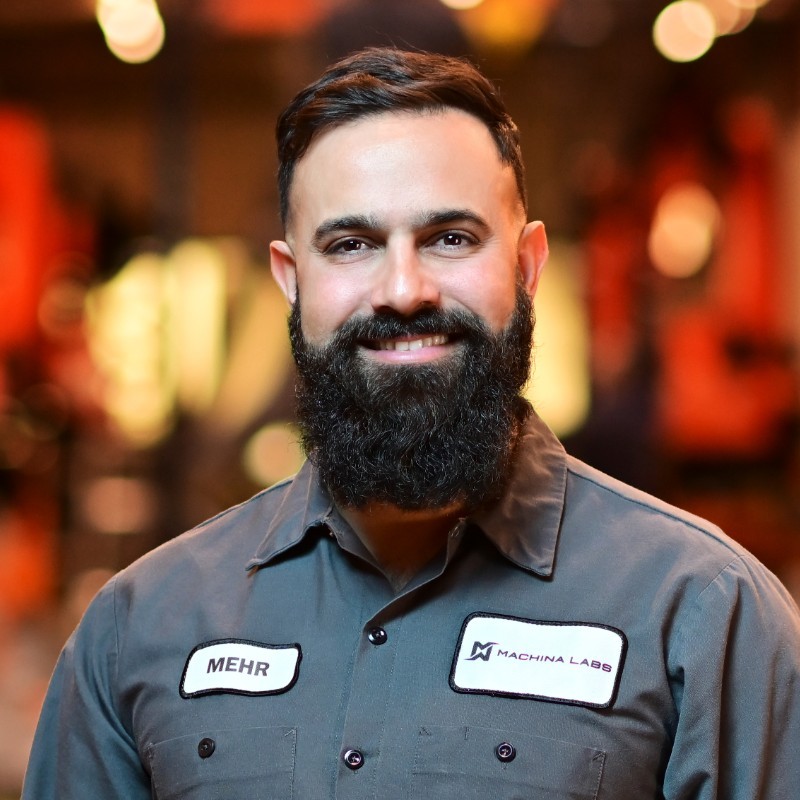
Edward Mehr of Machina Labs shares insights at the NYSE Wired Robotics and AI Media Week. Hosted by theCUBE Research, this session explores the transformative potential of robotics and AI in modern manufacturing. The discussion, guided by the interviewer, covers innovative approaches Mehr and their team implement to revolutionize factory design and operation.
Mehr outlines Machina Labs' groundbreaking concept of "Robocraftsman," a flexible robotic system that mimics a skilled craftsman by adapting to different manufacturing tasks without retooling. T...Read more
exploreKeep Exploring
What is the next generation of factories being built by Machina Labs called and what can they do?add
What are some of the cost-effective advantages of using a system that eliminates the need for specific tooling in factories?add
What is the process and capabilities of the Robocraftsman system?add
What application is going to come out first in the field of robotics?add
>> Welcome back, everyone. It's theCUBE Live coverage here in the New York Stock Exchange with theCUBE plus the NYSE Wired community an open community of leaders sharing their knowledge, of course, bringing down all the news and commentary. We're focusing on robotics and AI leaders this week, all five days here in theCUBE Studios in the East Coast. Of course, we've got Palo Alto and Silicon Valley connecting tech and Wall Street and money together. Edward Mehr's here, the co-founder and CEO of Machina Labs. Edward, thanks for coming in.
Edward Mehr
>> It's exciting to be here. Thanks for having me.>> Great chat before we came on camera about some of the cool things you're working on. Robots are hot. We were just at GTC two weeks ago, Nvidia. I mean, you can't ask for any more hype then. And they're delivering the goods too. The processors are amazing and the software they got is good, but robots are on the stage. Jensen Huang, the CEO of Nvidia, and he's the only CEO that I know that says the word computer science, and there were three times in the keynote. You never hear people kind of really reinforce the engineering and the science behind some of the stuff going on in robots.
Edward Mehr
>> Right. Right.>> AI specifically. Physical AI is a big theme of this week. Safety first. You guys are in the middle of this, with robots doing craftsmanship, kind of really precision, but also versatile.
Edward Mehr
>> Mm-hmm.>> Take a minute and explain what you guys are building, what you guys are working on. Then we can get into some of the cool things you have.
Edward Mehr
>> Oh, yeah. Absolutely. Yeah. So we are building the next generation of factories, right? We're basically building a robotic system that works like a craftsman. Like you said, we actually call it Robocraftsman, right? It's a robotic system that can pick up different tools, apply it differently to material, make different types of parts. Because right now, if you look at factories, they're very much specific to the parts they're building. The traditional way of building stuff is, you build a factory very specific for the part that you want, for the material that you want. Demo when you want to change your design, you want to change your material, you have to change your factory. With Robocraftsman, with Machina, you can make aircraft's part in the morning, you can make automotive in the afternoon, and at night, go make defense products. It's the same system that can just learn how to do a different skill, and do a different type of a manufacturing operation.>> So you can basically have a multipurpose factory with one footprint. So from a business case standpoint, rather than building a purpose-built factory for a line of goods and then start another one, engineering that out, that line, you can essentially have kind of a multipurpose throughput.
Edward Mehr
>> Yeah. Yeah, exactly. For the first time, you can have a physical model that the data centers have had, right? If you have a data center, you can go program it to do different things, but you couldn't have done that in the physical world. You have to go build another factory every time you want to build another thing. For the first time, you can have a factory that you can almost like log in into it through a portal and program it to make different types of parts, depending what you need.>> Yeah. Racking stacks and robots as they say. Pun intended. Talk about the origination. When did this come together? How long have you guys been operating? What's the status?
Edward Mehr
>> Yeah. So we started in 2019. Our team comes with a lot of aerospace, defense, and automotive background. I used to be at SpaceX, so I saw the problem of manufacturing first hand. You look at a company like SpaceX, 24 years, very progressive company, very advanced, two rocket families only, right? And each of them was built in different facilities. We had Falcon. And for 15, 16 years, now it's a cash cow. Then they started looking at Starship, they had to build it in another factory. So I saw some of the challenges, and that was the core of understanding what we need to do to build more agile factories. We started in 2019. Right now we work with a lot of good customers. Department of Defense is one of our customers. We work with Toyota. We work with Lockheed Martin. So now we are in the fourth year of operation.>> And you have shipping product right now, robots in the field?
Edward Mehr
>> Yeah. We actually recently shipped one of our manufacturing cells to Department of Defense. They use it to repair weapon systems, defense systems, when they break down. People are surprised to know that even though we are the largest military in the world, when an aircraft gets down, because you don't have the industrial foundation, industrial network to make the parts that break, it takes very long hours. Sometimes months, sometimes years before you can fix an aircraft parts. With our technology, that takes into hours. You can click a button and make another part. So we deployed, recently deployed our latest system into one of the maintenance depots at Department of Defense.>> So basically, you can basically build a spot factory, for lack of a better word, saying you need parts. We've seen, something's happening. You might see forecasts that says, "Hey, we might have to repair something."
Edward Mehr
>> Right.>> "Where are we going to get it from?"
Edward Mehr
>> Exactly.>> We sit around, put an RFP out there and wait.
Edward Mehr
>> Yep.>> And you have an asset out of commission.
Edward Mehr
>> Yeah. You have to find the vendor. The vendor needs to build the tooling specifically for that part. And then after spending sometimes hundreds of thousands of dollars, sometimes millions of dollars into tooling, then they can get you their first part?>> Yeah.
Edward Mehr
>> And that sometimes takes months, sometimes years, right? Where it sits now, it's just a vending machine. You go to this robotic system, you push a button, you select a part from the menu, put the raw feed stock, and it starts making that part.>> Talk about the business model, how you guys are financing. You mentioned SpaceX, you worked there. I like, by the way, we'll get to the whole how they simplified around the platforms.
Edward Mehr
>> Right.>> And then made that multipurpose. But SpaceX, that took a lot of capital.
Edward Mehr
>> Right.>> What's your capital requirements? What's the business model there? What's the CapEx requirements? Is it high? Is it heavy?
Edward Mehr
>> Yeah. So because we eliminate the need for specific tooling for factories, we're actually very cost-effective. It's the same equipment that can be used for multiple applications. So almost in less than a year it pays back for itself. And also with the architecture of the system is done in such a way that we're using as much as we can off the shelf hardware systems. Like, 70% of our bomb is off the shelf. So it's the parts that are being used in other industries. 30% is specific to us. And really, the key enablers is software that controls the robots. They can learn from the data how to do different operations. It allows us to be able to scale much easily. Just you get off the shelf parts at a very competitive price and scale it in single cell. I mean, we talked about Department of Defense. They looked at our system. A single system over 25 years saves them $85 million.>> Yeah.
Edward Mehr
>> Right? Because every time they have to do a different part, they have to go invest in a whole other set of tooling that might be as expensive as the hardware.>> And that's assuming that the process is legit and it's smooth.
Edward Mehr
>> Right.>> Usually it's slow. The beltway bandits, as they've been called, procurement, all that stuff goes on. You mentioned the software. Let's get into some of the tech. Because one of the themes, we were talking before we came on camera, you asked me which interviews I like this week. They all have the same theme. The ones that are doing really great work fast and effectively are really good software hardware models.
Edward Mehr
>> Yep.>> Because AI's changing so fast. How do you guys look at that? You mentioned, it sounds like you're designing around the concept of Falcon, one central platform.
Edward Mehr
>> Right.>> And then make that multipurpose or versatile.
Edward Mehr
>> Yeah.>> What's the relationship between the hardware and software? How do you guys design that?
Edward Mehr
>> Yeah. So we are full-stack, right? I think in order for the hardware to work properly, you need to have a software really designed with hardware in mind. So it's a full-stack system. But what we try to do is, try to keep the hardware as much as possible off the shelf. So it's easily financeable, right? But the full, it only can do the things it can do if it can have a full-stack software and hardware together. So full integration is key for us to be able to deliver what we need to do. Yeah.>> Yeah. One of the things that I'm noticing is that you mentioned off the shelf, which is great, then you can get supply from some of the supply chain.
Edward Mehr
>> Right.>> But as software comes in, you have a complexity of the supply chain. Because one, they might be off the shelf, but they might have their own software, right?
Edward Mehr
>> Right.>> So the software abstraction between, say your platform and the multitude of suppliers, can be complex, but AI is solving a lot of problems. Do you see that same thing happening? Where, "Hey, it really doesn't really matter. We don't have to write a lot of software because AI can help be an integration layer between the suppliers." I mean, they all have specs probably, but there is diversity around. Every company's probably got their own software.
Edward Mehr
>> Yeah.>> Where now it's like with AI, it seems to be that's accelerating the integrations. What's your reaction to that?
Edward Mehr
>> Yeah. I think you have to have good partnerships with your suppliers. So when we work with the suppliers, we try to have very limited number of... Not go too wide, have select group of suppliers, but be diversified enough in each category, but have a very good relationship with them. But to your point, I think the AI piece allows us to build these interfaces much faster. If you're building an interface for product A that we give supplier A and product B that we get from supplier B, the speed of developing interfaces for these products so that we can work with our systems is much faster right now because of AI. Right?>> What's the coolest thing that's happening in your mind from a tech perspective? What's your favorite piece of the project that jumps out at you and says, "Oh, that's cool."?
Edward Mehr
>> Yeah. Yeah. No, I think all these, most of the physical AI stuff is pretty cool. I think the main challenge we have in physical AI is for the first time you're dealing with problems that the data is not available.>> Yeah.
Edward Mehr
>> Right? So it almost looks like very complex, fresh ground to solve problems. If you're building only software, virtual products, the data is on internet. You can go scrape it, you can build models, right? With this physical world, you almost have to have a system that goes out there and start exploring the world, gather data. Be good enough initially to be adopted in the market. Gather the data and then slowly improve. So I would say I'm excited about humanoids significantly, obviously, about what we are doing, but most of the physical embedded AI application's pretty exciting.>> It's interesting. What I love about this area is that, we've been around for 15 years doing theCUBE, and the industrial edge was the big term.
Edward Mehr
>> Yeah.>> Intelligent edge.
Edward Mehr
>> Right.>> And that was just devices. I mean, it was mostly operations, operation technology. It wasn't really internet technology. And so that got better. And then you fast-forward today, robotics and robots specifically, are more than just measurement devices. They're actually active. You have in your robot deploying and building.
Edward Mehr
>> Yeah.>> So it's awesome. So clearly the game has changed. The intelligent edge has kind of evolved to the human and the robot. Take me through, if I'm got a factory, what's it look like? What am I buying? What do the robots look like? Are they tailored? Can they be customized?
Edward Mehr
>> Yeah.>> Are they humanoid looking?
Edward Mehr
>> Yeah.>> Are they building? Are they just arms? I mean, take us through the robotic element of this and what you guys deploy.
Edward Mehr
>> So the system itself is actually, if you look at, it's like a 30-foot by 40-foot system, it's like 16 foot tall. We actually use industrial robotic arms. Because the type of precision and the part of forces we need, we require very hefty robots. So humanoids are not a good front form factor for us, as exciting as they are, but they're not a good factor in the manufacturing space. And like I said, the real piece is the intelligence. How does the robot picks up different tools? What process parameters it figures out to actually form the accurate part. Now, this whole packet, we call it Robocraftsman, this whole package, can be either deployed. It actually turns into a set of containers, two containers. It, almost like a transformer, it closed into a container. You can ship it into any facility. Within the same day in opens up. It self-calibrates. All it needs is power and air. You can put it on any warehouse floor. It self-calibrates, within the same day it can start manufacturing. So you ship it anywhere, same day you have a factory going, right? So that's one way of doing business. That's what we work, for example, when we work with military, that's what we do. We deploy to their maintenance centers. They get it up. But we also manufacture these, manufacture parts in our own facilities. So when we're working with some of the other suppliers like Toyota and Lockheed, where they want us to manufacture the components for them, we actually have facilities that these robots are operating and manufacturing parts for the customer.>> Yeah. We were talking before we came on camera, that it's kind of like that scene in the Matrix, where he wants to learn how to fly a helicopter, you upload helicopter skills. Is there a Matrix-like vibe here? Because it sounds like there's some requirements.
Edward Mehr
>> Yeah.>> Obviously it's going to reason.
Edward Mehr
>> Right.>> It comes out of the box. It's like I'm in a process. Do I have to do any uploading or any kind of LLM, or what are the requirements? Take me through that piece of it and the opening.
Edward Mehr
>> So today we start from a design, and we have a software stack that turns that design, and turns it into robot instructions. And then the robots also have their own in-loop kind of control system mind, that they look at almost 150 channels of sensors and adjust to form an accurate part to make an accurate part. But from there, we're scoping the span of what it does. Can the software also help with the design? Can you get to the point where you speak to the system, it says, "Hey, I want a panel for an aircraft, and these are the specifications." And they actually design the part for you and it starts manufacturing. We actually explored some of this with OpenAI. There are artists in resident actually did this project where you actually could speak to our robotic system. You can say, "Hey, this is the type of a part that I want. I want a part that looks like a shell structure, and these properties." And the AI system will just come up with a design, and an hour later you have the part, physical part, which was like 5 foot by 12 foot, out in the physical reality. So completely not bridged from, it went almost from a thought to a physical presence.>> It sourced the requirements.
Edward Mehr
>> Yeah.>> The bomb and everything.
Edward Mehr
>> Yes. Everything was there. Yeah.>> And just makes it happen.
Edward Mehr
>> Yeah. Yeah.>> Yeah, that's awesome. I'm just trying to visualize it like a table. It's like, okay, get the parts there. How much computer vision, you mentioned sensors. What's in the tech in terms of the awareness? Situational awareness is critical for the reasoning side of it.
Edward Mehr
>> Yeah.>> What are some of the tech that's used?
Edward Mehr
>> So we have 152 sensors that are gathering. Every four millisecond they're gathering data from the system. Now this can be vision sensors, basically. Oh, how is the part deforming? Or it can be the force. How much force am I applying to the part in this location, right? The challenge in the embedded space, I kind of alluded to this earlier, is that the data doesn't exist. So you almost have to build a system that generates its own data.>> Yeah.
Edward Mehr
>> And then uses that data to improve itself.>> Yeah.
Edward Mehr
>> Right? And that's why traditional factories could never enter this paradigm, because they're not built to generate data at the high rate enough for us to build and learn these models.>> Yeah.
Edward Mehr
>> So, yeah. So we look at a whole array of sensing data. From, like I said, vision, 3D scans of the parts that we are doing, the amount of deflections we are seeing in the system, the amount of force that the robot's applying to the part. Like I said, have 152 sensor channels every four milliseconds.>> I mean, folks, watch this. It's going to be really intrigued because obviously the manufacturing costs are impacted. You got versatility. It's almost like swapping out assembly lines in real time with the robots being a key part of it.
Edward Mehr
>> Yeah.>> I mean, it's multifunction kind of device at that point. And not to oversimplify it, but what do I do? It sounds hard to me. I'm just thinking, I had a factory. I'm not a big manufacturing guy, but studied operations in business school, one class. But I'm thinking to myself, "Okay, I got an assembly line, I got the factory. I'm building something." It sounds super hard.
Edward Mehr
>> Yeah.>> What do I have to do as a requirement to roll this out? Is it just drop it in?
Edward Mehr
>> Yeah. I think when try to make it as easy as possible, right? Ship in a container, opens up. You're connected to power and air. Anywhere it has floor, it can start forming. It self-calibrates and it can start forming. I think, unfortunately, we have here, in the United States, we're in a situation where our industrial base eroded. So a lot of people don't even have these capabilities anymore in the US, traditional or new. So there's a lot of greenfield opportunities here. As bad as it is that we have lost industrial base, but there's an opportunity. It's greenfield opportunity to build factories from ground up with these new technologies in mind.>> I mean, I think there's a whole impact area here. There's a term called catalytic investing, which is like philanthropy to accelerate things. If the country wants to have an industrial strength, why lean on the old models? I mean, I can imagine if we wanted to build something, we could build a factory.
Edward Mehr
>> Yeah.>> I mean, with your enablement, there might be more factories emerging. Is that something that you see? Is that something you guys talk about?
Edward Mehr
>> Absolutely. No, absolutely. I think obviously, we were manufacturing powerhouse in the 50s and 60s during World War II. Over the last 10, 5, 6 decades. We kind of optimized this stack of manufacturing, created this huge supply chain, complicated supply chain, and offloaded a lot of this to mostly Southeast Asia. And the reason that offloading what's cost-effective is because, if you don't have a flexible factory, you need to build a large factory that makes parts for the rest of the world, right? Because it's not flexible, it better makes a lot of pieces.>> Yeah.
Edward Mehr
>> And imported to the rest of the world. So to some extent, this phenomenon that happened, that we offshored manufacturing, was a technological problem.>> Yeah.
Edward Mehr
>> Because the factors could not be economical by making one part today and the other part in .>> Ed, some costs, they're built, they're out for purposes, the purpose of change.
Edward Mehr
>> Yeah. Put them in the cheapest area of labor, make the same thing over and over again, export it to the rest of the world. For the first time, with technologies like ours, that paradigm shifts. You can actually make it cost-effective, and flexible enough to put a factory in the United States, near the communities that are going to use the product, right?>> I like that Starlink background. I want to come back to that, because you mentioned that in context to the beginning. If you think about their objective, they just want to get to space.
Edward Mehr
>> Yeah.>> So that was the full soul part. Now they could do a variety of things in space. You got to get to space. You got to take off and land. So you mentioned that they built kind of around the Falcon.
Edward Mehr
>> Right.>> And that became a cash cow. In a way, that theme is coming back to manufacturing, where it's like it's just a system concept. Hey, if you built a core platform and then you can do other things. Here, the objective is not to get the space but to build stuff.
Edward Mehr
>> Right.>> So to your point about factories, they were built for a purpose.
Edward Mehr
>> Yeah.>> The end game with specific purpose, device, outcome.
Edward Mehr
>> Right.>> Not generic outcome of building stuff.
Edward Mehr
>> Right.>> So that seems to be the way that's happening now.
Edward Mehr
>> Yeah.>> And that's just, I mean, that's been an environment software. That's what's been around for, architecture been around for years. Now, it's coming to robotics. Because the standards are being built. Is that the pattern that you see happening, where people are starting to think like a systems person, and saying, "Hey, I'm going to build something."?
Edward Mehr
>> Yeah.>> I want to have the best leverage possible.
Edward Mehr
>> Yeah. No, absolutely. I think in the world where asset is not a attractive thing to keep on your balance sheet, you want an asset that's very productive. So you want an asset that can do different types of things. But also, I think one thing you mentioned is, you said, "Well, we built FAC and now we can take a lot of stuff into space and do all these different applications." But also with our technology now for the first time also, we can do manufacturing in space. Actually, that was a contract we did at NASA around having a robotic system that can assemble things and build things in space. But you cannot take traditional factories into space. If tomorrow we go to Mars, we go to Moon, you have to have a flexible system that can do multiple operations. You can have them not have a multi-ton press to go into Moon and do manufacturing.>> Well, Edward, you solve a problem that I've been staying on theCUBE Pod jokingly to the space tech friends when they deploy technology so cheaply now. Because I would say, "Oh, it's hard to do break, fix in space." Software uploads is kind of my point. But now you can do break, fix, repair.
Edward Mehr
>> Exactly.>> So with what you're doing.
Edward Mehr
>> Yeah, exactly.>> It's an interesting kind of full circle moment there. But I mean, this is the efficiency. How do you optimize your time right now? I mean, what's your focus? What is your mean driving force focus right now?
Edward Mehr
>> Yeah. I think what we're trying to do is, we have this core technology, like you said, it's a platform. So what we're working on right now is integrating this platform in certain verticals, as much as we can to be full stack, so that we can get the benefits out there. To your point, we have this very complicated industrial base that exists today, and that industrial base is not going to just change easily. They cannot just change one part of it and say, "Okay, this part can be Robocraftsman." We almost have to rethink that industrial base. So a lot of the focus of the team right now is work with our customers, like Lockheed, like Toyota, like Department of Defense; and build the end-to-end system that can easily go from raw material to the final product they can use in the field immediately.>> Yeah.
Edward Mehr
>> Right? So most of the focus is around that and vertical integration.>> One of the things I was going to ask you to end the segment is, there's a lot on naysayers in robotics right now. I don't understand where that comes from, but maybe the hype. I mean, like I said, Jensen's talking about all the time, robots are cool what's not like to about robots? But it does put fear into some. Maybe some people don't understand that, but it's coming, it's here. What would you say to people that are watching that are learning about robotics, impact of their lives? Not necessarily getting into the industries themselves, but the benefits of robotics. What have you learned? What could you share? Observations about safety, risk, utility, value? I mean, educate the folks watching the key.
Edward Mehr
>> Yeah, true point. Robotics is here. It is going to impact industries. We had AI creating a huge impact in the virtual world, and robotics is going to be the link that's going to take that virtual impact into the physical world. So it's going to happen. I think the question is, what application is going to come out first? We think it's manufacturing. Some people might think it's in other spaces. So I think even the naysayers are mostly talking about how long it takes, right, before it becomes a thing. And I think some applications like manufacturing where robots are already present, much faster. Maybe some other application at home or other places, maybe slightly longer. So I would say I think the people who are looking at this podcast or at this stream, if you're excited about getting into space, I think now it's pretty exciting, because you have to be a very multidisciplinary person. Learn software and hardware. Learn material science. And it's actually pretty exciting. You ended up learning a lot of things to be able to be productive in this space.>> All right. Final, one more question, since it's such a great thread. I think that there's going to be a huge entrepreneurial wave in manufacturing.
Edward Mehr
>> Right.>> Been saying it on theCUBE for a while that it's not yesterday's manufacturing, it's kind of next, today's in the future manufacturing where everything's different. So AI is changing that. Certainly robotics is changing capabilities. So opportunity recognition, people are going to see opportunities.
Edward Mehr
>> Right.>> And so you're going to see probably people come up with new manufacturing techniques, and someone might say, "Hey, I could build something better than them and lower cost."
Edward Mehr
>> Yeah.>> And get into the market and dominate.
Edward Mehr
>> Yeah.>> I mean, it's entrepreneurial 101. So what opportunities do you see for entrepreneurs out there? How should they look at this? Because the enablement that you guys provide and others is compelling. So it's like, I can compete with Ford maybe in building cars, who knows?
Edward Mehr
>> Yeah. No, absolutely. I think this is one of the reasons a lot of people in our company joined our company, right? Even 10, 20 years ago, even almost 5, 6, 7 years ago, if you want a mechanical engineer and you wanted to have an impactful physical product, your only choice was to go to large companies. Because those were the only ones that could build a large factory to support your idea. Now, for the first time, you can go to an internet on a website and build parts, and build components, and receive them at a reasonable price. So I think this next few decades, it's going to be this Cambrian explosion of hardware products and hardware diversity, because these technologies are going to become available.>> I mean, you're a Tech For Good platform. You could be a philanthropist. The mission is for good. I mean, at the end of the day, that's a good mission.
Edward Mehr
>> Yeah.>> I mean, we're capitalism, but we want to make money.
Edward Mehr
>> Yeah.>> But I mean, there is a Tech For Good angle here.
Edward Mehr
>> Absolutely. And we express it. Provide ability for everybody with an idea to make it a reality? I think that would be a world that we all would want to live in, right? If you have an idea, you can immediately, without having to go build a factory, you can make it happen.>> Yeah. Jobs, innovation.
Edward Mehr
>> Right.>> All good stuff. Missions are aligned. I mean, I think we're living in a time now, I've never seen this in my whole life, career, is that tech, finance, money, and cultural impact is aligning.
Edward Mehr
>> Yeah.>> So you don't have to get rich and then donate money to some foundation or be a foundation.
Edward Mehr
>> Right.>> These missions are aligning, so you're seeing forces come together. It's not like you doing it for a non-profit.
Edward Mehr
>> Right.>> So you can make money and still do good.
Edward Mehr
>> Yeah, no, absolutely.>> Yeah.
Edward Mehr
>> You're absolutely right.>> Edward, thanks for coming on theCUBE.
Edward Mehr
>> No, thank you.>> Give a plug for the company. What are you working on? What are you looking to do? Hire? Fundraise?
Edward Mehr
>> Yeah, no. No. We are well capitalized, but we always look for talented people. Like I said, this is an opportunity to learn a lot of different skill sets and be jack of all trades, and learn a lot of this in different disciplines. So if you're excited about our mission, go to MachinaLabs.ai. We're also on X and LinkedIn. Follow us. Lots of good roles to contribute.>> All right. Appreciate it. All right. We have all the robotics, innovation, AI, coming together this week. We're in New York City. This is theCUBE. I'm the host, John Furrier. Thanks for watching.