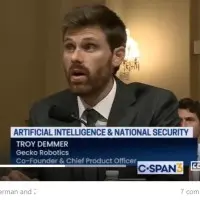
Troy Demmer of Gecko Robotics, co-founder and president, joins theCUBE Research hosts John Furrier and Dave Vellante to discuss how Gecko Robotics applies artificial intelligence and robotics to built‑world infrastructure and industrial asset management. Demmer explains the Cantilever platform, robot swarms and semantic digital twins and describes how structured datasets, edge compute and robotics integrate to improve inspection, maintenance and new‑build workflows.
Key takeaways include immediate return on investment from Gecko deployments with a three- to six-month payback and measurable uptime gains. They highlight reducing maintenance backlog through pre-dock robot swarms, creating actionable digital twins and scaling through defense and energy partnerships. theCUBE analysts observe that edge AI, open data architectures and software orchestration increase operational resilience and labor productivity.
Forgot Password
Almost there!
We just sent you a verification email. Please verify your account to gain access to
Physical AI & Robotics Leaders. If you don’t think you received an email check your
spam folder.
Sign in to theCUBE + NYSE Wired: Physical AI & Robotics Leaders.
In order to sign in, enter the email address you used to registered for the event. Once completed, you will receive an email with a verification link. Open this link to automatically sign into the site.
Register for theCUBE + NYSE Wired: Physical AI & Robotics Leaders
Please fill out the information below. You will receive an email with a verification link confirming your registration. Click the link to automatically sign into the site.
You’re almost there!
We just sent you a verification email. Please click the verification button in the email. Once your email address is verified, you will have full access to all event content for theCUBE + NYSE Wired: Physical AI & Robotics Leaders.
I want my badge and interests to be visible to all attendees.
Checking this box will display your presense on the attendees list, view your profile and allow other attendees to contact you via 1-1 chat. Read the Privacy Policy. At any time, you can choose to disable this preference.
Select your Interests!
add
Upload your photo
Uploading..
OR
Connect via Twitter
Connect via Linkedin
EDIT PASSWORD
Share
Forgot Password
Almost there!
We just sent you a verification email. Please verify your account to gain access to
Physical AI & Robotics Leaders. If you don’t think you received an email check your
spam folder.
Sign in to theCUBE + NYSE Wired: Physical AI & Robotics Leaders.
In order to sign in, enter the email address you used to registered for the event. Once completed, you will receive an email with a verification link. Open this link to automatically sign into the site.
Sign in to gain access to Physical AI & Robotics Leaders
Please sign in with LinkedIn to continue to Physical AI & Robotics Leaders. Signing in with LinkedIn ensures a professional environment.
Are you sure you want to remove access rights for this user?
Details
Manage Access
email address
Community Invitation
Troy Demmer, Gecko Robotics
Troy Demmer of Gecko Robotics, co-founder and president, joins theCUBE Research hosts John Furrier and Dave Vellante to discuss how Gecko Robotics applies artificial intelligence and robotics to built‑world infrastructure and industrial asset management. Demmer explains the Cantilever platform, robot swarms and semantic digital twins and describes how structured datasets, edge compute and robotics integrate to improve inspection, maintenance and new‑build workflows.
Key takeaways include immediate return on investment from Gecko deployments with a three- to six-month payback and measurable uptime gains. They highlight reducing maintenance backlog through pre-dock robot swarms, creating actionable digital twins and scaling through defense and energy partnerships. theCUBE analysts observe that edge AI, open data architectures and software orchestration increase operational resilience and labor productivity.
In this interview from theCUBE + NYSE Wired: Physical AI & Robotics, Troy Demmer, co-founder and president of Gecko Robotics, joins theCUBE's John Furrier to discuss how AI infrastructure is extending beyond data centers into the "built world" of factories, ships and energy facilities. Demmer explains how Gecko structures data from the physical world, creating digital twins that turn stagnant maintenance environments into ones with compounding productivity gains. He points to a Navy partnership where quality assurance cycle times dropped from months to days, ...Read more
exploreKeep Exploring
What does the term "Built World" mean, and how will AI (through platforms, structured datasets, and robotics) change the physical built environment—particularly regarding productivity, jobs, and ROI?add
How does Gecko's solution increase asset uptime and efficiency for industrial and defense customers while addressing maintenance backlogs, labor shortages, and worker safety?add
How do robot swarms and robotics technologies inspect ships (including beneath coatings), inform repair planning with digital twins, and reduce the time and cost of dry-docking?add
Question answered (neutral): What does your fund/organization do?
Note: the excerpt describes being an early-stage, Y Combinator–style fund for physical AI—providing mentorship and deploying capital into overlooked industries (e.g., insurance, weather data)—and does not state check sizes or signup eligibility.add
How does your platform (rather than a typical SaaS app) work—specifically how do you ingest and structure data to enable edge/robotics intelligence, and what is the strategy for deploying that intelligence in the field?add
How is Gecko positioned across sectors, and how does it plan to compete when it doesn't have the cheapest labor or energy?add
>> . Hello, I'm John Furrier with theCUBE here at our New York Stock Exchange studio. Of course, we have our Palo Alto studio connecting Silicon Valley to Wall Street. This is our physical AI and robotics series, a fast-growing and very popular series where we interview the leaders who are making it happen, and bringing robotics and digital together as one system. This is what we're seeing, the growth of NVIDIA, the entire AI infrastructure is lighting up and powering robotics. It's an edge application, manufacturing, drones, production, all aspects of society will be changed with robotics, and we're certainly going to see it. Our next guest is Troy Demmer, co-founder and president of Gecko Robotics, a very fast-growing company who had a really smart application. Let's go target these areas where work's tough. Started building systems over a decade ago and now, obviously, in the slipstream of growth. Thanks for coming on theCUBE, appreciate it.
Troy Demmer
>> Thanks for having me, John.
John Furrier
>> AI infrastructure is the hottest money vertical right now because you're seeing all the CapEx build out. That's a lot for the power stations, the AI factories. One area that's not really exposed well in the media is the AI factory at the edge. Autonomous vehicles, that's a moving factory. Robotics, certainly an application of, you need all the same things. GPUs, CPUs, inference, embedded systems, density, intelligence, software. So we're seeing AI factories move into robotics. We think that's going to fuel a lot of growth. You're in the middle of it. Tell us what's happening in the robotics field. Are we teetering on massive growth? Where's this market at right now?
Troy Demmer
>> Yeah, we're currently, meeting the moment as a country. I think it's really existential. When it comes to looking at our built world infrastructure, the physical world, we have not built technologies that fundamentally transform the way that we operate a facility or a factory. And, both within the AI unlock that's happening as well as robotics, we truly have the ability to improve the productivity gains, improve the quality of life for those working on the factory floor. the facilities. These are folks that have kind of been forgotten about, right? And these are the workforce that are the backbone for our industry, for our GDP. It's all so connected, as you said, compute and power, industrial base, building, sustaining this critical infrastructure is all so intertwined and it cannot move forward without robotics.
John Furrier
>> I love the slogan you have on your website. You kind of mentioned the word built world. you have a platform for the built world. What does that mean? Because people think buildings, building out, construction equipment, bring in the plumbing, put up the walls. we know what building the physical world is, but now that we have AI, how is that going to be impacted? What's changing the most? Obviously the job side is huge. We're seeing a certain resurgence in all kinds of physical build jobs, but it has a tech angle. What is the biggest change in this built world with AI infused in it?
Troy Demmer
>> Yeah, the opportunity and what Gecko's unlocking is that when you understand what's going on at that level of the atoms, right? the world that has shifted from a digital era, mobile, the internet, hasn't actually impacted necessarily what happens with boots on the ground, right, from an atoms level. And therefore, what Gecko from first principles decided to approach the problem was to go and structure these data sets, to index the physical world so that we can make these improvements, right? Because once that information is structured and understood and contextualized, then we can start to see the productivity gains, right? And this isn't something that takes years to play out. This is immediate ROI for our customers. So when we deploy robots and our AI stack as part of Cantilever into the factory floor, or into the facility, there's immediate ROI, three months, six month payback periods that start to generate real returns. And so we go from having an environment that maybe is pretty much plateaued in its productivity or in some cases atrophying and putting it on a different trajectory, putting it on a trajectory curve that is enabling it to improve over time and actually have leverage in the way they operate.
John Furrier
>> Give an example, help people visualize, paint a picture of what some examples are in this new build world that you guys are doing today and then how that might evolve in the future just paint the picture
Troy Demmer
>> absolutely so Gecko really thinks about the entire lifecycle ofan asset from the time it gets constructed and fabricated all the way through to end of life and it's really important to understand that how we build versus how we maintain today is kind of segregated it's different people you got EPC's building and you've got maintainers maintaining but what we saw was how interconnected those activities actually are and what is that kind of feedback loop from one area to the next. So in the case of new build, new construction, we're working with shipbuilders across the U.S., other builders of critical manufacturing capabilities, such as components that become part of the commercial industrial base, energy systems, or aerospace. aerospace and what we've seen is in environments that are you know artisanal have lower sort of automation already built into it how do you observe what's going on so cycle times may not be fully understood but these are critical components we're talking about naval reactors that power nuclear powered capabilities for our submarines and aircraft carriers we were able to reduce the cycle time for the quality assurance component from months down to a matter of days, 92 % reduction. And what that represents is an opportunity to repurpose those productivity hours, reduce the span, and be able to increase the capacity, ultimately, of our critical supply chains.
John Furrier
>> I love the build side. we all can relate to maintenance. We've all seen the guy climbing up on the tower, whether it's a cell tower or a water tower or a big construction site or manufacturing facility. It's dangerous. So, yeah, I can see innovation there. The build side is interesting. It's almost like a 3D printer in my mind. I was blown away when I first saw a 3D printer for the first time. I'm like, wow, that's incredible. I can almost imagine robots just building ships like you mentioned. That's happening. That's where the direction goes. We can see new builds, robotics integrated into new construction.
Troy Demmer
>> That's absolutely right. robotics that can weld, that can create those initial form factors, that can authenticate the part. Did we build it to the spec we desired? And then ultimately that final finishing and assembly to put it all together and verify that this is the model that we thought. This is the as-built model that becomes that starting point for then how we're going to maintain that asset over the next several decades.
John Furrier
>> I want to dig into the tech on Gecko because there's so much to explore there. But I also want to talk about the business. From origination to now, the journey. And you guys have a new venture fund, you and your co-founder, going on. So you're also investing. So you're building, operating, investing. Talk about the business momentum and then the fund you're doing.
Troy Demmer
>> Absolutely. So, the business is really strong right now. Gecko started this 10 years ago. We were on an island. People weren't talking about robotics or building for the physical world, but things have really changed from our early days in Silicon Valley. And, we decided to build in proximity to the end customers. And so we focused on the industries such as manufacturing, energy, process industrials, shipbuilding. I think this is highlighted with the partnership with the Navy, $72 million for one component of maintaining their surface ships. We're looking to expand that today. Currently, that's for one class of ships in the Pacific Fleet, bringing that over to the Atlantic Fleet, doing that for the nuclear-powered aircraft carriers. And what that really represents is an opportunity to scale. Because what Gecko has been able to prove with these customers, whether they be on the industrial side or the defense side, is that the ROI is a high rate of return, and they're able to redeploy that in terms of just making more impact, how they give leverage to the workers that are in the shipyards, the workers that are, the sailors today that are doing these dull, dirty, dangerous jobs. we're talking about two thirds of the time our ships are ready, one third they're not. And the reason for that one third is that there is a maintenance backlog. They are waiting for these insights to be generated. What materials should we have on hand? What labor should we have on hand? And how do we actually go take action? And so Gecko creates a structured data set, a digital twin you could say, to create that prescribed roadmap to say, this is what you should do once you're turning the wrenches. This works for the energy side of things too. We're working over in the Middle East with ADNOC. We've been public about this, but there's many other customers we're serving. And the same premise exists. When that asset comes offline, when we're gonna shut that asset down to make a repair or maintenance decision, How do we make sure that we have the information on hand so that we're going to be able to take action, turn those wrenches, make the repairs? We're not spending that time doing discovery. So what does that result in for our customer? More uptime, more availability of our critical infrastructure, less labor risk associated with the hazardous work environment, as well as just the reality that there's not enough labor to go around. We are a million skilled workers short here in the U.S., 300 ,000 welders alone. And that means that everyone's waiting on the same critical bottleneck, which is the labor.
John Furrier
>> Yeah. You mentioned, let's stay on that for a second, because I think one of the things that I love about these market transitions, when you have old way, new way, you can quantify it pretty quickly. Explain the scope of the old way. What would it have taken for the Navy and your other customers where they're getting all those gains? just the hazardous work alone is a safety gain. That's just probably quantifiable on its own. But what would it have taken to do the same job with people.
Troy Demmer
>> Yeah, absolutely.Even if they were available. So what would happen typically is a ship would come into dry dock and we'd spend time tearing that ship apart to discover what is actually going on in the nooks and crannies, what's going on under the surface. And what that would result in is a lot of time spent preparing a work plan, preparing those work items. We might go in with an idea of what needs to be done, but we discover a whole hell of a lot of things that are actually happening beneath the skin.
John Furrier
>> Got to document the data, collect data, tons of data gathering.
Troy Demmer
>> And honestly, it's just a limitation of the tools previously. We could not see what's going on beneath the coatings of the surface of the ship. So we didn't know what was going on with the metal beneath it or the compartments that abutted up to that. So the Navy has coined this term, the robot swarm. And we deploy this robot swarm prior to it making it into dry dock. And so it's scanning those surface decks. It's scanning all the nooks and crannies. It could be out at sea or even while it's just docked in a pier side environment, but still submerged The really expensive environment is when that asset's totally offline in a dry dock. That means that, a million dollars a day is the opportunity cost for that asset and the cost being associated with that for making the repairs and the labor. And so really the value is being able to drive those insights, getting that plan in place, getting the critical path, orchestrating that work, and then ultimately closing that loop This is where robotics is going. robotics today for Gecko is building that context, figuring out what is going on with these digital twins of critical infrastructure, but then also ultimately being able to take action on these insights.
John Furrier
>> Yeah, and they win too. They're saving money, cost, time, everything goes to the bottom line there for them. All right, talk about the momentum you have with the venture fund, because you guys are also inspiring through the Gecko execution, which is great. Now you've got cash, you're helping other entrepreneurs. What's the strategy? Talk about the fund. How much? What are you doing? How big are the checks? Who can sign up?
Troy Demmer
>> Yeah, absolutely. It's like a Y Combinator for physical AI. We went through Y Combinator 10 years ago, so the model very much is front of mind. I think it's a concentrated focus. You know, we see a lot of companies that see the spaces we've built in, a lot of companies that have seen the technology stack we've put together, robotics and AI, and the software orchestration between them. And what it really presented was an opportunity to give back to these entrepreneurs, not just in the sense of the mentorship and the guidance as an operator, but also to deploy capital. So we're an early stage fund, in partnership with Jake, who's my lifelong partner at Gecko and First Order Fund. And really it's all about deploying early stage into these industries that have been long forgotten. Things like insurance, weather data has long been overlooked. Climate, volatility of it. So many industries rely on it. the first principles approach is figuring out, okay, we need better weather data. That is an input to this problem. Or on the insurance side, we have these disjointed things that are, you know, MGAs versus brokers versus carriers versus reinsurers. If you put that all together and build it on modern day rails, what are the outcomes that could be achieved? And so Gecko really saw an opportunity to leverage its opportunities
John Furrier
>> . It makes total sense because your 10 -year journey,
John Furrier
>> you've been plowing the fields,
John Furrier
>> you've been on the frontier now,
John Furrier
>> but still you had to do all that work.
John Furrier
>> You've seen it all. You know where the white spaces are. Even on your own platform, there's opportunities for you to enable people to say, hey, we might not get to this. This is a problem that we've seen. It's a huge market opportunity. Go get some beachhead.
Troy Demmer
>> It's very virtuous, actually. We've had opportunities where companies, we've been partners, or we might acquire them, or we might invest in them. So it really is symbiotic, but the platform's done very well. It's been deployed for two years now, and it's a model that can scale for sure.
John Furrier
>> Very smart strategy. Very impressed. The platform, though, is really the hot thing in my mind. So you look at these systems that are being built on the AI infrastructure side, the application layer isn't a SaaS app. It's a platform. You're building Gecko. You look at this as a platform. you're enabling all the critical work you're bringing in from data ingestion, data intelligence. How's that going? Explain how it works because we watch NVIDIA every year. They talk about robotics for the past five years, digital twins for the past five years, you got Omniverse kicking ass. everything's getting smaller, faster, cheaper, component -wise, more density. So you're starting to see the hardware side really accelerate, but also the software, where's the intelligence. Talk about what it does and the strategy behind it.
Troy Demmer
>> Yeah, what's exciting is standing up a SaaS application 10 years ago is now what standing up a robotics application could be. You've got the componentry, you've got the edge compute. All this enables us to put that intelligence in the field where it's needed most. Gecko's building out the semantically rich data sets that bring in what's going on from a spatial standpoint, what's going on from a condition standpoint, what's the health chart of the asset, right? That's very important and critical. That's a data set that does not exist on the Internet. These are the corpuses of data that are also held inside the customers, too. Their standard way of operating, their unique procedures that make their secret sauce. And so it's really about contextualizing and bringing all that information together so that smarter, more informed decisions can be made. What's the next best action I can take? What we've seen in power generation is that at shift change, you've got one crew comes in from 7 a.m. to 7 p.m. all the knobs and dials change at 7 p.m. at shift change because that's their particular way of operating it. The nuances, the domain expertise. There's a lot of nuances in domain expertise. There's also a lot of variability. And how do you fuse those things together to create really the best model of operating to get to the peak performance that all these assets can? It's really about bringing more asset value.
John Furrier
>> I love this conversation because the big kind of general conversation in the internet is, oh, general intelligence versus specialized intelligence. They're not mutually exclusive. You can have, in your case, specialty intelligence in your domain and you're seeing use cases where the data is the moat okay in your case as you get more data that's a great advantage from a competitive strategy standpoint one to have durability so check yep but you're also providing more value with that how does that piece fit in because you're not trying to be the world model for all things physical AI there are people trying that NVIDIA donates a lot of their world models but you're taking a very unique approach in your swim lane, if you will.
Troy Demmer
>> That's right. Yeah.So we're partnered with the world modelers. We're working, you know, when I think about it, it's the form factors, the humanoids, the robotics platforms that can be built more quickly because we have those componentries, servo motors, things that are being developed. We've got the work happening on the world model side. And then we help when it gets all integrated together and it sort of works for the factories and facilities that need it most. There's a perspective that we have that the highest risk industrials need the most help here. We think the world models will solve lots of general broad problems. We're solving the narrow, deep problems.
John Furrier
>> What is industrial risk? Explain that term, because obviously regulated industries, oil and gas, oil rigs to nuclear submarine, explain industrial risk.
Troy Demmer
>> Yeah, absolutely. it's everything from a SUBSAFE standard. We can't have a submarine have any sort of defect or flaw that could jeopardize it, sending to the bottom of the ocean, right? We can't have that happen.
John Furrier
>> Space, too.
Troy Demmer
>> Space. Airworthiness, right? All these critical platforms need to perform the way they are, and so there's, like, high tolerance to building them. On the sort of maintaining and operating them, we are working with environments that can be volatile, right? And so from energy generation to industrial mining and manufacturing, these are environments that are high hazards. not just workplace hazards, not like super dangerous, but high heat, high pressure, high temperature, uncomfortable work environments. How do we give the operators today an exoskeleton? And what that exoskeleton is is a robot that can go into the confined space, a robot that can work at heights while they can monitor things from a central dashboard or bring in their expert inside of their, core competency of how they operate to give them eyes and ears to be in all their facilities at once. That's the capability that's being unlocked.
John Furrier
>> Being from Silicon Valley for the past 25 years with theCUBE, obviously now here in New York, it's funny. I can speak Silicon Valley and Wall Street. Silicon Valley speaks technology. People speak architecture, velocity, roadmap. Here they speak durability, returns, and risk. They're trading stock here. They don't really have that long view. You have to take a long view. You guys have. look where you are. You've been successful. How should people think about your roadmap, what you guys wake up every day doing? From a roadmap standpoint, what are you optimizing for? You got software supply chain. What other things do you think about that are on the roadmap that you're driving towards?
Troy Demmer
>> Yeah, look, there's a lot of work is in the core. Making that industrial model better, making our digital twin better about predictability on when an asset's gonna fail, how is it gonna fail, how to prevent that in the future, and then taking action, working to close that loop in a more sophisticated, automated way. And really, it's all done through the lens of the customer outcome, because technology has not served these industries well. There's an apprehension to adopting it. AI was adopted grassroots, bottoms up, by just individuals finding ways to make it useful. Enterprises did not buy this technology. This is the same way for robotics, right? There are a lot of trades and work that can be made easier, and the people that know and have proximity to those problems know how to deploy that probably even better than the CEO does. Now, the CEO wants transformation and they want technology and they want to make sure that they're going to be relevant in 10, 20 years. But the key part of the way we work is to go shoulder to shoulder with those environments and deploy our engineers and our technology so that we integrate in a way that's durable. It lasts. When we leave the site, that asset is operating. One of the things that's problematic for robots is today, they're fairly underemployed. When you look at them, a lot of companies buy them, they sit on a shelf, they're not used to the maximum extent. We take that turnkey approach and go shoulder to shoulder with our customers to make sure real value is generated from day one.
John Furrier
>> Yeah. And one of the things that's happening on that point of usage is the software piece of it becomes huge. We're seeing the hardware side be completely fungible in application. You can have some software come in, I'm going to change applications, not vertically integrated robotics per se. Like the old days, hey, I built a robot, it does a job, wait a minute, and the job's over with another task, but it's a different task. So you start to see intelligence, it's like The Matrix, upload a skill. A lot of that's happening.
Troy Demmer
>> Absolutely. No, it is, and I think it's so important that these things can be swapped in and out fairly easily. Open data architecture is our model because we want the end customer to be able to leverage that data, use that data, but then also be able to deploy different commercially available technologies. The cost curve is going to come down for everything from compute to robotics and so we want to have fungibility there.
John Furrier
>> That's my last question. First of all, thanks for coming. I really appreciate you sharing here on theCUBE and NYSE Wired program. I want to get your thoughts on the perception of robotics from two perspectives. The average consumer out there, the soccer mom, the working dad, someone just making it through the universe, robotics. Yeah, oh my God, what is it going to be? And then the business side, it's going to cost an arm and a leg to get robotics. It's too much of a heavy lift, pun intended. That's two perspectives. What's changed in those perspectives? How should the average person think about robotics in their life in the future? And how should business scope the opportunity from a cost ROI standpoint?
Troy Demmer
>> Yeah. I think there's so much technology at our fingertips in our day -to -day life. And when you think about your daughter or your son going into the workforce, and working in these critically important industries, wouldn't you want them to have modern architecture and stacks as well? And I think that's attracted a lot of new entrants into the environment. We're creating jobs and we're also creating rails and guardrails so that work can be performed properly with safeguards. And I think to answer your second question, it is very much a moment in time where the world is going, I think, is one in which this is incredibly exciting. We're talking about marginal cost of energy coming down, marginal cost of labor coming down. And so how do you put yourself in the decision loop there? And our big belief is that robots and AI can create intelligence, but there's going to be human judgment at the end of the day. And when we produce something or we transform the way that we operate certain industries, it requires the humans in the loop and on the loop to be able to perform those jobs, especially in these highly regulated industries.
John Furrier
>> And the skilled trades job market is evolving super fast. That's going to be obviously skilled labor in and of itself before technology. It's even more skilled labor and more valuable when you have some of the returns you're getting. That's clear. Is that coming out of the data?
Troy Demmer
>> Absolutely. The reason why our ticket sizes with our customers have gone up about 10x over the past couple years is because of scale. It's because of the demonstrated use case and value. we're on three and four buy cycles with our customers because we just continue to expand the aperture in terms of taking on more and more of that operating system.
John Furrier
>> So they're renewing and doing more, basically.
Troy Demmer
>> They're renewing and doing more. It's scaling what's working and it's innovating. It's taking the next bite at the apple in terms of connecting that end-to-end outcome.
John Furrier
>> That's awesome. Final question since you're here. That's an awesome conversation. What's next for you guys? Put a plug in for the company. You guys looking to expand? What are you looking for? What's the culture? What's on your to-do items?
Troy Demmer
>> Absolutely. Gecko's growing very quickly across many different sectors. I think what's really cool about the business and where it's at today as an inflection point is we're serving dual-use markets. The energy sector, the manufacturing sector, we've been building in those sectors for the last decade. The defense sector is really becoming a staple for how we operate. And it's never been a more critical time because what they might be relying on is the same energy grid that our residences are relying on or the same inputs from a metals, minerals standpoint. And so there's a moment that I'm seeing here in America with our allies to really come around some very complicated problems. But, we're finally, I think, having an answer to that in terms of how do we outcompete, when maybe we don't have the cheapest labor or the cheapest energy, we can outcompete through innovation.
John Furrier
>> It's a reconfiguration of the value chain of how things get built. Complete reset.
John Furrier
>> Absolutely.
John Furrier
>> New materials, new process, new workflows.
Troy Demmer
>> Absolutely.
John Furrier
>> Great to have you on. Congratulations. Love what you're doing. Physical AI has been on the radar in the tech world for over a decade. In the past five years in particular, it's been on the minds of the top AI builders in the technology side. Now it's going mainstream. You're starting to see real evidence of value, safety, economics, job creation all happening. Again, as the world transforms, we've crossed the threshold. We're going to see a lot more of this here on theCUBE. And of course, NYSE Wired program. I'm John Furrier, your host of theCUBE. Thanks for watching.