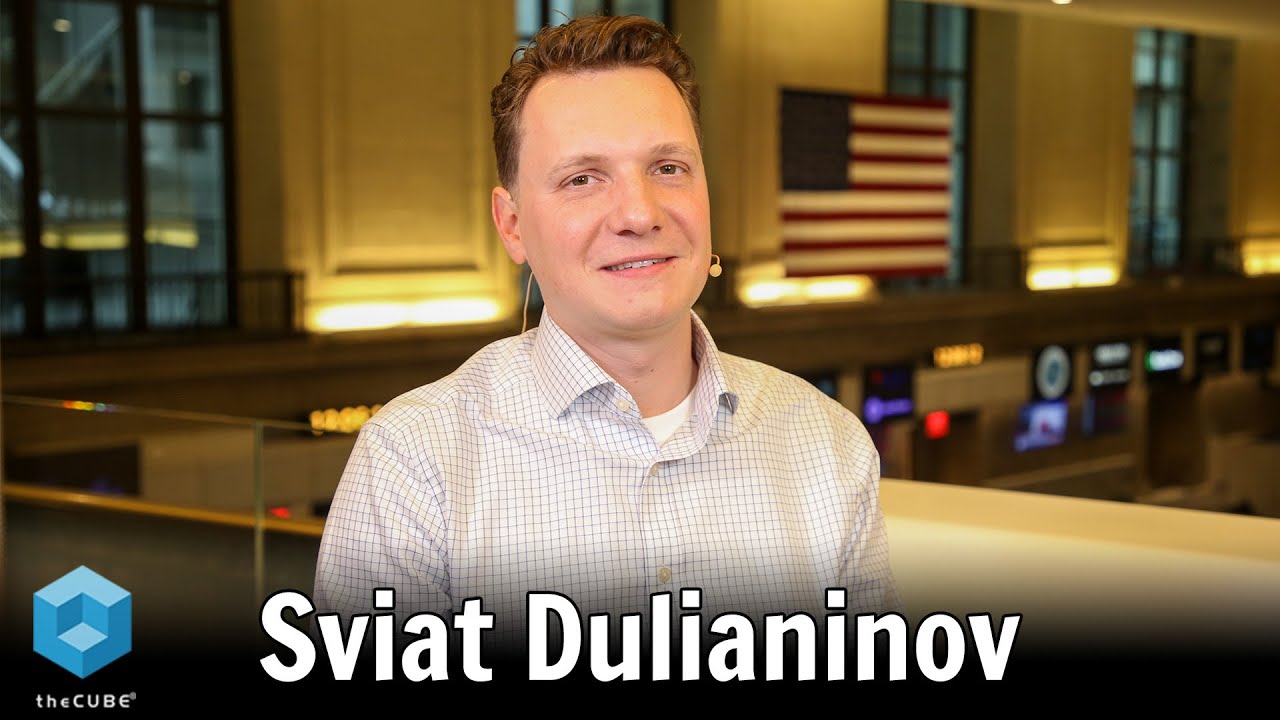
In this interview, Bright Machines CEO Sviat Dulianinov joins theCUBE + NYSE Wired co-host Gemma Allen to examine how advanced automation is redefining American manufacturing at a moment of historic urgency. Dulianinov details how Bright Machines is rebuilding critical AI infrastructure in the U.S. through software-defined robotics, data-driven engineering and modular microfactories. He outlines the company’s role in accelerating server and systems assembly for hyperscale data centers, while reducing exposure to offshore risk and increasingly fragile global supply chains.
According to Dulianinov, manufacturing is becoming a software-led, continuously optimized platform. Dulianinov discusses partnering with legacy OEMs, embedding automation into product design and deploying “edge manufacturing” close to where AI capacity is consumed. He also addresses geopolitical pressure and regulatory friction, alongside Bright Machines’ rapid deployment model and fundraising ambitions. The result is a clear-eyed view of how physical AI, precision robotics and cloud-era operating models are converging to reshape industrial competitiveness.
Forgot Password
Almost there!
We just sent you a verification email. Please verify your account to gain access to
theCUBE + NYSE Wired: Physical AI & Robotics Leaders. If you don’t think you received an email check your
spam folder.
Sign in to theCUBE + NYSE Wired: Physical AI & Robotics Leaders.
In order to sign in, enter the email address you used to registered for the event. Once completed, you will receive an email with a verification link. Open this link to automatically sign into the site.
Register For theCUBE + NYSE Wired: Physical AI & Robotics Leaders
Please fill out the information below. You will recieve an email with a verification link confirming your registration. Click the link to automatically sign into the site.
You’re almost there!
We just sent you a verification email. Please click the verification button in the email. Once your email address is verified, you will have full access to all event content for theCUBE + NYSE Wired: Physical AI & Robotics Leaders.
I want my badge and interests to be visible to all attendees.
Checking this box will display your presense on the attendees list, view your profile and allow other attendees to contact you via 1-1 chat. Read the Privacy Policy. At any time, you can choose to disable this preference.
Select your Interests!
add
Upload your photo
Uploading..
OR
Connect via Twitter
Connect via Linkedin
EDIT PASSWORD
Share
Forgot Password
Almost there!
We just sent you a verification email. Please verify your account to gain access to
theCUBE + NYSE Wired: Physical AI & Robotics Leaders. If you don’t think you received an email check your
spam folder.
Sign in to theCUBE + NYSE Wired: Physical AI & Robotics Leaders.
In order to sign in, enter the email address you used to registered for the event. Once completed, you will receive an email with a verification link. Open this link to automatically sign into the site.
Sign in to gain access to theCUBE + NYSE Wired: Physical AI & Robotics Leaders
Please sign in with LinkedIn to continue to theCUBE + NYSE Wired: Physical AI & Robotics Leaders. Signing in with LinkedIn ensures a professional environment.
Are you sure you want to remove access rights for this user?
Details
Manage Access
email address
Community Invitation
Sviat Dulianinov, Bright Machines
Metabob revolutionizes AI code analysis and optimization through innovative applications of cutting-edge technology. In this insightful session, Dave Vellante of SiliconANGLE Media hosts Axel Lönnfors, chief operating officer at Metabob, at the Rosewood for theCUBE + NYSE Wired event. Lönnfors discusses advancements in AI code analysis, providing a glimpse into Metabob's use of graph neural networks to streamline code optimization and refactor substantial legacy systems.
The Metabob platform leverages AI by integrating graph neural networks with large language models, effectively modernizing and detecting anomalies within extensive codebases. Co-hosted by theCUBE Research, the discussion explores how Metabob’s capabilities assist companies, ranging from government agencies to Fortune 500 firms, in managing their technical debt. Lönnfors details the enterprise-driven approach and the journey towards achieving product-market fit.
Key insights from the conversation include the importance of accurate anomaly detection and automated fixes for maintaining operational efficiency. Lönnfors emphasizes Metabob’s unique position, highlighting its focus on preserving code context to prevent issues such as 502 errors. They assert that customer satisfaction and value delivery remain the company's guiding principles, steering Metabob towards greater integration into AI-driven development environments.
In this interview, Bright Machines CEO Sviat Dulianinov joins theCUBE + NYSE Wired co-host Gemma Allen to examine how advanced automation is redefining American manufacturing at a moment of historic urgency. Dulianinov details how Bright Machines is rebuilding critical AI infrastructure in the U.S. through software-defined robotics, data-driven engineering and modular microfactories. He outlines the company’s role in accelerating server and systems assembly for hyperscale data centers, while reducing exposure to offshore risk and increasingly fragile global s...Read more
exploreKeep Exploring
What are Bright Machines' baselines from an investment perspective — specifically its size and scale?add
What are Bright Machines' baseline investment-related details — recent funding rounds and amounts, company age/founding year, and its current size/major partners?add
What was the company's founding thesis, how has it been affected or validated by COVID and subsequent geopolitical events, and how does the company's technology address supply‑chain and labor dependencies in electronics manufacturing?add
From a technology perspective, how are agentic and other AI models being integrated into manufacturing workflows?add
>> Welcome back to theCUBE here at our studio on the New York Stock Exchange. This is our physical AI and robotics series with MYSC Wired, where we talk to some of the builders and breakers who are reshaping the tech industry of tomorrow. Joining me now is Sviat Dulianinov, CEO of Bright Machines. Welcome Sviat.
Sviat Dulianinov
>> Thank you. It's actually really great to be back after one year.
Gemma Allen
>> Yeah, you were here just last year. So we were upstairs this morning at the Stock Exchange talking with a16z about American Dynamism and this idea of America really being future ready from the perspective of tech and the race for AI, right? Talk to me about the role Bright Machines is playing in that future.
Sviat Dulianinov
>> That's a great point because I think like the first American Dynamism list, our company was also on this list for the reason. And if you look at the market and you're trying to protect and localize critical industries, we play a direct role in bringing manufacturing back to the US and we focus on assembly of critical AI infrastructure and complex electronics. In this case, it's the computers, the servers and recs that go to data centers. So basically we enable manufacturing that with robots, software, leveraging the data to improve designs and so on and so forth, and doing it in the United States.
Gemma Allen
>> Give me the baselines for Bright Machines, from an investment perspective, size, scale.
Sviat Dulianinov
>> Well, we closed Series C a few years ago. It was 120 plus million dollars in terms of like this round size. We will likely go to the market this year with Series D a little bit later. We are around seven and a half year old company. We were founded in 2018. And right now we work with a number of really large leading companies. What's public is our partners and investors include, for example, Nvidia and Microsoft.
Gemma Allen
>> Yeah, absolutely. Wonderful credibility to have them-
Sviat Dulianinov
>> .
Gemma Allen
>> ... on the cast table. Absolutely. Okay. So talk to me a little bit about 2018 to now, in terms of what we've seen happen in the world of tech and speed and agility. What you're doing is you're trying to really declog the pipes, speed up parts of the supply chain. In this crazy world that we're in, which is really a race, right, a race to market.
Sviat Dulianinov
>> Yep.
Gemma Allen
>> Give me some use cases and how Bright Machines is like working with OEMs and other customers and making things life for me.
Sviat Dulianinov
>> Yeah. I think eight years ago when the company was started, the thesis was similar, but the market didn't realize yet how fast we would need to move and how dependent it might be on other regions. And then COVID happened that showed the world that supply chain is really fragile. And after this, all the geopolitical conflicts and right now the race to get more silicon into the data center is to be deployed and scale this bit of development of AI. We use all those years to build technology that enables to unlock that and be able to build complex electronics in any market that you want to do it. Not depending on labor, not depending on the scale of that labor, but leveraging software that is smart enough to tell robots how to assemble it and do it better and faster than humans. So that is the key unlock. What we also noticed, you mentioned like there were like several technological breakthroughs, right? We started initially deploying already AI, back then it was like machine learning. And right now we can see new type of AI and we also look at this, like how we integrate it into our operations and we use several policies together. So we have different types of machine learning and AI deployed for our robots. And that brings you to, I think, the whole series that you call physical AI. So I think what we can also see is right now the market understands the needs much better and you can see leading players working with us to unlock and actually bring manufacturing of those complex AI systems that are really expensive to the US and different parts of the US versus historically depending on markets like Taiwan, Thailand, China and others in Asia.
Gemma Allen
>> Well, let's talk about that complexity for a second because it is a phenomenally complex space, I have no doubt. And there is a perception that suddenly these complexities have been broken open by certain sorts of technological developments, right? Talk me through how you work with legacy players, especially in the OEM space where their factory lines have been doing things a particular way for a very long time. Scope out this opportunity for change and disruption, separate it out. Talk me through how that plays out.
Sviat Dulianinov
>> I think the interesting thing is like why we focus on AI infrastructure. The first reason was it is A, complex, but B really expensive. And so these customers really focus a lot of attention of how it is produced, how to gain more efficiency, what's the yield, the quality of those items? Because imagine if you build an item that is like $250,000, it's very different from building a coffee maker that is like $200, right? That brings a perspective being open to innovation. And I guess that's why those companies are more flexible of reassessing their supply chain or legacy operations. For example, if you historically used to build that, let's say with some manufacturing in China, and now you realize that this item is A, super expensive, B, there's a lot of IP in it, and then you start developing your own silicon. For example, if you're like a large company, you can afford it. You also want to gradually control the production because this is so strategic for you, right? So in this case, you open up your eyes to innovation and trying new methods. So it becomes a little bit easier for a company like ours to convince or like to partner with them to work on a new way of building things versus like if you go to a standard coffee maker production, likely they would be less motivated to rethink it because it's a cheap item and it's not strategic. There's not a lot of IP. It just makes coffee. So maybe you keep producing this in China and so on and so forth.
Gemma Allen
>> And in this scenario, are these customers coming to you with the vision of what they would like to see speed up? Are you actually providing some of the scoping exercise? What does the engagement look like if companies are working with Bright Machines?
Sviat Dulianinov
>> I mean, we have our vision and actually we share our vision how manufacturing should be right now and in the future. And those companies that are bought in into this vision, they partner with us and we start ... I think there are several things. First of all, we not only build stuff, manufacture, we also want to help with the design. So in an ideal world, like we sit down with their design team and look at the next generation of the product and our engineers and we have a special simulation platform, we use that to give feedback how to improve the design of the future generation of the product and then it's going to become easier to automate, higher quality and faster down to market. And then we use our manufacturing capabilities, basically our manufacturing service to start building it, introducing it to the line and then building it. So it's not only manufacturing, but actually it should start at the design phase.
Gemma Allen
>> Wow. And how repeatable is this? Like you work with the company who has a factory in Mexico, they can also then plug and play that same improvement based technology in Poland or in parts of Eastern Europe. How lift and shift are these models?
Sviat Dulianinov
>> Technically, our initial market is and was the United States for obvious reasons. We're an American company. We want to bring manufacturing to the US, but like, can I go to other markets? The answer is yes. The technology is pretty scalable from the perspective of you're going to take the same technology stack, which is going to be the software layer, our platform, AI behind it that powers it. It's going to be data layer that we collect. It's going to be our robotic cells and lines together. So you take this manufacturer in a box and you just bring it to a new location, whatever the location is. And as I think I mentioned before we started this, the alliance should be flexible enough. So software and robotics and just the design should provide flexibility for what we call heterogeneous manufacturing so when you could build multiple different items on the same line. And maybe just to give you another example, since we started with our previous model when we sold robots to the factory floor, right now we control it, but before that we deployed more than 130 microfactories or lines in different parts around the world. So that gives you an example of like, it's scalable and it can be deployed. And we were deployed in countries like China, the US, Ireland, other European markets, even India, so it could be anywhere.
Gemma Allen
>> Seems like it's also highly transferable into other industries too, like pharmaceuticals.
Sviat Dulianinov
>> Pharmaceuticals, no, but like other electronics, manufacturing could be. Right now we focus on, as I mentioned, AI infrastructure, but later it could be something adjacent. Or like for example, if you have some devices with chips like AI powered cameras or maybe telecommunication equipment like 5G boxes, that could be next use cases for us potentially.
Gemma Allen
>> At the session we're both at this morning, we heard a lot about how complicated it can be to rewire or to implement changes in a legacy supply chain, but sometimes it is actually cheaper and faster to just start to fresh. How do you see the world moving towards a more kind of 2PL, 3PL model where they're going to work with outsourcers, companies like yours? Do you think this is going to be in their race for speed, the most tactical option?
Sviat Dulianinov
>> Yeah. I think A, it's really good observation. In many parts we go to old school company or business, it's really hard to change. Change is always hard. I think we could revisit the whole manufacturing space actually and try to think in a new way. So what we are bringing this year is going to be what we call edge manufacturing. Imagine like before you could build a huge data center somewhere and half of the world could use it. Right now, each country is motivated to bring data centers inside the countries to localize it because it's strategic, AI becomes strategic for each nation. Why wouldn't you do the same with manufacturing, for example? So what we can do is like because of the technology, flexibility, speed, and robots, we can put manufacturing close to the space where the goods being manufactured are going to be used. So you can start building those micro factories like we call it Bright factory close to, like in our case, adjacent to data center or something like this. You need to rethink without depending on legacy operations in Taiwan or China or Mexico, whatever. You could start from like, "If I deploy it here, why don't I try to build it here as well?" So I think it's maybe not building from scratch, but integrating into a wider ecosystem and leveraging the advantages of that, like energy, space, time to market because it's closed and so on and so forth.
Gemma Allen
>> And what use cases have surprised you the most? Where have you seen the most activity that perhaps you didn't envision in 2018?
Sviat Dulianinov
>> Well, in 2018, we didn't do servers. So initially we did different kinds of electronics like drills, coffee makers, smoke detectors, infotainment systems for cars, but with time we learned that, as I mentioned, the more complex and expensive the item that you're building is, the more companies are motivated to innovate and try new methods. So actually we're really lucky in a way, because we've been building servers for like close to five years now before the whole AI boom and ChatGPT moment and now we see that growing the fastest and like we are excited to be there.
Gemma Allen
>> Let's talk about the geopolitical side of this for a second. We heard a lot as well this morning about China and the threat that China poses to the US from a manufacturing perspective and across, I guess, many spaces. What are your thoughts on what we need to do here in the US over the next decade to really win that race? What worries you the most about the position we're currently in?
Sviat Dulianinov
>> I think, look, to be fair, China is really strong in manufacturing. They were strong with manual labor and now they do deploy a lot of robots and software as well, so we shouldn't be delusional. I think the US need to act really smart in a smart way because you cannot compete in everything. So you have to make a few bets and few choices, and I think those choices should be strategic parts that the country wants to manufacture in house and then compete on that. For example, if it is defense or like aerospace, it should be built as capability in the US. If it is AI infrastructure that is strategic in this new world of AI, it should be built in the US. If it is, you mentioned pharmaceuticals, likely a lot of them should be also produced in the US, not my sector, but like it's strategic aspects. And if you think about other things like coffee makers and TVs, do you really need to localize it and build it here for the sake of like building a TV here? It's not that strategic or like coffee maker, right? So maybe that you leave to Asian markets that are really good at it and cheaper, but you choose really critical strategic parts of manufacturing that you bring here. And just to add, I think the government is doing many things to support it, the current administration. I think they should just continue doing that, bringing those critical parts of manufacturing back to the US.
Gemma Allen
>> What was interesting too this morning was folks talked about the decision making process state by state, right? This wrecky around what it takes, permits, regulation, some of the administrative burden that comes with anything that involves physicality and CapEx investment. Talk me through what you've seen too from the perspective of the many clients you've worked with. Do you think there is a state to state competition war here and what would we need to change?
Sviat Dulianinov
>> I think there are like a few things. First, there's like state level and permits and the speed at which you can move. I agree. The easier it is to move in the state, the faster you can build up a factory or production. There are like other incentives. For example, we, I think in Q3, Q4 last year, we got allocation for tax credits from Governor Newsom's office in California. That's a good incentive as well, but it doesn't solve the permit, for example, right? On the other hand, for most of the manufacturing, and especially in our case, there's also energy limitations, and China is bringing up a lot of energy every year, and the US is behind because of also regulation. I think nuclear is picking up now, but it should be more solar, for example. But the problem is like solar is mostly panels built in China and you tariff them and so on and so forth. But like this supported the government, not only with like permits, but also supported the government to those other industries that support the needs of manufacturing systems, plants, sites, like energy production.
Gemma Allen
>> Talk about the tech for a second. You're at a very interesting space here, robotics, computer vision, software, all coming together under one roof, like the future in one unique spot. What are you seeing from a tech perspective? How are you seeing a Agentic and other models entering the manufacturing workflows?
Sviat Dulianinov
>> I think technology wise, it depends on what kind of challenge or problem you are trying to solve. You hear a lot of news about several companies that are building general purpose models. In our case, the buildup of like the manufacturing of such a complex thing as like the modern AI server is not only complex, but it's also super precise. Imagine 40 to 70 micron precisions, like half of the human hair precision. For this, the general purpose models are not the best. So like you need to blend different technologies to have great results. That's what we are doing. As I mentioned, we do a lot of navigation, inspection, force control. We use a lot of AI behind it to teach it and learn all the time. And we're going to continue doing that. At some point we're going to, yes, Agentic, we're going to bring it maybe to our lines to work with data, for example, and so on and so forth. So with every year we adopt the technology that is relevant for our space and consider others, but maybe not adopt because it's not good for our use case because like use cases differ and you need different technology for different use cases for the best results.
Gemma Allen
>> How quickly, if a client comes on to work with you, can they see the impact, the output of a microfactory on their line? What is a typical lead time from envision, designing to actual physical impact?
Sviat Dulianinov
>> Great question. I'll give you a great example. So we put the first manufacturing site in our office actually, and we started end of last year. We started around September. Already in December, we already had a line, and right now in January, we're already producing AI servers from our San Francisco office. So that's pretty incredible speed of like September, October, November, it's like three months only to put up a line. And then there was holidays, another few weeks to stand up operations and start building things.
Gemma Allen
>> And what's the magic to making that repeatable?
Sviat Dulianinov
>> The magic is, well, first of all, a lot of experience, but of course the technology, because that's the way we design it, the way we design the line, the way we help with the design, the product, and all the software layer behind it that makes our robots, our system flexible and smart, that brings the precision, then that's the quality, the speed in throughput. And yeah, that's the key source, the software. Software defined smart automation unlocks that because just standard automation when you pre-program everything would not be able to do that.
Gemma Allen
>> Wow. So Sierra, what's ahead for you and the team at Bright Machines? What does the next 12 months look like? What's on the product roadmap?
Sviat Dulianinov
>> This year is supposed to be a huge year for us. As I mentioned, like this new running the full floor, providing manufacturing services as a cost concept of a bright factory, we're going to have a number of deployments this year, as I mentioned in different parts of the country, maybe in some other countries we'll see. And more than that, we will do the fundraising. We'll go for series D. So it's going to be a really busy year, both from the business perspective, also from fundraising perspective. We're going to increase our team. We're going to deliver many lines and going to improve our product even further.
Gemma Allen
>> Wow. Exciting times ahead. We'll certainly be watching here from the sidelines and hopefully maybe have you back at some point to keep us updated.
Sviat Dulianinov
>> Of course. Always happy to be back.
Gemma Allen
>> Thanks so much for coming on the queue.
Sviat Dulianinov
>> Thank you.
Gemma Allen
>> I'm Gemma Allen here at our CUBE Studio at the New York Stock Exchange. This is our Physical AI and Robotics Series. Thanks so much for watching.




































 Gemma Allen